


Obinutuzumab (Gazyva): Mechanism of Action, Dosing, Clinical Uses, Trials, and Side Effects
Key takeaways
- Obinutuzumab is a glycoengineered type II anti-CD20 antibody.
- Compared with rituximab, it enhances Fc-mediated cellular cytotoxicity and direct B-cell death.
- It was initially FDA approved in 2013.
- It is approved for selected CLL and follicular lymphoma indications.
- Its clinical applications expanded to lupus nephritis in 2025 and childhood-onset idiopathic nephrotic syndrome in 2026.
- The common IV dose is 1,000 mg, with indication-specific schedules.
- CLL11 demonstrated improved PFS with obinutuzumab–chlorambucil over rituximab–chlorambucil.
- GADOLIN and GALLIUM established its role in follicular lymphoma.
- REGENCY and INSHORE demonstrated benefits in autoimmune kidney diseases.
- Major toxicities include infusion reactions, neutropenia, infections, thrombocytopenia, and tumor lysis syndrome.
- HBV reactivation and PML are boxed warnings.
- Careful premedication, infection assessment, and blood-count monitoring are essential.
Obinutuzumab (Gazyva; Gazyvaro) is a humanized, glycoengineered type II anti-CD20 monoclonal antibody that targets CD20-positive B cells. Unlike rituximab, a type I anti-CD20 antibody, obinutuzumab is designed to enhance antibody-dependent cellular cytotoxicity and direct B-cell death, producing potent B-cell depletion.
Initially approved by the FDA in 2013 for chronic lymphocytic leukemia (CLL), obinutuzumab subsequently became an important treatment for follicular lymphoma (FL), both in previously untreated disease and following rituximab-containing therapy. Its role has expanded beyond oncology, with FDA approval for active lupus nephritis in October 2025and, most recently, frequently relapsing or steroid-dependent childhood-onset idiopathic nephrotic syndrome in September 2026.
Obinutuzumab is administered intravenously, usually at a dose of 1,000 mg, with dosing frequency determined by the indication. Its clinical development has been supported by pivotal studies including CLL11, GADOLIN, GALLIUM, REGENCY, and INSHORE.
Key Facts
- Generic name: Obinutuzumab
- Brand names: Gazyva, Gazyvaro
- Development code: GA101
- Drug class: Anti-CD20 monoclonal antibody
- Antibody type: Humanized, glycoengineered type II IgG1
- Target: CD20
- Mechanism: Enhanced ADCC/ADCP and direct B-cell death, with relatively less complement-dependent cytotoxicity than type I antibodies
- Administration: Intravenous infusion
- Initial FDA approval: 2013
- Standard dose: 1,000 mg IV, with indication-specific scheduling
- Available strength: 1,000 mg/40 mL (25 mg/mL)
- Oncology indications: Previously untreated CLL and selected follicular lymphoma settings
- Additional indications: Active lupus nephritis and prevention of relapse in specified childhood-onset idiopathic nephrotic syndrome
- Major adverse reactions: Infusion reactions, neutropenia, infections, thrombocytopenia
- Boxed warnings: HBV reactivation and progressive multifocal leukoencephalopathy
- Metabolism: Proteolytic catabolism
- Important monitoring: HBV serology, blood counts, infections, infusion reactions, renal function when indicated
- Pregnancy precaution: Effective contraception during treatment and for 6 months after the last dose
What Is Obinutuzumab?
Obinutuzumab is a CD20-directed monoclonal antibody developed to improve B-cell depletion through enhanced engagement of immune effector cells.
It differs from rituximab through two important properties.
First, obinutuzumab is a type II anti-CD20 antibody, which promotes direct B-cell death through mechanisms distinct from those associated with type I antibodies.
Second, its Fc region is glycoengineered with reduced fucosylation, increasing binding affinity for FcγRIII receptors and enhancing immune-effector-cell activity.
These characteristics result in potent B-cell depletion in malignant and autoimmune conditions.
Obinutuzumab does not require identification of a particular oncogenic mutation. In oncology, eligibility depends primarily on the disease diagnosis, CD20 expression, and treatment setting.
What Is the Mechanism of Action of Obinutuzumab?
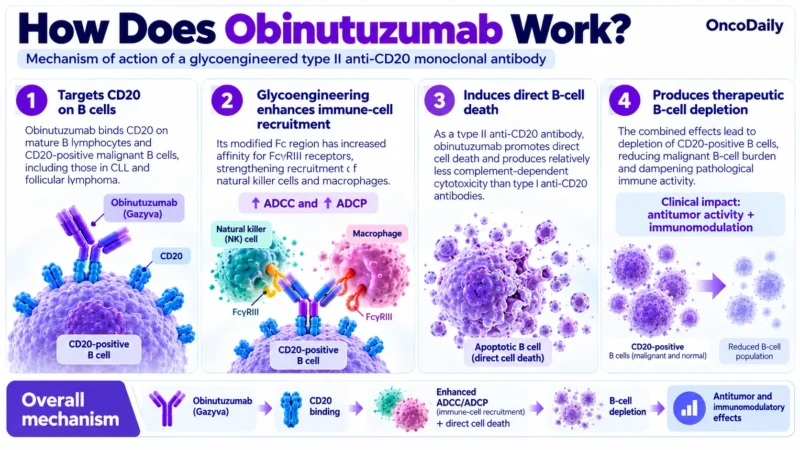
1. Obinutuzumab Targets CD20
CD20 is expressed on mature B lymphocytes and many malignant B cells, including those found in CLL and follicular lymphoma.
Obinutuzumab binds CD20 on the cell surface.
2. Glycoengineering Enhances Immune-Cell Recruitment
The antibody’s modified Fc region has increased affinity for FcγRIII receptors.
This promotes recruitment of immune effector cells, particularly natural killer cells and macrophages.
The result is enhanced:
Antibody-dependent cellular cytotoxicity (ADCC) and antibody-dependent cellular phagocytosis (ADCP).
3. Direct B-Cell Death Is Induced
As a type II anti-CD20 antibody, obinutuzumab can induce direct cell death through nonclassical mechanisms.
Compared with rituximab, it produces less CD20 redistribution into lipid rafts and less complement activation.
4. B-Cell Depletion Produces Therapeutic Effects
The combined mechanisms result in depletion of CD20-positive B cells.
In follicular lymphoma and CLL, this reduces malignant B-cell burden.
In autoimmune kidney diseases, B-cell depletion reduces pathological immune activity contributing to tissue injury.
Overall mechanism:
Obinutuzumab → CD20 binding → enhanced ADCC/ADCP + direct cell death → B-cell depletion → antitumor or immunomodulatory activity.
What Is the Recommended Dose of Obinutuzumab?
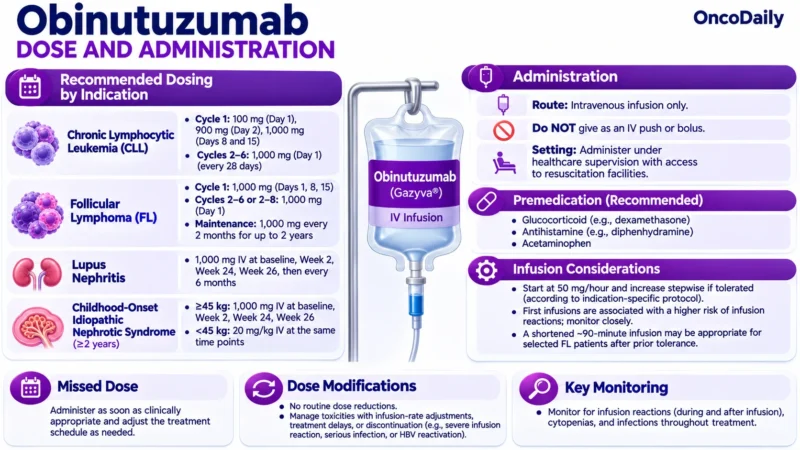
Chronic Lymphocytic Leukemia
Obinutuzumab is FDA approved in combination with chlorambucil for previously untreated CLL.
Cycle 1
- Day 1: 100 mg IV
- Day 2: 900 mg IV
- Day 8: 1,000 mg IV
- Day 15: 1,000 mg IV
Cycles 2–6
1,000 mg IV on Day 1 of each 28-day cycle.
The split first dose helps manage infusion-related reaction risk.
Follicular Lymphoma
Initial Treatment
1,000 mg IV on Days 1, 8, and 15 of Cycle 1.
Subsequently:
1,000 mg IV on Day 1 of Cycles 2–6 or 2–8, depending on the chemotherapy regimen.
Obinutuzumab may be combined with bendamustine, CHOP, or CVP according to the treatment setting.
Maintenance
Following an appropriate response to induction treatment:
1,000 mg IV every 2 months for up to 2 years.
For rituximab-refractory or early-relapsing FL, obinutuzumab is administered with bendamustine followed by obinutuzumab monotherapy in patients without disease progression.
Active Lupus Nephritis
For adults receiving standard therapy:
1,000 mg IV at:
- Initial infusion
- Week 2
- Week 24
- Week 26
- Every 6 months thereafter
Childhood-Onset Idiopathic Nephrotic Syndrome
For patients aged 2 years and older who are in complete remission and meet the approved relapse-risk criteria:
Body Weight 45 kg or More
1,000 mg IV at the initial infusion, Week 2, Week 24, and Week 26.
Body Weight Less Than 45 kg
20 mg/kg IV at the same four time points.
This indication is specifically for reducing relapse risk while in complete remission, rather than inducing remission during an active relapse.
How Should Obinutuzumab Be Administered?
Obinutuzumab must be administered by intravenous infusion under healthcare supervision.
It must not be given as an IV push or bolus.
Premedication
Premedication commonly includes:
- Glucocorticoid
- Acetaminophen
- Antihistamine
The precise requirements depend on the indication, infusion history, and the patient’s risk factors.
In patients with CLL or FL at risk of tumor lysis syndrome, prophylaxis may include adequate hydration and an antihyperuricemic agent.
Infusion Rates
Initial and subsequent infusion rates differ by indication.
For many 1,000-mg infusions, a starting rate of 50 mg/hour is used, with gradual escalation if tolerated.
However, first-infusion protocols for CLL are different because the initial 1,000-mg dose is split into 100-mg and 900-mg administrations.
Infusion rates must follow the indication-specific prescribing information.
A shortened approximately 90-minute infusion may be appropriate for selected eligible follicular lymphoma patients after previous infusions have been tolerated.
What Should You Do If an Obinutuzumab Dose Is Missed?
If a scheduled dose is missed:
- Administer the missed dose as soon as clinically appropriate.
- Adjust chemotherapy scheduling when necessary to preserve the intended cycle intervals.
- Maintain the original maintenance schedule when specified by the regimen.
Missed doses should be managed by the treating team. Patients should not receive an additional unscheduled dose independently.
How Are Obinutuzumab Dose Modifications Managed?
Obinutuzumab generally does not have a standard dose-reduction sequence.
Management focuses on infusion-rate changes, treatment delays, and discontinuation when necessary.
Infusion-Related Reactions
For mild or moderate reactions, temporarily interrupt or reduce the infusion rate and provide supportive treatment.
Severe reactions require interruption and careful assessment before any possible resumption.
Grade 4 infusion-related reactions require permanent discontinuation.
Severe Neutropenia
Monitor blood counts and signs of infection.
Consider:
- Treatment delay
- G-CSF when clinically indicated
- Antimicrobial prophylaxis in selected patients
Serious Infection
Withhold treatment during a serious active infection and initiate appropriate antimicrobial management.
HBV Reactivation or PML
HBV reactivation requires interruption and specialist-directed antiviral management.
PML requires discontinuation and urgent neurological evaluation.
What Drug Interactions Are Important With Obinutuzumab?
Obinutuzumab is not primarily metabolized by CYP450 enzymes.
Clinically important interactions arise mainly from additive immunosuppression.
Other Immunosuppressive Agents
Combination with chemotherapy, corticosteroids, or other immunomodulatory agents may increase infection and cytopenia risk.
Live Vaccines
Live vaccines are not recommended during treatment and until adequate B-cell recovery.
Vaccine responses may be reduced following therapy.
Antihypertensive Drugs
Because infusion-related hypotension may occur, clinicians may consider withholding antihypertensive medications around infusions when clinically appropriate.
Infection Prophylaxis
Antiviral or antimicrobial prophylaxis may be required based on HBV status, chemotherapy regimen, neutropenia, and other infection risks.
Does Obinutuzumab Require Dose Adjustment in Renal or Hepatic Impairment?
Renal Impairment
Obinutuzumab is predominantly cleared through antibody catabolism.
Routine dose adjustment is not generally specified for renal impairment.
However, renal function is clinically important when assessing tumor lysis syndrome and underlying kidney disease.
Hepatic Impairment
Obinutuzumab has not been adequately studied in hepatic impairment.
No established hepatic dose-adjustment algorithm is available.
HBV screening and monitoring remain essential.
What Is the Pharmacokinetic Profile of Obinutuzumab?
Half-Life
The terminal half-life varies by disease and treatment setting.
Representative estimates include:
- CLL: approximately 25.5 days
- Non-Hodgkin lymphoma: approximately 35.3 days
- Lupus nephritis: approximately 22.4 days
Distribution
Obinutuzumab distributes primarily within vascular and extracellular compartments.
Metabolism
It undergoes proteolytic catabolism, producing peptides and amino acids.
Clearance
Clearance includes both target-mediated and nonspecific pathways.
As CD20-positive B cells are depleted, target-mediated clearance can decrease.
B-Cell Depletion
B-cell depletion can persist for months after treatment, with variable recovery.
What Are the Clinical Uses of Obinutuzumab?
Chronic Lymphocytic Leukemia
Obinutuzumab is approved with chlorambucil for previously untreated CLL.
In contemporary clinical practice, obinutuzumab also has an important role in targeted combinations, particularly with venetoclax.
Venetoclax–obinutuzumab is an established time-limited first-line regimen for selected patients with CLL.
The approval and dosing of combination regimens should be distinguished from the original Gazyva indication.
Previously Untreated Follicular Lymphoma
Obinutuzumab is approved with chemotherapy, followed by maintenance monotherapy in responding patients with advanced-stage or bulky follicular lymphoma.
The GALLIUM trial established a progression-free survival advantage over rituximab-based immunochemotherapy.
Relapsed or Refractory Follicular Lymphoma
Obinutuzumab combined with bendamustine, followed by maintenance, is approved for patients whose follicular lymphoma relapsed after or was refractory to a rituximab-containing regimen.
The pivotal evidence comes from GADOLIN.
Active Lupus Nephritis
Obinutuzumab is approved for adults with active lupus nephritis who are receiving standard therapy.
The phase III REGENCY study demonstrated improved complete renal response when obinutuzumab was added to background treatment.
Childhood-Onset Idiopathic Nephrotic Syndrome
The September 2026 approval covers adult and pediatric patients aged 2 years and older with frequently relapsing or steroid-dependent childhood-onset idiopathic nephrotic syndrome who are in complete remission.
The indication is supported by the INSHORE study.
What Testing Is Required Before Obinutuzumab?
CD20 and Disease Assessment
For B-cell malignancies, confirm the relevant disease phenotype and CD20 expression through appropriate pathology or flow cytometry.
Hepatitis B Screening
Screen all patients for:
- HBsAg
- Anti-HBc
Current or previous HBV infection requires appropriate monitoring and antiviral management.
Baseline Laboratory Tests
Assess:
- Complete blood count
- Renal function
- Liver function
- Relevant electrolytes
- Immunoglobulins when indicated
- Infection status
Tumor Lysis Assessment
In patients with high-burden CLL or follicular lymphoma, assess uric acid, creatinine, potassium, phosphate, calcium, and other relevant markers.
What Did the Pivotal Clinical Trials Show?
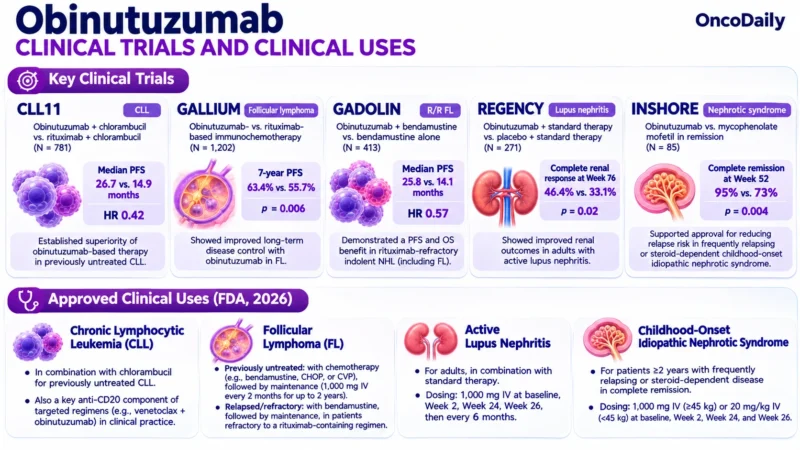
CLL11 — Obinutuzumab in Previously Untreated CLL
CLL11 evaluated obinutuzumab plus chlorambucil against rituximab plus chlorambucil and chlorambucil alone in previously untreated CLL.
Median Progression-Free Survival
Obinutuzumab plus chlorambucil versus rituximab plus chlorambucil:
- 26.7 months vs. 14.9 months
- HR: 0.42
Overall Response Rate
– 79.6% vs. 66.3%
The trial established superior disease control with obinutuzumab-based chemoimmunotherapy over rituximab–chlorambucil.
GADOLIN — Relapsed or Refractory Follicular Lymphoma
GADOLIN evaluated obinutuzumab plus bendamustine followed by obinutuzumab maintenance versus bendamustine alone in rituximab-refractory indolent NHL, including follicular lymphoma.
Median Progression-Free Survival
- Obinutuzumab–bendamustine strategy: 25.8 months
- Bendamustine alone: 14.1 months
- HR: 0.57
Overall Survival
An overall survival advantage was also demonstrated in the updated analysis:
HR: 0.67
These reported outcomes relate to the overall study population, which included patients beyond follicular lymphoma.
GALLIUM — Previously Untreated Follicular Lymphoma
The phase III GALLIUM trial compared obinutuzumab-based immunochemotherapy with rituximab-based immunochemotherapy.
A total of 1,202 patients with follicular lymphoma were randomized.
Seven-Year Progression-Free Survival
- Obinutuzumab: 63.4%
- Rituximab: 55.7%
p = 0.006
Obinutuzumab improved long-term disease control, although treatment selection must consider toxicity, including infection risk.
REGENCY — Active Lupus Nephritis
The phase III REGENCY study randomized 271 adults with active lupus nephritis to obinutuzumab or placebo, both with standard therapy.
Complete Renal Response at Week 76
- Obinutuzumab: 46.4%
- Placebo: 33.1%
- p = 0.02
Obinutuzumab significantly improved complete renal response when added to standard treatment.
Serious adverse events, particularly infections, were more frequent in the obinutuzumab group.
INSHORE — Childhood-Onset Idiopathic Nephrotic Syndrome
INSHORE compared obinutuzumab with mycophenolate mofetil in patients with frequently relapsing or steroid-dependent childhood-onset idiopathic nephrotic syndrome who were in remission at enrollment.
The trial randomized 85 patients.
Complete Remission at Week 52 Without Relapse After Week 8
- Obinutuzumab: 95%
- Mycophenolate mofetil: 73%
- p = 0.004
These results supported FDA approval in September 2026.
Does Obinutuzumab Have CNS Activity?
Obinutuzumab is a large monoclonal antibody with limited penetration across an intact blood–brain barrier.
It is not an established CNS-directed treatment.
Its use in primary or secondary CNS lymphoma is not an FDA-approved indication.
When CNS involvement is present, appropriate CNS-directed systemic or local therapy remains necessary.
Is Obinutuzumab FDA Approved?
Yes.
Obinutuzumab received its initial FDA approval in 2013.
As of October 2026, its U.S. indications include:
- Previously untreated CLL, with chlorambucil
- Selected previously untreated follicular lymphoma, with chemotherapy followed by maintenance
- Rituximab-refractory or early-relapsing follicular lymphoma, with bendamustine followed by maintenance
- Active lupus nephritis in adults receiving standard therapy
- Relapse-risk reduction in frequently relapsing or steroid-dependent childhood-onset idiopathic nephrotic syndrome in patients aged 2 years and older who are in complete remission
The latest addition was approved on September 25, 2026.
What Is the Current Clinical Role of Obinutuzumab in 2026?
Chronic Lymphocytic Leukemia
Obinutuzumab remains an important anti-CD20 component of modern targeted regimens, especially venetoclax-based time-limited therapy.
Its role has evolved beyond chlorambucil-based chemoimmunotherapy.
Follicular Lymphoma
Obinutuzumab is an established alternative to rituximab within selected chemoimmunotherapy strategies.
It may improve progression-free survival but requires careful evaluation of infection, cytopenia, and infusion-reaction risks.
Read more: Follicular Lymphoma: EHA 2026 Guidelines Move Chemotherapy-Free Combinations to First Relapse by OncoDaily.
Watch more: The Current Treatment Algorithm for Follicular Lymphoma and How This Is Evolving.
Autoimmune Kidney Diseases
The approvals for lupus nephritis in 2025 and childhood-onset idiopathic nephrotic syndrome in 2026 have significantly expanded obinutuzumab’s clinical applications beyond hematologic malignancies.
What Are the Major Side Effects of Obinutuzumab?
Infusion-Related Reactions
Infusion reactions are common, particularly during the first infusion.
Symptoms include:
- Fever and chills
- Nausea
- Hypotension
- Dyspnea
- Bronchospasm
- Rash
Severe or life-threatening reactions may occur.
Neutropenia
Obinutuzumab may cause significant neutropenia, including late-onset or prolonged neutropenia.
This increases the risk of serious infections.
Serious Infections
Infections may include:
- Respiratory tract infections
- Pneumonia
- Urinary tract infections
- Opportunistic infections
- Viral reactivation
Infection risk is influenced by concurrent chemotherapy or immunosuppression.
Hepatitis B Reactivation
HBV reactivation can lead to severe hepatitis, hepatic failure, and death.
This is an FDA boxed warning.
Progressive Multifocal Leukoencephalopathy
PML is a rare, potentially fatal JC virus-associated neurological infection.
This is also an FDA boxed warning.
Thrombocytopenia
Severe thrombocytopenia and bleeding may occur.
Some patients can develop acute thrombocytopenia following infusion.
Tumor Lysis Syndrome
Rapid destruction of malignant B cells may cause:
- Hyperuricemia
- Hyperkalemia
- Hyperphosphatemia
- Hypocalcemia
- Acute kidney injury
The risk is greatest in patients with high tumor burden or impaired renal function.
Additional Serious Toxicities
Other important risks include:
- Hypersensitivity reactions, including serum sickness
- Disseminated intravascular coagulation
- Hypogammaglobulinemia and prolonged B-cell depletion
- Embryo-fetal toxicity
These risks require individualized assessment.
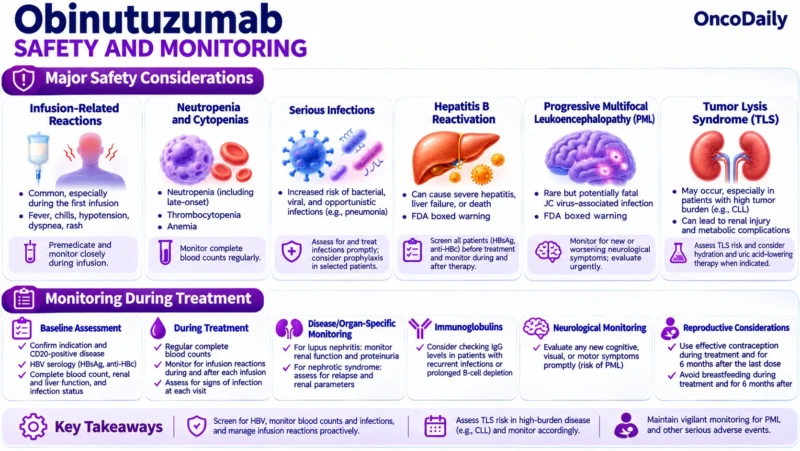
What Monitoring Is Required During Obinutuzumab Treatment?
Hepatitis B Monitoring
Before treatment:
- HBsAg
- Anti-HBc
Patients with current or previous HBV infection require appropriate specialist-directed prophylaxis and monitoring.
Complete Blood Count
Monitor:
- Neutrophils
- Hemoglobin
- Platelets
- Other white blood cell counts
Frequency depends on the regimen and clinical status.
Infusion Monitoring
Monitor vital signs and symptoms closely during infusions, particularly the first administration.
Infection Monitoring
Assess for:
- Fever
- Respiratory symptoms
- Recurrent infections
- Opportunistic infections
Tumor Lysis Monitoring
In high-risk CLL or FL:
- Uric acid
- Potassium
- Phosphate
- Calcium
- Creatinine
- LDH
Renal Monitoring
For lupus nephritis and nephrotic syndrome, monitoring includes renal function and proteinuria, according to the underlying disease and treatment plan.
Immunoglobulin and Immune Monitoring
Consider immunoglobulin assessment in patients with recurrent infections or prolonged B-cell depletion.
Neurological Monitoring
Investigate new neurological symptoms promptly because of the risk of PML.
Reproductive Precautions
Females of reproductive potential should use effective contraception during treatment and for 6 months after the final dose.
Breastfeeding is not recommended during treatment or for 6 months afterward.