


Neratinib (Nerlynx): Understanding Its Mechanism, Dosing, Clinical Uses, and Role in HER2-Positive Breast Cancer
Key takeaways
- Neratinib is an oral irreversible pan-HER inhibitor targeting EGFR, HER2, and HER4.
- Standard dosing is 240 mg once daily with food.
- Extended adjuvant therapy is continued for up to 1 year.
- In metastatic HER2-positive breast cancer, neratinib is given with capecitabine after at least two prior HER2-directed metastatic regimens.
- A two-week escalation schedule of 120 → 160 → 240 mg can improve gastrointestinal tolerability.
- In ExteNET, 5-year iDFS was 90.2% vs 87.7%, HR 0.73.
- In HR-positive patients starting neratinib within 1 year after trastuzumab, the absolute 5-year iDFS benefit was 5.1%.
- NALA showed improved PFS versus lapatinib + capecitabine, HR 0.76.
- Neratinib + capecitabine also reduced the need for CNS-directed intervention compared with lapatinib + capecitabine.
- Diarrhea is the major toxicity and requires proactive prevention and management.
- Avoid PPIs, strong CYP3A4 inhibitors, CYP3A4 inducers, and problematic P-gp interactions.
Neratinib (Nerlynx) is an oral, irreversible pan-HER tyrosine kinase inhibitor that targets EGFR (HER1), HER2, and HER4. By covalently binding the intracellular kinase domains of these receptors, neratinib suppresses receptor autophosphorylation and downstream MAPK and AKT signaling, thereby inhibiting proliferation and survival of HER-driven tumor cells.
In the United States, neratinib is FDA approved as extended adjuvant therapy after trastuzumab-based treatment for early-stage HER2-positive breast cancer and, in combination with capecitabine, for advanced or metastatic HER2-positive breast cancer after at least two prior anti-HER2 regimens in the metastatic setting.
Key Facts
- Generic name: Neratinib
- Brand name: Nerlynx
- Drug class: Irreversible pan-HER tyrosine kinase inhibitor
- Targets: EGFR/HER1, HER2, HER4
- Route: Oral
- Initial US approval: 2017
- Tablet strength: 40 mg
- Standard dose: 240 mg once daily
- Administration: With food, at approximately the same time each day
- Early-stage duration: Up to 1 year
- Metastatic use: With capecitabine
- Major toxicity: Diarrhea
- Other important risk: Hepatotoxicity
- Important interactions: Gastric-acid suppressants, CYP3A4 inhibitors/inducers, P-gp interactions
- Current FDA status: Approved for both extended adjuvant and later-line metastatic HER2-positive breast cancer.
What Is Neratinib?
Neratinib is a small-molecule HER-family tyrosine kinase inhibitor.
Unlike reversible HER2 TKIs such as lapatinib, neratinib binds irreversibly to the intracellular kinase domains of:
- EGFR/HER1
- HER2
- HER4
This produces sustained inhibition of HER-family signaling.
HER2-positive cancers can rely heavily on HER2-driven signaling through:
- PI3K–AKT
- RAS–RAF–MEK–ERK
These pathways regulate:
- Tumor-cell proliferation
- Cell survival
- Growth
- Migration
- Resistance to apoptosis
Neratinib suppresses this signaling at the receptor level.
What Is the Mechanism of Action of Neratinib?
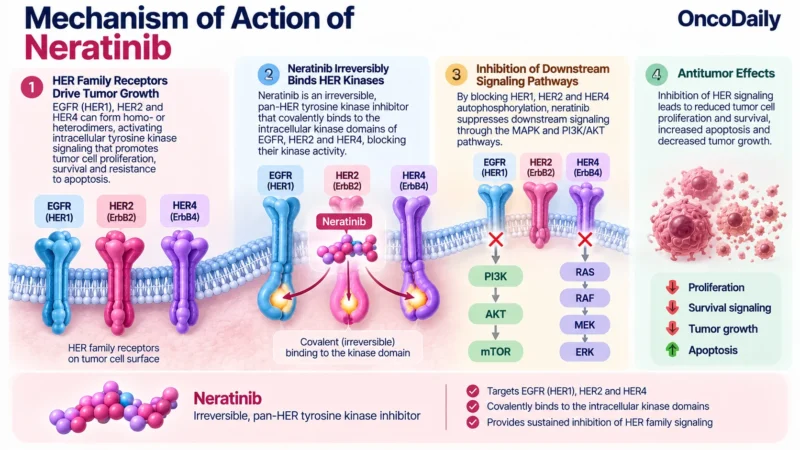
1. HER-Family Receptors Drive Growth Signaling
HER-family receptors include:
- EGFR/HER1
- HER2
- HER3
- HER4
HER2 can form homo- or heterodimers with other HER-family receptors, activating intracellular kinase signaling.
2. Receptor Activation Triggers Downstream Pathways
Activated HER receptors stimulate:
PI3K → AKT
and:
RAS → RAF → MEK → ERK
These pathways promote:
- Proliferation
- Survival
- Tumor growth
- Resistance to apoptosis
3. Neratinib Irreversibly Binds HER Kinases
Neratinib covalently binds the intracellular kinase domains of:
EGFR, HER2, and HER4.
Unlike reversible TKIs, this binding is irreversible.
4. Receptor Autophosphorylation Falls
Neratinib reduces:
- EGFR autophosphorylation
- HER2 autophosphorylation
5. MAPK and AKT Signaling Is Suppressed
Downstream signaling through:
- MAPK
- AKT
is reduced.
6. Antitumor Effects Follow
The overall result is:
- Reduced tumor-cell proliferation
- Reduced survival signaling
- Increased apoptosis
- Suppression of tumor growth
The pathway can be summarized as:
Neratinib → irreversible EGFR/HER2/HER4 inhibition → reduced receptor phosphorylation → ↓MAPK and ↓AKT signaling → decreased proliferation and survival.
What Is the Dose of Neratinib?
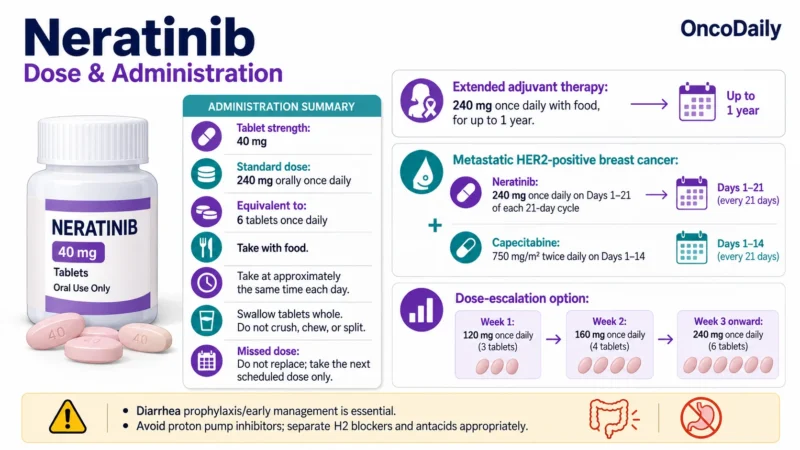
Extended Adjuvant Therapy
The recommended dose is:
240 mg orally once daily
which equals:
Six 40 mg tablets
taken with food.
Treatment is continued:
Until disease recurrence or for up to 1 year.
Metastatic Breast Cancer
For advanced or metastatic HER2-positive breast cancer:
Neratinib 240 mg orally once daily
on:
Days 1–21 of each 21-day cycle
plus:
Capecitabine 750 mg/m² orally twice daily
on:
Days 1–14 of each 21-day cycle.
Treatment continues until:
- Disease progression
- Unacceptable toxicity.
Neratinib Dose Escalation
A two-week dose-escalation strategy may be used to reduce early gastrointestinal toxicity.
Week 1
120 mg once daily
= three 40 mg tablets.
Week 2
160 mg once daily
= four 40 mg tablets.
Week 3 onward
240 mg once daily
= six 40 mg tablets.
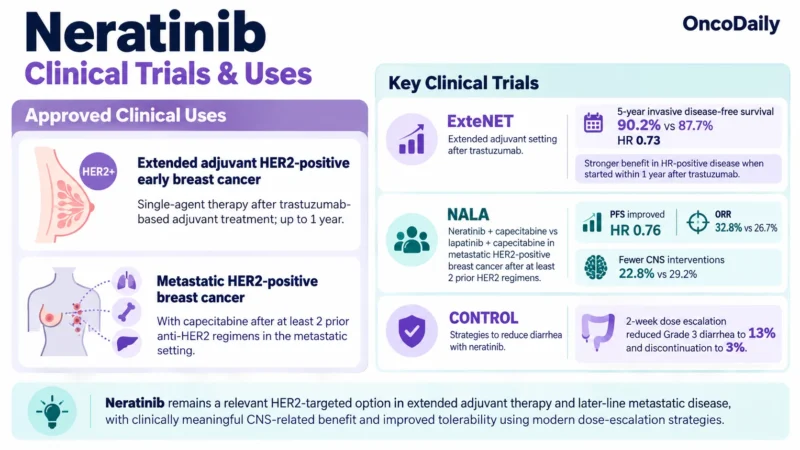
The CONTROL study showed that this strategy substantially reduced clinically important diarrhea compared with historical experience at full-dose initiation. Grade 3 diarrhea occurred in approximately 13% of patients using the two-week escalation strategy, and diarrhea-related discontinuation was approximately 3%.
How Should Neratinib Be Taken?
Neratinib should be taken:
- Once daily
- With food
- At approximately the same time every day
Tablets should be:
Swallowed whole.
They should not be:
- Crushed
- Chewed
- Split.
What If a Dose Is Missed?
If a dose is missed:
Do not replace the missed dose.
The patient should take the next dose at the:
Next regularly scheduled time.
Do not double the next dose.
How Are Neratinib Dose Reductions Made?
For monotherapy, the recommended dose reductions are:
- Starting dose: 240 mg once daily
- First dose reduction: 200 mg once daily
- Second dose reduction: 160 mg once daily
- Third dose reduction: 120 mg once daily
If toxicity remains unacceptable despite reduction to 120 mg once daily, permanent discontinuation of neratinib may be necessary.
Dose interruptions or reductions may be required for:
- Diarrhea
- Hepatotoxicity
- Other significant treatment-related toxicities.
Diarrhea Prophylaxis
Diarrhea is the defining toxicity of neratinib and should be proactively managed.
When dose escalation is not used, loperamide prophylaxis should begin with the first neratinib dose.
Days 1–14
Loperamide 4 mg three times daily
Days 15–56
Loperamide 4 mg twice daily
Week 9 onward
4 mg as needed
with a maximum of:
16 mg/day
and dosing titrated to approximately:
1–2 bowel movements per day.
If diarrhea develops despite prophylaxis, management may include:
- Additional antidiarrheals
- Fluids
- Electrolyte replacement
- Neratinib interruption
- Dose reduction.
What Are the Important Drug Interactions With Neratinib?
Neratinib has clinically important interactions involving:
- Gastric pH
- CYP3A4
- P-glycoprotein.
Proton Pump Inhibitors
PPIs may substantially reduce neratinib exposure.
Examples include:
- Omeprazole
- Pantoprazole
- Esomeprazole
- Lansoprazole
Concomitant use should generally be:
Avoided.
Lansoprazole has been shown to reduce neratinib:
- Cmax by approximately 71%
- AUC by approximately 65%.
H2-Receptor Antagonists
If an H2 blocker is necessary:
Take neratinib:
At least 2 hours before
or:
10 hours after
the H2-receptor antagonist. DailyMed
Antacids
Neratinib should be separated from antacids.
Take neratinib:
At least 3 hours after an antacid.
Strong CYP3A4 Inhibitors
Strong CYP3A4 inhibitors can significantly increase neratinib exposure.
Examples include:
- Ketoconazole
- Itraconazole
- Clarithromycin
- Ritonavir
They should generally be:
Avoided.
Ketoconazole increased neratinib:
- Cmax by approximately 221%
- AUC by approximately 381%.
CYP3A4 Inducers
Strong or moderate CYP3A4 inducers may substantially decrease neratinib exposure.
Examples include:
- Rifampin
- Carbamazepine
- Phenytoin
- Phenobarbital
- St. John’s wort
They should generally be:
Avoided.
Rifampin reduced neratinib exposure substantially, including an approximately 87% reduction in AUC.
P-glycoprotein Interactions
Neratinib can increase exposure to certain:
P-gp substrates.
For drugs with narrow therapeutic ranges, monitor carefully for toxicity.
For example, neratinib increased digoxin:
- Cmax by approximately 54%
- AUC by approximately 32%.
Grapefruit
Patients should avoid:
Grapefruit and grapefruit products
because of the potential for CYP3A-mediated interaction.
Does Neratinib Require Renal or Hepatic Dose Adjustment?
Renal Impairment
Renal function does not appear to have a clinically meaningful effect on neratinib pharmacokinetics.
Only about:
1.1%
of a radiolabeled dose is recovered in urine.
Routine dose modification based solely on renal function is therefore generally not required by the FDA label.
However, severe diarrhea can cause:
- Dehydration
- Creatinine elevation
- Acute kidney injury
so renal function should be monitored if significant gastrointestinal toxicity develops.
Hepatic Impairment
Mild or Moderate Hepatic Impairment
Child-Pugh A or B:
No starting-dose adjustment is recommended.
Severe Hepatic Impairment
Child-Pugh C:
Reduce the starting dose to:
80 mg once daily.
What Is the Pharmacokinetic Profile of Neratinib?
Absorption
Peak concentrations of neratinib and its major active metabolites are generally reached:
2–8 hours after dosing.
Food Effect
Food increases neratinib exposure.
Compared with fasting:
High-fat meal
- Cmax increases approximately 70%
- AUC increases approximately 120%
Standard breakfast
- Cmax increases approximately 20%
- AUC increases approximately 10%.
This supports administration:
With food.
Protein Binding
Neratinib is:
>99% protein bound
primarily to:
- Albumin
- Alpha-1 acid glycoprotein.
Half-Life
Mean neratinib plasma half-life in healthy subjects is approximately:
14.6 hours.
In patients after a single dose, reported mean elimination half-life ranges from:
7–17 hours.
Metabolism
Neratinib is metabolized mainly in the liver by:
CYP3A4
with a lesser contribution from:
Flavin-containing monooxygenase.
Active metabolites include:
- M3
- M6
- M7
- M11
which also retain HER-family inhibitory activity.
Elimination
Elimination is predominantly:
Fecal.
Approximately:
- 97% of a radiolabeled dose is recovered in feces
- 1.1% is recovered in urine.
What Are the Clinical Uses of Neratinib?
1. Extended Adjuvant Treatment of Early HER2-Positive Breast Cancer
Neratinib is FDA approved as:
Single-agent extended adjuvant therapy
for adults with early-stage HER2-positive breast cancer after completing:
Trastuzumab-based adjuvant therapy.
This strategy aims to reduce the risk of invasive recurrence after completion of standard HER2-directed adjuvant therapy.
The treatment duration is:
Up to 1 year.
2. Advanced or Metastatic HER2-Positive Breast Cancer
Neratinib is FDA approved:
In combination with capecitabine
for adults with advanced or metastatic HER2-positive breast cancer who have received:
Two or more prior anti-HER2 regimens in the metastatic setting.
What Did the ExteNET Trial Show?
ExteNET was the pivotal phase III study evaluating extended adjuvant neratinib after trastuzumab-based therapy.
A total of:
2,840 patients
with early-stage HER2-positive breast cancer were randomized to:
- Neratinib 240 mg daily for 1 year
- Placebo.
2-Year Invasive Disease-Free Survival
At 2 years:
- Neratinib: 93.9%
- Placebo: 91.6%
Hazard ratio:
0.67
P = 0.0091.
5-Year ExteNET Results
At approximately 5 years:
- Neratinib iDFS: 90.2%
- Placebo iDFS: 87.7%
Hazard ratio:
0.73
95% CI:
0.57–0.92
P = 0.0083.
This demonstrated a sustained reduction in invasive recurrence risk.
Hormone Receptor-Positive Subgroup
The benefit appeared particularly relevant in patients with:
HR-positive/HER2-positive disease
who initiated neratinib within:
1 year of completing trastuzumab.
In this subgroup:
- Absolute 5-year iDFS benefit: 5.1%
- Hazard ratio: 0.58.
Among patients with residual disease after neoadjuvant therapy, the analysis showed an absolute:
7.4% improvement in 5-year iDFS, although this was a subgroup analysis.
What Did the NALA Trial Show?
NALA was a randomized phase III trial comparing:
Neratinib + capecitabine
versus:
Lapatinib + capecitabine
in patients with HER2-positive metastatic breast cancer who had received at least:
Two prior HER2-directed regimens.
A total of:
621 patients
were randomized:
- Neratinib + capecitabine: 307
- Lapatinib + capecitabine: 314.
Progression-Free Survival
Neratinib + capecitabine significantly improved centrally assessed PFS.
Hazard ratio:
0.76
95% CI:
0.63–0.93
P = 0.0059.
Overall Survival
Overall survival was not significantly different.
Hazard ratio:
0.88
95% CI:
0.72–1.07
P = 0.2098.
Objective Response Rate
ORR was:
- Neratinib + capecitabine: 32.8%
- Lapatinib + capecitabine: 26.7%
Median duration of response:
- 8.5 months
- 5.6 months
respectively.
What About Brain Metastases?
Neratinib is particularly interesting because HER2-positive metastatic breast cancer has a high propensity for:
CNS involvement.
In NALA, patients with stable or asymptomatic CNS disease were eligible.
The cumulative incidence of intervention for CNS disease was:
- Neratinib + capecitabine: 22.8%
- Lapatinib + capecitabine: 29.2%
P = 0.043.
NALA CNS Subgroup
Among the:
101 patients
with known CNS metastases at baseline:
Mean PFS through 24 months was:
- Neratinib + capecitabine: 7.8 months
- Lapatinib + capecitabine: 5.5 months
At 12 months, cumulative incidence of progressive CNS disease was:
- 26.2%
- 41.6%
respectively.
Among patients with measurable CNS lesions, confirmed intracranial ORR was:
- 26.3%
- 15.4%
respectively.
These findings support genuine CNS activity, although modern HER2 treatment includes newer agents with stronger prospective intracranial datasets.
What Did the CONTROL Trial Show?
The phase II CONTROL trial evaluated strategies to reduce neratinib-associated diarrhea.
A total of:
563 patients
were enrolled across multiple cohorts. PubMed
Strategies included:
- Loperamide prophylaxis
- Loperamide + budesonide
- Loperamide + colestipol
- Colestipol + as-needed loperamide
- Two-week dose escalation
- Four-week dose escalation
The lowest Grade ≥3 diarrhea rate was seen with the:
Two-week dose-escalation strategy.
Grade ≥3 diarrhea:
13%
Diarrhea-related treatment discontinuation:
3%.
This trial directly influenced contemporary neratinib administration.
Is Neratinib FDA Approved?
Yes.
Neratinib is FDA approved for:
Extended Adjuvant Therapy
As a single agent after trastuzumab-based therapy in:
Early-stage HER2-positive breast cancer.
Advanced or Metastatic Disease
In combination with capecitabine after:
Two or more prior anti-HER2 regimens in the metastatic setting.
What Is the Current Clinical Role of Neratinib in 2026?
The clinical role of neratinib differs between:
- Early-stage disease
- Metastatic disease.
Early HER2-Positive Breast Cancer
Neratinib remains an option for:
Extended adjuvant HER2-directed therapy
after trastuzumab-based treatment.
Its greatest evidence-based benefit has historically been observed in patients with:
- HR-positive/HER2-positive disease
- Higher-risk clinical features
- Initiation within approximately 1 year after trastuzumab completion.
Patient selection is essential because the modern adjuvant landscape also includes:
- Pertuzumab
- T-DM1
- Other evolving HER2-directed approaches.
Metastatic HER2-Positive Breast Cancer
Neratinib + capecitabine remains an FDA-approved later-line option after at least:
Two prior HER2-directed metastatic regimens.
Its potential advantages include:
- Oral HER2 blockade
- Irreversible pan-HER inhibition
- Demonstrated CNS activity
However, treatment sequencing must account for newer agents with strong systemic and intracranial efficacy.
Read more: Neratinib With or Without Trastuzumab Shows Activity in HER2-Mutant Metastatic TNBC — OncoDaily’s coverage of the SUMMIT basket trial and the role of neratinib-based therapy in HER2-mutant metastatic breast cancer.
Watch more: OncoDaily discussion on targeted therapy in oncogene-driven cancers, relevant to HER-family inhibition and oral HER2-targeted TKIs such as neratinib.
What Are the Major Side Effects of Neratinib?
The most important toxicity is:
Diarrhea.
Other common adverse effects include:
- Nausea
- Vomiting
- Abdominal pain
- Fatigue
- Decreased appetite
- Constipation
- Weight loss
Important safety concerns include:
- Severe diarrhea
- Dehydration
- Renal complications secondary to gastrointestinal losses
- Hepatotoxicity
- Embryo-fetal toxicity.
Diarrhea
Diarrhea is extremely common with neratinib.
In ExteNET, where routine prophylaxis was not mandated:
Grade 3 diarrhea occurred in approximately 40% of patients.
This toxicity usually occurs:
Early in treatment.
Modern management includes:
- Prophylactic loperamide
- Dose escalation
- Early fluid replacement
- Electrolyte monitoring
- Dose interruption when necessary.
The two-week dose-escalation strategy reduced Grade 3 diarrhea to
approximately:
13% in CONTROL.
When Should Neratinib Be Interrupted for Diarrhea?
Treatment interruption may be required for:
- Diarrhea with complicated features
- Grade 2 diarrhea lasting >5 days despite optimal therapy
- Grade 3 diarrhea lasting >2 days despite optimal therapy
Treatment may be resumed after recovery to:
Grade ≤1 or baseline.
Grade 4 diarrhea generally requires:
Permanent discontinuation.
Hepatotoxicity
Neratinib can cause elevation of:
- ALT
- AST
- Bilirubin
Liver-function tests should be checked:
- Before treatment
- Monthly for the first 3 months
- Then every 3 months
- And as clinically indicated.
For:
Grade 3 liver abnormalities
Treatment should generally be:
Withheld.
Grade 4 liver abnormalities
Neratinib should be:
Permanently discontinued.
Renal Complications
Neratinib itself has minimal renal elimination, but severe diarrhea may lead to:
- Dehydration
- Elevated creatinine
- Acute kidney injury
In NALA, renal impairment events were reported in approximately:
7%
of patients receiving neratinib + capecitabine.
Monitoring should therefore focus on:
- Hydration
- Creatinine
- Electrolytes
when significant diarrhea develops.
Embryo-Fetal Toxicity
Neratinib can cause fetal harm.
Patients of reproductive potential should use:
Effective contraception during treatment.
Pregnancy status should be considered before treatment initiation.
Breastfeeding is not recommended during treatment.
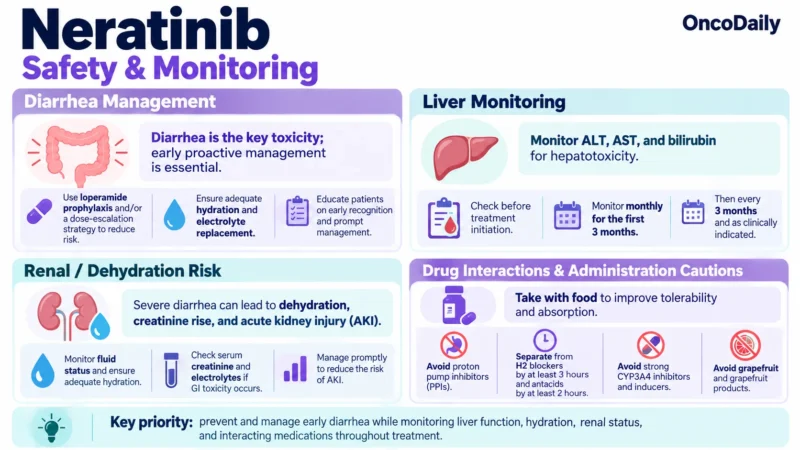
What Monitoring Is Required?
Monitoring during neratinib therapy should include:
- Stool frequency
- Severity and duration of diarrhea
- Hydration status
- Electrolytes
- Serum creatinine if significant diarrhea occurs
- ALT
- AST
- Bilirubin
- Liver-function tests monthly for the first 3 months
- Liver-function tests every 3 months thereafter
- Concomitant CYP3A4 medications
- P-gp substrates
- Proton-pump inhibitors and other acid-suppressive therapy
- Weight and nutritional status
- Pregnancy status when appropriate
- Capecitabine-related toxicity when used in combination.
FAQ
What Is Neratinib Used For?
- Extended adjuvant treatment after trastuzumab-based therapy in early HER2-positive breast cancer
- Advanced or metastatic HER2-positive breast cancer with capecitabine after at least two prior anti-HER2 metastatic regimens.
What Is the Standard Neratinib Dose?
How Many Tablets Is 240 mg?
40 mg tablets.
Can Neratinib Be Dose Escalated?
A commonly used FDA-label strategy is:
120 mg daily for Week 1 → 160 mg daily for Week 2 → 240 mg daily from Week 3 onward.
Why Is Loperamide Used With Neratinib?
Neratinib-associated diarrhea.
What Did ExteNET Show?
- iDFS: 90.2% with neratinib
- 87.7% with placebo
HR 0.73.
What Did NALA Show?
HR 0.76.
Does Neratinib Have Activity in Brain Metastases?
Should Neratinib Be Taken With Food?
Take neratinib:
With food at approximately the same time each day.
What Is the Most Important Side Effect?
It should be prevented or treated proactively from treatment initiation.