


Midostaurin (Rydapt): Understanding Its Mechanism, Dosing, Clinical Uses, and Role in FLT3-Mutated AML and Advanced Systemic Mastocytosis
Key takeaways
- Midostaurin is a multikinase inhibitor targeting FLT3 and KIT.
- It inhibits both FLT3-ITD and FLT3-TKD, as well as KIT D816V.
- In newly diagnosed FLT3-mutated AML, the approved dose is 50 mg twice daily with food on Days 8–21 of induction and consolidation cycles.
- In ASM, SM-AHN and MCL, the dose is 100 mg twice daily continuously.
- RATIFY demonstrated a significant survival benefit from adding midostaurin to intensive chemotherapy, with an OS HR of approximately 0.78.
- The benefit was observed across FLT3 mutation subtypes.
- Midostaurin also has clinically meaningful activity against advanced systemic mastocytosis, including KIT D816V-positive disease.
- It should be taken with food approximately 12 hours apart.
- Prophylactic antiemetics are recommended.
- Strong CYP3A4 inhibitors can markedly increase exposure, whereas strong CYP3A4 inducers can dramatically decrease it.
- Major safety considerations include GI toxicity, cytopenias, infection, pulmonary toxicity and QT prolongation.
- In 2026, midostaurin remains an important frontline option for intensively treated FLT3-mutated AML while sharing the evolving treatment landscape with newer selective FLT3 inhibitors.
- In advanced systemic mastocytosis, it remains an approved KIT inhibitor, although highly selective KIT-directed agents have expanded available options.
Midostaurin (Rydapt) is an oral multikinase inhibitor with activity against FLT3, including FLT3-ITD and FLT3-TKD mutations, and KIT, including the KIT D816V mutation that drives most cases of systemic mastocytosis. It is FDA approved for adults with newly diagnosed FLT3-mutated acute myeloid leukemia (AML) in combination with standard induction and consolidation chemotherapy, and as monotherapy for aggressive systemic mastocytosis (ASM), systemic mastocytosis with an associated hematologic neoplasm (SM-AHN), and mast cell leukemia (MCL).
In 2026, midostaurin remains an established frontline FLT3 inhibitor for fit patients with FLT3-mutated AML and an approved KIT-directed therapy for advanced systemic mastocytosis, although newer, more selective FLT3 and KIT inhibitors have expanded treatment choices in both diseases.
Key Facts
- Generic name: Midostaurin
- Brand name: Rydapt
- Drug class: Multikinase inhibitor
- Major targets: FLT3, KIT, PDGFRα/β, PKC-family kinases
- FLT3 activity: FLT3-ITD and FLT3-TKD
- KIT activity: Wild-type KIT and KIT D816V
- Route: Oral
- Initial U.S. approval: 2017
- Capsule strength: 25 mg
- FLT3-mutated AML dose: 50 mg twice daily
- Advanced systemic mastocytosis dose: 100 mg twice daily
- Administration: With food, approximately 12 hours apart
- Antiemetic prophylaxis: Recommended before treatment
- Major interaction: CYP3A4 inhibitors and inducers
- Important serious toxicity: Interstitial lung disease/pneumonitis
- Common toxicities: Nausea, vomiting, diarrhea, cytopenias and gastrointestinal toxicity
- QT consideration: ECG monitoring should be considered when used with QT-prolonging medications.
What Is Midostaurin?
Midostaurin is a small-molecule inhibitor of several receptor and non-receptor kinases involved in malignant-cell growth.
Its two major clinical targets are:
FLT3 in AML
and:
KIT in systemic mastocytosis.
In AML, FLT3 mutations cause constitutive receptor signaling and promote:
- Leukemic blast proliferation
- Survival
- Reduced apoptosis
- Disease progression
Midostaurin inhibits both:
- FLT3-ITD
- FLT3-TKD
mutant receptors.
In systemic mastocytosis, the key oncogenic driver is frequently:
KIT D816V
which activates KIT signaling independently of its normal ligand. Midostaurin can inhibit both wild-type KIT and KIT D816V.
What Is the Mechanism of Action of Midostaurin?
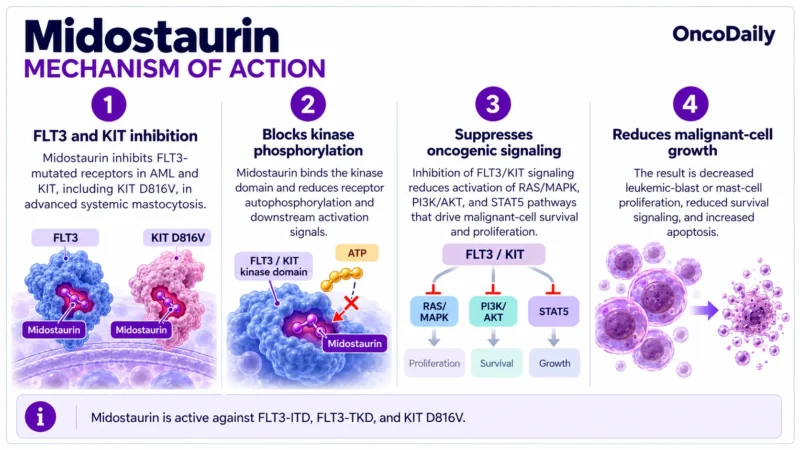
1. Oncogenic Kinases Become Constitutively Active
In FLT3-mutated AML, mutations such as:
- FLT3-ITD
- FLT3-TKD
cause persistent activation of FLT3.
In systemic mastocytosis, KIT D816V produces constitutive KIT signaling.
2. Downstream Signaling Promotes Malignant-Cell Survival
Activated FLT3 or KIT stimulates pathways including:
- RAS–RAF–MEK–ERK
- PI3K–AKT
- STAT signaling
These pathways promote:
- Proliferation
- Survival
- Resistance to apoptosis
3. Midostaurin Inhibits FLT3 and KIT
Midostaurin and its active metabolites inhibit:
- Wild-type FLT3
- FLT3-ITD
- FLT3-TKD
- Wild-type KIT
- KIT D816V
- PDGFRα/β
- PKC-family kinases.
4. Kinase Signaling Is Suppressed
Inhibition of FLT3 or KIT reduces receptor phosphorylation and downstream oncogenic signaling.
5. Malignant-Cell Proliferation Falls
In AML:
FLT3 inhibition → ↓ leukemic proliferation + ↑ apoptosis
In systemic mastocytosis:
KIT inhibition → ↓ mast-cell proliferation + ↓ histamine release + ↑ mast-cell apoptosis.
What Is the Recommended Dose of Midostaurin?
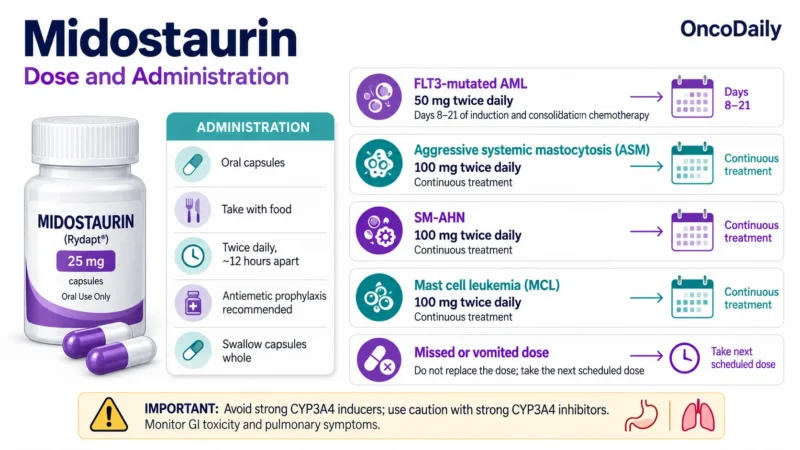
FLT3-Mutated Acute Myeloid Leukemia
The recommended dose is:
50 mg orally twice daily with food.
Midostaurin is administered on:
Days 8–21
of each cycle of induction chemotherapy with:
- Cytarabine
- Daunorubicin
and on:
Days 8–21
of each cycle of consolidation with high-dose cytarabine.
Importantly, Rydapt is:
not indicated as single-agent induction therapy for AML.
Aggressive Systemic Mastocytosis
Recommended dose:
100 mg orally twice daily with food.
Systemic Mastocytosis With Associated Hematologic Neoplasm
Recommended dose:
100 mg orally twice daily with food.
Mast Cell Leukemia
Recommended dose:
100 mg orally twice daily with food.
For advanced systemic mastocytosis, treatment continues until:
Disease progression
Unacceptable toxicity.
How Should Midostaurin Be Taken?
Rydapt should be administered:
- Twice daily
- Approximately 12 hours apart
- With food
Prophylactic antiemetic therapy should be given before treatment because nausea and vomiting are common.
The capsules should be:
Swallowed whole.
Do not:
- Open
- Crush
the capsules.
What Should You Do If You Miss a Dose of Midostaurin?
If a dose is missed:
- Do not replace the missed dose
- Take the next dose at the usual scheduled time
- Do not double the dose
If vomiting occurs after taking midostaurin:
- Do not take another capsule
- Take the next dose at the usual scheduled time.
How Are Midostaurin Dose Reductions Managed?
Dose-reduction guidance is particularly well defined for advanced systemic mastocytosis.
Neutropenia
If treatment-related neutropenia meets the label-defined threshold:
- Interrupt midostaurin
- Allow ANC recovery
- Restart at 50 mg twice daily
- If tolerated, increase again to 100 mg twice daily
Persistent severe neutropenia for >21 days may require discontinuation.
Thrombocytopenia
For clinically significant treatment-related thrombocytopenia:
- Interrupt therapy
- Wait for platelet recovery
- Resume at 50 mg twice daily
- Re-escalate to 100 mg twice daily if tolerated
Persistent thrombocytopenia for >21 days attributable to midostaurin may require discontinuation.
Anemia
For label-defined severe treatment-related anemia:
- Hold treatment
- Resume at 50 mg twice daily after recovery
- Re-escalate to 100 mg twice daily if tolerated
Persistent severe anemia attributable to treatment may require discontinuation.
Severe Nausea or Vomiting
For Grade 3–4 nausea or vomiting despite optimal antiemetic treatment:
- Interrupt midostaurin for 3 days / 6 doses
- Resume at 50 mg twice daily
- Increase to 100 mg twice daily if tolerated.
Other Grade 3–4 Nonhematologic Toxicity
- Interrupt treatment until recovery to Grade ≤2
- Restart at 50 mg twice daily
- Increase to 100 mg twice daily if tolerated.
What Drug Interactions Are Important With Midostaurin?
Midostaurin is primarily metabolized by:
CYP3A4.
Strong CYP3A4 Inhibitors
Strong CYP3A4 inhibitors can markedly increase exposure to midostaurin.
Examples include:
- Posaconazole
- Voriconazole
- Itraconazole
- Ketoconazole
- Clarithromycin
- Ritonavir
- Grapefruit juice
Ketoconazole increased single-dose midostaurin AUC approximately:
10.4-fold.
When possible, consider an alternative that does not strongly inhibit CYP3A4.
If concomitant treatment is necessary, closely monitor for toxicity, especially during the first week of midostaurin exposure.
This issue is particularly relevant in AML because azole antifungal prophylaxis is frequently required during intensive chemotherapy.
Strong CYP3A4 Inducers
Strong CYP3A4 inducers can dramatically lower midostaurin exposure.
Examples include:
- Rifampin
- Carbamazepine
- Phenytoin
- Enzalutamide
- Mitotane
- St. John’s wort
Rifampin decreased midostaurin AUC by approximately:
96%.
These combinations should be avoided.
Does Midostaurin Require Dose Adjustment in Renal or Hepatic Impairment?
Renal Impairment
Renal impairment with:
CrCl ≥30 mL/min
did not produce a clinically meaningful effect on midostaurin or active-metabolite pharmacokinetics.
Therefore, routine starting-dose adjustment is not generally required for:
- Mild renal impairment
- Moderate renal impairment
Pharmacokinetics in:
severe renal impairment, CrCl 15–29 mL/min
are not established.
Hepatic Impairment
Mild and moderate hepatic impairment did not produce clinically meaningful changes in exposure.
Routine dose adjustment is therefore not generally required for:
- Mild hepatic impairment
- Moderate hepatic impairment
Pharmacokinetics in severe hepatic impairment remain insufficiently characterized.
What Is the Pharmacokinetic Profile of Midostaurin?
Absorption
In the fasting state, peak concentrations are reached approximately:
1–3 hours
after dosing.
Food Effect
A standard meal increased midostaurin AUC approximately:
1.2-fold
while a high-fat meal increased AUC approximately:
1.6-fold.
This supports administration:
with food.
Active Metabolites
Midostaurin has two major active metabolites:
- CGP62221
- CGP52421
Both contribute to overall pharmacologic activity.
Half-Life
Approximate terminal half-lives are:
- Midostaurin: 19 hours
- CGP62221: 32 hours
- CGP52421: 482 hours.
The particularly long half-life of CGP52421 contributes to complex time-dependent pharmacokinetics.
Metabolism
Midostaurin is primarily metabolized by:
CYP3A4.
Excretion
Approximately:
- 95% of recovered drug-related material is excreted in feces
- 5% in urine.
What Are the Clinical Uses of Midostaurin?
Newly Diagnosed FLT3-Mutated AML
Midostaurin is FDA approved in adults with:
newly diagnosed FLT3 mutation-positive AML
as detected by an FDA-approved diagnostic test.
It is administered with:
- Standard daunorubicin + cytarabine induction
- High-dose cytarabine consolidation.
Importantly, activity was demonstrated across:
- FLT3-ITD
- FLT3-TKD
disease.
Aggressive Systemic Mastocytosis
Midostaurin is FDA approved for:
aggressive systemic mastocytosis.
Systemic Mastocytosis With Associated Hematologic Neoplasm
It is approved for:
SM-AHN.
Mast Cell Leukemia
It is also approved for:
mast cell leukemia.
What Did the Pivotal Clinical Trials Show?
RATIFY
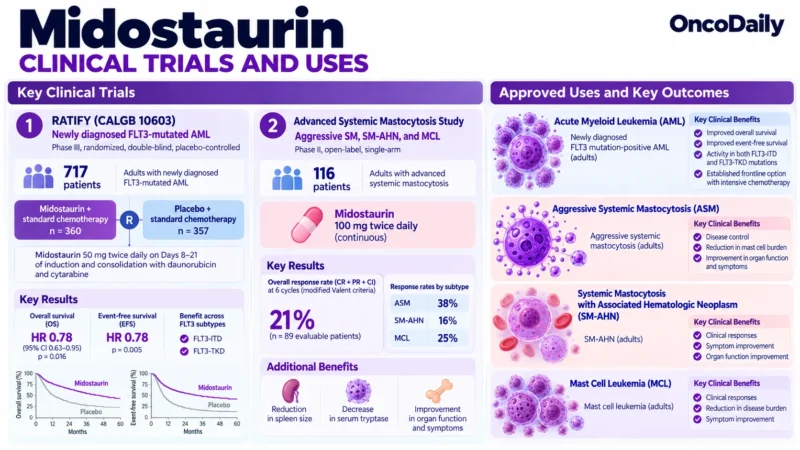
The pivotal phase III RATIFY/CALGB 10603 study established midostaurin as part of frontline treatment for FLT3-mutated AML.
A total of:
717 patients
with newly diagnosed FLT3-mutated AML were randomized to:
- Midostaurin + standard chemotherapy: 360
- Placebo + standard chemotherapy: 357.
Patients had:
- FLT3-ITD high allelic ratio
- FLT3-ITD low allelic ratio
- FLT3-TKD mutations
Overall Survival
Midostaurin significantly improved overall survival:
HR for death: 0.78
in the original published analysis.
The FDA analysis similarly reported:
HR 0.77; 95% CI 0.63–0.95; P = 0.016.
Event-Free Survival
Median EFS was:
- 8.2 months with midostaurin
- 3.0 months with placebo
HR:
0.78
P = 0.005 in the FDA analysis.
The survival benefit was observed across FLT3 mutation subtypes.
RATIFY FLT3-TKD Analysis
A dedicated analysis of patients with:
FLT3-TKD-mutated AML
showed 5-year event-free survival of:
- 45.2% with midostaurin
- 30.1% with placebo
P = 0.044.
This is clinically important because midostaurin has activity against both major classes of FLT3 mutation.
Advanced Systemic Mastocytosis Pivotal Study
The pivotal open-label study enrolled:
116 adults
with advanced systemic mastocytosis.
Patients received:
Midostaurin 100 mg twice daily
continuously.
Among 89 patients evaluable by modified Valent criteria:
CR + Incomplete Remission by 6 Cycles
Overall:
21%
with subtype rates of:
- ASM: 38%
- SM-AHN: 16%
- MCL: 25%.
A broader clinical assessment reported substantial disease responses and improvements in:
- Mast-cell burden
- Serum tryptase
- Splenomegaly
- Organ dysfunction
- Disease-related symptoms.
Is Midostaurin FDA Approved?
Yes.
Midostaurin is FDA approved for adults with:
Acute Myeloid Leukemia
Newly diagnosed FLT3 mutation-positive AML
in combination with:
- Standard cytarabine/daunorubicin induction
- Cytarabine consolidation
FLT3 positivity should be established using an:
FDA-approved test.
Advanced Systemic Mastocytosis
- Aggressive systemic mastocytosis
- Systemic mastocytosis with associated hematologic neoplasm
- Mast cell leukemia.
What Is the Current Clinical Role of Midostaurin in 2026?
FLT3-Mutated AML
Midostaurin remains an established frontline FLT3 inhibitor for fit adults receiving intensive chemotherapy.
In contemporary AML management:
7+3 chemotherapy + a FLT3 inhibitor
remains a standard approach for fit patients with FLT3-mutated AML. Midostaurin remains one of those established FLT3 inhibitors.
Its particular strengths include:
- Extensive long-term clinical experience
- Activity against FLT3-ITD
- Activity against FLT3-TKD
- Proven survival benefit with intensive chemotherapy
FLT3 testing should therefore occur rapidly at diagnosis so that targeted treatment can be incorporated into induction.
The FLT3 treatment landscape has nevertheless evolved. Quizartinib provides another frontline FLT3-directed strategy, particularly for FLT3-ITD AML, while other FLT3 inhibitors are important in relapsed/refractory disease.
A large 2026 real-world analysis of 1,658 adults with FLT3-mutated AML also supported the continued effectiveness of intensive chemotherapy plus midostaurin, with median OS of 47.2 versus 19.3 months compared with intensive chemotherapy alone in the unmatched overall cohort.
Read more: Acute Myeloid Leukemia (AML) in 2026: Current Practice and Evolving Directions by OncoDaily.
Watch more: Integrating midostaurin into FLT3-positive AML treatment — Miguel Sanz, MD, discusses the role of midostaurin with standard chemotherapy in FLT3-mutated AML, directly tying into the RATIFY data and frontline clinical use.
Advanced Systemic Mastocytosis
Midostaurin remains an approved KIT inhibitor for:
- ASM
- SM-AHN
- MCL
and retains activity against:
KIT D816V.
However, the systemic mastocytosis treatment landscape has changed with the availability of highly selective KIT inhibitors, particularly avapritinib. Contemporary treatment therefore depends on:
- SM subtype
- KIT mutation
- Cytopenias
- Associated hematologic neoplasm
- Disease burden
- Comorbidities
- Prior therapy.
Real-world 2025 data continue to demonstrate meaningful durable responses with midostaurin in advanced systemic mastocytosis, supporting its ongoing role as an active therapeutic option.
What Are the Major Side Effects of Midostaurin?
The toxicity profile differs somewhat between AML combination therapy and continuous treatment for systemic mastocytosis.
Gastrointestinal Toxicity
Gastrointestinal adverse effects are very common.
These include:
- Nausea
- Vomiting
- Diarrhea
- Abdominal discomfort
In the AML trial:
- Nausea: 83%
- Vomiting: 61%
- Mucositis: 66%
were reported in the midostaurin arm.
Because nausea and vomiting are frequent:
prophylactic antiemetics are recommended.
Myelosuppression and Febrile Neutropenia
In AML, cytopenias largely occur in the setting of intensive chemotherapy.
Febrile neutropenia was very common:
83% in the midostaurin-treated population in the label’s safety analysis.
In advanced systemic mastocytosis, treatment can also produce:
- Anemia
- Neutropenia
- Thrombocytopenia
and dose interruption or reduction may be required.
Pulmonary Toxicity
An important serious toxicity is:
- Interstitial lung disease
- Pneumonitis
Fatal cases have been reported.
Patients should be evaluated for:
- New cough
- Dyspnea
- Chest discomfort
- Hypoxia
If noninfectious ILD or pneumonitis is suspected:
discontinue midostaurin.
QT Prolongation
Formal QT testing did not demonstrate a clear concentration-dependent QT effect, but QT prolongation occurred clinically.
In AML studies, QTcF >500 ms occurred in:
- 6.2% with midostaurin
- 2.6% with placebo.
Consider ECG monitoring when midostaurin is used with medications that prolong QT.
This is particularly relevant because many supportive-care drugs used in AML can also affect QT.
Infection
Patients receiving intensive chemotherapy are at substantial risk for:
- Bacterial infection
- Fungal infection
- Sepsis
- Device-related infection
Drug-interaction assessment is particularly important when using azole antifungal prophylaxis because many azoles strongly inhibit CYP3A4.
Embryo-Fetal Toxicity
Midostaurin may cause fetal harm.
Pregnancy status should be verified within:
7 days before treatment initiation.
Effective contraception should be used by:
- Females of reproductive potential
- Males with female partners of reproductive potential
during therapy and for:
4 months after the last dose.
Breastfeeding is not recommended during therapy or for:
4 months after the final dose.
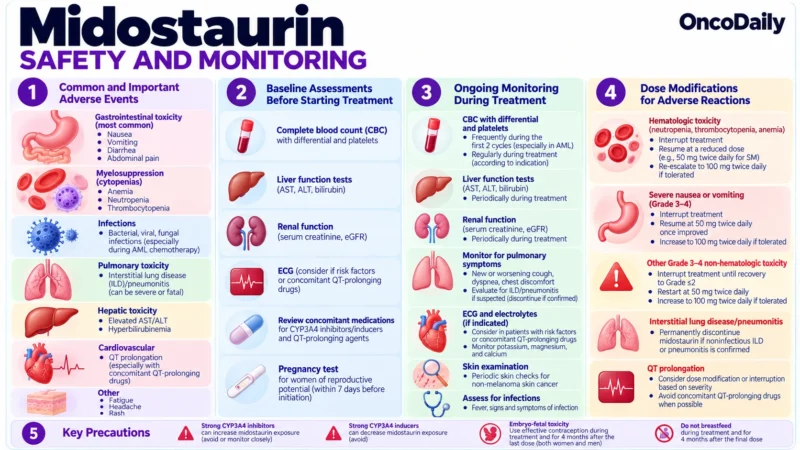
What Monitoring Is Required During Midostaurin Treatment?
Monitoring should be tailored to the indication and concomitant therapy.
CBC
Monitor:
- Hemoglobin
- Platelets
- ANC
- Total leukocyte count
particularly during AML chemotherapy and continuous treatment for advanced systemic mastocytosis.
FLT3 Status in AML
At diagnosis, test for:
- FLT3-ITD
- FLT3-TKD
using an appropriate validated/FDA-approved assay before selecting midostaurin.
Gastrointestinal Toxicity
Monitor for:
- Nausea
- Vomiting
- Diarrhea
- Dehydration
- Nutritional compromise
Use prophylactic antiemetic therapy.
Pulmonary Symptoms
Monitor for:
- Cough
- Dyspnea
- Chest discomfort
- Hypoxia
and investigate possible:
ILD/pneumonitis.
ECG and Electrolytes
Consider:
- ECG
- Potassium
- Magnesium
- Calcium
particularly when other QT-prolonging medications are used.
Liver and Renal Function
Monitor:
- ALT
- AST
- Bilirubin
- Serum creatinine
especially during intensive chemotherapy or when other potentially hepatotoxic or nephrotoxic agents are administered.
Systemic Mastocytosis Monitoring
For ASM, SM-AHN and MCL, monitor treatment toxicity:
- At least weekly during the first 4 weeks
- Every other week for the next 8 weeks
- Monthly thereafter.
Disease response may also include assessment of:
- Blood counts
- Bone-marrow mast-cell burden
- Serum tryptase
- Spleen size
- Organ damage
- KIT mutation burden where appropriate
Drug Interactions
Review medication lists carefully for:
- Strong CYP3A4 inhibitors
- Strong CYP3A4 inducers
- Azole antifungals
- QT-prolonging agents
- BCRP/OATP1B1 substrates
FAQ
What is midostaurin used for?
- Newly diagnosed FLT3-mutated AML in combination with chemotherapy
- Aggressive systemic mastocytosis
- SM-AHN
- Mast cell leukemia
What is the AML dose?
What is the systemic mastocytosis dose?
Does midostaurin work against FLT3-ITD?
Does midostaurin work against FLT3-TKD?
RATIFY included both mutation classes.
Is midostaurin active against KIT D816V?
This explains its activity in advanced systemic mastocytosis.
Should midostaurin be taken with food?
It should be taken with food approximately:
12 hours apart.
Should patients receive antiemetic prophylaxis?
Prophylactic antiemetics are recommended because nausea and vomiting are common.