





Lomustine: A Key Oral Chemotherapy for Brain Tumors and Glioblastoma
Key takeaways
- Lomustine (CCNU) is an oral nitrosourea alkylating chemotherapy with strong central nervous system penetration.
- It is FDA-approved for certain primary and metastatic brain tumors and for Hodgkin lymphoma in combination therapy after progression.
- Lomustine remains particularly relevant in recurrent glioblastoma, where it is commonly used as a treatment option and clinical-trial comparator.
- Its most important toxicity is delayed, cumulative myelosuppression, especially thrombocytopenia and leukopenia.
- In the Phase 3 EORTC 26101 trial, adding bevacizumab to lomustine improved progression-free survival but did not improve overall survival.
- Careful blood-count monitoring and treatment adjustment are essential because hematologic toxicity may appear several weeks after treatment.
Lomustine, also known as CCNU, is an oral nitrosourea alkylating chemotherapy used in the treatment of primary and metastatic brain tumors. Its high lipid solubility allows lomustine and its active metabolites to penetrate the central nervous system, making the drug particularly relevant in neuro-oncology.
Lomustine is FDA-approved for primary and metastatic brain tumors following appropriate surgery and/or radiotherapy and as part of combination chemotherapy for Hodgkin lymphoma that has progressed after initial chemotherapy. It also remains widely studied and used as a reference treatment in recurrent glioblastoma clinical trials.
This article aims to review lomustine, including its mechanism of action, treatment schedule, administration, dose modifications, pharmacokinetics, safety profile, clinical-trial findings, approved indications, and current role in glioblastoma.
Lomustine Key Facts
- Drug class: Nitrosourea alkylating agent
- Other name: CCNU
- Brand name: Gleostine
- Administration: Oral capsules
- Treatment schedule: Single oral treatment given at intervals of at least six weeks
- Main oncology use: Primary and metastatic brain tumors
- Additional FDA indication: Hodgkin lymphoma after progression following initial chemotherapy
- FDA approval: Yes
- Initial U.S. approval: 1976
- Major safety concern: Delayed and cumulative myelosuppression
- Role in glioblastoma: Common comparator and treatment option in recurrent disease research
What Is Lomustine?
Lomustine is an oral nitrosourea alkylating agent that damages DNA and interferes with cancer-cell replication.
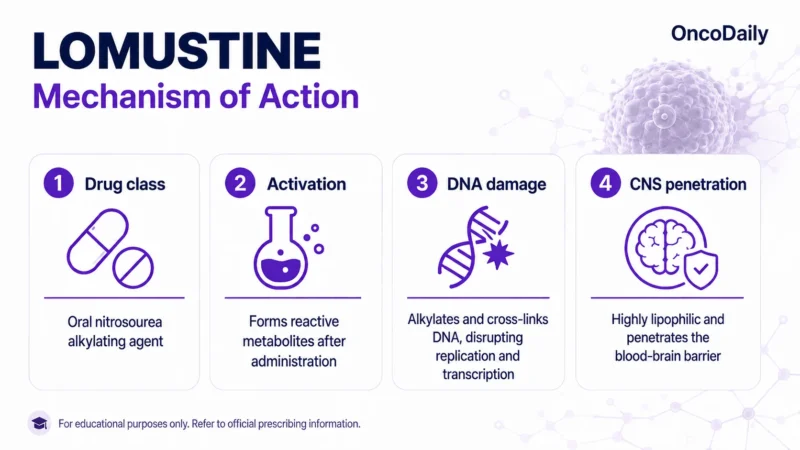
After administration, lomustine forms reactive metabolites capable of modifying DNA and other cellular components. DNA cross-linking interferes with replication and transcription, ultimately limiting cancer-cell proliferation.
Lomustine is highly lipid soluble, allowing its metabolites to enter the central nervous system. This characteristic helped establish its role in the treatment of malignant brain tumors.
The drug is also commonly referred to as CCNU, derived from its chemical designation.
What Is the Dose of Lomustine?
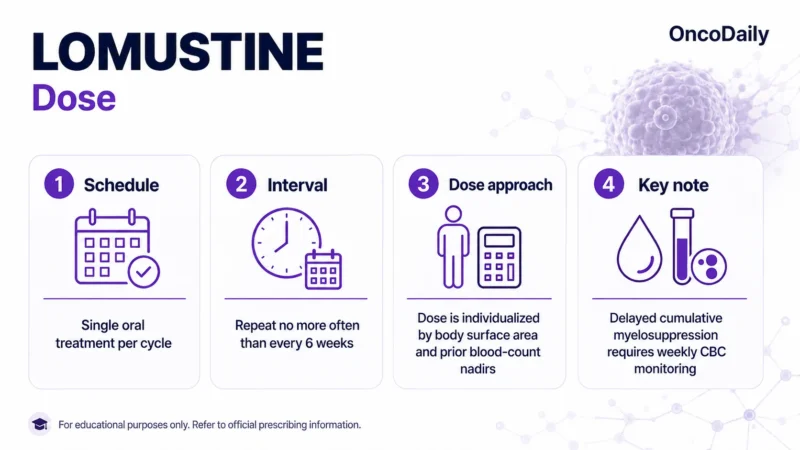
Lomustine uses a body-surface-area-based dose administered as a single oral treatment, followed by a prolonged treatment-free interval.
The current FDA label specifies that treatment should not be repeated more frequently than every six weeks, because bone-marrow suppression develops gradually and can become cumulative with subsequent treatment cycles.
Dose selection and subsequent modifications depend on factors including:
- Bone-marrow reserve
- Blood-cell nadirs after the previous treatment
- Concomitant myelosuppressive therapies
- Overall clinical condition
- Renal and hepatic function
Because excessive or too-frequent administration can result in severe or fatal toxicity, lomustine carries a boxed warning concerning overdose.
How Is Lomustine Administered?
Lomustine is administered orally as capsules rather than by intravenous infusion.
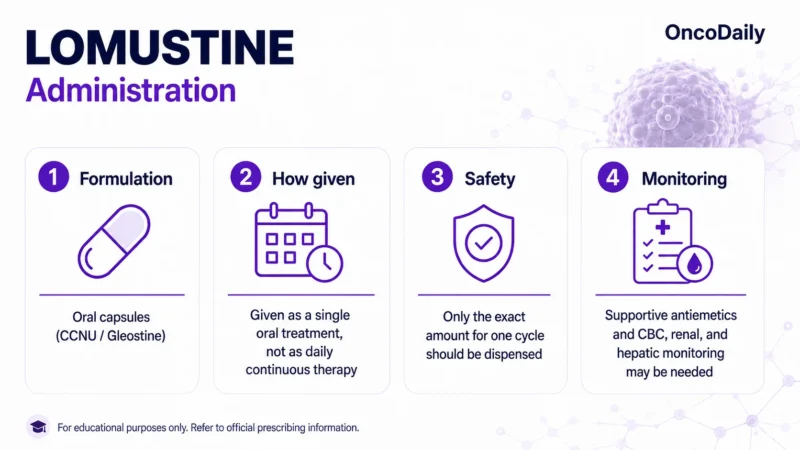
Unlike most chemotherapy regimens administered over consecutive days, lomustine is given as a single treatment within each cycle, with a prolonged interval before another treatment may be considered.
The available capsule strengths allow the prescribed treatment amount to be assembled from more than one capsule strength.
Lomustine is a cytotoxic medication and requires appropriate oncology-pharmacy handling and dispensing procedures. The FDA label specifically warns that only the amount required for a single treatment should be dispensed because accidental repeated administration has resulted in fatal toxicity.
Does Lomustine Require an In-Line Filter?
Lomustine does not require an in-line filter because it is administered orally.
No intravenous dilution, infusion tubing, infusion bag, or flushing procedure is required for lomustine itself.
If lomustine is given as part of a combination regimen containing intravenous treatments, those agents may have their own preparation and filtration requirements.
Is Premedication Required?
Lomustine does not have a mandatory drug-specific premedication regimen in its FDA prescribing information.
However, nausea and vomiting are recognized adverse effects, and supportive antiemetic therapy may be used according to the treatment protocol and clinical judgment.
Additional supportive treatment depends on the accompanying anticancer regimen and individual patient factors.
Are Dose Reductions Used?
Yes. Lomustine treatment may be delayed or reduced according to the degree of bone-marrow suppression observed after the preceding treatment.
The most important factors are:
- Leukocyte recovery
- Platelet recovery
- Severity of prior cytopenias
- Concomitant myelosuppressive therapy
- Clinical tolerance
The FDA label recommends weekly blood-count monitoring after treatment and adjustment of subsequent treatment according to hematologic nadirs. Severe decreases in leukocytes or platelets require substantial reduction or postponement of further treatment.
This is particularly important because lomustine-induced myelosuppression is delayed, dose-related, and cumulative.
What Is Known About Lomustine Pharmacokinetics?
Lomustine is an orally administered, highly lipid-soluble nitrosourea.
After administration, it undergoes extensive metabolism, producing active metabolites that contribute substantially to its anticancer activity.
Its lipid solubility facilitates penetration across the blood-brain barrier, an important pharmacological feature for treating central nervous system malignancies.
The delayed hematologic effects of lomustine distinguish it from many other cytotoxic agents. Bone-marrow suppression commonly becomes apparent several weeks after exposure rather than immediately after treatment.
Are Renal or Hepatic Dose Adjustments Required?
The current U.S. prescribing information does not provide a standardized dose-adjustment algorithm specifically for renal or hepatic impairment.
However, lomustine and its metabolites are substantially excreted through the kidneys, and impaired renal function may increase the risk of toxicity.
Lomustine itself can also cause:
- Nephrotoxicity, including progressive renal impairment
- Hepatotoxicity, including elevations in transaminases, alkaline phosphatase, and bilirubin
Renal and hepatic function therefore require monitoring during treatment.
What Did Clinical Trials Show?
Lomustine has been evaluated extensively in recurrent glioblastoma and has become one of the most commonly used comparator treatments in clinical trials.
EORTC 26101
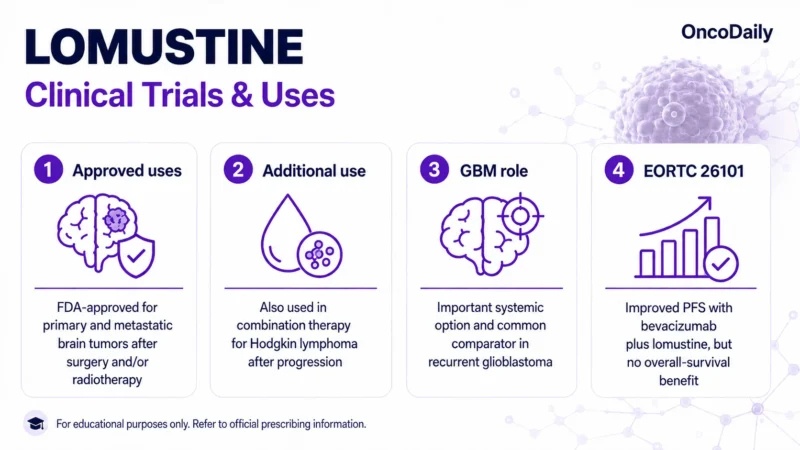
The randomized Phase 3 EORTC 26101 trial evaluated lomustine alone compared with lomustine plus bevacizumab in patients with progressive glioblastoma.
Adding bevacizumab improved progression-free survival but did not produce a statistically significant overall-survival advantage compared with lomustine alone.
Median overall survival was approximately:
- 9.1 months with bevacizumab plus lomustine
- 8.6 months with lomustine alone
Median progression-free survival was:
- 4.2 months with the combination
- 1.5 months with lomustine alone
The study established that adding bevacizumab improved disease control but did not prolong overall survival in this setting.
Lomustine as a Recurrent Glioblastoma Control
Lomustine continues to serve as an important comparator in recurrent glioblastoma studies.
For example, the adaptive GBM AGILE trial, NCT03970447, incorporates lomustine among standard-of-care control options for patients with recurrent glioblastoma while evaluating investigational therapies.
This continued use reflects lomustine’s established position as a reference systemic treatment in recurrent glioblastoma despite the development of newer targeted, immune, and experimental therapies.
Read more: glioblastoma treatment and emerging therapies on OncoDaily.
Watch more: Learn about the comparison of regorafenib versus lomustine in relapsed glioblastoma in this ecancer discussion.
What Are the Side Effects of Lomustine?
The most clinically important adverse effect of lomustine is delayed myelosuppression.
The FDA label carries a boxed warning because bone-marrow suppression can be severe or fatal. It generally appears approximately four to six weeks after treatment and can persist for one to two weeks. Thrombocytopenia is typically more pronounced than leukopenia, and toxicity may become progressively more severe with repeated exposure.
Other reported adverse effects include:
- Nausea
- Vomiting
- Stomatitis
- Alopecia
- Leukopenia
- Thrombocytopenia
- Pulmonary toxicity
- Hepatotoxicity
- Nephrotoxicity
- Neurologic effects
- Visual disturbances
Long-term treatment has also been associated with secondary malignancies, including acute leukemia and myelodysplastic syndromes.
Pulmonary fibrosis represents another important but less common toxicity, particularly following substantial cumulative exposure.
What Is the Current Status of Lomustine?
Lomustine remains an FDA-approved anticancer treatment.
Its approved U.S. indications include:
- Primary brain tumors after appropriate surgery and/or radiotherapy
- Metastatic brain tumors following appropriate local treatment
- Hodgkin lymphoma, in combination with other chemotherapy, following progression after initial chemotherapy
The drug received its initial U.S. approval in 1976. Generic lomustine capsules also received an FDA first-generic approval in October 2025.
In contemporary neuro-oncology, lomustine is particularly relevant in recurrent glioblastoma, where it remains a treatment option and frequently serves as a comparator in trials testing novel therapies.
Written by Mirna Antabian, MD