


Lapatinib (Tykerb): Understanding Its Mechanism, Dosing, Clinical Uses, and Role in HER2-Positive Breast Cancer
Key takeaways
- Lapatinib is an oral dual HER2/EGFR tyrosine kinase inhibitor.
- It was first FDA approved in 2007.
- With capecitabine, the recommended lapatinib dose is 1,250 mg once daily.
- With letrozole, the recommended dose is 1,500 mg once daily.
- Lapatinib should be taken at least 1 hour before or 1 hour after food.
- EGF100151 demonstrated a significant improvement in time to progression with lapatinib + capecitabine, HR 0.57.
- EGF30008 showed median PFS 8.2 vs 3.0 months with lapatinib + letrozole versus letrozole alone in HR-positive/HER2-positive metastatic breast cancer.
- Lapatinib has some CNS activity, but newer HER2-targeted agents generally provide stronger intracranial efficacy.
- The most important safety issue is hepatotoxicity, which carries a boxed warning.
- Other important risks include LVEF reduction, diarrhea, ILD/pneumonitis, QT prolongation, and severe skin reactions.
- In 2026, lapatinib remains FDA approved but has a more limited later-line or selected-patient role because the HER2 treatment landscape has evolved substantially.
Lapatinib (Tykerb) is an oral, small-molecule tyrosine kinase inhibitor that targets both HER2 (ErbB2) and EGFR (ErbB1/HER1). By reversibly inhibiting the intracellular kinase domains of these receptors, lapatinib suppresses downstream proliferative and survival signaling through pathways such as PI3K–AKT and RAS–RAF–MEK–ERK.
In the United States, lapatinib remains FDA approved in combination with capecitabine for selected patients with previously treated HER2-positive advanced or metastatic breast cancer, and in combination with letrozole for postmenopausal patients with HR-positive, HER2-positive metastatic breast cancer when endocrine therapy is appropriate. The current Tykerb label was updated in January 2026.
Key Facts
- Generic name: Lapatinib
- Brand name: Tykerb
- Drug class: Dual HER2/EGFR tyrosine kinase inhibitor
- Targets: HER2/ErbB2 and EGFR/ErbB1
- Route: Oral
- Initial US approval: 2007
- Tablet strength: 250 mg
- With capecitabine: 1,250 mg once daily
- With letrozole: 1,500 mg once daily
- Administration: At least 1 hour before or 1 hour after food
- Important interaction pathway: CYP3A4/5
- Major safety concerns: Hepatotoxicity, diarrhea, reduced LVEF, ILD/pneumonitis, QT prolongation, severe cutaneous reactions
- Boxed warning: Hepatotoxicity
- Current FDA status: Approved.
What Is Lapatinib?
Lapatinib is a small-molecule inhibitor of the intracellular tyrosine kinase domains of:
- HER2
- EGFR
HER2-positive breast cancers frequently depend on signaling through HER-family receptors to sustain:
- Cell proliferation
- Survival
- Migration
- Resistance to apoptosis
Unlike monoclonal antibodies such as trastuzumab, which bind the extracellular portion of HER2, lapatinib acts:
Inside the cell
by inhibiting the intracellular kinase domain.
Because it is a small molecule, it also has some ability to cross biologic barriers, which led to considerable interest in its activity against HER2-positive CNS disease.
What Is the Mechanism of Action of Lapatinib?
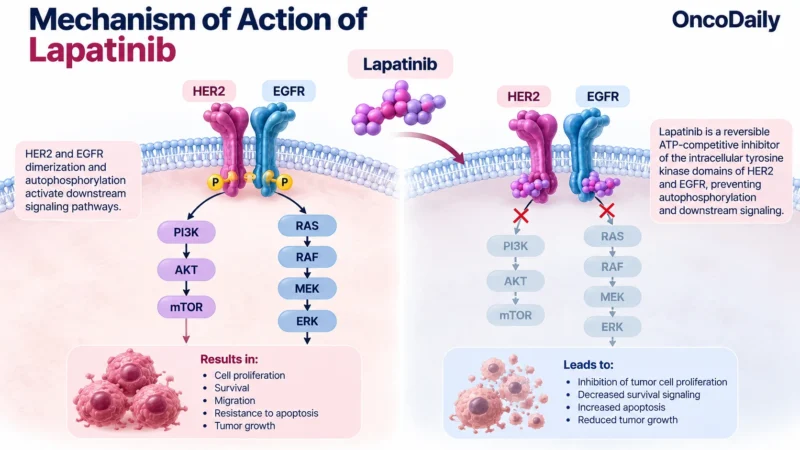
1. HER2 and EGFR Signaling Activates Growth Pathways
HER2 and EGFR are members of the ErbB receptor family.
After receptor activation and dimerization, their intracellular tyrosine kinase domains become phosphorylated.
This activates downstream pathways including:
PI3K → AKT → mTOR
and:
RAS → RAF → MEK → ERK.
These signals promote:
- Tumor-cell proliferation
- Cell survival
- Growth
- Migration
- Resistance to apoptosis
2. Lapatinib Binds HER2 and EGFR Kinase Domains
Lapatinib is a:
Reversible ATP-competitive tyrosine kinase inhibitor.
It binds intracellularly to:
- HER2
- EGFR
and prevents ATP-dependent receptor phosphorylation.
3. Receptor Autophosphorylation Is Reduced
This suppresses downstream signaling from the HER-family receptors.
4. PI3K/AKT and MAPK Signaling Fall
Reduced receptor activity decreases signaling through:
- PI3K/AKT
- RAS/RAF/MEK/ERK
5. Tumor Growth Is Inhibited
The downstream result is:
- Reduced proliferation
- Reduced survival signaling
- Increased apoptosis
- Reduced tumor growth
The mechanism can be summarized as:
Lapatinib → HER2/EGFR kinase inhibition → reduced receptor phosphorylation → suppression of PI3K/AKT and MAPK signaling → decreased tumor-cell proliferation and survival.
What Is the Dose of Lapatinib?
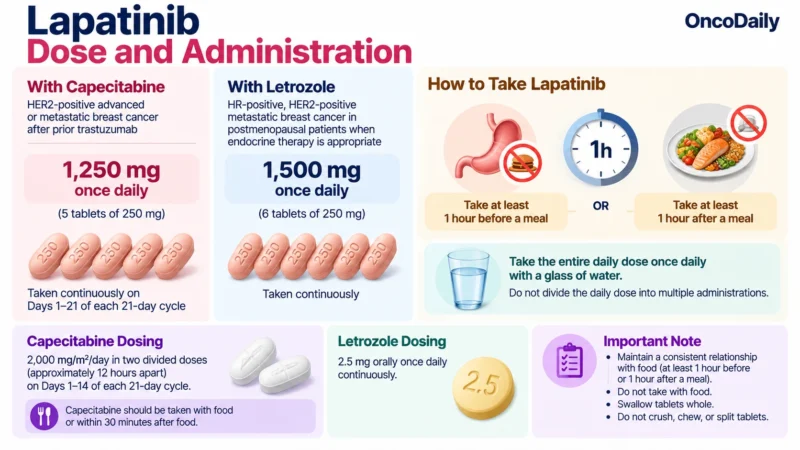
The dose depends on the combination regimen.
With Capecitabine
For HER2-positive advanced or metastatic breast cancer:
Lapatinib 1,250 mg orally once daily
given continuously on:
Days 1–21
of each 21-day cycle.
This corresponds to:
Five 250 mg tablets once daily.
Capecitabine is administered at:
2,000 mg/m²/day
in two divided doses approximately 12 hours apart on:
Days 1–14
of each 21-day cycle.
With Letrozole
For postmenopausal patients with:
HR-positive, HER2-positive metastatic breast cancer
when endocrine therapy is appropriate:
Lapatinib 1,500 mg orally once daily
continuously.
This corresponds to:
Six 250 mg tablets once daily.
Letrozole is administered at:
2.5 mg orally once daily.
How Should Lapatinib Be Taken?
Lapatinib should be taken:
At least 1 hour before or at least 1 hour after a meal.
The entire daily dose should be taken:
Once daily.
Do not divide the daily dose into multiple administrations.
This is important because divided dosing can substantially increase exposure.
By contrast:
Capecitabine should be taken with food or within 30 minutes after food.
What If a Dose Is Missed?
If a day’s dose is missed:
Do not double the dose the following day.
Simply resume the next scheduled dose.
The current prescribing information does not recommend taking extra tablets to compensate for the missed dose.
How Are Lapatinib Dose Reductions Made?
Dose modification depends on the treatment combination and toxicity.
Lapatinib + Capecitabine
Starting dose:
1,250 mg once daily
Typical reduced dose after certain toxicities:
1,000 mg once daily.
Lapatinib + Letrozole
Starting dose:
1,500 mg once daily
Typical reduced dose:
1,250 mg once daily.
Dose interruption or reduction may be required for:
- LVEF reduction
- Diarrhea
- Hepatotoxicity
- Severe cutaneous toxicity
- Other Grade ≥2 adverse events
- CYP3A4 interactions
Dose Modification for Cardiac Toxicity
Lapatinib should be discontinued for:
- Symptomatic Grade ≥2 LVEF reduction
- LVEF falling below the institutional lower limit of normal
Treatment may be restarted after at least:
2 weeks
if:
- LVEF returns to normal
- The patient is asymptomatic
at a reduced lapatinib dose:
- 1,000 mg/day with capecitabine
- 1,250 mg/day with letrozole.
Dose Modification for Diarrhea
Lapatinib should be interrupted for:
- Grade 3 diarrhea
- Grade 1–2 diarrhea with complicating features such as dehydration, fever, significant nausea/vomiting, neutropenia, bleeding, sepsis, or impaired performance status
After recovery to Grade ≤1:
- 1,250 mg may be reduced to 1,000 mg
- 1,500 mg may be reduced to 1,250 mg
Grade 4 diarrhea requires:
Permanent discontinuation.
What Are the Important Drug Interactions With Lapatinib?
Lapatinib is primarily metabolized through:
CYP3A4 and CYP3A5.
Strong CYP3A4 Inhibitors
These can substantially increase lapatinib exposure.
Examples include:
- Ketoconazole
- Itraconazole
- Clarithromycin
- Ritonavir
- Voriconazole
They should generally be:
Avoided.
If unavoidable, the label suggests that reducing lapatinib to approximately:
500 mg/day
may normalize exposure, although clinical data for this adjustment are limited.
Grapefruit
Grapefruit can increase lapatinib exposure and should be:
Avoided.
Strong CYP3A4 Inducers
Strong inducers can markedly reduce lapatinib exposure.
Examples include:
- Rifampin
- Carbamazepine
- Phenytoin
- Phenobarbital
- St. John’s wort
They should generally be avoided.
The prescribing information describes potential dose escalation if a strong inducer absolutely cannot be avoided, but these higher doses are based on pharmacokinetic modeling rather than robust clinical efficacy data.
Effects on Other Drugs
Lapatinib may increase exposure to drugs that are substrates of:
- CYP3A4
- CYP2C8
- P-glycoprotein
Therefore concomitant medications should be reviewed carefully.
Does Lapatinib Require Renal or Hepatic Dose Adjustment?
Renal Impairment
Renal elimination is minimal:
<2%
of lapatinib and metabolites are excreted through the kidneys.
Therefore mild or moderate renal dysfunction is not expected to substantially alter lapatinib exposure.
However:
Experience in severe renal impairment is limited.
Hepatic Impairment
Lapatinib exposure increases with hepatic dysfunction.
In:
- Moderate hepatic impairment: AUC increased by approximately 14%
- Severe hepatic impairment: AUC increased by approximately 63%.
For severe hepatic impairment, the label recommends considering:
Capecitabine regimen
1,250 mg → 750 mg/day
Letrozole regimen
1,500 mg → 1,000 mg/day.
What Is the Pharmacokinetic Profile of Lapatinib?
Absorption
Absorption is:
Incomplete and variable.
Median lag time before serum detection:
0.25 hours.
Peak plasma concentration occurs at approximately:
4 hours.
Steady State
Steady state is generally achieved within:
6–7 days.
Half-Life
Terminal half-life after a single dose:
Approximately 14.2 hours.
Effective half-life after repeated dosing:
Approximately 24 hours.
Food Effect
Food has a major effect on lapatinib exposure.
Compared with fasting:
- Low-fat meal increases AUC approximately 3-fold
- High-fat meal increases AUC approximately 4-fold
Cmax increases approximately:
- 2.5-fold with a low-fat meal
- 3-fold with a high-fat meal.
This is why dosing relative to meals must be consistent.
Protein Binding
Lapatinib is:
>99% protein bound
primarily to:
- Albumin
- Alpha-1 acid glycoprotein.
Metabolism
Lapatinib undergoes extensive metabolism primarily through:
- CYP3A4
- CYP3A5
with smaller contributions from:
- CYP2C19
- CYP2C8.
Elimination
Elimination is predominantly:
Fecal.
Median recovery of unchanged parent drug in feces:
27%.
Renal elimination is:
<2%.
What Are the Clinical Uses of Lapatinib?
1. HER2-Positive Advanced or Metastatic Breast Cancer After Prior Trastuzumab
Lapatinib is FDA approved:
With capecitabine
for patients with advanced or metastatic HER2-positive breast cancer who have previously received:
- An anthracycline
- A taxane
- Trastuzumab
The current label specifically states that patients should have:
Disease progression on trastuzumab
before initiation of lapatinib plus capecitabine.
2. HR-Positive, HER2-Positive Metastatic Breast Cancer
Lapatinib is also FDA approved:
With letrozole
for postmenopausal patients with:
- Hormone receptor-positive
- HER2-positive
- Metastatic breast cancer
when endocrine therapy is appropriate.
What Did Lapatinib Clinical Trials Show?
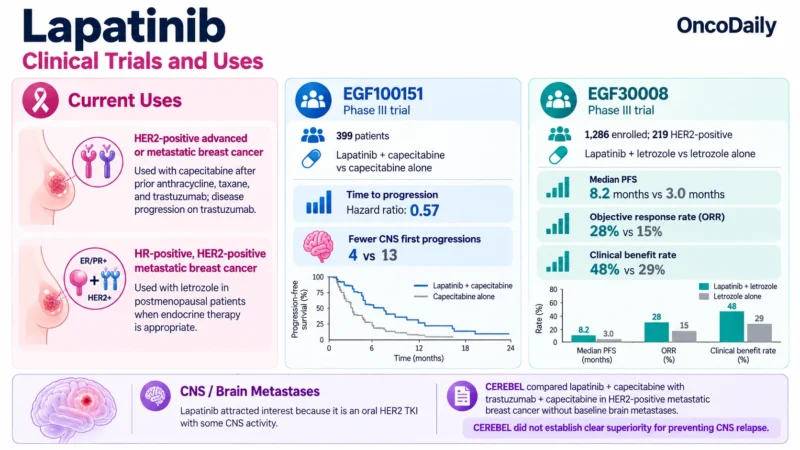
EGF100151 — Lapatinib + Capecitabine
The pivotal phase III trial evaluated:
Lapatinib + capecitabine
versus:
Capecitabine alone
in HER2-positive advanced or metastatic breast cancer previously treated with:
- Anthracyclines
- Taxanes
- Trastuzumab.
A total of:
399 patients
were randomized.
Time to Progression
Lapatinib + capecitabine significantly prolonged time to progression.
Hazard ratio:
0.57
95% CI:
0.43–0.77
P < 0.001.
The combination also produced fewer cases of CNS involvement as first progression:
- 4 patients with lapatinib + capecitabine
- 13 patients with capecitabine alone
P = 0.045.
Final Survival Analysis of EGF100151
Final median overall survival was:
- 75.0 weeks with lapatinib + capecitabine
- 64.7 weeks with capecitabine alone
Hazard ratio:
0.87
P = 0.210.
Because the study was stopped early and crossover occurred, overall-survival interpretation was complicated.
A crossover-adjusted analysis suggested a lower risk of death with combination therapy.
EGF30008 — Lapatinib + Letrozole
The phase III EGF30008 trial evaluated:
Lapatinib + letrozole
versus:
Letrozole + placebo
in postmenopausal patients with HR-positive metastatic breast cancer.
A total of:
1,286 patients
were enrolled.
Among them:
219 patients
had HER2-positive disease.
Median Progression-Free Survival
In the HR-positive/HER2-positive subgroup:
- Lapatinib + letrozole: 8.2 months
- Letrozole alone: 3.0 months
Hazard ratio:
0.71
P = 0.019.
Objective Response Rate
- 28%
- 15%
respectively.
Clinical Benefit Rate
- 48%
- 29%.
These results supported dual targeting of:
- HER2 signaling
- Estrogen receptor signaling
in HR-positive/HER2-positive metastatic breast cancer.
What About Brain Metastases?
Lapatinib attracted considerable interest because it is a:
Small-molecule HER2 inhibitor
with some CNS penetration.
Early phase II studies demonstrated activity in patients with:
HER2-positive breast cancer and progressive brain metastases after trastuzumab.
However, lapatinib’s intracranial activity is modest compared with several newer HER2-directed therapies.
CEREBEL — Prevention of CNS Progression
The phase III CEREBEL trial compared:
- Lapatinib + capecitabine
- Trastuzumab + capecitabine
in HER2-positive metastatic breast cancer without baseline brain metastases.
The primary endpoint was:
CNS metastases as first site of relapse.
The trial enrolled:
540 patients
before being terminated early.
CEREBEL did not establish lapatinib as clearly superior for preventing CNS relapse.
Is Lapatinib FDA Approved?
Yes.
Lapatinib received its initial US approval in:
2007.
Current FDA-approved combinations include:
Lapatinib + Capecitabine
For previously treated HER2-positive advanced or metastatic breast cancer.
Lapatinib + Letrozole
For postmenopausal HR-positive/HER2-positive metastatic breast cancer when endocrine therapy is appropriate.
What Is the Current Clinical Role of Lapatinib?
Lapatinib remains FDA approved, but its clinical role has substantially narrowed.
HER2-Positive Metastatic Breast Cancer
Lapatinib plus capecitabine was historically an important post-trastuzumab HER2-targeted regimen.
However, the modern HER2-positive metastatic breast-cancer landscape now includes multiple newer agents with stronger efficacy and CNS activity.
Therefore, in 2026, lapatinib is generally:
- Not a preferred early-line HER2-targeted therapy
- More likely to be considered in selected later-line situations
- Potentially relevant where newer HER2-directed options are unavailable or unsuitable
Its historical importance remains substantial because it was one of the first successful oral HER2-targeted TKIs.
HR-Positive/HER2-Positive Disease
The combination of:
Lapatinib + letrozole
remains an FDA-approved chemotherapy-free option for selected postmenopausal patients when endocrine therapy is appropriate.
However, modern HER2-positive and HR-positive disease management has evolved substantially, so patient selection is important.
Read more: HER2 at the Center: Boehringer Ingelheim and Jazz Pharmaceuticals Drive Dual Therapy Advances in Breast Cancer on OncoDaily.
Watch more: OncoDaily discussion on targeted therapies in oncogene-driven cancer, relevant to the role of HER2-directed TKIs such as lapatinib.
What Are the Major Side Effects of Lapatinib?
Common adverse effects include:
- Diarrhea
- Rash
- Nausea
- Vomiting
- Fatigue
- Palmar-plantar erythrodysesthesia when combined with capecitabine
- Decreased appetite
- Dyspepsia
The major clinically important risks include:
- Hepatotoxicity
- LVEF reduction
- Severe diarrhea
- ILD/pneumonitis
- QT prolongation
- Severe cutaneous reactions.
Hepatotoxicity
Hepatotoxicity carries a boxed warning.
Lapatinib-associated liver injury may be:
- Severe
- Potentially fatal
It can occur:
Days to several months after starting treatment.
Liver tests should include:
- ALT
- AST
- Bilirubin
- Alkaline phosphatase
and should be checked:
- Before treatment
- Every 4–6 weeks
- As clinically indicated.
If severe hepatic injury occurs:
Permanently discontinue lapatinib and do not rechallenge.
Decreased Left Ventricular Ejection Fraction
Lapatinib may cause:
Reduced LVEF.
Before starting therapy:
Confirm normal LVEF.
Cardiac function should continue to be monitored during treatment.
In clinical trials, LVEF assessments were commonly performed approximately every:
8 weeks.
Diarrhea
Diarrhea is one of the most common and clinically characteristic lapatinib toxicities.
Nearly half of patients who develop diarrhea experience their first episode within:
6 days.
Typical duration:
4–5 days.
Most cases are low grade, but severe diarrhea can result in:
- Dehydration
- Electrolyte abnormalities
- Infection
- Renal complications
Early treatment with an antidiarrheal such as:
Loperamide
is recommended after the first unformed stool. DailyMed
Interstitial Lung Disease/Pneumonitis
Lapatinib has been associated with:
- ILD
- Pneumonitis
Monitor for:
- New cough
- Dyspnea
- Hypoxia
- New pulmonary symptoms
For Grade ≥3 treatment-related pulmonary toxicity:
Discontinue lapatinib.
QT Prolongation
Lapatinib causes:
Concentration-dependent QT prolongation.
Patients at increased risk include those with:
- Congenital long QT syndrome
- Hypokalemia
- Hypomagnesemia
- QT-prolonging medications
- Prior high cumulative anthracycline exposure
Consider monitoring:
- ECG
- Potassium
- Magnesium
and correct electrolyte abnormalities before treatment.
Severe Cutaneous Reactions
Rare but serious skin reactions include:
- Stevens-Johnson syndrome
- Toxic epidermal necrolysis
- Erythema multiforme
If a life-threatening skin reaction is suspected:
Discontinue lapatinib.
Embryo-Fetal Toxicity
Lapatinib can cause fetal harm.
Patients of reproductive potential should receive counseling regarding:
- Pregnancy risk
- Effective contraception
Pregnancy status should be verified before treatment.
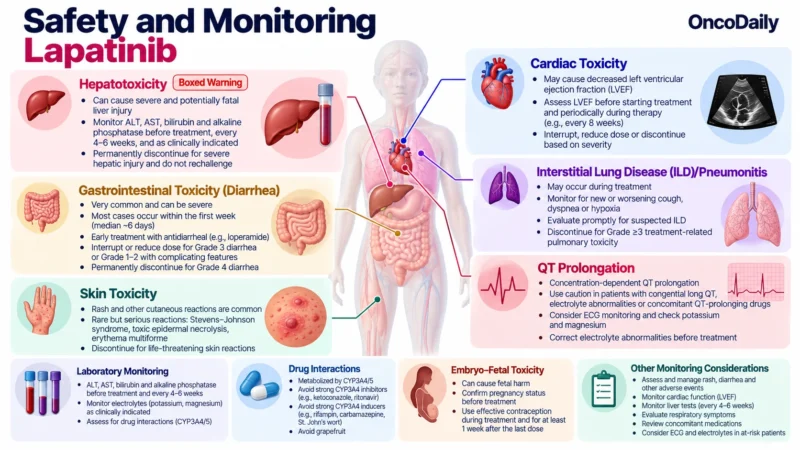
What Monitoring Is Required?
Monitoring during lapatinib therapy should include:
- LVEF before treatment
- Periodic LVEF assessment
- ALT
- AST
- Bilirubin
- Alkaline phosphatase
- Liver testing every 4–6 weeks
- Stool frequency and diarrhea severity
- Hydration status
- Electrolytes
- Respiratory symptoms
- ECG when clinically appropriate
- Potassium
- Magnesium
- Skin and mucosal symptoms
- CYP3A4 drug interactions
- Pregnancy status
- Concomitant QT-prolonging medications.
FAQ
What Is Lapatinib Used For?
- Capecitabine for previously treated HER2-positive advanced or metastatic breast cancer
- Letrozole for selected postmenopausal HR-positive/HER2-positive metastatic breast cancer.
What Is the Standard Dose With Capecitabine?
What Is the Standard Dose With Letrozole?
Should Lapatinib Be Taken With Food?
Take it:
At least 1 hour before or 1 hour after a meal.
How Does Lapatinib Work?
HER2 and EGFR
thereby suppressing PI3K/AKT and MAPK signaling.
What Did EGF100151 Show?
0.57.
What Did EGF30008 Show?
- Median PFS: 8.2 vs 3.0 months
- ORR: 28% vs 15%
- Clinical benefit rate: 48% vs 29%.
Does Lapatinib Work in Brain Metastases?
What Is the Most Important Safety Warning?
It carries an FDA boxed warning.