


Infigratinib (Truseltiq; BGJ398): Understanding Its Mechanism, Dosing, Clinical Uses, and Role in FGFR2-Rearranged Cholangiocarcinoma
Key takeaways
- Infigratinib (Truseltiq) is an oral, reversible FGFR1–3 tyrosine kinase inhibitor.
- It was developed for advanced cholangiocarcinoma harboring FGFR2 fusions or rearrangements.
- It received FDA accelerated approval in May 2021.
- FDA approval was withdrawn on May 16, 2024.
- Its historical recommended dose was 125 mg daily for 21 days followed by 7 days off.
- Dose reductions were 125 mg → 100 mg → 75 mg → 50 mg.
- Administration required an empty stomach.
- The pivotal phase II study demonstrated an ORR of 23.1%, median DoR of 5.0 months, and median PFS of 7.3 months.
- Hyperphosphatemia and retinal toxicity were important safety concerns.
- CYP3A inhibitors, inducers, and gastric acid-reducing agents were clinically relevant interactions.
- Infigratinib contributed to the development of FGFR-targeted precision therapy and understanding of acquired FGFR resistance.
Infigratinib (Truseltiq; BGJ398) is an oral, selective, reversible FGFR1–3 tyrosine kinase inhibitor developed for cancers driven by fibroblast growth factor receptor alterations, particularly FGFR2 fusion- or rearrangement-positive cholangiocarcinoma.
Infigratinib competitively binds the ATP-binding region of the FGFR kinase domain, inhibiting receptor phosphorylation and downstream signaling pathways involved in malignant-cell proliferation, survival, and tumor progression.
Infigratinib received FDA accelerated approval on May 28, 2021, for adults with previously treated, unresectable locally advanced or metastatic cholangiocarcinoma harboring an FGFR2 fusion or other rearrangement. However, its U.S. approval was voluntarily withdrawn, effective May 16, 2024, following difficulties completing the required confirmatory clinical trial. The withdrawal was not attributed to newly identified safety concerns.
As of October 2026, infigratinib should therefore be discussed as a previously FDA-approved FGFR inhibitor, rather than a currently approved treatment for cholangiocarcinoma in the United States.
Key Facts
- Generic name: Infigratinib
- Brand name: Truseltiq
- Development name: BGJ398
- Drug class: Reversible FGFR tyrosine kinase inhibitor
- Primary targets: FGFR1, FGFR2, FGFR3
- Key molecular alteration: FGFR2 fusion or rearrangement
- Route: Oral
- Initial U.S. approval: May 28, 2021
- FDA approval withdrawal: May 16, 2024
- Historical recommended dose: 125 mg once daily
- Schedule: 21 days on treatment, followed by 7 days off
- Capsule strengths: 25 mg and 100 mg
- Administration: On an empty stomach
- Dose reductions: 125 mg → 100 mg → 75 mg → 50 mg
- Characteristic toxicity: Hyperphosphatemia
- Major ocular toxicity: Retinal pigment epithelial detachment (RPED)
- Other frequent toxicities: Nail toxicity, stomatitis, dry eye, fatigue, alopecia, palmar-plantar erythrodysesthesia, arthralgia, dysgeusia, constipation, and diarrhea
- Major metabolic pathway: CYP3A4
Important interactions: CYP3A inhibitors, CYP3A inducers, and gastric acid-reducing medications - Pivotal trial: Phase II BGJ398 study (NCT02150967)
- Current U.S. regulatory status: FDA approval withdrawn
What Is Infigratinib?
Infigratinib is a small-molecule kinase inhibitor that selectively targets:
- FGFR1
- FGFR2
- FGFR3
It has substantially lower inhibitory potency against FGFR4.
FGFR signaling regulates several physiological processes, including:
- Cell proliferation
- Cell survival
- Differentiation
- Angiogenesis
- Tissue development and repair
In certain malignancies, FGFR gene alterations result in constitutive activation of these signaling pathways.
One of the most clinically relevant examples is:
FGFR2 gene fusion or rearrangement in cholangiocarcinoma.
These genomic alterations are particularly associated with intrahepatic cholangiocarcinoma and can drive persistent FGFR2 signaling, promoting tumor-cell survival and proliferation.
Infigratinib inhibits dysregulated FGFR signaling by preventing receptor phosphorylation and downstream activation of pathways that support malignant growth.
Unlike futibatinib, which irreversibly binds FGFR through a covalent mechanism, infigratinib is a reversible ATP-competitive FGFR inhibitor.
What Is the Mechanism of Action of Infigratinib?
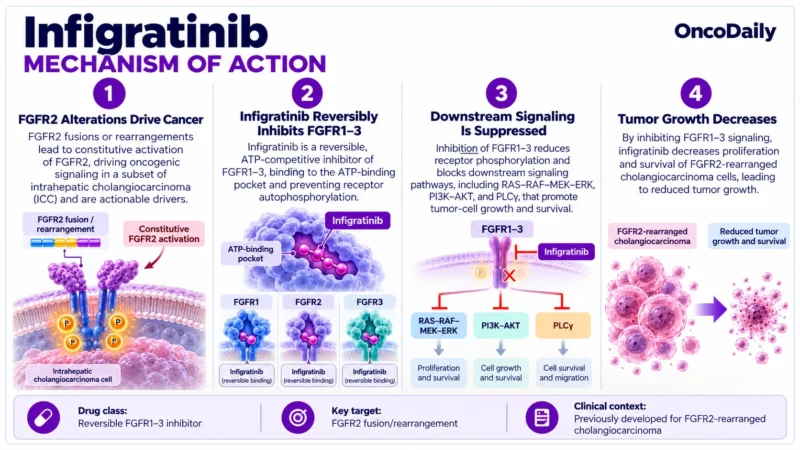
1. FGFR2 Alterations Activate Oncogenic Signaling
In a subset of cholangiocarcinomas, an:
FGFR2 fusion or rearrangement
can produce persistent activation of FGFR2 signaling.
These genomic alterations may generate fusion proteins that maintain receptor kinase activity independently of normal physiological regulation.
2. Activated FGFR Stimulates Downstream Pathways
Constitutive FGFR signaling activates intracellular pathways including:
- RAS–RAF–MEK–ERK
- PI3K–AKT
- PLCγ
- STAT-associated signaling
These pathways promote:
- Cell proliferation
- Cell survival
- Resistance to apoptosis
- Tumor progression
3. Infigratinib Inhibits FGFR1–3
Infigratinib competitively binds the ATP-binding pocket of FGFR tyrosine kinase domains.
This prevents receptor autophosphorylation and kinase activation.
4. Downstream Signaling Is Suppressed
Inhibition of FGFR phosphorylation decreases activation of oncogenic pathways, particularly:
- MAPK signaling
- PI3K–AKT signaling
5. Malignant-Cell Growth Decreases
Overall:
Infigratinib → FGFR1–3 inhibition → ↓ FGFR phosphorylation → ↓ MAPK/PI3K signaling → ↓ tumor-cell proliferation and survival
This mechanism explains its antitumor activity in FGFR2 fusion/rearrangement-positive cholangiocarcinoma.
What Was the Recommended Dose of Infigratinib?
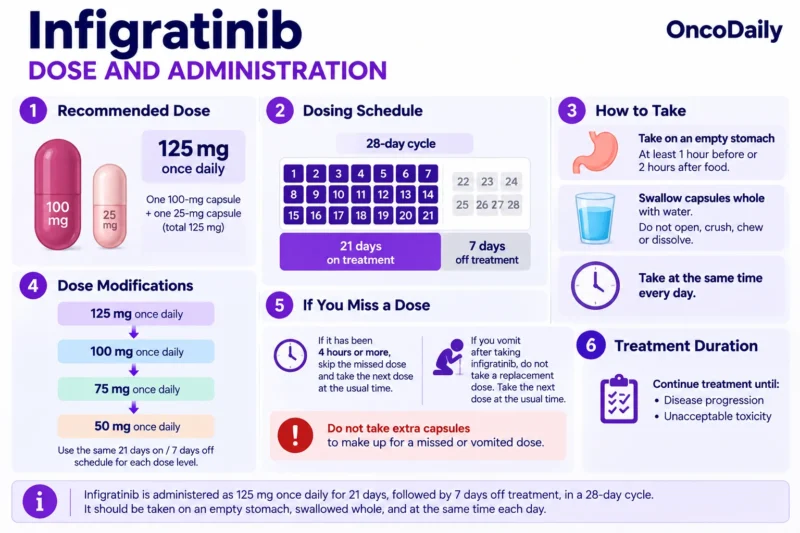
Under its former FDA-approved prescribing information, the recommended dose was:
125 mg orally once daily for 21 consecutive days
followed by:
7 days off treatment
in each:
28-day cycle.
The 125-mg dose consisted of:
- One 100-mg capsule
- One 25-mg capsule
Treatment continued until:
- Disease progression
- Unacceptable toxicity
This represents the historical FDA-approved regimen. Infigratinib is no longer FDA approved in the United States.
How Should Infigratinib Be Taken?
Infigratinib was administered:
- Once daily
- At approximately the same time each day
- On an empty stomach
Patients were instructed to take it:
At least 1 hour before or 2 hours after food.
Capsules should be swallowed whole with water.
Do not:
- Open
- Crush
- Chew
- Dissolve
the capsules.
Food substantially increases infigratinib exposure, making the fasting requirement clinically important.
Unlike pemigatinib and futibatinib, which may be taken with or without food, infigratinib required administration on an empty stomach.
What Should You Do If You Miss a Dose of Infigratinib?
If a dose was missed by:
4 hours or more
patients were instructed to skip that dose and resume the normal dosing schedule the following day.
If vomiting occurred after taking infigratinib:
- Do not replace the dose
- Resume with the next scheduled dose
Patients should not take extra capsules to compensate for a missed or vomited dose.
How Were Infigratinib Dose Reductions Managed?
The historical dose-reduction sequence was:
125 mg → 100 mg → 75 mg → 50 mg
using the same:
21 days on / 7 days off schedule.
First Dose Reduction
Reduce from:
125 mg to 100 mg once daily.
Second Dose Reduction
Reduce from:
100 mg to 75 mg once daily.
Third Dose Reduction
Reduce from:
75 mg to 50 mg once daily.
If the patient could not tolerate:
50 mg once daily
permanent discontinuation was recommended.
Hyperphosphatemia
Hyperphosphatemia is a characteristic on-target adverse effect of FGFR inhibition.
Serum Phosphate >5.5 to ≤7.5 mg/dL
- Continue infigratinib at the current dose.
- Initiate or adjust phosphate-binding therapy.
- Monitor serum phosphate weekly.
- Withhold phosphate binders during the scheduled 7-day treatment break and treatment interruptions for other adverse reactions.
Serum Phosphate >7.5 mg/dL
Or a single serum phosphate measurement:
>9 mg/dL
- Withhold infigratinib.
- Continue phosphate-lowering treatment.
- Monitor serum phosphate until it returns to ≤5.5 mg/dL.
If the elevation above 7.5 mg/dL persisted for fewer than 7 days, treatment could resume at the same dose.
If phosphate remained above 7.5 mg/dL for more than 7 days, or a single measurement exceeded 9 mg/dL, treatment resumed at the next lower dose.
Life-Threatening Hyperphosphatemia
For hyperphosphatemia causing life-threatening complications requiring urgent intervention:
Permanently discontinue infigratinib.
Retinal Pigment Epithelial Detachment
If RPED developed:
- Continue periodic ophthalmologic assessment.
- If the abnormality resolved within 14 days, continue treatment at the current dose.
- If it did not resolve within 14 days, withhold infigratinib until improvement.
- Resume at the previous or a reduced dose depending on the degree of recovery.
Other Toxicities
For Grade 3 adverse reactions:
- Withhold treatment until recovery to Grade 1 or baseline.
- Resume at the next lower dose.
- Permanently discontinue if recovery does not occur within 14 days.
For Grade 4 adverse reactions:
Permanently discontinue infigratinib.
What Drug Interactions Are Important With Infigratinib?
Infigratinib is predominantly metabolized through:
CYP3A4.
Its systemic exposure can also be affected by changes in gastric pH.
Strong or Moderate CYP3A Inhibitors
Concomitant administration should be avoided.
Examples include:
- Itraconazole
- Ketoconazole
- Clarithromycin
- Other clinically relevant CYP3A inhibitors
Itraconazole increased infigratinib:
- AUC by 622%
- Cmax by 164%
This interaction can markedly increase systemic drug exposure and potentially increase toxicity.
Strong or Moderate CYP3A Inducers
Strong or moderate CYP3A inducers should also be avoided.
Examples include:
- Rifampin
- Carbamazepine
- Phenytoin
- Phenobarbital
- St. John’s wort
Rifampin reduced infigratinib:
- AUC by 56%
- Cmax by 44%
These changes may decrease antitumor activity.
Gastric Acid-Reducing Agents
Unlike several other FGFR inhibitors, infigratinib has clinically significant interactions with medications that increase gastric pH.
Avoid when possible:
- Proton-pump inhibitors
- H2-receptor antagonists
- Antacids
Lansoprazole decreased infigratinib:
- AUC by approximately 45%
- Cmax by approximately 49%
If an H2-receptor antagonist could not be avoided, the former label recommended taking infigratinib:
At least 2 hours before or 10 hours after the H2-receptor antagonist.
For locally acting antacids:
Separate administration by at least 2 hours before or after infigratinib.
Proton-pump inhibitor coadministration should generally be avoided rather than managed by simple dose separation.
Did Infigratinib Require Dose Adjustment in Renal or Hepatic Impairment?
Renal Impairment
Unlike many other FGFR inhibitors, the historical infigratinib label required dose reduction even in mild renal impairment.
For creatinine clearance:
30–89 mL/min
the recommended dose was:
100 mg orally once daily for 21 days, followed by 7 days off.
For severe renal impairment:
CrCl <30 mL/min
or dialysis-dependent renal failure, a recommended dose was not established.
Hepatic Impairment
For mild hepatic impairment, the recommended dose was:
100 mg once daily
using the standard 21-days-on/7-days-off schedule.
For moderate hepatic impairment:
75 mg once daily
using the same schedule.
For severe hepatic impairment, an appropriate dose was not established.
These adjustments were important because renal and hepatic impairment could increase exposure to infigratinib and its active metabolites.
What Is the Pharmacokinetic Profile of Infigratinib?
Time to Peak Concentration
The median time to peak plasma concentration at steady state was approximately:
6 hours.
Half-Life
The terminal elimination half-life was approximately:
33.5 hours.
Protein Binding
Infigratinib is approximately:
96.8% protein bound.
Metabolism
Infigratinib is primarily metabolized by:
CYP3A4
with a smaller contribution from FMO3.
Its major active metabolites include:
- BHS697
- CQM157
These metabolites contribute to the overall pharmacologic activity of infigratinib.
Excretion
Following administration of radiolabeled infigratinib:
- Approximately 77% of recovered radioactivity was detected in feces.
- Approximately 7.2% was detected in urine.
Effect of Food
High-fat meals substantially increase infigratinib exposure.
Therefore, the drug required administration on an empty stomach.
Drug Accumulation
Steady-state concentrations were reached within approximately:
15 days.
Drug accumulation occurred with repeated daily administration.
What Were the Clinical Uses of Infigratinib?
Previously Treated FGFR2-Rearranged Cholangiocarcinoma
Infigratinib was previously FDA approved for adults with:
Previously treated, unresectable locally advanced or metastatic cholangiocarcinoma
harboring:
FGFR2 gene fusions or other rearrangements.
These molecular alterations were required to identify patients most likely to benefit from treatment.
Although the former FDA indication encompassed cholangiocarcinoma generally, FGFR2 rearrangements are predominantly associated with intrahepatic cholangiocarcinoma.
This indication is no longer FDA approved following the May 2024 withdrawal.
Other Investigational Uses
Infigratinib has also been investigated in other FGFR-altered conditions, including:
- Other FGFR-driven solid tumors
- FGFR3-associated skeletal disorders
These investigational applications should be distinguished from its withdrawn cholangiocarcinoma indication.
What Did the Pivotal Clinical Trial Show?
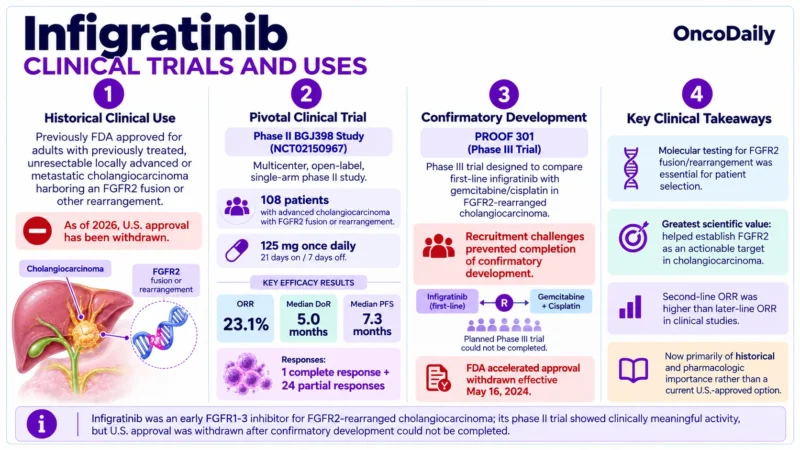
Phase II BGJ398 Study — NCT02150967
The pivotal phase II study evaluated infigratinib in patients with previously treated advanced cholangiocarcinoma harboring FGFR2 fusions or rearrangements.
The study was:
- Multicenter
- Open-label
- Single-arm
- Phase II
The mature efficacy analysis included:
108 patients.
Among them:
- 83 patients (77%) had FGFR2 fusions.
- Approximately 54% had received at least two previous systemic treatment lines.
Patients received:
125 mg orally once daily for 21 days, followed by 7 days off.
Objective Response Rate
23.1%
corresponding to:
25 of 108 patients.
Responses included:
- 1 complete response
- 24 partial responses
Median Duration of Response
5.0 months
Approximately 32% of responders maintained their response for at least 6 months.
Median Progression-Free Survival
7.3 months
Response by Treatment Line
Among patients receiving infigratinib in the second-line setting:
Objective response rate: 34%.
Among patients receiving treatment in the third-line or later setting:
Objective response rate: 13.8%.
These results demonstrated clinically meaningful antitumor activity in molecularly selected patients with FGFR2 fusion/rearrangement-positive cholangiocarcinoma.
However, the study was single-arm, and randomized confirmation of clinical benefit was not completed.
What Happened to the Phase III Confirmatory Trial?
PROOF 301
The phase III PROOF 301 study was designed to evaluate first-line infigratinib compared with gemcitabine/cisplatin in patients with advanced cholangiocarcinoma harboring FGFR2 fusions or rearrangements.
The objective was to provide randomized evidence of clinical benefit.
However, recruitment difficulties prevented successful completion of the required confirmatory development program.
The sponsor concluded that continued commercial distribution of infigratinib for its existing second-line indication was not commercially reasonable.
Consequently, the FDA approval was voluntarily withdrawn, effective:
May 16, 2024.
Importantly, this withdrawal does not invalidate the objective responses observed in the earlier phase II study.
However, it means that infigratinib should not be presented as a currently FDA-approved therapeutic option in 2026.
How Does Resistance to Infigratinib Develop?
Acquired resistance to reversible FGFR inhibitors represents a major challenge in FGFR2-driven cholangiocarcinoma.
Several resistance mechanisms have been identified.
Secondary FGFR2 Kinase-Domain Mutations
On-target mutations can alter the FGFR2 kinase domain and reduce the ability of reversible FGFR inhibitors to bind effectively.
Important resistance-associated alterations include mutations involving:
- FGFR2 N550
- FGFR2 V565
- Other kinase-domain residues
Polyclonal Resistance
Multiple FGFR2 resistance mutations may develop simultaneously in different tumor subclones.
Consequently, a single tumor may contain several distinct resistance mechanisms.
Bypass Signaling
Tumors may reactivate downstream signaling independently of FGFR2 through alternative molecular pathways.
Clinical Implications
Repeat molecular profiling, including circulating tumor DNA analysis, may help identify emerging resistance mechanisms.
The development of irreversible FGFR inhibitors, including futibatinib, provided a potential strategy for overcoming certain secondary FGFR2 mutations.
However, irreversible inhibitors also have resistance profiles, and no single FGFR inhibitor is effective against every secondary resistance mutation.
Does Infigratinib Have CNS Activity?
Infigratinib has demonstrated measurable brain exposure in preclinical studies.
In rats, the brain-to-plasma exposure ratio was approximately:
0.68.
However, this observation does not establish clinically meaningful intracranial efficacy in patients with brain metastases.
The pivotal cholangiocarcinoma study was not designed to establish CNS activity.
Therefore, infigratinib should not be considered an established CNS-directed treatment.
Is Infigratinib FDA Approved?
No.
Infigratinib previously received FDA accelerated approval but is no longer approved in the United States.
May 28, 2021 — Accelerated Approval
The FDA granted accelerated approval for previously treated advanced cholangiocarcinoma harboring FGFR2 fusions or other rearrangements.
Confirmatory Development
A phase III confirmatory development program was initiated to establish clinical benefit.
However, difficulties recruiting patients prevented successful completion of the required study.
May 16, 2024 — Approval Withdrawal
The FDA formally withdrew infigratinib’s approval following the sponsor’s voluntary request.
As of October 2026, infigratinib is not an FDA-approved oncology treatment in the United States.
What Is the Current Clinical Role of Infigratinib in 2026?
Infigratinib remains scientifically relevant as one of the early FGFR-targeted precision therapies developed for cholangiocarcinoma.
Its development helped establish several important principles:
- FGFR2 fusions and rearrangements are actionable oncogenic drivers in cholangiocarcinoma.
- Molecular testing can identify patients more likely to benefit from FGFR-directed therapy.
- Reversible FGFR inhibition can produce clinically meaningful responses in previously treated advanced cholangiocarcinoma.
- Secondary FGFR2 kinase-domain mutations are important mechanisms of acquired resistance.
- New generations of FGFR inhibitors may overcome certain resistance mechanisms.
However, because its FDA approval was withdrawn, infigratinib should now be discussed primarily within a:
historical, pharmacologic, and investigational context.
Current FGFR-directed approaches include other agents, such as pemigatinib and futibatinib, which have different pharmacologic properties, dosing schedules, and toxicity profiles.
The infigratinib experience also highlights the importance of confirmatory randomized trials following accelerated approval.
Read more: For further developments in molecularly targeted therapies for cholangiocarcinoma, explore OncoDaily’s Hepatobiliary Cancer Coverage.
Watch more: Infigratinib (BGJ398) and FGFR2-Targeted Therapy in Cholangiocarcinoma.
What Are the Major Side Effects of Infigratinib
Hyperphosphatemia
Hyperphosphatemia was the defining on-target metabolic toxicity of infigratinib.
Across 351 patients receiving infigratinib in clinical trials, laboratory-defined hyperphosphatemia occurred in approximately:
82%.
Median time to onset was approximately:
8 days.
Approximately 83% of patients received phosphate-binding therapy.
Potential complications of clinically significant or prolonged hyperphosphatemia include:
- Soft-tissue mineralization
- Cutaneous calcinosis
- Vascular calcification
- Non-uremic calciphylaxis
- Myocardial calcification
Management includes:
- Serum phosphate monitoring
- Dietary phosphate restriction
- Phosphate-binding therapy
- Treatment interruption
- Dose reduction when indicated
Ocular Toxicity
Infigratinib can cause:
Retinal pigment epithelial detachment (RPED)
and related central serous retinopathy-like abnormalities.
Across clinical studies, RPED occurred in approximately:
11%
of patients.
Median time to onset was:
26 days.
Symptoms may include:
- Blurred vision
- Reduced visual acuity
- Floaters
- Other visual disturbances
Some retinal abnormalities may be asymptomatic and identified only during routine ophthalmologic examination.
Dry Eye
Dry eye occurred in approximately:
29%
of patients in the pooled clinical-trial safety population.
Management may include:
- Artificial tears
- Ocular lubricants
- Additional ophthalmologic assessment when appropriate
Gastrointestinal Toxicity
Common gastrointestinal adverse effects include:
- Stomatitis
- Constipation
- Diarrhea
- Abdominal pain
- Dry mouth
- Nausea
- Vomiting
- Reduced appetite
In the pivotal phase II study:
Stomatitis occurred in approximately 55% of patients.
Skin, Hair, and Nail Toxicity
FGFR inhibition commonly produces mucocutaneous adverse reactions.
These include:
- Nail dystrophy
- Onycholysis
- Nail discoloration
- Alopecia
- Dry skin
- Palmar-plantar erythrodysesthesia syndrome
- Eyelash changes
Fatigue
Fatigue was reported in approximately:
40%
of patients in the pivotal phase II study.
Laboratory Abnormalities
Important laboratory abnormalities include:
- Increased serum phosphate
- Increased creatinine
- Increased alkaline phosphatase
- Increased ALT and AST
- Increased lipase
- Increased calcium
- Decreased hemoglobin
- Decreased lymphocyte count
- Hyponatremia
- Thrombocytopenia
- Hypokalemia
These findings reflect both the effects of FGFR inhibition and the underlying clinical complexity of patients with advanced biliary tract cancer.
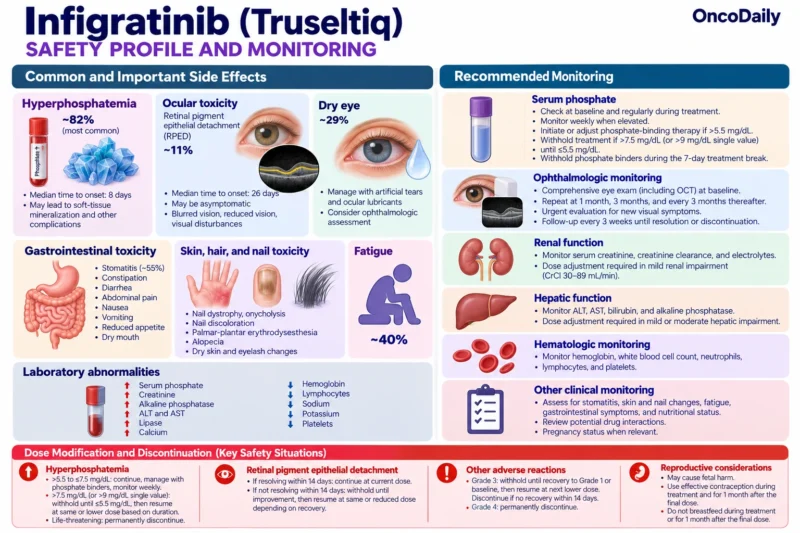
What Monitoring Was Required During Infigratinib Treatment?
Serum Phosphate
Monitor serum phosphate:
- At baseline
- Regularly throughout treatment
- Weekly when elevated
Phosphate-lowering therapy was recommended when serum phosphate exceeded:
5.5 mg/dL.
Treatment interruption was required for more severe elevations, particularly:
>7.5 mg/dL.
Phosphate binders were generally withheld during scheduled treatment breaks.
Ophthalmologic Monitoring
Perform a comprehensive ophthalmologic examination, including:
Optical coherence tomography (OCT)
- Before treatment
- At 1 month
- At 3 months
- Every 3 months thereafter
If new visual symptoms developed:
- Arrange urgent ophthalmologic evaluation.
- Repeat assessment approximately every 3 weeks until resolution or treatment discontinuation.
Renal Function
Monitor:
- Serum creatinine
- Creatinine clearance
- Electrolytes
Renal function was particularly important because even mild renal impairment required a lower starting dose under the historical prescribing information.
Hepatic Function
Monitor:
- ALT
- AST
- Bilirubin
- Alkaline phosphatase
Patients with hepatic impairment required label-directed dose adjustments.
Hematologic Monitoring
Monitor:
- Hemoglobin
- White blood cell count
- Neutrophils
- Lymphocytes
- Platelets
Other Clinical Monitoring
Also assess:
- Stomatitis and oral mucosal changes
- Nail toxicity
- Skin changes
- Fatigue
- Gastrointestinal symptoms
- Nutritional status
- Drug interactions
- Pregnancy status when relevant
Reproductive Considerations
Infigratinib may cause fetal harm.
Under its historical U.S. label, effective contraception was recommended during treatment and for:
1 month after the final dose
for patients of reproductive potential, as applicable.
Breastfeeding was not recommended during treatment or for:
1 month after the final dose.