


Glofitamab (Columvi): Mechanism of Action, Dosing, Clinical Uses, Trials, and Side Effects
Key takeaways
- Glofitamab is a 2:1 CD20×CD3 bispecific T-cell-engaging antibody.
- It recruits cytotoxic T cells to destroy CD20-positive lymphoma cells.
- It received initial FDA approval in June 2023.
- It requires obinutuzumab pretreatment.
- Its step-up dosing is 2.5 mg → 10 mg → 30 mg.
- Treatment consists of a maximum of 12 cycles.
- The FDA regulatory analysis showed an ORR of 56% and CR rate of 43%.
- The phase III STARGLO trial demonstrated significantly improved overall and progression-free survival with Glofit-GemOx versus R-GemOx.
- The major boxed-warning toxicity is CRS.
- Serious neurological toxicity, infections, cytopenias, HLH, and tumor flare require monitoring.
- Glofitamab provides a fixed-duration, off-the-shelf immunotherapy option in relapsed/refractory large B-cell lymphoma.
Glofitamab-gxbm (Columvi) is a CD20×CD3 bispecific T-cell-engaging antibody used to treat selected patients with relapsed or refractory large B-cell lymphoma (LBCL). It simultaneously binds CD20 on malignant B lymphocytes and CD3 on T lymphocytes, bringing the two cells into close contact and triggering T-cell-mediated tumor destruction.
Unlike conventional anti-CD20 monoclonal antibodies such as rituximab and obinutuzumab, glofitamab directly recruits cytotoxic T cells. Unlike antibody–drug conjugates, it does not carry a chemotherapy payload.
Glofitamab has a distinctive 2:1 antibody configuration, with two CD20-binding domains and one CD3-binding domain. Its treatment strategy also differs from other bispecific antibodies because it requires obinutuzumab pretreatment, followed by step-up dosing and a fixed maximum of 12 treatment cycles.
The FDA initially approved glofitamab on June 15, 2023, for adults with relapsed or refractory diffuse large B-cell lymphoma (DLBCL), not otherwise specified, or LBCL arising from follicular lymphoma after at least two previous systemic therapies.
Major clinical studies include NP30179 and the phase III STARGLO trial. The latter demonstrated significantly improved survival with glofitamab plus gemcitabine and oxaliplatin compared with rituximab plus gemcitabine and oxaliplatin in transplant-ineligible relapsed/refractory DLBCL. However, this combination is not included in the U.S. prescribing information revised June 2026.
Key Facts
- Generic name: Glofitamab-gxbm
- Brand name: Columvi
- Drug class: Bispecific T-cell-engaging monoclonal antibody
- Targets: CD20 and CD3
- Antibody format: Humanized IgG1-based, 2:1 CD20×CD3 bispecific antibody
- Mechanism: T-cell recruitment, immunological synapse formation, cytotoxic T-cell activation, lymphoma-cell apoptosis
- Initial FDA approval: June 15, 2023
- Administration: Intravenous infusion
- Required pretreatment: Obinutuzumab 1,000 mg IV
- Step-up doses: 2.5 mg and 10 mg
- Full treatment dose: 30 mg
- Cycle duration: 21 days
- Treatment duration: Maximum 12 cycles
- FDA indication: Selected relapsed/refractory DLBCL or LBCL after at least two systemic treatment lines
- Pivotal trial: NP30179
- Major randomized trial: STARGLO
- Tumor target: CD20
- Boxed warning: Cytokine release syndrome (CRS)
- Other serious risks: ICANS and other neurological toxicity, serious infections, tumor flare, HLH, and PML
- Monitoring: Vital signs, neurological status, CBC, infection surveillance, liver function, and tumor response
- Elimination half-life: Approximately 7.6 days at steady state
- Available vial strengths: 2.5 mg and 10 mg
What Is Glofitamab?
Glofitamab is a recombinant humanized bispecific monoclonal antibody engineered to recognize two different antigens.
CD20 is expressed on mature normal and malignant B cells, including most DLBCL cells.
CD3 forms part of the T-cell receptor complex and is expressed on T lymphocytes.
Glofitamab connects these cells and stimulates cytotoxic T-cell activity against CD20-positive malignant cells.
Unlike epcoritamab, which is administered subcutaneously, glofitamab is administered intravenously.
Unlike mosunetuzumab, which has a conventional 1:1 bispecific antibody format, glofitamab has two CD20-binding domains and one CD3-binding domain.
This structural difference contributes to its distinctive binding characteristics.
What Is the Mechanism of Action of Glofitamab?
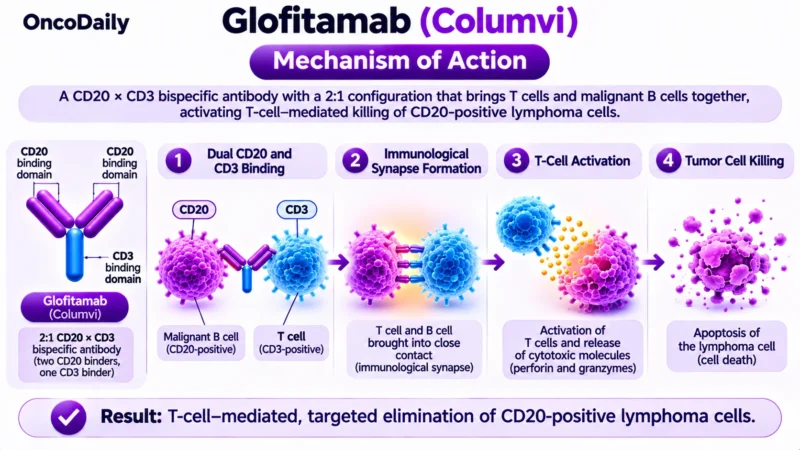
1. CD20 Recognition
Glofitamab binds CD20 on the surface of malignant B lymphocytes.
Its two CD20-binding domains provide bivalent recognition of the tumor-associated antigen.
2. CD3 Binding
The third binding domain recognizes CD3 on T lymphocytes.
This allows glofitamab to recruit T cells toward CD20-positive lymphoma cells.
3. Immunological Synapse Formation
Simultaneous engagement of CD20 and CD3 brings the malignant B cell and T cell into close contact.
An immunological synapse forms, activating T-cell signaling pathways.
4. T-Cell Activation
Activated T lymphocytes release:
- Perforin
- Granzymes
These cytotoxic molecules initiate programmed cell death in the malignant B cell.
5. Serial Tumor-Cell Killing
Activated T cells may subsequently engage additional CD20-positive lymphoma cells.
This enables repeated T-cell-mediated cytotoxicity.
6. Cytokine Release
T-cell activation also stimulates inflammatory cytokine production, including IL-6, IL-2, interferon-gamma, and TNF-alpha.
Excessive cytokine release can produce CRS, the drug’s principal boxed-warning toxicity.
Overall mechanism:
Glofitamab → bivalent CD20 binding + CD3 binding → immunological synapse → T-cell activation → perforin/granzyme release → lymphoma-cell apoptosis.
Why Is Obinutuzumab Given Before Glofitamab?
One of glofitamab’s most distinctive features is mandatory pretreatment with obinutuzumab, a CD20-directed monoclonal antibody.
Obinutuzumab reduces the circulating and tissue B-cell burden before glofitamab begins engaging T cells.
This helps mitigate the severity of cytokine release syndrome.
The FDA-approved regimen requires obinutuzumab 1,000 mg IV seven days before the first glofitamab infusion.
This pretreatment is part of the approved schedule and should not be omitted.
What Is the Recommended Dose of Glofitamab?
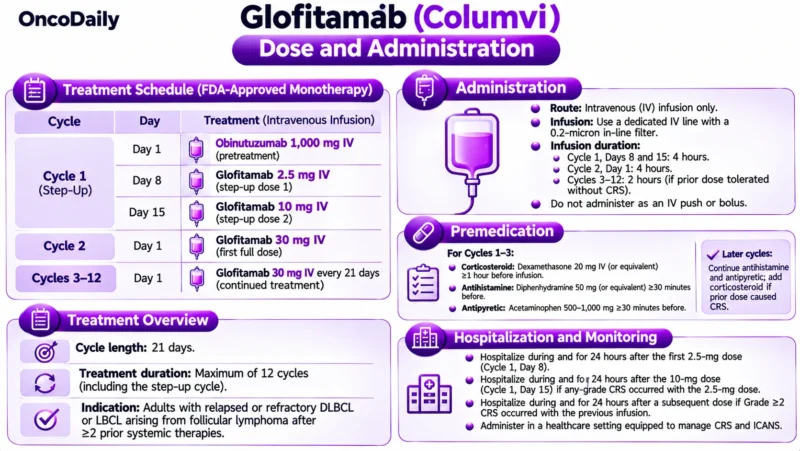
All doses are administered intravenously in 21-day cycles.
Cycle 1: Pretreatment and Step-Up Dosing
- Day 1: Obinutuzumab 1,000 mg IV
- Day 8: Glofitamab 2.5 mg IV
- Day 15: Glofitamab 10 mg IV
Cycle 2: Full Treatment Dose
– Day 1: Glofitamab 30 mg IV
Cycles 3–12: Continued Treatment
– Day 1 of each cycle: Glofitamab 30 mg IV every 21 days
FDA-labeled monotherapy schedule, June 2026.
Treatment continues for a maximum of 12 cycles, including the initial step-up cycle, or until disease progression or unacceptable toxicity.
This fixed-duration approach is an important distinction from bispecific antibodies administered continuously until progression.
How Should Glofitamab Be Administered?
Intravenous Infusion
Glofitamab is administered through a dedicated intravenous infusion line containing a sterile 0.2-micron in-line filter.
It must not be administered as an IV push or bolus.
Infusion Duration
- Cycle 1, Days 8 and 15: Four-hour infusions.
- Cycle 2, Day 1: Four-hour infusion.
- Cycles 3–12: Two-hour infusions if the previous dose was tolerated without CRS.
The infusion duration may need to be prolonged when CRS has occurred.
Premedication
For Cycles 1–3, patients receive:
Corticosteroid
Dexamethasone 20 mg IV, completed at least one hour before infusion.
Alternatives include prednisone 100 mg, prednisolone 100 mg, or methylprednisolone 80 mg IV.
Antihistamine
Diphenhydramine 50 mg orally or intravenously, or equivalent, at least 30 minutes before infusion.
Antipyretic
Acetaminophen 500–1,000 mg orally, at least 30 minutes before infusion.
During subsequent cycles, antihistamine and acetaminophen premedication continue; corticosteroid premedication is additionally required if the preceding dose caused CRS.
Hospitalization
Hospitalization is recommended:
- During and for 24 hours after completion of the first 2.5-mg dose.
- During and for 24 hours after the 10-mg dose if any-grade CRS occurred with the preceding 2.5-mg dose.
- During and for 24 hours after a subsequent dose if Grade 2 or higher CRS occurred with the previous infusion.
All infusions must occur in a healthcare setting equipped to manage severe CRS.
What Should You Do If a Glofitamab Dose Is Missed?
If a dose is delayed:
- Assess the interval since the previous dose.
- Identify the last administered dose.
- Follow the FDA label’s restart algorithm.
- Repeat the step-up schedule and obinutuzumab pretreatment when indicated.
- Do not double the subsequent dose.
For example, after a 30-mg dose, an interval of more than six weeks generally requires repeating obinutuzumab pretreatment and the 2.5-mg and 10-mg step-up doses before resuming 30 mg.
How Are Glofitamab Dose Modifications Managed?
Routine dose reductions are not recommended.
Toxicities are managed through treatment interruption, supportive care, restarting according to the label, or permanent discontinuation.
CRS
- Grade 1–2: Withhold treatment, provide supportive care, and resume after resolution according to the prescribing information.
- Grade 3: Withhold treatment and manage in an appropriate monitored setting; recurrent Grade 3 CRS requires permanent discontinuation.
- Grade 4: Permanently discontinue glofitamab.
CRS management may include corticosteroids and tocilizumab according to established clinical guidelines.
ICANS and Neurological Toxicity
Interrupt treatment and evaluate neurological symptoms immediately.
Severe or persistent neurological toxicity may require permanent discontinuation.
Serious Infections
Withhold treatment during serious active infection until adequate recovery.
Tumor Flare
Assess tumor-related swelling, airway compromise, obstruction, or symptoms caused by local inflammation.
Severe tumor flare may require treatment interruption and specialist intervention.
What Drug Interactions Are Important With Glofitamab?
CYP450-Metabolized Medications
Glofitamab is not primarily metabolized through CYP450 enzymes.
However, cytokine release can transiently suppress CYP450 activity and increase exposure to certain medications.
This is particularly relevant to drugs with narrow therapeutic indices.
Immunosuppressive Agents
Concomitant immunosuppression may increase infection risk.
Live Vaccines
Live-virus vaccines should generally be avoided during clinically significant treatment-related immunosuppression.
Other Antilymphoma Treatments
Investigational combinations may increase the risk of:
- Cytopenias
- Infections
- CRS
- Hepatotoxicity
- Organ dysfunction
Does Glofitamab Require Dose Adjustment in Renal or Hepatic Impairment?
Renal Impairment
No standard dose adjustment is required for mild or moderate renal impairment.
Data are limited in severe renal impairment and end-stage renal disease.
Hepatic Impairment
No standard adjustment is required for mild hepatic impairment.
The pharmacokinetics and safety in moderate or severe hepatic impairment remain insufficiently characterized.
What Is the Pharmacokinetic Profile of Glofitamab?
Molecular Structure
Glofitamab is a full-length IgG1-based bispecific antibody with an approximate molecular weight of 197 kDa.
Distribution
Estimated volume of distribution:
5.6 L
Elimination Half-Life
Approximately:
7.6 days at steady state
Clearance
Estimated steady-state clearance:
0.617 L/day
Metabolism
Glofitamab undergoes proteolytic catabolism into small peptides and amino acids.
Steady-state exposure is approached around Cycle 6.
What Are the Clinical Uses of Glofitamab?
Relapsed or Refractory DLBCL
Glofitamab is FDA approved for adults with DLBCL, not otherwise specified, after two or more lines of systemic therapy.
It provides an off-the-shelf bispecific immunotherapy option for patients with heavily pretreated disease.
Large B-Cell Lymphoma Arising From Follicular Lymphoma
Glofitamab is also approved for LBCL arising from follicular lymphoma after at least two prior systemic therapies.
This includes patients whose previously indolent follicular lymphoma has transformed into aggressive large B-cell lymphoma.
Treatment After CAR-T Therapy
Glofitamab has demonstrated activity in patients previously treated with CD19-directed CAR-T therapy.
Because its target is CD20 rather than CD19, it represents a different immunotherapeutic approach.
However, outcomes depend on previous therapy, disease biology, performance status, and available alternatives.
Glofitamab With Gemcitabine and Oxaliplatin
The phase III STARGLO trial demonstrated improved survival with glofitamab plus gemcitabine and oxaliplatin (Glofit-GemOx) compared with rituximab plus gemcitabine and oxaliplatin (R-GemOx).
The trial enrolled patients with relapsed/refractory DLBCL who were ineligible for autologous stem cell transplantation.
Important regulatory distinction: The positive STARGLO results should not be interpreted as U.S. FDA approval of Glofit-GemOx. The June 2026 U.S. label continues to specify the later-line glofitamab monotherapy indication.
Other B-Cell Lymphomas
Glofitamab is being investigated in earlier-line DLBCL and additional B-cell lymphoma settings.
These applications remain distinct from the approved U.S. indication.
What Biomarker Testing Is Required Before Glofitamab?
CD20 Expression
CD20 is the principal tumor-cell target.
Confirm lymphoma histology and assess CD20 expression by immunohistochemistry or appropriate flow cytometry.
DLBCL Diagnostic Assessment
Relevant studies include:
- CD20
- CD19
- CD10
- BCL2
- BCL6
- Ki-67
- MYC, BCL2, and BCL6 rearrangements when indicated
These investigations help classify the lymphoma and inform treatment selection.
Prior Treatment Assessment
Review previous exposure to:
- Rituximab or obinutuzumab
- Anthracycline-containing chemotherapy
- CAR-T-cell therapy
- Other bispecific antibodies
- Stem cell transplantation
Baseline Clinical Evaluation
Assess CBC, renal and hepatic function, infection status, performance status, tumor burden, and neurological history.
What Did the Pivotal Clinical Trials Show?
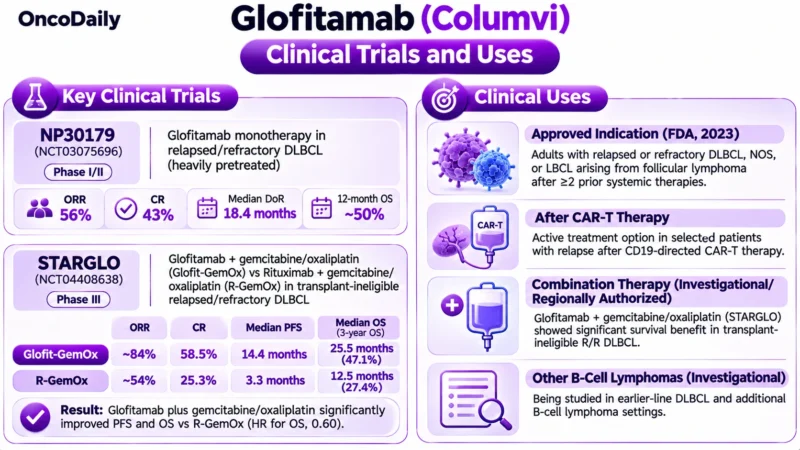
NP30179 — Glofitamab Monotherapy in Relapsed/Refractory DLBCL
NP30179 (NCT03075696) was a multicenter phase I/II study evaluating glofitamab in heavily pretreated B-cell lymphomas.
The original phase II DLBCL analysis included 155 patients who received the recommended treatment regimen.
Overall Response Rate
52%
Complete Response Rate
39%
Median Progression-Free Survival
4.9 months
Estimated 12-Month Overall Survival
50%
Complete responses were also observed among patients previously exposed to CAR-T therapy.
In that subgroup, the complete response rate was approximately 35%.
These results established glofitamab’s meaningful single-agent activity in relapsed/refractory DLBCL.
NP30179 — FDA Regulatory Efficacy Population
The U.S. approval analysis focused on 132 patients with DLBCL, NOS, or LBCL arising from follicular lymphoma.
Overall Response Rate
56%
Complete Response Rate
43%
Median Duration of Response
18.4 months
Estimated Response Durability at Nine Months
68.5%
These figures differ slightly from the original published 155-patient analysis because of differences in eligibility, population, and assessment dates.
The results supported the June 2023 accelerated FDA approval.
STARGLO — Glofitamab Plus Gemcitabine and Oxaliplatin
STARGLO (NCT04408638) is a randomized phase III trial comparing:
- Glofitamab + gemcitabine + oxaliplatin
- Rituximab + gemcitabine + oxaliplatin
The study randomized 274 patients with relapsed or refractory DLBCL who were not candidates for autologous stem cell transplantation.
The updated three-year follow-up was reported in 2026.
Updated Median Overall Survival
- Glofit-GemOx: 25.5 months
- R-GemOx: 12.5 months
HR: 0.60
Updated Median Progression-Free Survival
- Glofit-GemOx: 14.4 months
- R-GemOx: 3.3 months
HR: 0.41
Complete Response Rate
- Glofit-GemOx: 58.5%
- R-GemOx: 25.3%
Three-Year Overall Survival
- Glofit-GemOx: 47.1%
- R-GemOx: 27.4%
The longer follow-up continued to show a clinically meaningful survival advantage without new safety signals.
The trial supports an important potential role for glofitamab-containing combination therapy, particularly in patients who are ineligible for transplantation.
Read More: Graham Collins: STARGLO – A Practice-Changing Study by OncDaily.
Watch More: Glofit-GemOx Shows Clinically Meaningful Benefit in Relapsed/Refractory DLBCL.
Does Glofitamab Have CNS Activity?
Glofitamab is not an established CNS-directed lymphoma treatment.
Its large antibody structure limits penetration across an intact blood–brain barrier.
Patients with active or prior CNS lymphoma were excluded from the pivotal U.S. regulatory trial.
Small clinical studies and case reports have investigated glofitamab in CNS-involved lymphoma, but evidence remains insufficient to establish it as a standard standalone treatment.
Is Glofitamab FDA Approved?
Yes.
Glofitamab received accelerated FDA approval on June 15, 2023.
Its approved U.S. indication is treatment of adults with:
- Relapsed/refractory DLBCL, NOS
- Relapsed/refractory LBCL arising from follicular lymphoma
after two or more systemic treatment lines.
The indication remains subject to the accelerated approval framework, with continued approval potentially dependent on confirmation of clinical benefit.
What Is the Current Clinical Role of Glofitamab in 2026?
Third-Line or Later DLBCL
Glofitamab remains an important bispecific immunotherapy option in heavily pretreated disease.
After CAR-T Therapy
It can be considered in selected patients with relapse following CD19-directed CAR-T treatment, provided the disease and patient circumstances support its use.
Fixed-Duration Immunotherapy
Unlike epcoritamab, which may continue until progression, glofitamab has a maximum planned treatment duration of 12 cycles.
This provides the possibility of a defined treatment-free period after completion.
Earlier-Line Combination Treatment
The STARGLO trial demonstrated that glofitamab combined with chemotherapy can improve survival in transplant-ineligible relapsed/refractory DLBCL.
Its availability within a specific treatment line depends on regional regulatory approvals, guidelines, and local practice.
Relationship to Other CD20×CD3 Bispecific Antibodies
Glofitamab, epcoritamab, and mosunetuzumab share the ability to redirect T cells toward CD20-positive lymphoma cells.
However, they differ in antibody structure, route of administration, pretreatment requirements, dosing schedules, and approved indications.
What Are the Major Side Effects of Glofitamab?
Cytokine Release Syndrome
CRS is glofitamab’s FDA boxed-warning toxicity.
It results from inflammatory cytokine release following T-cell activation.
Symptoms include:
- Fever
- Tachycardia
- Hypotension
- Chills
- Hypoxia
- Dyspnea
- Organ dysfunction
In the FDA safety population of 145 patients:
- Any-grade CRS: 70%
- Grade 1: 52%
- Grade 2: 14%
- Grade 3: 2.8%
- Grade 4: 1.4%
Most events occurred during early step-up dosing.
Severe and fatal cases can occur, making pretreatment, step-up dosing, and appropriate hospitalization essential.
Neurological Toxicity and ICANS
Glofitamab may cause neurological adverse events, including ICANS.
Symptoms include confusion, tremor, aphasia, cognitive changes, encephalopathy, and seizures.
Severe neurological symptoms require immediate assessment.
Serious Infections
Potential complications include:
- Pneumonia
- Sepsis
- Herpesvirus infections
- Opportunistic infections
- Progressive multifocal leukoencephalopathy
PML has been reported in clinical experience with glofitamab.
Cytopenias
Important laboratory abnormalities include:
- Lymphopenia
- Neutropenia
- Anemia
- Thrombocytopenia
In the FDA safety population, Grade 3–4 laboratory neutrophil decreases occurred in approximately 26% of patients.
Hypofibrinogenemia
Reduced fibrinogen levels may occur.
Grade 3–4 fibrinogen decreases were reported in approximately 21% of the safety population.
Tumor Flare
Tumor flare may cause painful swelling or enlargement of lymphoma lesions.
In anatomically sensitive locations, inflammatory swelling can produce obstruction, pain, or compression of nearby structures.
Hemophagocytic Lymphohistiocytosis
HLH is a potentially life-threatening hyperinflammatory syndrome reported with glofitamab.
It may present with persistent fever, cytopenias, elevated ferritin, liver dysfunction, and multiorgan complications.
Tumor Lysis Syndrome
Patients with substantial tumor burden may develop tumor lysis syndrome.
Possible complications include hyperuricemia, electrolyte abnormalities, and acute kidney injury.
Other Common Adverse Reactions
- Musculoskeletal pain
- Rash
- Fatigue
- Fever
- Nausea
- Diarrhea
- Constipation
Embryo-Fetal Toxicity
Glofitamab may cause fetal harm.
Females of reproductive potential should use effective contraception during treatment and for one month after the last dose.
Breastfeeding is not recommended during treatment and for one month afterward.
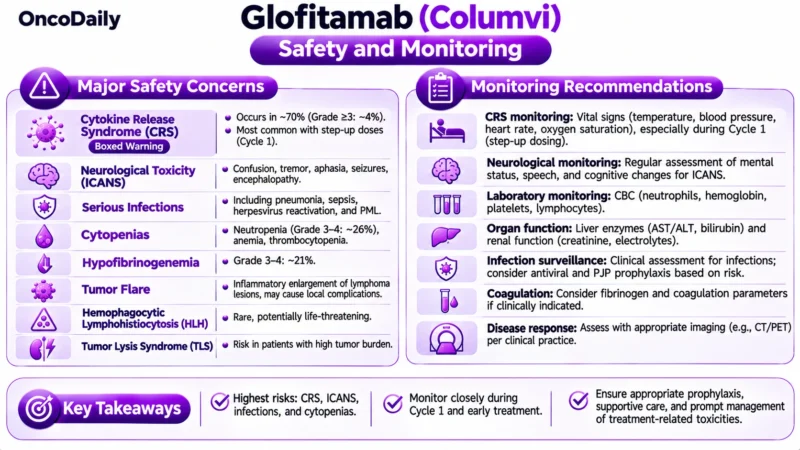
What Monitoring Is Required During Glofitamab Treatment?
CRS Monitoring
Assess temperature, blood pressure, heart rate, oxygen saturation, and respiratory symptoms.
Monitoring is particularly important during Cycle 1 and after the first full 30-mg dose.
Neurological Monitoring
Assess mental status, speech, orientation, tremor, and seizure symptoms.
Promptly evaluate unexplained neurological deterioration, including the possibility of ICANS or PML.
Complete Blood Count
Monitor neutrophils, hemoglobin, platelets, and lymphocyte counts.
Infection Surveillance
Evaluate for fever, respiratory symptoms, and opportunistic infections.
Consider antiviral prophylaxis and PJP or CMV prophylaxis according to individual risk and institutional protocols.
Liver and Renal Function
Monitor AST, ALT, bilirubin, creatinine, and electrolytes according to clinical circumstances.
Fibrinogen and Coagulation
Consider monitoring fibrinogen and coagulation parameters when clinically indicated, particularly with significant inflammatory toxicity.
Tumor Lysis Monitoring
For high-risk patients, evaluate potassium, phosphate, calcium, uric acid, creatinine, and LDH.
Tumor Response
Assess lymphoma response using appropriate imaging and clinical criteria.
Reproductive Monitoring
Verify pregnancy status when appropriate and provide contraception counseling.