


Futibatinib (Lytgobi): Understanding Its Mechanism, Dosing, Clinical Uses, and Role in FGFR2-Rearranged Intrahepatic Cholangiocarcinoma
Key takeaways
- Futibatinib is an oral irreversible FGFR1–4 inhibitor.
- Its defining characteristic is covalent binding to FGFR.
- It is FDA approved for previously treated FGFR2 fusion/rearrangement-positive unresectable, locally advanced or metastatic intrahepatic cholangiocarcinoma.
- The standard dose is 20 mg orally once daily continuously.
- Dose reductions are 20 mg → 16 mg → 12 mg.
- FOENIX-CCA2 demonstrated an ORR of 42% and median DoR of 9.7 months.
- Peer-reviewed follow-up reported median PFS of 9.0 months and OS of 21.7 months.
- Hyperphosphatemia is the defining on-target toxicity and requires proactive monitoring and treatment.
- RPED and other ocular toxicities require scheduled ophthalmologic monitoring with OCT.
- Futibatinib's covalent mechanism may preserve activity against some secondary FGFR2 resistance mutations.
- Emerging 2026 evidence suggests activity after progression on non-covalent FGFR inhibitors, although these data remain retrospective.
- Futibatinib remains under FDA accelerated approval as of October 2026.
- Molecular testing is essential before therapy.
Futibatinib (Lytgobi) is an oral, selective, irreversible FGFR1–4 tyrosine kinase inhibitor approved for adults with previously treated, unresectable, locally advanced or metastatic intrahepatic cholangiocarcinoma (iCCA) harboring an FGFR2 gene fusion or other rearrangement. Its distinguishing pharmacologic feature is covalent binding to FGFR, which may allow inhibition of some secondary FGFR2 resistance mutations that emerge during treatment with reversible FGFR inhibitors.
The current U.S. prescribing information was revised in October 2025, and the approved dose remains 20 mg orally once daily continuously until disease progression or unacceptable toxicity.
Key Facts
- Generic name: Futibatinib
- Brand name: Lytgobi
- Drug class: Irreversible FGFR tyrosine kinase inhibitor
- Targets: FGFR1, FGFR2, FGFR3, FGFR4
- Key disease target: FGFR2 fusion/rearrangement
- Route: Oral
- Initial U.S. approval: 2022
- Standard dose: 20 mg once daily
- Tablet strengths: 4 mg and 16 mg
- Schedule: Continuous daily dosing
- Food: With or without food
- Dose reductions: 20 mg → 16 mg → 12 mg
- Characteristic toxicity: Hyperphosphatemia
- Major ocular toxicity: Retinal pigment epithelial detachment
- Other frequent toxicities: Nail toxicity, musculoskeletal pain, diarrhea, constipation, stomatitis, fatigue, alopecia and dry skin
- Major metabolic pathway: CYP3A
- Important interactions: Strong CYP3A inhibitors and strong CYP3A inducers should be avoided.
What Is Futibatinib?
Futibatinib is a small-molecule kinase inhibitor targeting:
- FGFR1
- FGFR2
- FGFR3
- FGFR4
with biochemical IC50 values below 4 nM.
FGFR signaling regulates several fundamental cellular processes, including:
- Cell proliferation
- Cell survival
- Differentiation
- Angiogenesis
- Tissue development
Genomic alterations involving FGFR genes can cause persistent receptor signaling and oncogenic growth.
In intrahepatic cholangiocarcinoma, the most clinically important alterations are:
FGFR2 gene fusions and other FGFR2 rearrangements.
These alterations can maintain constitutive FGFR2 signaling and promote tumor survival.
Futibatinib is unusual among clinically established FGFR inhibitors because it covalently binds the FGFR kinase domain, resulting in irreversible inhibition.
What Is the Mechanism of Action of Futibatinib?
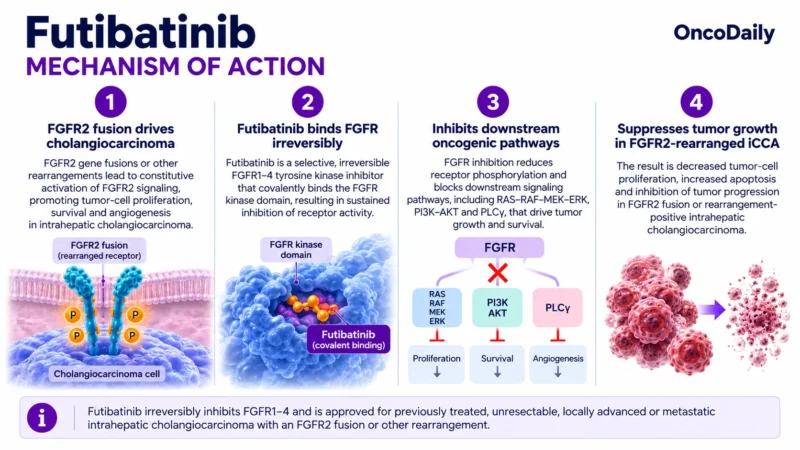
1. FGFR2 Rearrangements Produce Persistent Signaling
In a subset of intrahepatic cholangiocarcinomas, an:
FGFR2 fusion or rearrangement
results in constitutive activation of FGFR2 signaling.
2. FGFR Signaling Activates Oncogenic Pathways
Activated FGFR can stimulate downstream signaling through pathways including:
- RAS–RAF–MEK–ERK
- PI3K–AKT
- PLCγ
- STAT-associated pathways
These pathways promote:
- Tumor-cell proliferation
- Survival
- Resistance to apoptosis
- Tumor progression
3. Futibatinib Covalently Binds FGFR1–4
Futibatinib interacts covalently with FGFR receptors.
Unlike reversible inhibitors, covalent binding produces irreversible kinase inhibition.
4. FGFR Phosphorylation and Signaling Decline
FGFR inhibition reduces:
- Receptor phosphorylation
- Downstream MAPK signaling
- PI3K/AKT pathway activation
5. Tumor-Cell Growth Is Suppressed
Overall:
Futibatinib → irreversible FGFR1–4 inhibition → ↓ FGFR phosphorylation → ↓ downstream MAPK/PI3K signaling → ↓ tumor-cell proliferation and survival
The irreversible mechanism may also provide activity against some secondary FGFR2 resistance mutations that emerge during treatment with reversible FGFR inhibitors.
What Is the Recommended Dose of Futibatinib?
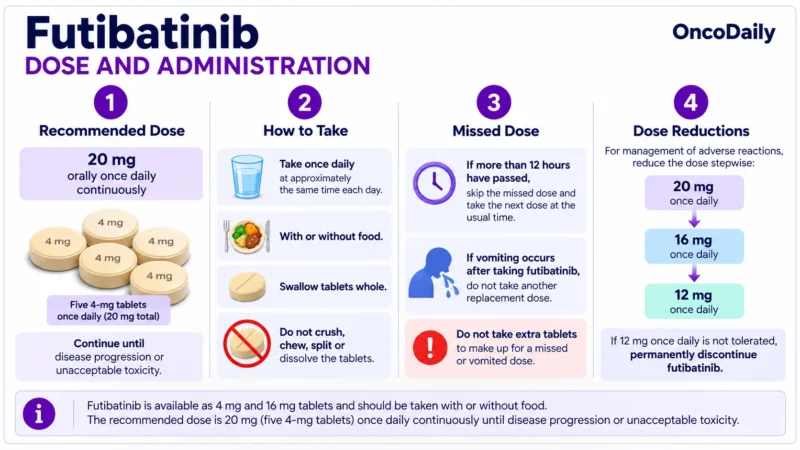
The recommended dose is:
20 mg orally once daily
continuously.
This corresponds to:
five 4-mg tablets once daily.
Treatment continues until:
- Disease progression
- Unacceptable toxicity
There is no planned treatment-free interval in the standard regimen.
How Should Futibatinib Be Taken?
Futibatinib should be taken:
- Once daily
- At approximately the same time each day
- With or without food
Tablets should be:
swallowed whole.
Do not:
- Crush
- Chew
- Split
- Dissolve
the tablets.
What Should You Do If You Miss a Dose of Futibatinib?
If the dose has been missed by:
more than 12 hours
skip the missed dose and take the next dose at the normal scheduled time.
If vomiting occurs after taking futibatinib:
- Do not take another replacement dose
- Resume treatment with the next scheduled dose
Do not take extra tablets to compensate for a missed or vomited dose.
How Are Futibatinib Dose Reductions Managed?
The standard dose-reduction sequence is:
20 mg once daily → 16 mg once daily → 12 mg once daily
If the patient cannot tolerate:
12 mg once daily
futibatinib should be:
permanently discontinued.
Hyperphosphatemia
Hyperphosphatemia is a pharmacodynamic consequence of FGFR inhibition and is one of the defining toxicities of futibatinib.
Serum Phosphate ≥5.5 to ≤7 mg/dL
- Continue futibatinib at the current dose
- Start phosphate-lowering therapy
- Monitor serum phosphate weekly
Serum Phosphate >7 to ≤10 mg/dL
- Initiate or intensify phosphate-lowering therapy
- Monitor phosphate weekly
- Reduce futibatinib to the next lower dose
If phosphate falls to:
≤7 mg/dL within 2 weeks
continue the reduced dose.
If it remains above 7 mg/dL:
- Reduce to the next dose level
If it remains above 7 mg/dL despite the second reduction:
- Withhold futibatinib
- Resume when phosphate returns to ≤7 mg/dL
Serum Phosphate >10 mg/dL
- Initiate or intensify phosphate-lowering therapy
- Monitor weekly
- Withhold futibatinib until phosphate is ≤7 mg/dL
- Resume at the next lower dose
Permanently discontinue if phosphate cannot be reduced to ≤7 mg/dL within 2 weeks despite two treatment interruptions and dose reductions.
How Is Retinal Pigment Epithelial Detachment Managed?
Futibatinib can cause:
retinal pigment epithelial detachment (RPED).
Patients may experience:
- Blurred vision
- Visual disturbance
- Floaters
- Other changes in vision
If RPED develops:
- Continue periodic ophthalmologic evaluation
If the abnormality resolves within 14 days:
- Continue at the current futibatinib dose
If it does not resolve within 14 days:
- Withhold futibatinib until improvement
- Resume at either the previous or a lower dose depending on the clinical situation.
How Are Other Futibatinib Toxicities Managed?
Grade 3 Hematologic Toxicity
Withhold until recovery to:
Grade 1 or baseline.
If recovery occurs within 1 week:
Resume at the dose used before interruption
Other Grade 3 Toxicity
Withhold until recovery to:
Grade 1 or baseline
then resume at:
the next lower dose.
Grade 4 Toxicity
Generally:
permanently discontinue futibatinib.
What Drug Interactions Are Important With Futibatinib?
Futibatinib is a substrate of:
- CYP3A
- P-glycoprotein
and is also a substrate of BCRP.
Dual P-gp and Strong CYP3A Inhibitors
Avoid concomitant administration when possible because these drugs can increase futibatinib exposure and toxicity.
Itraconazole increased:
- Futibatinib Cmax by 51%
- Futibatinib AUC by 41%
Examples may include certain potent azole antifungals and other drugs with simultaneous strong CYP3A/P-gp inhibitory activity.
Patients should also avoid:
grapefruit and grapefruit products.
Dual P-gp and Strong CYP3A Inducers
These should also be avoided because they may markedly decrease futibatinib exposure.
Rifampin decreased:
- Cmax by 53%
- AUC by 64%
Potential examples include:
- Rifampin
- Carbamazepine
- Phenytoin
- St. John’s wort
when they provide relevant CYP3A/P-gp induction.
Effect of Futibatinib on Other Drugs
Futibatinib inhibits:
- P-gp
- BCRP
It may therefore increase exposure to sensitive substrates of these transporters.
More frequent toxicity monitoring and adjustment of the substrate drug may be necessary.
Interestingly, a proton-pump inhibitor study with lansoprazole did not produce a meaningful change in futibatinib AUC.
Does Futibatinib Require Dose Adjustment in Renal or Hepatic Impairment?
Renal Impairment
No clinically meaningful pharmacokinetic differences were observed with:
mild to moderate renal impairment
defined as creatinine clearance:
30–89 mL/min.
Therefore, routine dose adjustment is not established for this population.
Futibatinib pharmacokinetics have not been adequately studied in:
- Severe renal impairment: CrCl 15–29 mL/min
- End-stage renal disease
- Patients receiving dialysis
Thus, there is insufficient evidence to define a standard dose modification for severe renal dysfunction.
Hepatic Impairment
The label does not provide a simple standard dose-reduction algorithm comparable with pemigatinib.
There are limited data in patients with markedly elevated bilirubin.
In patients with cirrhosis and bilirubin:
>1 to 1.5 × ULN
unbound futibatinib exposure increased approximately 1.7-fold.
With cirrhosis and bilirubin:
>1.5 × ULN
mean unbound:
- AUC increased approximately 3.2-fold
- Cmax increased approximately 2.4-fold
Patients with cirrhosis and elevated bilirubin may therefore have increased toxicity risk and require careful clinical monitoring.
What Is the Pharmacokinetic Profile of Futibatinib?
Time to Peak Concentration
Median Tmax is approximately:
2 hours.
Half-Life
Mean elimination half-life is approximately:
2.9 hours.
Protein Binding
Futibatinib is approximately:
95% protein bound.
Metabolism
Futibatinib is primarily metabolized through:
CYP3A
with lesser contributions from:
- CYP2C9
- CYP2D6
Excretion
Following radiolabeled futibatinib:
- Approximately 91% of recovered radioactivity was detected in feces
- Approximately 9% was detected in urine
with negligible unchanged futibatinib recovered.
Accumulation
Clinically significant accumulation was not observed after repeated once-daily dosing.
QT Interval
Even at exposure corresponding to approximately four times the recommended dose, futibatinib was not associated with clinically significant QTc prolongation.
What Are the Clinical Uses of Futibatinib?
FGFR2 Fusion/Rearrangement-Positive Intrahepatic Cholangiocarcinoma
Futibatinib is FDA approved for adults with:
previously treated, unresectable, locally advanced or metastatic intrahepatic cholangiocarcinoma
harboring:
an FGFR2 gene fusion or other rearrangement.
Molecular testing is therefore essential before treatment.
In the pivotal study, FGFR2 alterations were primarily identified using:
next-generation sequencing.
The most common fusion partner identified was:
BICC1.
What Did the Pivotal Clinical Trial Show?
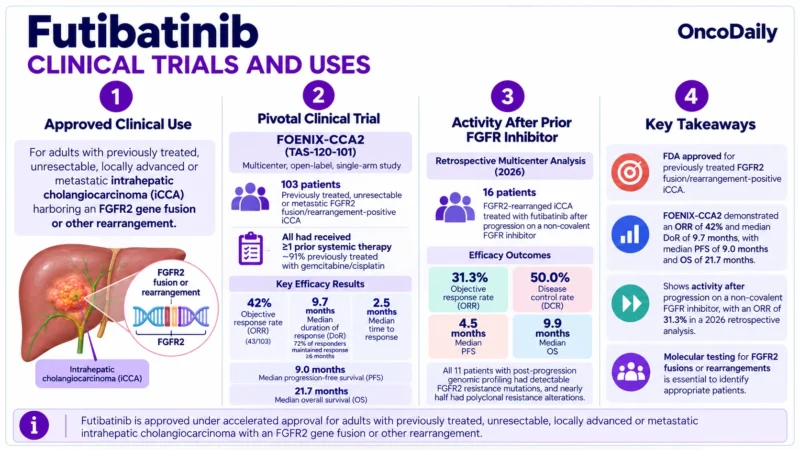
FOENIX-CCA2 / TAS-120-101
The pivotal FOENIX-CCA2 cohort of TAS-120-101 was a multicenter, open-label, single-arm study involving:
103 patients
with previously treated, unresectable, locally advanced or metastatic FGFR2 fusion/rearrangement-positive intrahepatic cholangiocarcinoma.
All patients had received at least one previous systemic therapy.
Approximately:
- 30% had received two previous lines
- 23% had received three or more previous lines
All had previously received platinum therapy, including approximately:
91% treated with gemcitabine/cisplatin.
Patients received:
futibatinib 20 mg orally once daily continuously.
Objective Response Rate
42%
with:
43 partial responses among 103 patients.
Median Duration of Response
9.7 months
with:
- 72% of responders maintaining response for ≥6 months
- 14% maintaining response for ≥12 months
Median Time to Response
2.5 months.
The peer-reviewed FOENIX-CCA2 analysis additionally reported:
Median Progression-Free Survival
9.0 months
Median Overall Survival
21.7 months.
Responses occurred across clinically important subgroups, including heavily pretreated patients, older adults and patients with co-occurring TP53 alterations.
Can Futibatinib Work After Another FGFR Inhibitor?
This is an important emerging area.
Futibatinib’s irreversible covalent binding provides a biological rationale for activity against some secondary FGFR2 mutations associated with resistance to reversible FGFR inhibitors.
A 2026 European multicenter retrospective analysis evaluated 16 patients with FGFR2-rearranged iCCA who received futibatinib after progression on a non-covalent FGFR inhibitor.
With futibatinib:
- ORR: 31.3%
- Disease control rate: 50.0%
- Median PFS: 4.5 months
- Median OS: 9.9 months
All 11 patients who underwent post-progression genomic profiling had detectable FGFR2 resistance mutations, and nearly half had polyclonal resistance alterations.
These findings suggest clinically meaningful activity after reversible FGFR inhibition, but this is retrospective evidence and should not be interpreted as establishing a separate FDA-approved indication.
How Does Resistance to Futibatinib Develop?
Although irreversible FGFR inhibition may overcome some resistance mechanisms, resistance to futibatinib itself can still emerge.
Genomic analyses from the FOENIX program identified secondary FGFR kinase-domain mutations during acquired resistance.
Frequently detected mutations included:
- FGFR2 V565L
- FGFR2 V565F
- FGFR2 N550K
Resistance can be:
polyclonal
meaning several different resistant subclones and FGFR2 mutations may emerge simultaneously.
Circulating tumor DNA may therefore become useful for identifying evolving resistance mechanisms and informing future FGFR sequencing strategies.
Does Futibatinib Have CNS Activity?
Futibatinib is not currently established as a CNS-directed therapy.
Its pivotal cholangiocarcinoma development program was not designed to establish intracranial efficacy, and there are insufficient clinical data to define meaningful CNS penetration or activity against brain metastases.
Therefore, futibatinib should not presently be selected specifically on the basis of presumed CNS activity.
Is Futibatinib FDA Approved?
Yes.
The FDA granted futibatinib accelerated approval on:
September 30, 2022.
The indication is for adults with:
previously treated, unresectable, locally advanced or metastatic intrahepatic cholangiocarcinoma
harboring:
FGFR2 gene fusions or other rearrangements.
As of October 2026, this remains an:
accelerated approval.
FDA lists the confirmatory requirement as ongoing, with a randomized study intended to further verify clinical benefit and compare futibatinib dosing strategies.
What Is the Current Clinical Role of Futibatinib in 2026?
Futibatinib remains an important molecularly targeted option for patients with previously treated:
FGFR2 fusion/rearrangement-positive advanced intrahepatic cholangiocarcinoma.
Its defining pharmacologic feature is:
irreversible covalent FGFR inhibition.
This differentiates it mechanistically from reversible FGFR inhibitors and has generated particular interest in treatment sequencing after acquired FGFR resistance.
However, the FGFR2-targeted cholangiocarcinoma landscape continues to expand. Molecular profiling is increasingly important because advanced biliary tract cancers can harbor actionable alterations involving not only FGFR2 but also IDH1, HER2, BRAF, NTRK, RET, KRAS and MSI/MMR pathways.
The emergence of additional next-generation FGFR2 inhibitors also means that treatment selection will increasingly depend on:
- Prior FGFR inhibitor exposure
- Specific resistance mutations
- Toxicity profiles
- Regulatory availability
- Molecular sequencing results
- Clinical-trial access
Futibatinib nevertheless remains distinctive because of its covalent FGFR1–4 inhibition and growing clinical evidence demonstrating activity in some tumors resistant to non-covalent FGFR inhibition.
Read more: Acquired Resistance to FGFR Inhibitors in Cholangiocarcinoma by OncoDaily.
Watch more: FGFR2-Targeted Therapy in Cholangiocarcinoma.
What Are the Major Side Effects of Futibatinib?
Hyperphosphatemia
Hyperphosphatemia is the hallmark on-target toxicity of FGFR inhibition.
Across the pooled clinical-trial safety population, laboratory-defined hyperphosphatemia occurred in approximately:
88%
of patients.
Median onset was approximately:
5 days.
Phosphate-binding therapy was used in approximately:
77%
of patients.
In the pivotal cholangiocarcinoma population, increased serum phosphate was observed in approximately:
97%
with Grade 3-level laboratory elevations in approximately:
39%.
Potential complications of severe or prolonged hyperphosphatemia include:
- Soft-tissue mineralization
- Calcinosis
- Vascular calcification
- Non-uremic calciphylaxis
Management includes:
- Dietary phosphate restriction
- Phosphate-lowering therapy
- Dose reduction
- Treatment interruption
- Permanent discontinuation when necessary
Ocular Toxicity
Retinal Pigment Epithelial Detachment
Across clinical trials:
RPED occurred in approximately 9%
of patients.
Median time to first onset was:
40 days.
In the pivotal cholangiocarcinoma study, RPED was reported in approximately:
7.8%.
Scheduled ophthalmologic monitoring is essential.
Dry Eye and Corneal Toxicity
Dry eye occurred in approximately:
15%
across the pooled clinical-trial population.
The pivotal cholangiocarcinoma cohort reported dry-eye-related events in approximately:
25%.
Artificial tears or other ocular lubricants may be used when appropriate.
Nail Toxicity
Nail disorders are particularly common with futibatinib.
In FOENIX-CCA2:
47%
experienced nail toxicity.
Manifestations may include:
- Onycholysis
- Nail discoloration
- Nail dystrophy
- Paronychia
- Nail pain
- Nail fragility
Gastrointestinal Toxicity
Common adverse events included:
- Constipation: 39%
- Diarrhea: 39%
- Dry mouth: 35%
- Stomatitis: 30%
- Abdominal pain: 30%
- Nausea: 24%
- Vomiting: 20%
Skin and Hair Toxicity
Common events include:
- Alopecia: 34%
- Dry skin: 29%
- Palmar-plantar erythrodysesthesia syndrome: 21%
Musculoskeletal Toxicity
- Musculoskeletal pain: 43%
- Arthralgia: 25%
Fatigue
Fatigue occurred in approximately:
37%
of patients.
Laboratory Abnormalities
Important laboratory abnormalities include:
- Increased phosphate
- Increased creatinine
- Increased AST/ALT
- Increased alkaline phosphatase
- Decreased hemoglobin
- Decreased lymphocytes
- Thrombocytopenia
- Hyponatremia
- Calcium abnormalities
- Creatine kinase elevation.
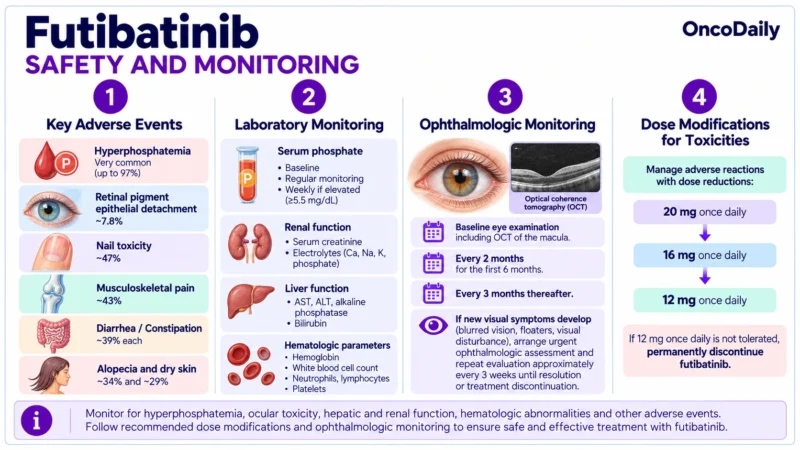
What Monitoring Is Required During Futibatinib Treatment?
Serum Phosphate
Check:
- At baseline
- Regularly during treatment
- Weekly once clinically significant elevation occurs
When phosphate reaches:
≥5.5 mg/dL
initiate:
- Low-phosphate diet
- Phosphate-lowering treatment
When phosphate exceeds:
7 mg/dL
dose reduction or interruption may be necessary according to severity and persistence.
Ophthalmologic Monitoring
Perform a comprehensive ophthalmologic examination including:
optical coherence tomography of the macula
- Before treatment
- Every 2 months for the first 6 months
- Every 3 months thereafter
If new visual symptoms develop:
- Arrange urgent ophthalmologic assessment
- Repeat evaluation approximately every 3 weeks until resolution or treatment discontinuation.
Renal Function and Electrolytes
Monitor:
- Creatinine
- Sodium
- Potassium
- Calcium
- Phosphate
Hepatic Function
Monitor:
- ALT
- AST
- Alkaline phosphatase
- Bilirubin
Particular caution is appropriate in patients with cirrhosis and elevated bilirubin because unbound futibatinib exposure may increase.
Hematologic Monitoring
Monitor:
- Hemoglobin
- White-cell count
- Neutrophils
- Lymphocytes
- Platelets
Dermatologic and Nail Assessment
Monitor for:
- Nail changes
- Paronychia
- Dry skin
- Hand-foot syndrome
- Alopecia
Reproductive Considerations
Futibatinib can cause fetal harm.
Verify pregnancy status before treatment when relevant.
Effective contraception is recommended:
- During treatment
- For 1 week after the final dose
for both females of reproductive potential and males with partners of reproductive potential.
Breastfeeding should be avoided:
- During treatment
- For 1 week after the last dose.
FAQ
What is futibatinib used for?
What is the standard futibatinib dose?
Is futibatinib taken in cycles?
Can futibatinib be taken with food?
It can be taken:
with or without food.
What is unusual about the mechanism of futibatinib?
irreversible covalent FGFR1–4 inhibitor.
This distinguishes it from reversible FGFR inhibitors.
What is the most characteristic toxicity?
Does futibatinib cause retinal toxicity?
Retinal pigment epithelial detachment can occur, requiring baseline and scheduled ophthalmologic monitoring with OCT.
What happens if a dose is missed?
If vomiting occurs, do not repeat the dose.
What are the main dose reductions?
If 12 mg cannot be tolerated, permanently discontinue treatment.