





Fludarabine: Understanding Its Mechanism, Dosing, and Clinical Role
Key takeaways
- Fludarabine is a purine nucleoside analog and antimetabolite.
- It is converted to the active metabolite 2-fluoro-ara-ATP.
- It inhibits several enzymes involved in DNA synthesis and repair.
- The standard labeled IV CLL regimen is 25 mg/m² daily for 5 days every 28 days.
- Renal function is critical for dosing.
- Fludarabine historically played a major role in B-cell CLL, including the FCR regimen.
- Modern targeted therapies have substantially reduced its routine role in CLL.
- Fludarabine remains an important component of allogeneic transplant conditioning.
- It is also widely used in lymphodepletion before CAR-T-cell therapy, commonly with cyclophosphamide.
- Major toxicities include myelosuppression, severe immunosuppression, infections, neurotoxicity, and autoimmune hemolytic anemia.
- Neurologic toxicity can be delayed and potentially irreversible.
- Careful renal, hematologic, infectious, and neurologic monitoring is essential.
Fludarabine is a purine nucleoside analog and antimetabolite used primarily in the treatment of B-cell chronic lymphocytic leukemia (CLL) and, in selected settings, as part of conditioning or combination regimens for hematologic malignancies. The commonly used intravenous formulation is administered as fludarabine phosphate, which is converted intracellularly to the active metabolite 2-fluoro-ara-ATP.
This article aims to review fludarabine’s mechanism of action, dose, administration, clinical uses, clinical-trial findings, pharmacokinetics, safety profile, and current clinical role.
Key Facts
- Generic name: Fludarabine phosphate
- Common name: Fludarabine
- Drug class: Purine nucleoside analog; antimetabolite
- Route: Intravenous (IV); oral formulations have also been used in some regions
- Primary established use: B-cell CLL
- Typical IV dose for CLL: 25 mg/m² daily for 5 consecutive days
- Treatment cycle: Generally every 28 days
- Active metabolite: 2-Fluoro-ara-ATP
- Major mechanism: Inhibition of DNA synthesis and DNA repair
- Major toxicities: Myelosuppression, infections, neurotoxicity, and autoimmune hemolytic anemia
- Important monitoring: CBC, renal function, infection, and neurologic status
- Key caution: Dose adjustment is required in renal impairment
What Is Fludarabine?
Fludarabine is a fluorinated purine nucleoside analog.
The clinically used drug is fludarabine phosphate, a water-soluble prodrug that is converted in the body to 2-fluoro-ara-A (F-ara-A).
F-ara-A enters cells and undergoes intracellular phosphorylation to form the active metabolite:
2-Fluoro-ara-ATP
This active metabolite interferes with several enzymes required for DNA synthesis and repair.
Fludarabine is particularly active against lymphoid cells, which explains its historical importance in CLL and other lymphoproliferative disorders.
What Is the Mechanism of Action of Fludarabine?
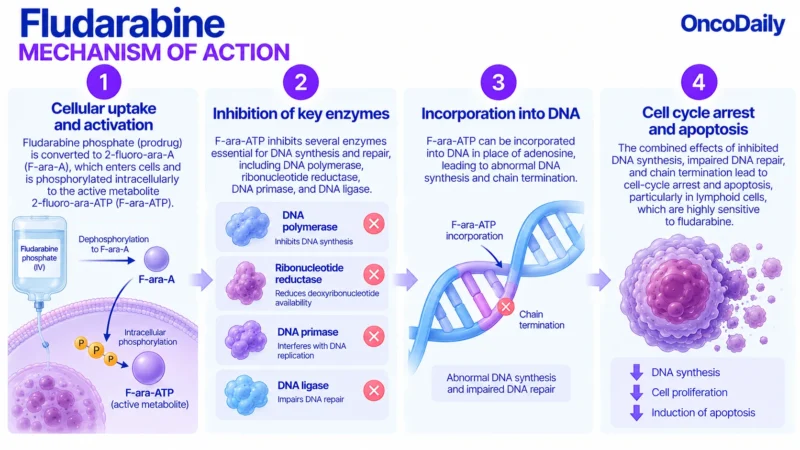
Fludarabine produces cytotoxic effects through several interconnected mechanisms.
1. Conversion to the Active Metabolite
Fludarabine phosphate is converted to F-ara-A, which enters malignant cells.
Inside cells, F-ara-A is phosphorylated to:
2-Fluoro-ara-ATP
2. Inhibition of DNA Polymerase
Fludarabine triphosphate inhibits DNA polymerase, interfering with DNA synthesis.
3. Inhibition of Ribonucleotide Reductase
It also inhibits ribonucleotide reductase, reducing the availability of deoxyribonucleotides required for DNA synthesis.
4. Inhibition of DNA Primase and DNA Ligase
Fludarabine metabolites interfere with enzymes involved in DNA replication and repair, including DNA primase and DNA ligase.
5. DNA Incorporation and Chain Termination
The active metabolite can become incorporated into DNA, resulting in abnormal DNA synthesis and chain termination.
6. Apoptosis
The combined disruption of DNA synthesis and repair ultimately promotes cell-cycle arrest and apoptosis.
The mechanism can be summarized as:
Fludarabine → F-ara-A → intracellular phosphorylation → 2-Fluoro-ara-ATP → inhibition of DNA polymerase + ribonucleotide reductase + DNA repair enzymes → impaired DNA synthesis → apoptosis
What Is the Dose of Fludarabine?
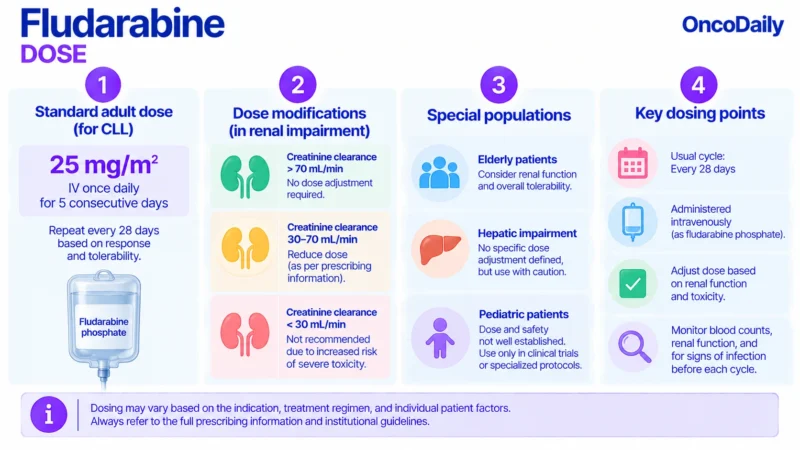
For adults with B-cell CLL, the labeled intravenous regimen is:
25 mg/m² IV once daily for 5 consecutive days
The cycle is generally repeated:
Every 28 days
Treatment is continued according to response and tolerability.
The prescribing information recommends continuing treatment until the best response is achieved, generally followed by additional cycles according to the clinical situation.
Renal Dose Adjustment
Renal function is particularly important with fludarabine because the drug and its metabolites are substantially eliminated through the kidneys.
For patients with reduced creatinine clearance, the dose should be reduced according to the prescribing information.
Fludarabine should not be administered to patients with severe renal impairment because of the increased risk of severe toxicity.
How Is Fludarabine Administered?
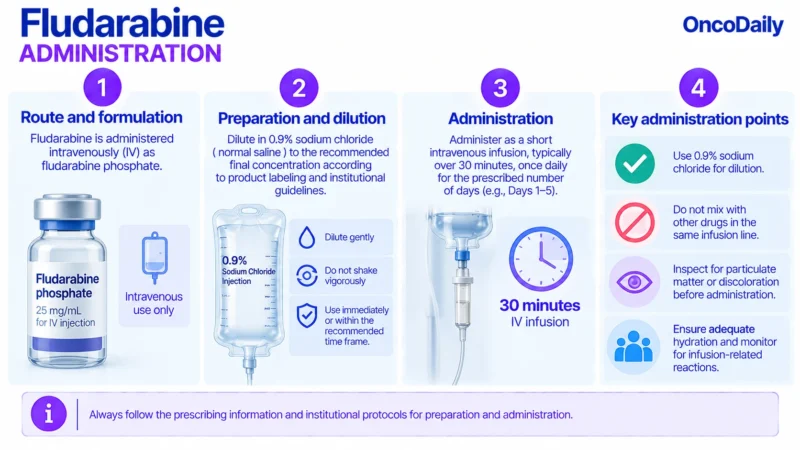
Fludarabine phosphate is administered intravenously.
For the standard CLL regimen:
25 mg/m² IV → once daily → Days 1–5 → repeat approximately every 28 days
The drug is administered as an IV infusion according to the specific product formulation and institutional chemotherapy procedures.
Adequate hydration and appropriate monitoring are important during therapy.
Does Fludarabine Require an In-Line Filter?
No routine in-line filter is specifically required for fludarabine.
Administration should follow the product-specific preparation instructions and institutional IV chemotherapy procedures.
Does Fludarabine Require Premedication?
No specific routine premedication is required.
Supportive medications may be given according to the patient’s chemotherapy regimen and individual clinical needs.
Because fludarabine causes substantial immunosuppression, infection prophylaxis may be incorporated into treatment protocols.
Are Dose Reductions Used?
Yes.
Dose reduction or treatment interruption may be necessary for:
- Renal impairment
- Severe myelosuppression
- Serious infection
- Neurotoxicity
- Other significant toxicity.
Renal function should be assessed before treatment because reduced clearance can substantially increase exposure.
What Is the Pharmacokinetic Profile of Fludarabine?
Fludarabine phosphate is rapidly converted to F-ara-A in plasma.
F-ara-A enters cells and is phosphorylated intracellularly to the active triphosphate:
2-Fluoro-ara-ATP
The intracellular metabolite has a substantially longer persistence than the parent compound in plasma, allowing continued pharmacologic activity after plasma concentrations decline.
Renal elimination is clinically important, and impaired renal function can increase systemic exposure.
Does Fludarabine Require Renal or Hepatic Dose Adjustment?
Renal Impairment
Yes. Renal function is a major determinant of fludarabine dosing.
Dose reduction is required in patients with moderate renal impairment.
Fludarabine is contraindicated in patients with severe renal impairment, depending on the formulation and labeling.
Hepatic Impairment
There is less clearly defined dosing guidance for hepatic impairment than for renal impairment.
Patients with significant hepatic dysfunction should therefore be treated cautiously, with consideration of the overall clinical situation and the specific product labeling.
What Are the Clinical Uses of Fludarabine?
Chronic Lymphocytic Leukemia
Fludarabine’s classic indication is B-cell CLL.
Historically, fludarabine was an important component of combination regimens such as:
FCR = fludarabine + cyclophosphamide + rituximab
Before the development and widespread adoption of modern targeted therapies, fludarabine-containing combinations were major treatment approaches for fit patients with CLL.
Indolent Lymphoid Malignancies
Fludarabine has also been investigated and used in selected lymphoid malignancies, including:
- Indolent non-Hodgkin lymphomas
- Waldenström macroglobulinemia
- Other mature B-cell lymphoproliferative disorders.
Its current use in these diseases is substantially more limited because of the availability of targeted therapies.
Hematopoietic Stem Cell Transplantation
Fludarabine is widely used as a component of reduced-intensity and nonmyeloablative conditioning regimens before allogeneic hematopoietic stem-cell transplantation.
It is commonly combined with agents such as:
- Busulfan
- Melphalan
- Cyclophosphamide
- Total-body irradiation in selected protocols.
In this setting, its role is primarily immunosuppressive and cytoreductive, helping facilitate donor-cell engraftment.
CAR-T and Cellular Therapy Conditioning
Fludarabine is also an important component of lymphodepleting chemotherapy before certain cellular therapies, particularly CAR-T-cell therapy.
A common approach combines:
Fludarabine + cyclophosphamide
The purpose is to reduce endogenous lymphocytes and create an immune environment that supports subsequent expansion and persistence of infused T cells.
Watch more: New CLL Treatments, the Standard of Care and the Importance of Clonal Evolution — Michael Hallek
What Did Fludarabine Clinical Trials Show?
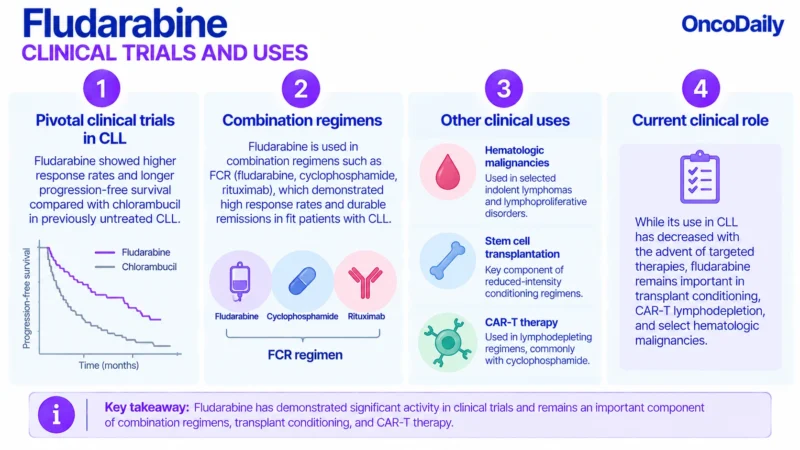
Fludarabine Versus Chlorambucil in CLL
Randomized studies established fludarabine as a highly active therapy for previously untreated CLL.
In the pivotal trial conducted by the German CLL Study Group, fludarabine produced higher overall response and complete response rates than chlorambucil.
Fludarabine also improved progression-free survival.
These studies helped establish purine-analog therapy as an important component of CLL treatment before the era of targeted agents.
FCR in CLL
The combination of:
Fludarabine + Cyclophosphamide + Rituximab (FCR)
produced high response rates and prolonged progression-free survival in fit patients with CLL.
Long-term follow-up demonstrated that selected patients with IGHV-mutated CLL could experience particularly durable remissions following FCR.
However, FCR has largely been displaced from routine first-line treatment by targeted therapies such as BTK and BCL2 inhibitors.
Fludarabine in Transplant Conditioning
Fludarabine-based reduced-intensity conditioning regimens have been extensively investigated in allogeneic transplantation.
The combination allows effective immunosuppression while generally producing less toxicity than fully myeloablative approaches in appropriately selected patients.
Is Fludarabine FDA Approved?
Yes.
Fludarabine phosphate injection is FDA approved for the treatment of adults with B-cell CLL whose disease has not responded to or has progressed during treatment with at least one standard alkylating-agent-containing regimen.
The labeled indication reflects the historical regulatory role of fludarabine; its contemporary clinical use extends beyond this specific label in transplant conditioning and cellular therapy protocols.
What Is the Current Clinical Role of Fludarabine?
Fludarabine’s role has changed substantially with the development of targeted therapies.
In CLL, drugs such as BTK inhibitors and BCL2-targeted therapy have largely replaced fludarabine-based chemotherapy for routine treatment.
Nevertheless, fludarabine remains highly relevant in:
- Allogeneic stem-cell transplantation conditioning
- CAR-T lymphodepletion
- Selected hematologic malignancy protocols
- Specific chemotherapy combinations.
Its ability to produce profound lymphodepletion and immunosuppression makes it particularly valuable in cellular therapy and transplant medicine.
Fludarabine is also commonly combined with cyclophosphamide for lymphodepletion before CAR-T-cell therapy. Learn more about cyclophosphamide and its role in cancer treatment by OncoDaily.
What Are the Major Side Effects of Fludarabine?
Myelosuppression
Common hematologic toxicities include:
- Neutropenia
- Thrombocytopenia
- Anemia
- Pancytopenia.
Infection
Fludarabine can cause profound and prolonged immunosuppression, increasing susceptibility to:
- Bacterial infections
- Viral infections
- Fungal infections
- Opportunistic infections.
Prophylaxis against selected opportunistic infections is often incorporated into treatment protocols.
Neurotoxicity
High cumulative exposure can cause serious neurological toxicity.
Potential manifestations include:
- Confusion
- Visual disturbances
- Weakness
- Encephalopathy
- Severe central nervous system toxicity.
Some neurological toxicity can be delayed and irreversible.
Autoimmune Hemolytic Anemia
Fludarabine has been associated with autoimmune hemolytic anemia, particularly in patients with CLL.
Tumor Lysis Syndrome
Rapid tumor-cell destruction can result in tumor lysis syndrome in patients with high tumor burden.
Nausea and Gastrointestinal Effects
Nausea, vomiting, diarrhea, and other gastrointestinal symptoms can occur.
What Monitoring Is Required?
Monitoring should include:
- CBC with differential
- Platelet count
- Renal function
- Liver function
- Assessment for infection
- Neurologic assessment
- Assessment for hemolysis when clinically indicated
- Tumor lysis monitoring in high-risk patients.
Because of the profound immunosuppressive effects of fludarabine, infection surveillance is particularly important.