


Fedratinib (Inrebic): Understanding Its Mechanism, Dosing, Clinical Uses, and Role in Myelofibrosis
Key takeaways
- Fedratinib is an oral JAK2 inhibitor used in intermediate-2 or high-risk myelofibrosis.
- The standard dose is 400 mg once daily for patients with platelets ≥50 × 10⁹/L.
- It can be taken with or without food; a high-fat meal may reduce nausea and vomiting.
- Every patient should receive thiamine 100 mg orally daily.
- The boxed warning is encephalopathy, including Wernicke encephalopathy.
- Severe renal impairment requires reduction to 200 mg once daily.
- Strong CYP3A4 inhibitors also require reduction to 200 mg daily.
- JAKARTA showed week-24 spleen response of 47% vs 1% with placebo and symptom response of 40% vs 9%.
- JAKARTA2 demonstrated meaningful activity after ruxolitinib.
- FREEDOM2 confirmed second-line efficacy, with SVR35 of 36% vs 6% with best available therapy.
- The main practical toxicities are GI toxicity, anemia, thrombocytopenia, hepatotoxicity, pancreatic enzyme elevation, and thiamine deficiency.
- Uveitis is now an additional important post-marketing safety consideration.
- Supportive care, nutritional monitoring, and thiamine prophylaxis are essential components of modern fedratinib therapy.
Fedratinib (Inrebic) is an oral Janus kinase 2 (JAK2) inhibitor approved for adults with intermediate-2 or high-risk primary myelofibrosis or secondary myelofibrosis following polycythemia vera or essential thrombocythemia. It can be used both in JAK-inhibitor–naïve patients and after prior ruxolitinib exposure. The current U.S. prescribing information was updated in March 2026.
A defining safety issue is the boxed warning for encephalopathy, including Wernicke encephalopathy, which makes thiamine assessment and supplementation essential. All patients receiving fedratinib should receive thiamine 100 mg orally every day during therapy.
Key Facts
- Generic name: Fedratinib
- Brand name: Inrebic
- Drug class: JAK2 inhibitor
- Primary target: JAK2
- Additional kinase activity: FLT3 and other kinases
- Route: Oral
- Initial U.S. approval: 2019
- Standard adult dose: 400 mg once daily
- Minimum baseline platelet count for recommended dosing: ≥50 × 10⁹/L
- Food: With or without food
- High-fat meal: May reduce nausea and vomiting
- Required concomitant medication: Thiamine 100 mg orally daily
- Capsule strength: 100 mg
- Major boxed warning: Encephalopathy, including Wernicke encephalopathy
- Characteristic toxicities: Diarrhea, nausea, vomiting, anemia, thrombocytopenia
- Other important risks: Hepatotoxicity, elevated amylase/lipase, uveitis, thrombosis, MACE
- Major interaction pathway: CYP3A4.
What Is Fedratinib?
Fedratinib is a small-molecule kinase inhibitor that primarily suppresses JAK2-mediated signaling.
Myelofibrosis is frequently characterized by constitutive activation of the:
JAK–STAT pathway
through molecular abnormalities such as:
- JAK2 V617F
- CALR mutations
- MPL mutations
- Other alterations that converge on JAK-STAT signaling
Aberrant JAK2 activation contributes to:
- Clonal myeloid proliferation
- Excessive cytokine signaling
- Splenomegaly
- Constitutional symptoms
- Bone-marrow fibrosis
Fedratinib reduces abnormal JAK2 signaling irrespective of whether the underlying driver mutation is JAK2 itself or another alteration activating the same pathway.
What Is the Mechanism of Action of Fedratinib?
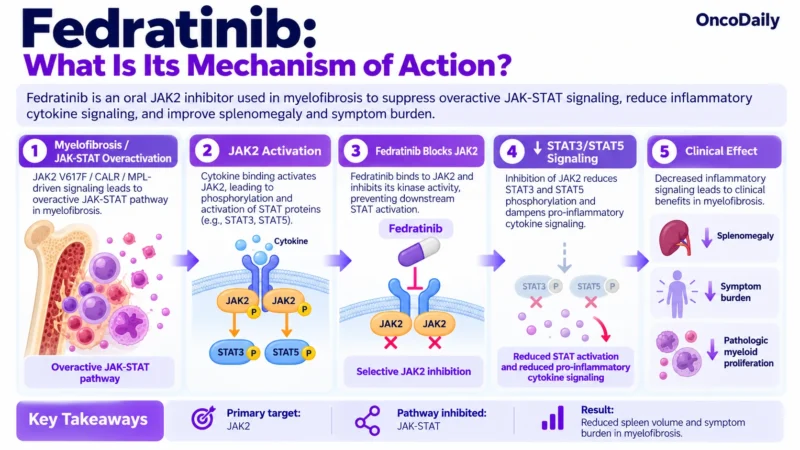
1. Abnormal JAK2 Signaling Drives Myelofibrosis
Constitutive activation of JAK2 promotes phosphorylation of downstream STAT proteins.
This activates transcriptional programs that support:
- Abnormal hematopoietic-cell proliferation
- Cytokine production
- Inflammation
- Splenic extramedullary hematopoiesis
- Myelofibrosis-related symptoms
2. Fedratinib Inhibits JAK2
Fedratinib inhibits JAK2 kinase activity and reduces JAK2-dependent signaling.
3. STAT Phosphorylation Is Suppressed
Blocking JAK2 decreases activation of downstream:
STAT proteins
and associated signaling networks.
4. Pathologic Cytokine Signaling Declines
This reduces the inflammatory and proliferative signaling responsible for:
- Splenomegaly
- Constitutional symptoms
- Abnormal myeloid-cell expansion
5. Clinical Disease Burden Falls
The overall effect is:
Fedratinib → JAK2 inhibition → ↓ STAT activation → ↓ pathologic cytokine/proliferative signaling → ↓ spleen volume and symptom burden
What Is the Recommended Dose of Fedratinib?
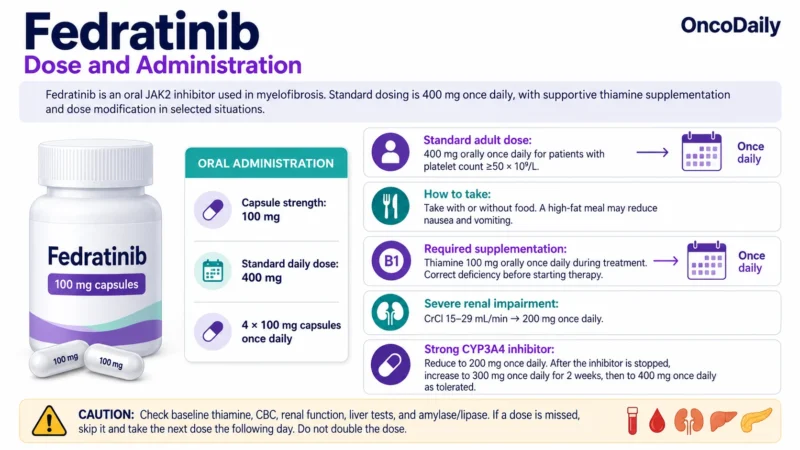
The recommended dose is:
400 mg orally once daily
for patients with a baseline platelet count:
≥50 × 10⁹/L.
Patients previously receiving ruxolitinib should have ruxolitinib appropriately tapered and discontinued before starting fedratinib.
Severe Renal Impairment
For:
CrCl 15–29 mL/min
reduce the dose to:
200 mg once daily.
Strong CYP3A4 Inhibitors
If a strong CYP3A4 inhibitor must be administered:
400 mg → 200 mg once daily.
When the strong inhibitor is discontinued:
- Increase fedratinib to 300 mg once daily for 2 weeks
- Then increase to 400 mg once daily as tolerated.
How Should Fedratinib Be Taken?
Fedratinib can be taken:
With or without food.
Administration with a:
high-fat meal
may reduce nausea and vomiting.
Capsules should normally be swallowed orally.
For patients unable to swallow capsules, or those with a nasogastric tube, the current label permits the capsule contents to be dispersed in approximately:
180 mL of Ensure Plus
and administered within:
2 hours of preparation.
Most importantly, all patients should receive:
Thiamine 100 mg orally once daily
throughout fedratinib therapy.
What Should You Do If You Miss a Dose of Fedratinib?
If a dose is missed:
- Skip the missed dose
- Take the next scheduled dose the following day
- Do not take an extra or double dose.
How Are Fedratinib Dose Reductions Managed?
Dose modifications usually occur in:
100 mg increments.
Patients unable to tolerate:
200 mg once daily
should discontinue fedratinib.
Thrombocytopenia
For:
- Grade 4 thrombocytopenia
- Grade 3 thrombocytopenia with active bleeding
interrupt fedratinib until recovery to:
Grade ≤2 or baseline
then restart:
100 mg below the previous dose.
Neutropenia
For Grade 4 neutropenia:
- Interrupt treatment
- Wait for recovery to Grade ≤2 or baseline
- Restart 100 mg below the prior dose.
Severe Gastrointestinal Toxicity
For Grade ≥3:
- Nausea
- Vomiting
- Diarrhea
that does not respond to supportive therapy within 48 hours:
- Hold fedratinib
- Wait for recovery to Grade ≤1 or baseline
- Restart 100 mg lower.
Hepatotoxicity
For Grade ≥3:
- ALT
- AST
- Bilirubin
elevation:
- Interrupt fedratinib
- Resume at a dose 100 mg lower after recovery
If Grade ≥3 hepatic toxicity recurs:
discontinue fedratinib.
Other Grade ≥3 Toxicities
Interrupt until recovery and restart:
100 mg below the previous dose.
What Drug Interactions Are Important With Fedratinib?
Fedratinib is metabolized primarily through:
- CYP3A4
- CYP2C19
- FMO3.
Strong CYP3A4 Inhibitors
Strong CYP3A4 inhibitors increase fedratinib exposure.
Ketoconazole increased fedratinib exposure approximately:
3-fold
after a single dose.
If unavoidable:
Reduce fedratinib to 200 mg once daily.
Strong or Moderate CYP3A4 Inducers
Avoid concomitant strong or moderate CYP3A4 inducers.
Examples include:
- Rifampin
- Carbamazepine
- Phenytoin
- Phenobarbital
- Certain antiepileptic agents
Rifampin reduced fedratinib exposure by approximately:
81%.
Dual CYP3A4/CYP2C19 Inhibitors
These may further increase fedratinib exposure and require:
- More intensive toxicity monitoring
- Dose modification when necessary.
Effects on Other Medications
Fedratinib can increase exposure to drugs that are substrates of:
- CYP3A4
- CYP2C19
- CYP2D6
- OCT2
- MATE1/2-K
This can be clinically important for medications such as metformin and several cardiovascular or psychiatric drugs.
Does Fedratinib Require Dose Adjustment in Renal or Hepatic Impairment?
Renal Impairment
For severe renal impairment:
CrCl 15–29 mL/min → 200 mg once daily.
Exposure increases approximately:
- 1.5-fold in moderate renal impairment
- 1.9-fold in severe renal impairment.
Patients with moderate renal impairment should be monitored more closely for adverse reactions.
Hepatic Impairment
Current pharmacokinetic data show no clinically meaningful change in fedratinib exposure across:
- Child-Pugh A
- Child-Pugh B
- Child-Pugh C
hepatic impairment.
Routine starting-dose modification based solely on hepatic impairment is therefore not specified in the current label, although hepatic function should be monitored because fedratinib itself can cause hepatotoxicity.
What Is the Pharmacokinetic Profile of Fedratinib?
Food Effect
Food produces only a modest increase in fedratinib exposure.
A high-fat meal increased:
- AUC by up to approximately 24%
- Cmax by up to approximately 14%.
Protein Binding
Fedratinib is:
≥92% protein bound.
Half-Life
Fedratinib has:
- Effective half-life: approximately 41 hours
- Terminal half-life: approximately 114 hours.
Metabolism
Metabolism involves:
- CYP3A4
- CYP2C19
- FMO3.
Excretion
Following radiolabeled administration:
- 77% was recovered in feces
- 5% in urine.
What Are the Clinical Uses of Fedratinib?
Fedratinib is FDA approved for adults with:
Primary Myelofibrosis
Intermediate-2 or high-risk:
primary myelofibrosis.
Post-Polycythemia Vera Myelofibrosis
Intermediate-2 or high-risk:
post-PV myelofibrosis.
Post-Essential Thrombocythemia Myelofibrosis
Intermediate-2 or high-risk:
post-ET myelofibrosis.
It can be used in:
- JAK-inhibitor–naïve disease
- Patients previously treated with ruxolitinib
provided the patient meets the approved clinical criteria.
What Did the Pivotal Clinical Trials Show?
JAKARTA
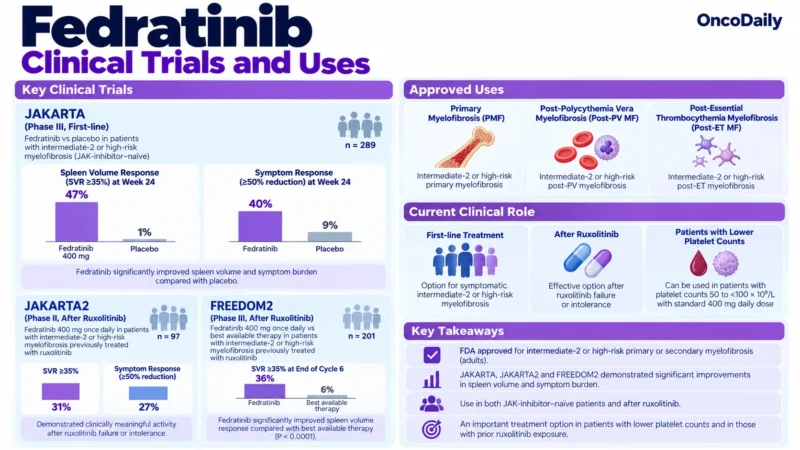
The pivotal randomized phase III JAKARTA trial evaluated fedratinib in JAK-inhibitor–naïve patients with intermediate-2 or high-risk myelofibrosis.
Patients received:
- Fedratinib 400 mg once daily
- Fedratinib 500 mg once daily
- Placebo
The approved dose is:
400 mg once daily.
Updated analysis showed that at week 24:
Spleen Volume Response ≥35%
- Fedratinib 400 mg: 47%
- Placebo: 1%
Symptom Response ≥50%
- Fedratinib: 40%
- Placebo: 9%.
The original randomized analysis also confirmed significant reductions in splenomegaly and symptom burden versus placebo.
JAKARTA2
The phase II JAKARTA2 study evaluated fedratinib after previous ruxolitinib treatment.
Patients received:
400 mg once daily.
In the updated intention-to-treat analysis:
Spleen Volume Response ≥35%
31%
Symptom Response ≥50%
27%.
These results established clinically meaningful activity after ruxolitinib failure or intolerance.
FREEDOM2
The randomized phase III FREEDOM2 trial directly compared:
- Fedratinib 400 mg daily
- Best available therapy
in patients with intermediate-2 or high-risk myelofibrosis previously treated with ruxolitinib.
A total of:
201 patients
were treated.
At the end of cycle 6:
SVR35
- Fedratinib: 36%
- Best available therapy: 6%
P < 0.0001.
This trial provided randomized evidence confirming fedratinib as an effective second-line JAK inhibitor after ruxolitinib.
Importantly, the study incorporated:
- Prophylactic antiemetics
- Thiamine supplementation
- Antidiarrheal treatment
which substantially improved management of gastrointestinal toxicity and low thiamine levels.
Is Fedratinib FDA Approved?
Yes.
Fedratinib is FDA approved for adults with:
Intermediate-2 or high-risk primary or secondary myelofibrosis, including:
- Primary MF
- Post-polycythemia vera MF
- Post-essential thrombocythemia MF.
Initial U.S. approval occurred in:
2019.
What Is the Current Clinical Role of Fedratinib in 2026?
First-Line Myelofibrosis
Fedratinib is an established JAK2-inhibitor option for patients with symptomatic intermediate-2 or high-risk MF.
JAKARTA demonstrated clinically meaningful improvements in:
- Spleen volume
- Constitutional symptoms
- Overall symptom burden.
In practice, selection between available JAK inhibitors depends on:
- Platelet count
- Hemoglobin level
- Prior JAK-inhibitor exposure
- Spleen burden
- Symptom burden
- Comorbidities
- Cytopenias
- Gastrointestinal tolerance
After Ruxolitinib
One of fedratinib’s most important roles is:
second-line therapy after ruxolitinib failure or intolerance.
JAKARTA2 demonstrated activity in this population, and FREEDOM2 subsequently confirmed superiority over best available therapy for spleen response.
Read more: Talha Badar: Myelofibrosis after failure of Ruxolitinib by OncoDaily.
Watch more: Fedratinib for Primary Myelofibrosis — Ruben A. Mesa, MD, discusses the JAKARTA and JAKARTA2 trials and when fedratinib is used in myelofibrosis.
Patients With Lower Platelet Counts
Fedratinib can be used at the standard:
400 mg daily
in patients with baseline platelet counts:
50 to <100 × 10⁹/L
without an initial dose reduction.
Trial analyses demonstrated spleen and symptom activity in this population, although thrombocytopenia requires close monitoring.
Importance of Supportive Care
Modern fedratinib therapy differs significantly from its earliest development because current treatment includes:
- Baseline thiamine testing
- Daily thiamine supplementation
- Prophylactic antiemetics
- Early antidiarrheal treatment
- Nutritional assessment
These measures have improved tolerability and substantially reduced the clinical risk related to thiamine deficiency.
What Are the Major Side Effects of Fedratinib?
The most common adverse reactions include:
- Diarrhea
- Nausea
- Anemia
- Vomiting
Other important adverse events include:
- Thrombocytopenia
- Neutropenia
- Hepatic enzyme elevation
- Amylase/lipase elevation
- Uveitis
- Thiamine deficiency
- Encephalopathy
- Cardiovascular events
- Thrombosis.
Wernicke Encephalopathy
Fedratinib carries a boxed warning for:
encephalopathy, including Wernicke encephalopathy.
Wernicke encephalopathy is a neurologic emergency associated with thiamine deficiency.
Symptoms may include:
- Confusion
- Memory impairment
- Drowsiness
- Ataxia
- Diplopia
- Nystagmus.
Before treatment:
- Measure thiamine level
- Assess nutritional status
- Correct thiamine deficiency
During treatment:
Give thiamine 100 mg orally daily.
If Wernicke encephalopathy is suspected:
- Immediately discontinue fedratinib
- Administer parenteral thiamine
- Continue monitoring until symptoms improve and thiamine normalizes.
Gastrointestinal Toxicity
GI toxicity is extremely common.
In JAKARTA:
- Diarrhea: 66%
- Nausea: 62%
- Vomiting: 39%.
Median onset was approximately:
1 day
and most events occurred during the first:
2 weeks.
Management should include:
- Prophylactic antiemetic therapy
- Prompt antidiarrheal treatment
- Hydration
- Nutritional support
- Thiamine monitoring
Anemia
New or worsening Grade 3 anemia occurred in approximately:
34%
of fedratinib-treated patients.
Median onset was approximately:
2 months.
Red-blood-cell transfusions were required in approximately:
51%.
Thrombocytopenia
Grade ≥3 thrombocytopenia occurred in approximately:
12%
of patients.
CBC and platelet counts should be monitored carefully.
Hepatotoxicity
ALT and AST elevations occurred in approximately:
- ALT: 43%
- AST: 40%
Most occurred within the first:
3 months.
Amylase and Lipase Elevation
Grade ≥3:
- Amylase elevation: 2%
- Lipase elevation: 10%
Pancreatitis has also been reported.
Uveitis
The current 2026 prescribing information includes uveitis as an important warning.
Post-approval studies reported uveitis in approximately:
4%
of evaluated patients.
Median first onset was approximately:
14 months.
Symptoms may include:
- Eye pain
- Redness
- Photophobia
- Floaters
- Reduced vision
Prompt ophthalmologic evaluation is recommended.
MACE and Thrombosis
The current label also includes warnings regarding:
- Major adverse cardiovascular events
- Venous thrombosis
- Arterial thrombosis
These are class-related JAK-inhibitor concerns.
Risk-benefit assessment is particularly important in:
- Smokers
- Former smokers
- Patients with cardiovascular risk factors.
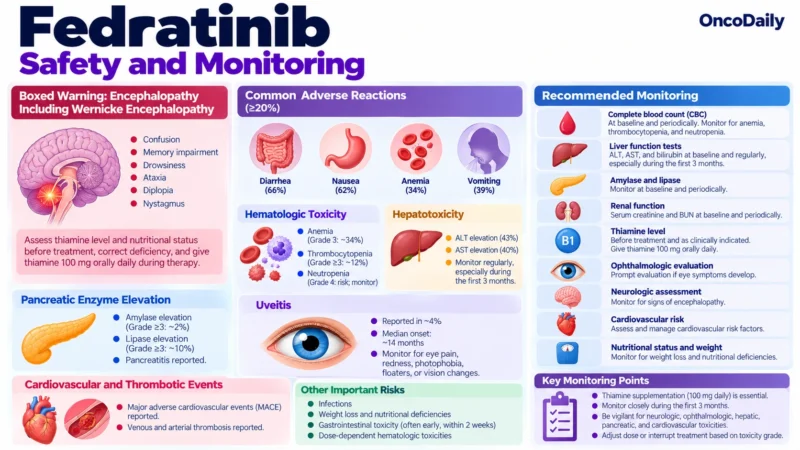
What Monitoring Is Required During Fedratinib Treatment?
Before treatment and periodically during therapy, monitor:
- Thiamine level
- CBC with platelets
- Creatinine
- BUN
- ALT
- AST
- Bilirubin
- Amylase
- Lipase.
Also monitor:
- Nutritional status
- Weight loss
- GI symptoms
- Neurologic symptoms
- Hydration
- Thrombotic symptoms
- Cardiovascular risk factors
- Eye symptoms
- Drug interactions
Thiamine
Assess:
before treatment
and thereafter:
as clinically indicated.
All patients should receive:
100 mg oral thiamine daily.
CBC
Monitor for:
- Anemia
- Thrombocytopenia
- Neutropenia
at baseline and periodically.
Liver Function
Monitor:
- ALT
- AST
- Bilirubin
especially during the first several months.
Pancreatic Enzymes
Monitor:
- Amylase
- Lipase
because enzyme elevation can occur early.
Ophthalmologic Monitoring
Patients developing:
- Eye pain
- Photophobia
- Redness
- Floaters
- Vision changes
should receive prompt ophthalmologic assessment because of the risk of uveitis.
FAQ
What is fedratinib used for?
What is the standard fedratinib dose?
Can fedratinib be used after ruxolitinib?
JAKARTA2 and FREEDOM2 demonstrated meaningful efficacy after ruxolitinib failure or intolerance.
Does fedratinib need to be taken with food?
It can be taken with or without food, although a high-fat meal may decrease nausea and vomiting.
Why must patients take thiamine?
All patients should receive:
Thiamine 100 mg orally daily.
Can fedratinib be started if thiamine is low?
Thiamine deficiency should be corrected before treatment begins.
What is the most common toxicity?
- Diarrhea
- Nausea
- Vomiting
is very common.
Does fedratinib require renal dose adjustment?
For CrCl:
15–29 mL/min → 200 mg once daily.
Can fedratinib be used with strong CYP3A4 inhibitors?
If unavoidable:
reduce fedratinib to 200 mg once daily.