





Exemestane (Aromasin): Mechanism of Action, Dosage, Clinical Uses, Trials, and Side Effects
Key takeaways
- Exemestane is a third-generation steroidal aromatase inhibitor that permanently inactivates CYP19A1.
- The standard dose is 25 mg orally once daily after a meal.
- Its irreversible mechanism distinguishes it from the reversible aromatase inhibitors anastrozole and letrozole.
- IES demonstrated that switching to exemestane after two to three years of tamoxifen improves recurrence-related outcomes.
- TEAM supported exemestane monotherapy and sequential endocrine strategies as options in postmenopausal early breast cancer.
- BOLERO-2 established improved progression-free survival with everolimus plus exemestane in selected patients with advanced HR-positive/HER2-negative disease.
- MAP.3 demonstrated a 65% relative reduction in invasive breast cancer incidence among high-risk postmenopausal women, although prevention is not FDA-approved.
- TEXT/SOFT established the importance of exemestane with ovarian suppression in selected premenopausal patients.
- Bone loss, fractures, arthralgia, cardiovascular risk, and adherence are major long-term considerations.
Exemestane (Aromasin) is a third-generation, steroidal aromatase inhibitor (AI) used primarily in the treatment of hormone receptor-positive (HR-positive) breast cancer. It permanently inactivates the aromatase enzyme (CYP19A1), substantially reducing estrogen production and suppressing estrogen-dependent tumor growth.
Unlike anastrozole and letrozole, which reversibly inhibit aromatase, exemestane acts through irreversible, mechanism-based inhibition, also called suicide inhibition. Aromatase activity can recover only after new enzyme molecules are synthesized.
Exemestane is structurally related to androstenedione, a natural substrate of aromatase. This allows it to interact with the enzyme’s catalytic site and permanently inactivate it.
First approved by the U.S. FDA in 1999, exemestane is indicated for postmenopausal women with estrogen receptor-positive early breast cancer after two to three years of tamoxifen, and for advanced breast cancer following progression on tamoxifen.
The landmark Intergroup Exemestane Study (IES) established the benefit of switching from tamoxifen to exemestane. Additional studies, including TEAM, BOLERO-2, and MAP.3, expanded evidence for its role in adjuvant treatment, endocrine-resistant metastatic disease, and breast cancer risk reduction.
Exemestane remains an important endocrine treatment option in 2026, particularly in sequential endocrine therapy and as a backbone for everolimus-containing regimens in selected patients with advanced HR-positive/HER2-negative breast cancer.
Key Facts
- Generic name: Exemestane
- Brand name: Aromasin
- Drug class: Third-generation aromatase inhibitor
- Drug type: Steroidal endocrine therapy
- Molecular target: Aromatase (CYP19A1)
- Mechanism: Irreversible, mechanism-based aromatase inactivation
- Initial FDA approval: 1999
- Administration: Oral
- Standard dose: 25 mg once daily after a meal
- Available formulation: 25 mg tablet
- Dose with strong CYP3A4 inducers: 50 mg once daily after a meal
- Approved adjuvant treatment: Following two to three years of tamoxifen, completing five years of endocrine therapy
- Approved advanced breast cancer setting: Postmenopausal disease progressing after tamoxifen
- Additional uses: Selected endocrine combination regimens, initial adjuvant treatment, and risk reduction
- Five featured trials: IES, TEAM, BOLERO-2, MAP.3, and TEXT/SOFT combined analysis
- Key biomarker: Estrogen receptor (ER) expression
- Important metabolic enzyme: CYP3A4
- Elimination half-life: Approximately 24 hours
- Boxed warning: None
- Major adverse effects: Arthralgia, bone loss, fractures, hot flashes, fatigue, and insomnia
- Monitoring: Bone mineral density, vitamin D, fracture risk, cardiovascular symptoms, and treatment adherence
What Is Exemestane?
Exemestane is an orally administered, steroidal aromatase inactivator used to reduce estrogen production in patients with hormone-sensitive breast cancer.
In postmenopausal women, estrogen synthesis occurs predominantly through the conversion of circulating androgens into estrogens in peripheral tissues.
Aromatase catalyzes the conversion of:
- Androstenedione → Estrone (E1)
- Testosterone → Estradiol (E2)
Exemestane resembles androstenedione structurally and acts as a false substrate for aromatase.
During enzyme-mediated processing, exemestane forms an intermediate that irreversibly binds to and inactivates the catalytic site.
This results in sustained suppression of estrogen synthesis.
At the standard dose of 25 mg daily, clinical pharmacology studies demonstrated 85–95% suppression of circulating estrogens and approximately 98% inhibition of whole-body aromatization.
Unlike SERMs such as tamoxifen, exemestane does not directly block estrogen receptors or exert clinically meaningful estrogen agonist activity.
How Does Exemestane Differ From Letrozole and Anastrozole?
All three agents inhibit estrogen synthesis, but their mechanisms differ.
Exemestane is a steroidal, irreversible aromatase inactivator.
Letrozole and anastrozole are nonsteroidal, reversible aromatase inhibitors.
This distinction may be relevant when considering endocrine treatment sequencing after progression on a nonsteroidal aromatase inhibitor.
However, exemestane is not universally effective after nonsteroidal AI resistance, and switching aromatase inhibitor class does not guarantee clinical benefit.
Watch More: Exemestane (Aromasin) for Breast Cancer: Everything You Need to Know — Yerbba.
What Is the Mechanism of Action of Exemestane?
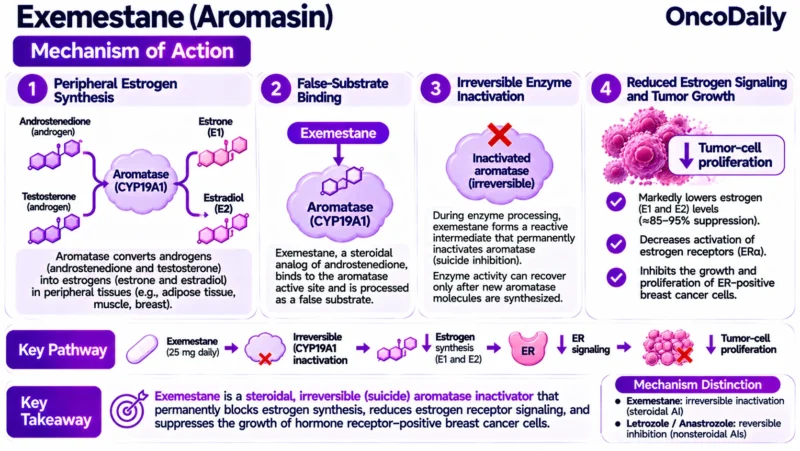
1. Peripheral Estrogen Synthesis
In postmenopausal women, aromatase converts androgen precursors into estrogens.
Estrogen subsequently activates ERα signaling in hormone-sensitive breast cancer cells.
2. Structural Mimicry of Androstenedione
Exemestane is a steroidal compound structurally related to the natural aromatase substrate androstenedione.
This allows it to interact with the enzyme’s active site.
3. Irreversible Aromatase Inactivation
Aromatase processes exemestane as a false substrate.
A reactive intermediate permanently inactivates the enzyme.
This process is called mechanism-based or suicide inhibition.
4. Suppression of Estrogen Production
Inactivated aromatase can no longer catalyze androgen-to-estrogen conversion.
At 25 mg daily, exemestane produces approximately 85–95% suppression of circulating estrogen concentrations in postmenopausal women.
5. Reduced Estrogen Receptor Signaling
Lower estradiol availability decreases ligand-dependent activation of estrogen receptors in breast cancer cells.
This reduces estrogen-regulated gene transcription.
6. Reduced Tumor-Cell Proliferation
Decreased ER signaling suppresses cell-cycle progression and proliferation in endocrine-sensitive breast cancer.
This can produce tumor regression, disease stabilization, or reduced recurrence risk.
7. Sustained Enzyme Inhibition and Resistance
Because exemestane irreversibly inactivates aromatase, enzyme activity requires synthesis of new aromatase molecules to recover.
However, breast cancer cells can develop resistance through ESR1 alterations, PI3K/AKT/mTOR signaling, and other estrogen-independent pathways.
Overall mechanism:
Exemestane → false-substrate binding to CYP19A1 → irreversible aromatase inactivation → reduced E1/E2 synthesis → decreased ERα signaling → inhibition of breast cancer-cell proliferation.
What Is the Recommended Dose of Exemestane?
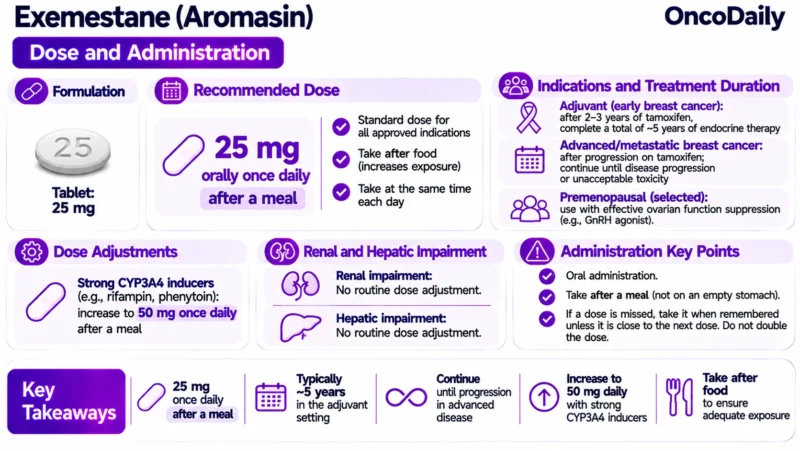
Standard Adult Dose
The FDA-recommended dose is:
Exemestane 25 mg orally once daily after a meal.
Unlike letrozole and anastrozole, exemestane should specifically be administered after food, because food increases drug exposure.
Adjuvant Treatment of Early-Stage Breast Cancer
For postmenopausal women with ER-positive early breast cancer who have received two to three years of tamoxifen:
Exemestane 25 mg once daily after a meal, continuing until a total of approximately five consecutive years of adjuvant endocrine therapy is completed.
This is the specific adjuvant regimen described in the U.S. Aromasin label.
Initial Adjuvant Exemestane
Exemestane 25 mg daily for five years has also been studied as initial adjuvant endocrine therapy.
The TEAM trial demonstrated outcomes comparable to a sequential tamoxifen–exemestane regimen.
However, five years of exemestane monotherapy is not the specific adjuvant schedule described in the standalone FDA label.
Extended Adjuvant Endocrine Therapy
Additional aromatase inhibitor treatment beyond five total years may be considered in selected patients with a higher risk of late recurrence.
The optimal duration depends on prior therapy, recurrence risk, menopausal status, and tolerability.
Extended treatment should not automatically be recommended for all patients.
Advanced or Metastatic Breast Cancer
The labeled regimen is:
25 mg orally once daily after a meal for postmenopausal women with advanced breast cancer that has progressed following tamoxifen.
Treatment generally continues until progression or unacceptable toxicity.
Exemestane Plus Everolimus
A widely established regimen for selected patients with HR-positive/HER2-negative advanced breast cancer progressing after nonsteroidal aromatase inhibitor treatment is:
- Exemestane: 25 mg orally once daily after a meal
- Everolimus: 10 mg orally once daily
Everolimus dosing may require modifications for toxicity, hepatic impairment, and drug interactions.
The combination has additional safety requirements, particularly monitoring for stomatitis, infections, pneumonitis, metabolic abnormalities, and cytopenias.
Premenopausal Breast Cancer With Ovarian Suppression
Exemestane 25 mg daily may be administered with effective ovarian function suppression in selected premenopausal women.
Exemestane should not be used as endocrine monotherapy in women with functioning ovaries.
Breast Cancer Risk Reduction
The MAP.3 trial evaluated:
Exemestane 25 mg daily for five years in postmenopausal women at increased breast cancer risk.
This is an evidence-supported risk-reduction strategy but not an FDA-approved indication for exemestane.
Dose Adjustment With Strong CYP3A4 Inducers
When exemestane must be administered with strong CYP3A4 inducers such as rifampin or phenytoin:
Increase to 50 mg orally once daily after a meal, according to the U.S. prescribing information.
Where clinically feasible, an alternative noninducing medication may be preferable.
How Should Exemestane Be Administered?
Oral Administration
Take exemestane once daily, preferably at the same time each day.
Always take it after a meal.
This administration requirement is important because taking exemestane with food increases systemic exposure.
Available Formulation
Aromasin and generic exemestane are supplied as 25 mg oral tablets.
Duration of Treatment
In the labeled adjuvant setting, exemestane completes approximately five total years of endocrine therapy after initial tamoxifen treatment.
In metastatic disease, therapy continues while clinically beneficial and tolerated.
Administration With Other Treatments
Exemestane may be combined with selected targeted therapies, including everolimus, when indicated.
Endocrine therapy is generally started after adjuvant cytotoxic chemotherapy, when chemotherapy is prescribed.
Treatment may overlap with radiotherapy according to the clinical plan.
What Should You Do If an Exemestane Dose Is Missed?
If a dose is missed:
- Take it when remembered unless the next dose is approaching.
- If nearly time for the next dose, skip the missed dose.
- Resume the normal schedule.
- Do not take two doses together.
Patients should avoid routinely taking exemestane on an empty stomach.
How Are Exemestane Dose Modifications Managed?
There is no standard toxicity-based dose-reduction algorithm for exemestane monotherapy.
Arthralgia or Musculoskeletal Symptoms
Manage mild to moderate symptoms with supportive treatment.
Severe symptoms may justify temporary interruption or switching endocrine therapy.
Bone Loss or Osteoporosis
Bone loss does not routinely require dose reduction.
Consider antiresorptive therapy and reassess endocrine treatment when skeletal toxicity is clinically significant.
Strong CYP3A4 Inducers
Increase exemestane to 50 mg daily after a meal if concomitant treatment with a strong CYP3A4 inducer cannot be avoided.
Hepatic or Renal Impairment
Routine dose adjustment is not required solely because of hepatic or renal impairment, although increased drug exposure has been documented.
Severe Hypersensitivity
Discontinue treatment in patients with clinically significant hypersensitivity.
Combination With Everolimus
Dose reductions for everolimus-related toxicity apply to everolimus, not automatically to exemestane.
What Drug Interactions Are Important With Exemestane?
Strong CYP3A4 Inducers
Exemestane is metabolized partly through CYP3A4.
Strong CYP3A4 inducers may substantially decrease systemic exposure.
Examples include:
- Rifampin
- Phenytoin
- Carbamazepine
- Phenobarbital
- St. John’s wort
If a strong inducer must be used, the U.S. label recommends exemestane 50 mg once daily after a meal.
Strong CYP3A4 Inhibitors
Unlike strong CYP3A4 inducers, strong CYP3A4 inhibitors have not consistently demonstrated clinically meaningful increases in exemestane exposure.
A ketoconazole interaction study did not show a significant effect on exemestane pharmacokinetics.
Routine dose modification for CYP3A4 inhibitors is therefore not established.
Estrogen-Containing Medications
Systemic estrogen replacement may counteract exemestane’s pharmacological effects.
Concurrent use should generally be avoided.
Tamoxifen
Exemestane and tamoxifen are usually used sequentially, not concurrently.
Targeted Anticancer Agents
Everolimus can be combined with exemestane in appropriate clinical settings.
Medication review must also account for the interactions and adverse effects of the accompanying targeted agent.
Does Exemestane Require Dose Adjustment in Renal or Hepatic Impairment?
Renal Impairment
Exemestane exposure increases in patients with moderate or severe renal impairment, particularly when creatinine clearance is below approximately 35 mL/min/1.73 m².
However, routine dose adjustment is not recommended in the U.S. prescribing information.
Patients with advanced kidney disease still require individualized clinical assessment.
Hepatic Impairment
Moderate or severe hepatic impairment can increase exemestane exposure.
Nevertheless, routine dose adjustment is not recommended in the prescribing information.
This differs from letrozole, for which a specific reduced-frequency regimen is recommended in severe hepatic dysfunction with cirrhosis.
What Is the Pharmacokinetic Profile of Exemestane?
Absorption
Exemestane is absorbed following oral administration.
Administration with food increases systemic exposure compared with fasting administration.
This is why the recommended regimen specifies after a meal.
Distribution
Exemestane is extensively distributed into tissues and approximately 90% protein-bound.
Metabolism
Exemestane is extensively metabolized, including through CYP3A4-mediated oxidation and reduction pathways.
Its metabolites generally have substantially weaker aromatase-inhibitory activity than the parent compound.
Elimination Half-Life
Approximately 24 hours.
However, irreversible enzyme inhibition allows the pharmacodynamic effect to persist beyond the plasma elimination half-life.
Estrogen Suppression
The recommended 25 mg daily dose produces approximately 85–95% suppression of circulating estrogens.
Whole-body aromatization is reduced by approximately 98% in postmenopausal women with breast cancer.
Excretion
Exemestane is eliminated primarily as metabolites through urine and feces.
Steroidogenesis
At therapeutic doses, exemestane does not meaningfully suppress cortisol or aldosterone synthesis.
Routine glucocorticoid or mineralocorticoid replacement is therefore unnecessary.
What Are the Clinical Uses of Exemestane?
Adjuvant Treatment of HR-Positive Early Breast Cancer
Exemestane is FDA-approved for postmenopausal patients with ER-positive early breast cancer who switch to exemestane after two to three years of tamoxifen.
The treatment sequence completes a total of approximately five years of endocrine treatment.
Initial Adjuvant Endocrine Therapy
Exemestane has been studied as initial endocrine monotherapy in postmenopausal early breast cancer.
Its use should follow contemporary clinical guidance, with recognition that the standalone U.S. label specifically describes the tamoxifen-to-exemestane switching strategy.
Advanced or Metastatic Breast Cancer
Exemestane is FDA-approved for postmenopausal women with advanced breast cancer following progression on tamoxifen.
In contemporary practice, its role depends on prior endocrine exposure, endocrine resistance, molecular biomarkers, and available targeted combinations.
Endocrine-Resistant Metastatic Breast Cancer
Exemestane plus everolimus is an established option for selected patients with HR-positive/HER2-negative advanced breast cancer after progression on letrozole or anastrozole.
The combination targets both estrogen synthesis and mTOR signaling.
Premenopausal Breast Cancer With Ovarian Suppression
Exemestane plus ovarian function suppression is an established endocrine strategy for selected higher-risk premenopausal patients.
This approach was extensively studied in TEXT and SOFT.
Breast Cancer Risk Reduction
Exemestane has demonstrated reduced invasive breast cancer incidence in high-risk postmenopausal women.
The MAP.3 trial supports its risk-reduction activity.
However, this indication is not FDA-approved.
What Molecular Testing Is Required Before Exemestane?
Estrogen Receptor Testing
ER testing is essential when selecting exemestane for early-stage hormone-dependent invasive breast cancer.
ER positivity is defined by immunohistochemistry showing nuclear staining in at least 1% of invasive tumor cells.
Patients with ER-low expression may derive less predictable endocrine benefit.
Progesterone Receptor Testing
PR testing provides additional information regarding hormone sensitivity.
HER2 Testing
HER2 status should be determined in invasive breast cancer to guide the broader systemic treatment strategy.
Menopausal Status
Confirm menopause before prescribing exemestane alone.
If used in premenopausal patients, effective ovarian suppression is essential.
ESR1 Mutation Testing
ESR1 mutations can cause ligand-independent estrogen receptor activation and contribute to aromatase inhibitor resistance.
In metastatic disease, ESR1 testing may inform the choice of subsequent endocrine therapy.
Additional Molecular Biomarkers
Relevant biomarkers in advanced HR-positive/HER2-negative breast cancer may include:
- PIK3CA
- AKT1
- PTEN
- BRCA1/2
These tests guide treatment sequencing and targeted therapy selection rather than routine exemestane dosing.
What Did the Pivotal Clinical Trials Show?
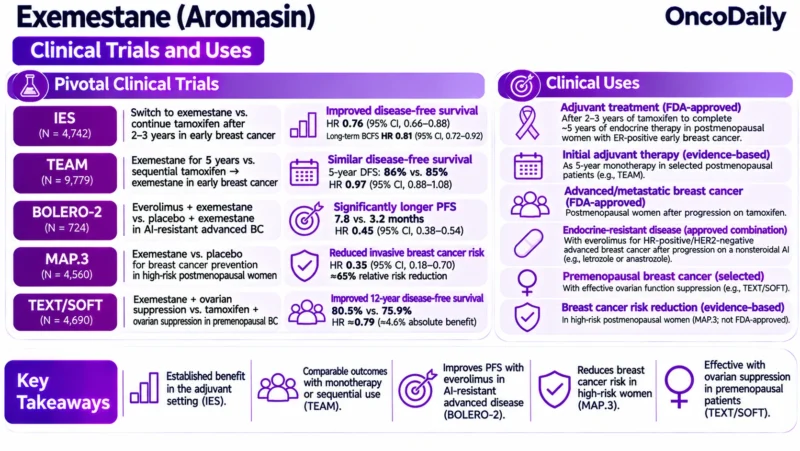
1. IES — Switching From Tamoxifen to Exemestane
The Intergroup Exemestane Study (IES) randomized approximately 4,742 postmenopausal women with early breast cancer who had remained disease-free after two to three years of tamoxifen.
Patients were assigned to switch to exemestane or continue tamoxifen to complete five years of endocrine therapy.
Disease-Free Survival — Approximately 56-Month Follow-Up
- Exemestane events: 354
- Tamoxifen events: 455
Hazard Ratio: 0.76 (95% CI, 0.66–0.88)
P = 0.0001
In the long-term analysis, switching to exemestane reduced breast cancer-related events.
Ten-Year Breast Cancer-Free Survival
- Hazard ratio: 0.81 (95% CI, 0.72–0.92)
- Absolute difference: 4.0 percentage points
These findings established switching to exemestane after two to three years of tamoxifen as an effective adjuvant endocrine strategy.
The long-term analysis showed a modest overall survival difference that was not statistically significant in the ER-positive/unknown population.
2. TEAM — Exemestane Monotherapy Versus Sequential Tamoxifen–Exemestane
The TEAM trial randomized 9,779 postmenopausal women with HR-positive early breast cancer.
Participants received either:
- Exemestane 25 mg daily for five years
- Tamoxifen followed by exemestane for a total of five years
Five-Year Disease-Free Survival
- Exemestane alone: 86%
- Sequential treatment: 85%
Hazard Ratio: 0.97 (95% CI, 0.88–1.08)
P = 0.60
No significant difference in disease-free survival was demonstrated.
The trial supported both strategies as reasonable endocrine options for appropriate postmenopausal patients.
3. BOLERO-2 — Everolimus Plus Exemestane
BOLERO-2 (NCT00863655) was a randomized phase III study involving 724 postmenopausal women with HR-positive/HER2-negative advanced breast cancer after progression on letrozole or anastrozole.
Patients received everolimus plus exemestane or placebo plus exemestane.
Median Progression-Free Survival — Investigator Assessment
- Everolimus + exemestane: 7.8 months
- Placebo + exemestane: 3.2 months
Hazard Ratio: 0.45 (95% CI, 0.38–0.54)
P < 0.0001
Median Progression-Free Survival — Independent Central Review
- Everolimus + exemestane: 11.0 months
- Placebo + exemestane: 4.1 months
Hazard Ratio: 0.38 (95% CI, 0.31–0.48)
The combination substantially improved progression-free survival.
However, the final overall survival analysis did not demonstrate a statistically significant improvement.
The added efficacy reflects the contribution of everolimus, rather than superiority of exemestane alone.
Read More: EVERGREEN Study: Everolimus Shows Modest Benefit After CDK4/6 Progression by OncoDaily.
4. MAP.3 — Exemestane for Breast Cancer Prevention
MAP.3 (NCT00083174) was a randomized, double-blind, placebo-controlled trial enrolling 4,560 postmenopausal women at increased breast cancer risk.
Participants received exemestane 25 mg daily or placebo.
At a median follow-up of 35 months:
Invasive Breast Cancer Cases
- Exemestane: 11
- Placebo: 32
Hazard Ratio: 0.35 (95% CI, 0.18–0.70)
P = 0.002
Relative Reduction in Invasive Breast Cancer Incidence: 65%
The study demonstrated that exemestane can substantially reduce invasive breast cancer incidence in selected high-risk postmenopausal women.
However, primary breast cancer prevention is not an FDA-approved exemestane indication.
5. TEXT and SOFT — Exemestane Plus Ovarian Suppression
The combined analysis of TEXT and SOFT evaluated endocrine treatment in premenopausal women with HR-positive early breast cancer.
The comparison included 4,690 women assigned to exemestane plus ovarian suppression or tamoxifen plus ovarian suppression.
At 12 years:
Disease-Free Survival
Exemestane plus ovarian suppression improved disease-free survival compared with tamoxifen plus ovarian suppression.
Absolute DFS Improvement: 4.6 percentage points
Hazard Ratio: Approximately 0.79
Distant recurrence-free outcomes also favored exemestane plus ovarian suppression.
The overall survival difference was not statistically significant in the combined population, although clinically important benefits were observed in selected higher-risk subgroups.
These trials established exemestane plus ovarian suppression as an important option for premenopausal women at increased recurrence risk.
Does Exemestane Have CNS Activity?
Exemestane is not considered a CNS-directed anticancer agent.
Evidence supporting meaningful intracranial efficacy as monotherapy is limited.
In patients with HR-positive metastatic breast cancer and brain metastases, treatment selection should consider neurological symptoms, tumor biology, systemic disease status, previous endocrine therapy, and available CNS-directed treatments.
Exemestane is not approved for primary CNS malignancies.
Is Exemestane FDA Approved?
Yes.
Exemestane was first approved in the United States in 1999.
The standalone Aromasin label includes:
- Adjuvant treatment: Postmenopausal women with ER-positive early breast cancer who have received two to three years of tamoxifen and switch to exemestane to complete five years of endocrine treatment.
- Advanced breast cancer: Postmenopausal women whose disease has progressed following tamoxifen treatment.
Exemestane is also part of an approved everolimus-containing combination for selected patients with advanced HR-positive/HER2-negative breast cancer following progression on nonsteroidal aromatase inhibitors.
Primary breast cancer prevention and treatment of premenopausal women are not indications of the standalone Aromasin label.
What Is the Current Clinical Role of Exemestane in 2026?
Exemestane remains a useful steroidal aromatase inhibitor for endocrine-sensitive and selected endocrine-resistant breast cancer settings.
In early breast cancer, it is an established component of sequential endocrine treatment following tamoxifen.
For appropriately selected premenopausal women, exemestane combined with ovarian suppression can improve recurrence-related outcomes compared with tamoxifen-based endocrine strategies.
In metastatic HR-positive/HER2-negative disease, exemestane may be used after previous endocrine treatment, particularly in combination with everolimus.
However, contemporary treatment sequencing increasingly depends on prior CDK4/6 inhibitor exposure, ESR1 mutation status, PI3K/AKT pathway alterations, and other targeted treatment options.
Exemestane’s irreversible mechanism distinguishes it pharmacologically from letrozole and anastrozole, but treatment selection must be guided by clinical evidence rather than mechanism alone.
What Are the Major Side Effects of Exemestane?
Arthralgia and Musculoskeletal Pain
Arthralgia is one of the most common adverse effects of exemestane.
Patients may experience joint pain, stiffness, myalgia, and reduced mobility.
In the IES safety analysis, arthralgia was reported in approximately 15% of patients receiving exemestane versus 9% receiving tamoxifen.
Persistent musculoskeletal symptoms can contribute to treatment interruption and reduced adherence.
Bone Mineral Density Loss
Exemestane causes sustained estrogen deprivation, which increases bone turnover and reduces bone mineral density.
Potential complications include:
- Osteopenia
- Osteoporosis
- Fragility fractures
- Accelerated bone loss in patients with additional risk factors
Baseline bone mineral density assessment is important, particularly for patients with osteoporosis or increased fracture risk.
Fractures
Long-term aromatase inhibition increases fracture risk compared with tamoxifen in certain treatment populations.
The risk should be evaluated alongside age, baseline bone density, prior fractures, and other clinical factors.
Vasomotor Symptoms
Hot flashes and increased sweating are frequently reported.
In the IES trial:
- Hot flashes: 21% with exemestane versus 20% with tamoxifen
- Increased sweating: 12% versus 10%
Fatigue and Insomnia
Fatigue, sleep disturbance, and reduced energy may affect quality of life.
In IES:
- Fatigue: 16% versus 15%
- Insomnia: 12% versus 9%
Cardiovascular Events
Cardiovascular risk should be considered, particularly in patients with pre-existing disease.
In IES, cardiac ischemic events were reported in:
- Exemestane: 1.6%
- Tamoxifen: 0.6%
These findings require interpretation in the context of patient characteristics and tamoxifen’s biological effects.
Lipid Changes
Exemestane may affect lipid metabolism, including reductions in HDL cholesterol.
The extent and clinical relevance of lipid changes vary across studies.
Vaginal and Genitourinary Symptoms
Potential adverse effects include vaginal dryness, dyspareunia, and other symptoms associated with estrogen deprivation.
Gastrointestinal Symptoms
Nausea, abdominal discomfort, and other gastrointestinal symptoms may occur.
Taking exemestane after food is important for appropriate drug exposure, although it does not eliminate all gastrointestinal adverse effects.
Mood Changes
Depression, anxiety, and other mood-related symptoms have been reported.
Persistent symptoms should prompt assessment and supportive care.
Hepatic Toxicity
Rare cases of hepatitis, including cholestatic hepatitis, have been reported.
Clinically significant liver abnormalities require evaluation.
Hypersensitivity and Dermatological Reactions
Rare reactions include urticaria, pruritus, and serious cutaneous reactions.
Tendonitis, tenosynovitis, and tendon rupture have also been reported after marketing.
Pregnancy and Reproductive Toxicity
Exemestane can cause fetal harm.
For patients with reproductive potential, pregnancy testing is recommended within seven days before starting treatment.
Effective contraception should be used during treatment and for one month after the final dose.
Breastfeeding is not recommended during treatment or for one month after the final dose.
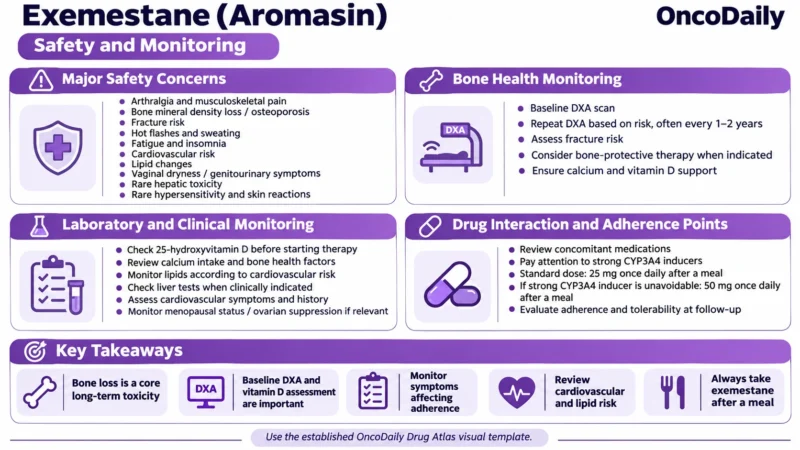
What Monitoring Is Required During Exemestane Treatment?
Bone Mineral Density
Assess baseline bone mineral density, generally by DXA, particularly in patients with osteoporosis or increased fracture risk.
Repeat assessment according to risk, often every one to two years in patients receiving prolonged aromatase inhibitor therapy.
Vitamin D Status
The U.S. prescribing information recommends routine assessment of 25-hydroxyvitamin D before starting aromatase inhibitor treatment.
Correct vitamin D deficiency when present.
Calcium and Bone Health
Assess calcium intake, nutritional status, physical activity, and other bone-health factors.
Consider bone-protective therapy for patients with osteoporosis or elevated fracture risk.
Musculoskeletal Symptoms
Review arthralgia, stiffness, muscle pain, and functional limitations during follow-up.
Early symptom management can support treatment adherence.
Cardiovascular Risk
Assess hypertension, diabetes, dyslipidemia, smoking status, and established cardiovascular disease.
Investigate new chest pain or other symptoms suggestive of ischemic disease.
Lipid Profile
Monitor lipids according to cardiovascular risk and clinical circumstances.
Liver Function
Evaluate liver enzymes and bilirubin when clinically indicated, particularly in patients with liver disease or suspected toxicity.
Menopausal Status
Confirm postmenopausal status before exemestane monotherapy.
If exemestane is used with ovarian suppression, reassess ovarian function when suppression is uncertain.
Drug Interactions
Review concomitant medications, particularly strong CYP3A4 inducers.
Treatment Adherence
Regularly evaluate adherence, tolerability, and the expected duration of endocrine treatment.
Cancer Surveillance
Continue appropriate breast imaging and clinical follow-up according to treatment setting.