





Eribulin: Understanding Its Mechanism, Dosing, and Clinical Role in Cancer
Key takeaways
- Eribulin is a non-taxane microtubule dynamics inhibitor derived from the halichondrin B structure.
- It primarily inhibits microtubule growth, producing mitotic blockade and cancer-cell death.
- The standard dose is 1.4 mg/m² IV on Days 1 and 8 every 21 days.
- Administration takes only 2–5 minutes.
- Eribulin is FDA-approved for selected patients with metastatic breast cancer and unresectable or metastatic liposarcoma.
- EMBRACE demonstrated an overall-survival benefit in heavily pretreated metastatic breast cancer.
- A phase III sarcoma trial demonstrated an overall-survival advantage over dacarbazine, with particularly pronounced benefit in liposarcoma.
- Neutropenia and peripheral neuropathy are major treatment-limiting toxicities.
- Reduced starting doses are required in renal and hepatic impairment.
- QT prolongation is an important but less common safety consideration.
Eribulin mesylate (Halaven) is a non-taxane microtubule dynamics inhibitor used primarily in metastatic breast cancerand unresectable or metastatic liposarcoma. It is a synthetic analog of halichondrin B, a natural compound originally isolated from a marine sponge.
Unlike taxanes, which stabilize microtubules, eribulin primarily inhibits microtubule growth without significantly affecting the shortening phase. This produces abnormal mitotic spindles, prolonged mitotic blockade, and ultimately cancer-cell death.
Eribulin received its initial FDA approval in 2010 for metastatic breast cancer and later received approval for unresectable or metastatic liposarcoma following prior anthracycline-containing therapy.
Key Facts
- Generic name: Eribulin mesylate
- Brand name: Halaven
- Drug class: Non-taxane microtubule dynamics inhibitor
- Route: Intravenous
- Initial FDA approval: 2010
- FDA-approved indications: Metastatic breast cancer and unresectable/metastatic liposarcoma
- Standard dose: 1.4 mg/m² IV on Days 1 and 8 of a 21-day cycle
- Administration time: 2–5 minutes
- Available concentration: 0.5 mg/mL
- Major mechanism: Inhibition of microtubule growth
- Major toxicities: Neutropenia, peripheral neuropathy, fatigue, alopecia, nausea, and anemia
- Premedication: Not routinely required
- In-line filter: No routine in-line filter requirement
- Important monitoring: CBC, peripheral neuropathy, liver and renal function, and QT-risk factors
Some non-US product information expresses the dose as 1.23 mg/m² of eribulin, which is equivalent to 1.4 mg/m² of eribulin mesylate.
What Is Eribulin?
Eribulin is a fully synthetic analog of halichondrin B, a structurally complex natural product originally isolated from the marine sponge Halichondria okadai.
Its anticancer activity is based principally on disruption of microtubule dynamics.
Microtubules are essential for:
- Formation of the mitotic spindle
- Chromosome segregation
- Intracellular transport
- Maintenance of cellular architecture
Eribulin interacts with tubulin differently from taxanes and classic vinca alkaloids.
Rather than simply stabilizing or broadly depolymerizing microtubules, eribulin preferentially suppresses microtubule growth, producing nonfunctional mitotic structures and prolonged cell-cycle arrest.
What Is the Mechanism of Action of Eribulin?
1. Binding to Tubulin
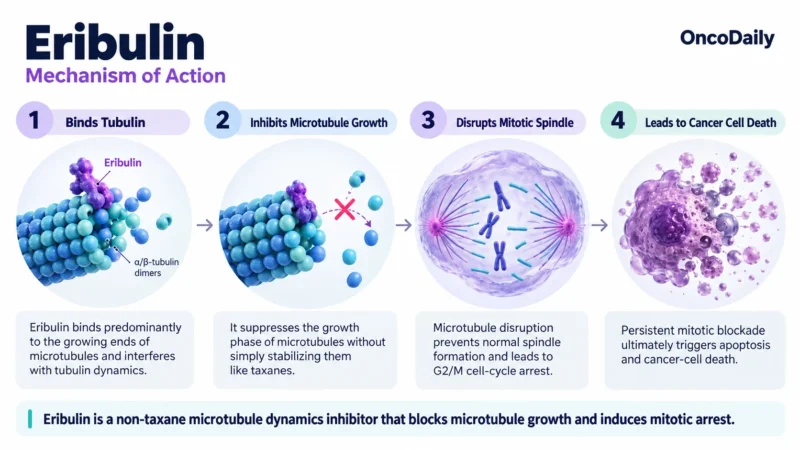
Eribulin interacts predominantly with tubulin at the growing ends of microtubules.
2. Inhibition of Microtubule Growth
Eribulin suppresses the growth phase of microtubule dynamics.
Unlike taxanes, it does not stabilize microtubules.
Unlike classical vinca alkaloids, its major effect is not simply generalized microtubule depolymerization.
3. Formation of Nonproductive Tubulin Aggregates
Tubulin becomes sequestered into nonfunctional aggregates, reducing the amount available for normal microtubule assembly.
4. Mitotic Spindle Disruption
Because functional microtubules are essential for chromosome segregation, inhibition of microtubule growth prevents formation of a normal mitotic spindle.
5. G2/M Cell-Cycle Blockade
Cancer cells accumulate in the G2/M phase and cannot complete mitosis.
6. Cancer-Cell Death
Persistent mitotic blockade ultimately triggers apoptosis and cancer-cell death.
The mechanism can be summarized as:
Eribulin → inhibition of microtubule growth → abnormal mitotic spindle → G2/M blockade → apoptosis → cancer-cell death.
What Is the Dose of Eribulin?
The standard FDA-recommended dose is:
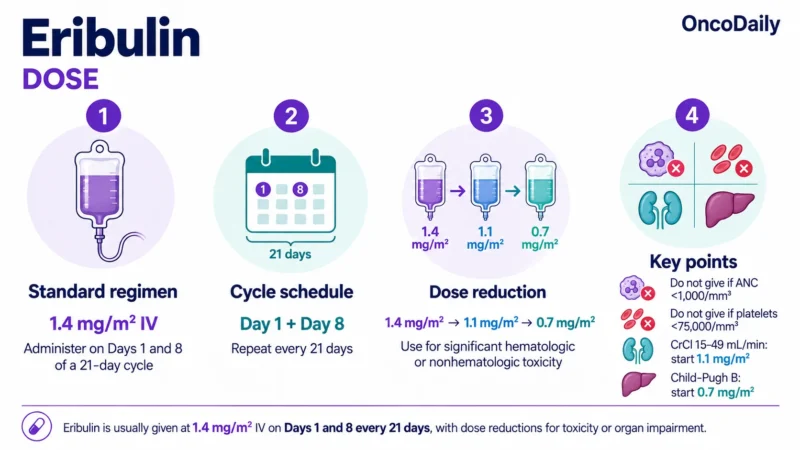
1.4 mg/m² IV over 2–5 minutes on Days 1 and 8 of each 21-day cycle.
This schedule is used for both:
- Metastatic breast cancer
- Unresectable or metastatic liposarcoma
Treatment continues according to clinical response and tolerability.
Dose Modifications
Eribulin treatment should not be administered on Day 1 or Day 8 when:
- ANC <1,000/mm³
- Platelets <75,000/mm³
- Grade 3 or 4 nonhematologic toxicity is present
If toxicity prevents administration of the Day 8 dose, treatment may be delayed for up to one week.
If recovery has not occurred by Day 15, the dose should generally be omitted.
Dose-Reduction Sequence
When dose reduction is required:
1.4 mg/m² → 1.1 mg/m² → 0.7 mg/m²
Once a dose has been reduced, it should generally not be re-escalated.
Dose reduction may be required following:
- Prolonged severe neutropenia
- Febrile neutropenia
- Severe thrombocytopenia
- Grade 3–4 nonhematologic toxicity
- Significant peripheral neuropathy
How Is Eribulin Administered?
Eribulin is administered:
Intravenously over 2–5 minutes.
This relatively short administration time distinguishes it from many other cytotoxic chemotherapy drugs.
Available Formulation
Eribulin mesylate injection is supplied as:
1 mg/2 mL
with a concentration of:
0.5 mg/mL.
Preparation
Eribulin may be administered:
- Undiluted, or
- Diluted in up to 100 mL of 0.9% sodium chloride
Important Compatibility Point
Eribulin should not be diluted in dextrose-containing solutions.
It should also not be mixed with other medications in the same infusion preparation.
Stability
Prepared eribulin may generally be stored for limited periods under room-temperature or refrigerated conditions according to the specific product instructions.
Where possible, freshly prepared medication should be administered promptly.
Does Eribulin Require an In-Line Filter?
No routine in-line filter is specified for eribulin administration.
Does Eribulin Require Premedication?
Routine corticosteroid or antihistamine premedication is not required.
Antiemetic prophylaxis may be used according to patient-specific risk and institutional practice.
Does Eribulin Require Renal or Hepatic Dose Adjustment?
Renal Impairment
Eribulin exposure increases in patients with moderate or severe renal impairment.
For patients with:
Creatinine clearance 15–49 mL/min
the recommended starting dose is:
1.1 mg/m² IV on Days 1 and 8 every 21 days.
Patients should be monitored carefully for hematologic and nonhematologic toxicity.
Hepatic Impairment
Hepatic dysfunction also increases eribulin exposure.
Mild Hepatic Impairment
For Child-Pugh A hepatic impairment:
1.1 mg/m² IV on Days 1 and 8 every 21 days.
Moderate Hepatic Impairment
For Child-Pugh B hepatic impairment:
0.7 mg/m² IV on Days 1 and 8 every 21 days.
Eribulin has not been adequately studied in patients with severe hepatic impairment.
What Is the Pharmacokinetic Profile of Eribulin?
Distribution
Eribulin demonstrates extensive tissue distribution.
Its apparent volume of distribution at steady state is approximately:
43–114 L/m².
Plasma protein binding is relatively low compared with many anticancer drugs, at approximately:
49–65%.
Metabolism
Eribulin undergoes relatively limited metabolism.
It is not extensively metabolized through CYP pathways, although interactions involving CYP3A4 have been investigated.
Elimination
Eribulin is eliminated predominantly through the:
Fecal route.
Approximately:
- 82% of administered radioactivity is recovered in feces
- Around 9% is recovered in urine
Most circulating drug remains unchanged eribulin.
Half-Life
The terminal elimination half-life is approximately:
40 hours.
What Are the Clinical Uses of Eribulin?
Metastatic Breast Cancer
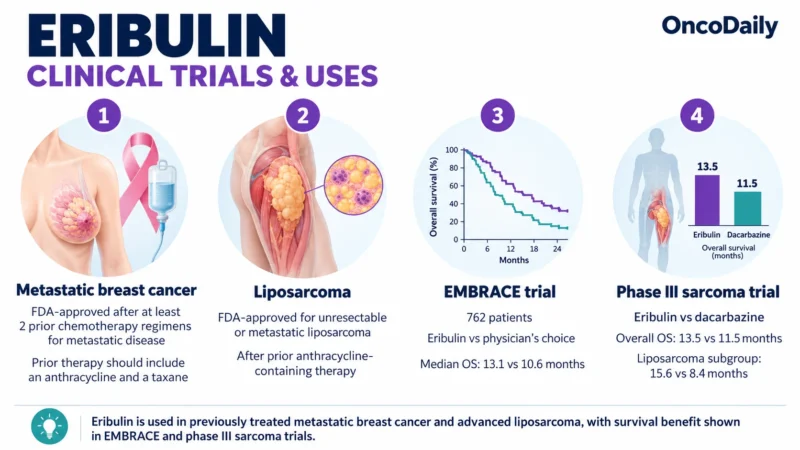
Eribulin is FDA-approved for patients with metastatic breast cancer who have previously received at least two chemotherapy regimens for metastatic disease.
Prior treatment should have included:
- An anthracycline
- A taxane
in either the adjuvant or metastatic setting, unless these treatments were inappropriate for the patient.
Eribulin demonstrated an overall-survival advantage in heavily pretreated metastatic breast cancer in the pivotal EMBRACE trial.
Its role today is particularly relevant in patients who have already received several prior systemic therapies.
Triple-Negative Breast Cancer
Eribulin has demonstrated activity in triple-negative breast cancer and is used in selected patients with previously treated metastatic disease.
However, treatment sequencing has evolved substantially with the introduction of:
- Antibody-drug conjugates
- Immunotherapy
- PARP inhibitors in selected patients
- Other biomarker-directed approaches
Eribulin therefore generally represents one of several later-line chemotherapy options rather than a universal preferred treatment.
HER2-Negative Metastatic Breast Cancer
Eribulin may also be used in previously treated hormone receptor-positive/HER2-negative metastatic breast cancer after exhaustion or progression on appropriate endocrine and targeted therapies.
Liposarcoma
Eribulin is FDA-approved for:
Unresectable or metastatic liposarcoma following a prior anthracycline-containing regimen.
This approval was based on a phase III comparison of eribulin with dacarbazine.
Importantly, the regulatory indication applies specifically to liposarcoma, despite the pivotal trial enrolling both liposarcoma and leiomyosarcoma.
What Did Eribulin Clinical Trials Show?
EMBRACE: Eribulin in Metastatic Breast Cancer
The phase III EMBRACE trial evaluated eribulin in heavily pretreated patients with locally recurrent or metastatic breast cancer.
The study enrolled:
762 patients.
Patients were randomized to:
- Eribulin
- Treatment of physician’s choice
Median Overall Survival
- Eribulin: 13.1 months
- Treatment of physician’s choice: 10.6 months
Eribulin reduced the relative hazard of death by approximately:
19%.
The trial was particularly important because it demonstrated an overall-survival benefit with single-agent chemotherapy in a heavily pretreated metastatic breast cancer population.
These findings supported the initial FDA approval of eribulin.
Watch more: Eribulin and the EMBRACE Study: Efficacy, Side-Effect Management and Patient Selection — Prof. Javier Cortés discusses the pivotal phase III EMBRACE trial, including the survival benefit of eribulin in heavily pretreated metastatic breast cancer.
Study 301: Eribulin Versus Capecitabine
Another phase III trial compared:
Eribulin versus capecitabine
in patients with previously treated locally advanced or metastatic breast cancer.
Median Overall Survival
- Eribulin: approximately 15.9 months
- Capecitabine: approximately 14.5 months
The difference did not meet the prespecified threshold for statistical superiority.
Progression-free survival was also similar between the treatment groups.
Although the trial did not demonstrate superiority over capecitabine, it provided additional evidence supporting eribulin’s antitumor activity in previously treated breast cancer.
Phase III Eribulin Versus Dacarbazine in Liposarcoma and Leiomyosarcoma
A pivotal phase III trial compared:
Eribulin versus dacarbazine
in patients with advanced liposarcoma or leiomyosarcoma previously treated with anthracycline-containing therapy.
The study enrolled:
452 patients.
Overall Population
Median overall survival was:
- Eribulin: 13.5 months
- Dacarbazine: 11.5 months
The study demonstrated a statistically significant overall-survival advantage for eribulin.
Liposarcoma Subgroup
The benefit was particularly pronounced in patients with liposarcoma.
Median overall survival was approximately:
- Eribulin: 15.6 months
- Dacarbazine: 8.4 months
This finding formed the basis for FDA approval of eribulin in unresectable or metastatic liposarcoma after prior anthracycline therapy.
Eribulin is not FDA-approved for leiomyosarcoma on the basis of this study.
Is Eribulin FDA Approved?
Yes.
Eribulin received its initial FDA approval in 2010.
Its current major US indications are:
- Metastatic breast cancer after prior anthracycline- and taxane-containing therapy and at least two prior chemotherapy regimens for metastatic disease
- Unresectable or metastatic liposarcoma following a prior anthracycline-containing regimen
The liposarcoma indication was added in 2016.
What Is the Current Clinical Role of Eribulin?
Eribulin remains an important later-line cytotoxic treatment in metastatic breast cancer and a distinct systemic treatment option in previously treated advanced liposarcoma.
Eribulin remains an important later-line treatment option in advanced liposarcoma. Learn more about liposarcoma, including its subtypes, diagnosis, staging, and treatment, on OncoDaily.
Its role in breast cancer has evolved as the treatment landscape has expanded to include antibody-drug conjugates and molecularly targeted therapies.
Patient selection therefore depends increasingly on:
- Breast cancer subtype
- HER2 expression
- Germline and somatic biomarkers
- Previous antibody-drug conjugates
- Previous taxane exposure
- Treatment-related neuropathy
- Bone-marrow reserve
- Patient preference and performance status
In liposarcoma, eribulin remains one of the relatively small number of agents supported by randomized phase III evidence demonstrating an overall-survival benefit.
What Are the Major Side Effects of Eribulin?
Common and clinically important adverse effects include:
- Neutropenia
- Anemia
- Leukopenia
- Peripheral neuropathy
- Fatigue
- Alopecia
- Nausea
- Constipation
- Reduced appetite
- Arthralgia and myalgia
- Fever
- Electrolyte abnormalities
Neutropenia
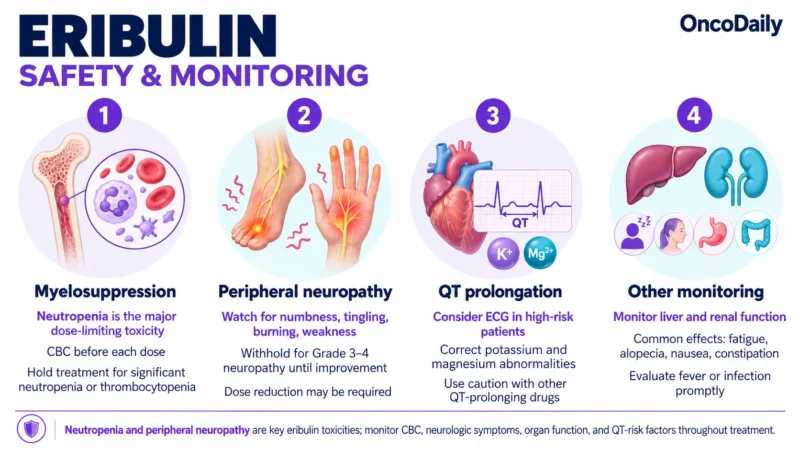
Myelosuppression, particularly neutropenia, is one of the most important toxicities of eribulin.
Severe neutropenia may lead to:
- Febrile neutropenia
- Infection
- Sepsis
- Treatment delays
- Dose reduction
CBC should be monitored before each treatment dose.
Peripheral Neuropathy
Eribulin can cause cumulative peripheral neuropathy.
Symptoms may include:
- Numbness
- Tingling
- Burning sensations
- Sensory loss
- Weakness
- Difficulty with fine motor function
Treatment should be withheld for:
Grade 3 or 4 peripheral neuropathy
until improvement to Grade 2 or lower.
Dose reduction may subsequently be necessary.
Fatigue
Fatigue and asthenia are common during treatment and may be compounded by anemia, prior therapy, advanced malignancy, and nutritional factors.
Alopecia
Hair loss is common with eribulin.
Gastrointestinal Toxicity
Potential gastrointestinal effects include:
- Nausea
- Vomiting
- Constipation
- Diarrhea
- Reduced appetite
Constipation should be monitored carefully, particularly in patients with pre-existing bowel dysfunction.
QT Prolongation
Eribulin can prolong the QT interval.
ECG monitoring should be considered in patients with:
- Congestive heart failure
- Bradyarrhythmias
- Congenital long-QT syndrome
- Concomitant QT-prolonging medications
- Significant electrolyte abnormalities
Electrolytes such as potassium and magnesium should be corrected before treatment when abnormal.
Embryo-Fetal Toxicity
Eribulin can cause fetal harm.
Appropriate contraception and reproductive counseling should be provided according to current prescribing information.
What Monitoring Is Required?
Monitoring should include:
- CBC before each dose
- Absolute neutrophil count
- Platelet count
- Hemoglobin
- Peripheral neuropathy assessment
- Liver function
- Renal function
- Potassium and magnesium when clinically indicated
- ECG in patients at increased risk of QT prolongation
- Signs of infection
- Treatment tolerance and performance status
Particular attention should be given to neutropenia and peripheral neuropathy, which commonly determine treatment delays and dose modifications.