


Elotuzumab (Empliciti): Mechanism of Action, Dosing, Clinical Uses, Trials, and Side Effects
Key takeaways
- Elotuzumab is a humanized SLAMF7-directed IgG1κ monoclonal antibody.
- It promotes NK-cell activation and antibody-dependent cellular cytotoxicity.
- It was initially FDA approved in November 2015.
- It is used with lenalidomide/dexamethasone or pomalidomide/dexamethasone.
- Elo-Rd uses 10 mg/kg IV, initially weekly and then every two weeks.
- Elo-Pd uses 10 mg/kg IV weekly for two cycles, followed by 20 mg/kg every four weeks.
- ELOQUENT-2 demonstrated median PFS of 19.4 versus 14.9 months and final median OS of 48.3 versus 39.6 months.
- ELOQUENT-3 demonstrated median PFS of 10.3 versus 4.7 months and median OS of 29.8 versus 17.4 months.
- Elotuzumab has limited activity as monotherapy.
- Major risks include infusion reactions, infections, hepatotoxicity, and second primary malignancies.
- Premedication, CBC monitoring, infection surveillance, and liver-function assessment are essential.
Elotuzumab (Empliciti) is a humanized IgG1κ monoclonal antibody targeting SLAMF7 (Signaling Lymphocytic Activation Molecule Family Member 7), also known as CS1 or CD319. SLAMF7 is highly expressed on malignant plasma cells and natural killer (NK) cells.
Unlike anti-CD38 antibodies such as daratumumab and isatuximab, elotuzumab primarily works by promoting immune-mediated tumor-cell destruction through antibody-dependent cellular cytotoxicity (ADCC) and activating NK-cell activity.
Elotuzumab received its first FDA approval on November 30, 2015, for relapsed or refractory multiple myeloma (RRMM) in combination with lenalidomide and dexamethasone. In November 2018, approval expanded to include pomalidomide and dexamethasone after at least two prior therapies.
Elotuzumab is administered intravenously at 10 mg/kg or 20 mg/kg, depending on the combination regimen and treatment cycle.
Its clinical efficacy was established in the pivotal ELOQUENT-2 and ELOQUENT-3 trials, which demonstrated improvements in progression-free survival and overall survival in selected previously treated patients.
Key Facts
- Generic name: Elotuzumab
- Brand name: Empliciti
- Drug class: SLAMF7-directed immunostimulatory monoclonal antibody
- Antibody type: Humanized IgG1κ
- Molecular target: SLAMF7 (CS1/CD319)
- Mechanism: NK-cell activation and ADCC
- Initial FDA approval: November 30, 2015
- Administration: Intravenous infusion
- Recommended doses: 10 mg/kg and 20 mg/kg
- Available strengths: 300 mg and 400 mg single-dose vials
- Main indication: Relapsed or refractory multiple myeloma
- Approved combinations: Elotuzumab–lenalidomide–dexamethasone (Elo-Rd) and elotuzumab–pomalidomide–dexamethasone (Elo-Pd)
- Pivotal trials: ELOQUENT-2 and ELOQUENT-3
- Additional trial: ELOQUENT-1
- Essential biomarker: No mandatory molecular biomarker
- Common adverse reactions: Fatigue, infections, diarrhea, constipation, fever, and cough
- Serious adverse events: Infusion reactions, serious infections, hepatotoxicity, and second primary malignancies
- Important monitoring: CBC, infection surveillance, liver function, infusion reactions, and myeloma response
- Metabolism: Proteolytic catabolism
- Important distinction: Elotuzumab has limited clinically meaningful activity as monotherapy and is used with immunomodulatory drugs and dexamethasone.
What Is Elotuzumab?
Elotuzumab is a monoclonal antibody designed to recognize SLAMF7, a cell-surface protein expressed on malignant plasma cells and NK cells.
SLAMF7 participates in immune-cell signaling and cellular interactions.
Its expression on multiple myeloma cells provides a target for antibody-mediated immune recognition.
Elotuzumab has a distinctive biological mechanism because it interacts with SLAMF7 on both tumor cells and immune effector cells.
When bound to malignant plasma cells, elotuzumab facilitates their recognition and destruction by NK cells.
It can also enhance NK-cell activity through SLAMF7-dependent signaling.
Unlike daratumumab and isatuximab, which target CD38, elotuzumab targets SLAMF7 and relies predominantly on NK-cell-mediated antitumor activity.
What Is the Mechanism of Action of Elotuzumab?
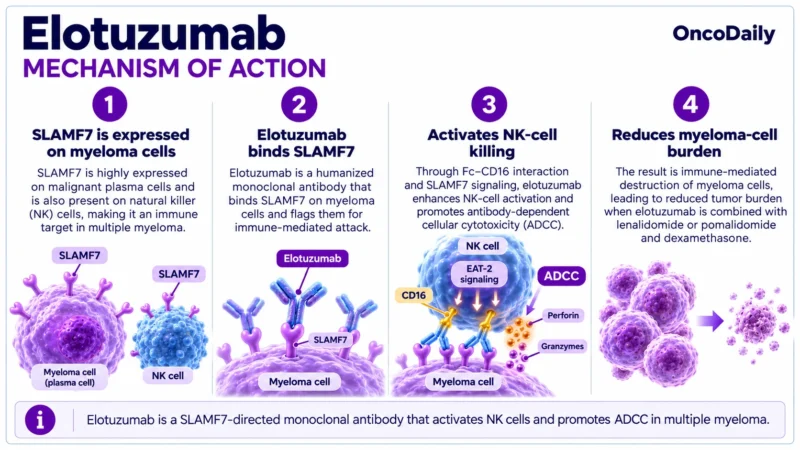
1. SLAMF7 Is Expressed on Myeloma Cells
SLAMF7 is expressed at high levels on malignant plasma cells.
It is also present on NK cells and subsets of other immune cells.
This provides an opportunity to connect tumor-cell recognition with immune effector activity.
2. Elotuzumab Binds SLAMF7 on Myeloma Cells
Elotuzumab recognizes the extracellular domain of SLAMF7.
The antibody coats malignant plasma cells, allowing immune effector cells to recognize its Fc region.
3. Antibody-Dependent Cellular Cytotoxicity Is Activated
NK cells express FcγRIIIa (CD16), which interacts with the Fc portion of elotuzumab bound to myeloma cells.
This interaction activates NK cells and promotes the release of:
- Perforin
- Granzymes
These cytotoxic molecules induce myeloma-cell death.
ADCC is a principal antitumor mechanism of elotuzumab.
4. NK-Cell Activity Is Enhanced
SLAMF7 signaling in NK cells involves the intracellular adaptor protein EAT-2.
Elotuzumab can stimulate NK-cell activity through this pathway, supporting antitumor immune responses.
5. Immunomodulatory Drugs Enhance Its Activity
Lenalidomide and pomalidomide can enhance T-cell and NK-cell immune function.
Combining these agents with elotuzumab increases the potential for immune-mediated myeloma-cell destruction.
This explains why elotuzumab is clinically effective in combination regimens but has limited activity when administered alone.
Overall mechanism:
Elotuzumab → SLAMF7 binding on malignant plasma cells and NK cells → enhanced NK-cell activation + CD16-mediated ADCC → myeloma-cell destruction.
What Is the Recommended Dose of Elotuzumab?
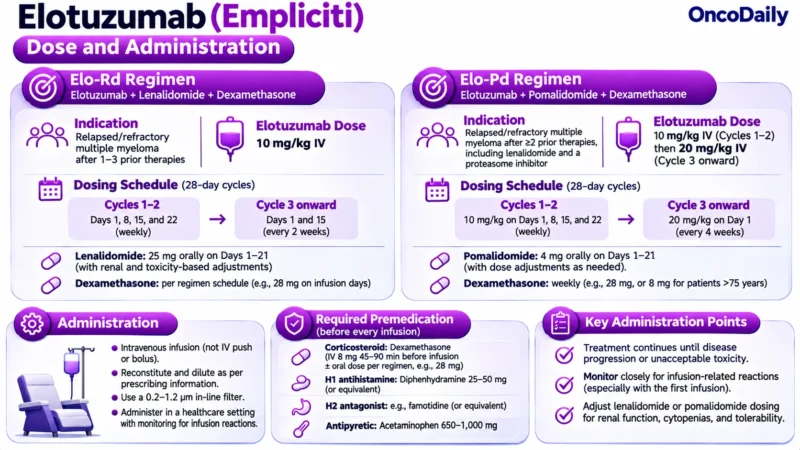
Elotuzumab With Lenalidomide and Dexamethasone (Elo-Rd)
For adults with multiple myeloma who have received one to three prior therapies.
Cycles 1–2 (28-Day Cycles)
10 mg/kg IV on Days 1, 8, 15, and 22.
Cycle 3 Onward
10 mg/kg IV on Days 1 and 15 of each 28-day cycle.
Combination Treatment
Lenalidomide:
25 mg orally on Days 1–21, subject to renal and toxicity-related dose adjustments.
Dexamethasone:
Administered according to the elotuzumab-specific schedule, including both oral and IV components on infusion days.
Treatment continues until disease progression or unacceptable toxicity.
Elotuzumab With Pomalidomide and Dexamethasone (Elo-Pd)
For adults who have received at least two prior therapies, including lenalidomide and a proteasome inhibitor.
Cycles 1–2 (28-Day Cycles)
10 mg/kg IV on Days 1, 8, 15, and 22.
Cycle 3 Onward
20 mg/kg IV on Day 1 of each 28-day cycle.
Combination Treatment
Pomalidomide:
4 mg orally on Days 1–21, with adjustments according to tolerability and prescribing information.
Dexamethasone:
Administered weekly, with dosing modified according to age and whether elotuzumab is administered that day.
Treatment continues until progression or unacceptable toxicity.
How Should Elotuzumab Be Administered?
Intravenous Infusion
Empliciti is supplied as a lyophilized powder requiring reconstitution and dilution before administration.
It must not be administered as an IV push or bolus.
Preparation
Reconstitute using sterile water for injection.
The resulting solution is further diluted with:
- 0.9% sodium chloride, or
- 5% dextrose
Use a sterile, low-protein-binding in-line filter with a pore size of 0.2–1.2 micrometers.
Do not mix elotuzumab with other drugs in the same infusion.
Infusion Rate
First 10 mg/kg Infusion
- First 30 minutes: 0.5 mL/min
- Next 30 minutes: 1 mL/min
- Thereafter: 2 mL/min
Second 10 mg/kg Infusion
- First 30 minutes: 3 mL/min
- Thereafter: 4 mL/min
Subsequent 10 mg/kg Infusions
5 mL/min, if previous infusions were tolerated.
First 20 mg/kg Infusion
Start at 3 mL/min, increasing according to the prescribed stepwise schedule.
The maximum infusion rate is:
5 mL/min.
Required Premedication
Administer appropriate premedication before every elotuzumab infusion.
Corticosteroid
On infusion days, a typical schedule includes:
- Oral dexamethasone 3–24 hours before infusion
- 8 mg IV dexamethasone 45–90 minutes before infusion
The oral dose depends on the regimen and patient age.
For Elo-Rd, the usual oral dose on infusion days is 28 mg.
For Elo-Pd, it is 28 mg for patients 75 years or younger and 8 mg for patients older than 75 years.
H1 Antihistamine
Diphenhydramine 25–50 mg orally or intravenously, or an equivalent agent.
H2 Antagonist
An appropriate H2-receptor antagonist.
Antipyretic
Acetaminophen 650–1,000 mg orally.
H1 and H2 blockers and acetaminophen should be completed 45–90 minutes before infusion.
What Should You Do If an Elotuzumab Dose Is Missed?
If an infusion is missed:
- Contact the treating oncology team.
- Administer the delayed dose when clinically appropriate.
- Review the overall combination schedule.
- Adjust subsequent treatment dates if required.
Do not double a subsequent dose.
If dexamethasone is delayed or discontinued, the clinician must reassess whether elotuzumab can be administered safely because corticosteroid premedication helps reduce infusion reactions.
How Are Elotuzumab Dose Modifications Managed?
Elotuzumab generally does not require routine stepwise dose reductions.
Treatment interruption and supportive management are used when adverse events occur.
Infusion Reactions
For Grade 2 or higher infusion reactions:
- Interrupt the infusion.
- Provide appropriate supportive treatment.
- After resolution to Grade 1 or lower, restart at 0.5 mL/min.
- Increase gradually as tolerated.
If the reaction recurs, stop the infusion and do not restart on the same day.
Severe reactions may require permanent discontinuation.
Hepatotoxicity
For Grade 3 or higher liver-enzyme elevation:
Stop elotuzumab.
After recovery to baseline, restarting may be considered according to the clinical circumstances.
Serious Infections
Evaluate whether treatment interruption is necessary.
Treat infections promptly and reassess before subsequent infusions.
Cytopenias
Elotuzumab combinations may require treatment delays or dose changes to the accompanying lenalidomide or pomalidomide.
Follow the individual prescribing information for these agents.
What Drug Interactions Are Important With Elotuzumab?
Immunomodulatory Drugs
Elotuzumab is combined with lenalidomide or pomalidomide.
These drugs enhance immune-mediated antitumor effects but contribute additional risks of:
- Myelosuppression
- Infection
- Thromboembolism
- Fatigue
Corticosteroids
Dexamethasone is required as part of the combination regimen and infusion-reaction prevention strategy.
Steroid-associated adverse effects include hyperglycemia, insomnia, psychiatric symptoms, and infection susceptibility.
Serum Protein Testing
Elotuzumab is an IgGκ monoclonal antibody and may be detected during serum protein electrophoresis or immunofixation.
This can interfere with the evaluation of complete response or relapse in patients with IgGκ multiple myeloma.
CYP450 Interactions
Elotuzumab is not primarily metabolized by CYP450 enzymes.
Clinically significant CYP-mediated pharmacokinetic interactions are not expected.
Does Elotuzumab Require Dose Adjustment in Renal or Hepatic Impairment?
Renal Impairment
Elotuzumab does not require routine dose adjustment across the studied degrees of renal impairment, including severe impairment.
However, lenalidomide requires renal dose adjustment, and pomalidomide has specific dosing guidance for patients requiring dialysis.
Hepatic Impairment
No standard adjustment is required for mild hepatic impairment based on available pharmacokinetic evidence.
Data in moderate and severe impairment are limited.
Liver function should be monitored because hepatotoxicity has been reported.
What Is the Pharmacokinetic Profile of Elotuzumab?
Distribution
Elotuzumab distributes mainly within vascular and extracellular compartments.
Metabolism
As a monoclonal antibody, it undergoes proteolytic catabolism.
Clearance
Elotuzumab exhibits nonlinear clearance related partly to target-mediated disposition.
Clearance decreases as the dose increases and target-mediated elimination becomes saturated.
Elimination
Elimination is prolonged, as expected for an IgG monoclonal antibody.
The pharmacokinetics support weekly loading followed by every-two-week or every-four-week administration according to the approved combination regimen.
What Are the Clinical Uses of Elotuzumab?
Relapsed or Refractory Multiple Myeloma After One to Three Prior Therapies
Elotuzumab with lenalidomide and dexamethasone is FDA approved for patients who have received one to three prior treatments.
The ELOQUENT-2 trial demonstrated improvements in progression-free survival, overall response rate, and mature overall survival outcomes.
The regimen is particularly relevant when patients remain suitable for lenalidomide-based treatment.
Relapsed or Refractory Multiple Myeloma After at Least Two Prior Therapies
Elotuzumab with pomalidomide and dexamethasone is indicated for patients previously treated with:
- Lenalidomide
- A proteasome inhibitor
The ELOQUENT-3 trial demonstrated improved progression-free and overall survival.
Newly Diagnosed Multiple Myeloma
Elotuzumab is not FDA approved for newly diagnosed multiple myeloma.
Clinical studies have evaluated adding elotuzumab to frontline treatment, but results have not established a routine frontline indication.
Elotuzumab Monotherapy
Elotuzumab has demonstrated limited objective antimyeloma activity when used alone.
It should not be considered an established monotherapy for multiple myeloma.
What Molecular Testing Is Required Before Elotuzumab?
Elotuzumab does not require a specific mutation for eligibility.
Baseline Multiple Myeloma Evaluation
Testing typically includes:
- Bone marrow aspirate and biopsy
- Serum protein electrophoresis
- Serum immunofixation
- Serum free light chains
- Quantitative immunoglobulins
- Urine protein studies when indicated
- Appropriate imaging
- Cytogenetic and FISH assessment
SLAMF7 Expression
SLAMF7 is commonly expressed on malignant plasma cells.
Routine SLAMF7 expression testing is not required before prescribing elotuzumab.
Cytogenetic Risk Assessment
Standard myeloma risk stratification may include:
- del(17p)/TP53 alterations
- t(4;14)
- t(14;16)
- Gain or amplification of 1q
These markers inform prognosis and treatment selection rather than being mandatory predictors of elotuzumab response.
What Did the Pivotal Clinical Trials Show?
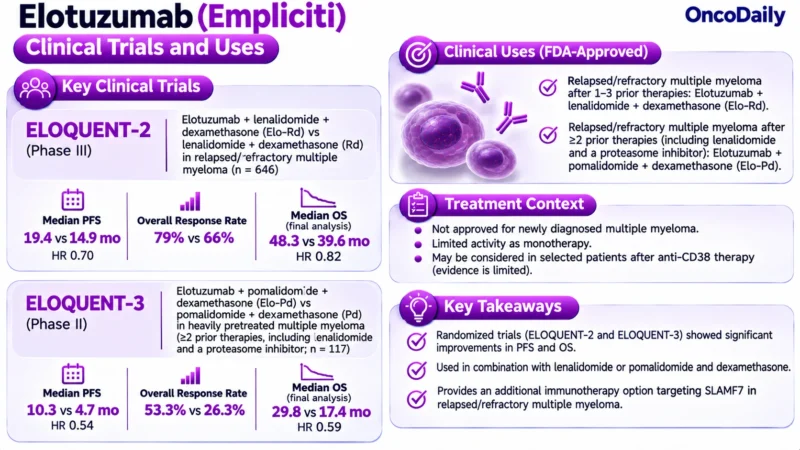
ELOQUENT-2 — Elotuzumab Plus Lenalidomide and Dexamethasone
ELOQUENT-2 was a randomized phase III study evaluating:
- Elotuzumab + lenalidomide + dexamethasone (Elo-Rd)
- Lenalidomide + dexamethasone (Rd)
A total of 646 patients with relapsed or refractory multiple myeloma were randomized.
Median Progression-Free Survival
- Elo-Rd: 19.4 months
- Rd: 14.9 months
HR: 0.70
Overall Response Rate
- Elo-Rd: 79%
- Rd: 66%
Final Median Overall Survival
- Elo-Rd: 48.3 months
- Rd: 39.6 months
HR: 0.82
The final survival analysis demonstrated a statistically significant overall survival benefit with elotuzumab.
ELOQUENT-2 established the role of adding SLAMF7-targeted therapy to lenalidomide and dexamethasone in previously treated multiple myeloma.
Watch More: ELOQUENT-2 Trial of Elotuzumab Plus Lenalidomide/Dexamethasone in Multiple Myeloma.
ELOQUENT-3 — Elotuzumab Plus Pomalidomide and Dexamethasone
ELOQUENT-3 was a randomized phase II trial evaluating:
- Elotuzumab + pomalidomide + dexamethasone (Elo-Pd)Pomalidomide + dexamethasone (Pd)
A total of 117 patients were randomized.
Patients had received at least two previous treatment lines, including lenalidomide and a proteasome inhibitor.
Median Progression-Free Survival
- Elo-Pd: 10.3 months
- Pd: 4.7 months
HR: 0.54
Overall Response Rate
- Elo-Pd: 53.3%
- Pd: 26.3%
Final Median Overall Survival
- Elo-Pd: 29.8 months
- Pd: 17.4 months
HR: 0.59
The final analysis showed a statistically significant overall survival improvement with Elo-Pd.
The trial established the benefit of elotuzumab in more heavily pretreated multiple myeloma.
ELOQUENT-1 — Elotuzumab in Newly Diagnosed Multiple Myeloma
ELOQUENT-1 was a randomized phase III study investigating elotuzumab with lenalidomide and dexamethasone in newly diagnosed, transplant-ineligible multiple myeloma.
Unlike ELOQUENT-2, the study did not demonstrate a statistically significant progression-free survival benefit from adding elotuzumab.
These results did not support expansion of elotuzumab into routine frontline treatment.
Does Elotuzumab Have CNS Activity?
Elotuzumab is a large monoclonal antibody with limited penetration across an intact blood–brain barrier.
Its efficacy in central nervous system myeloma has not been established.
There are insufficient prospective clinical data supporting elotuzumab as a CNS-directed treatment.
Management of CNS myeloma requires individualized systemic and local treatment approaches.
Is Elotuzumab FDA Approved?
Yes.
Elotuzumab received its first FDA approval on:
November 30, 2015.
Approved Indications
1. Elo-Rd: For adults with multiple myeloma after one to three prior therapies.
2. Elo-Pd: For adults after at least two prior therapies, including lenalidomide and a proteasome inhibitor.
The second indication was approved on November 6, 2018.
Elotuzumab is not FDA approved as monotherapy, as frontline multiple myeloma treatment, or for AL amyloidosis.
What Is the Current Clinical Role of Elotuzumab in 2026?
Previously Treated Multiple Myeloma
Elotuzumab remains an approved treatment option in relapsed or refractory disease, particularly with lenalidomide or pomalidomide when these remain appropriate.
Treatment After Anti-CD38 Exposure
Anti-CD38 therapies are widely used earlier in the multiple myeloma treatment pathway.
Because elotuzumab targets SLAMF7 rather than CD38, it may be considered in selected patients after exposure to CD38-directed antibodies.
However, clinical evidence specifically establishing its effectiveness after anti-CD38-refractory disease is limited, and its suitability depends on prior treatment resistance.
Read More: Myeloma Paper of the Day, September 7th, suggested by Robert Orlowski by OncoDaily.
Role Among Newer Therapies
The introduction of BCMA-directed therapies, bispecific antibodies, CAR-T cell therapy, and newer combination regimens has reduced elotuzumab’s relative prominence in many treatment sequences.
Nevertheless, its mechanism and established randomized trial evidence preserve a role in carefully selected patients.
Combination Rather Than Monotherapy
A key clinical principle is that elotuzumab depends on an immunologically active combination partner.
Its established benefit comes from combinations with lenalidomide or pomalidomide and dexamethasone.
What Are the Major Side Effects of Elotuzumab?
Infusion-Related Reactions
Elotuzumab may cause infusion-related reactions, particularly during the first administration.
Reported symptoms include:
- Fever
- Chills
- Hypertension
- Hypotension
- Bradycardia
- Chest discomfort
In ELOQUENT-2, infusion reactions occurred in approximately 10% of patients receiving elotuzumab.
Most were Grade 1–2.
In ELOQUENT-3, infusion reactions occurred in approximately 3.3% of patients.
Severe reactions may require treatment interruption or discontinuation.
Infections
Elotuzumab-containing regimens increase the risk of infections.
These include:
- Upper respiratory tract infections
- Pneumonia
- Herpes zoster
- Opportunistic infections
- Fungal infections
In ELOQUENT-2, infections occurred in approximately 81% of patients receiving Elo-Rd versus 74% receiving Rd.
Grade 3–4 infections occurred in 28% versus 24%, respectively.
Fatigue
Fatigue is a common adverse reaction, particularly when elotuzumab is administered with lenalidomide and dexamethasone.
Gastrointestinal Toxicity
Common symptoms include:
- Diarrhea
- Constipation
- Reduced appetite
- Nausea
Cytopenias
Anemia, neutropenia, lymphocytopenia, and thrombocytopenia can occur.
These toxicities may be influenced by the accompanying immunomodulatory drug and underlying disease.
Peripheral Neuropathy
Peripheral neuropathy has been reported with elotuzumab-containing regimens.
The contribution of previous myeloma treatments should also be considered.
Hepatotoxicity
Elotuzumab can cause liver injury.
In ELOQUENT-2, laboratory findings consistent with hepatotoxicity occurred in approximately 2.5% of patients receiving Elo-Rd versus 0.6% receiving Rd.
Grade 3 or higher liver-enzyme elevation requires treatment interruption and assessment.
Second Primary Malignancies
Second primary malignancies have been reported in patients receiving elotuzumab-containing treatment.
In ELOQUENT-2, invasive second primary malignancies occurred in approximately 9% of Elo-Rd recipients versus 6% of Rd recipients.
Continue appropriate malignancy surveillance.
Embryo-Fetal Toxicity
The approved elotuzumab combinations contain lenalidomide or pomalidomide, both of which are highly teratogenic.
Patients must follow the relevant pregnancy-prevention and REMS requirements.
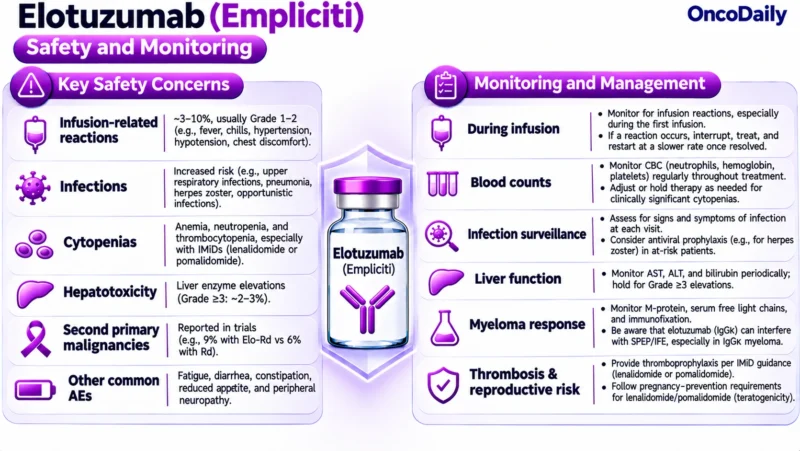
What Monitoring Is Required During Elotuzumab Treatment?
Infusion Monitoring
Assess patients for infusion reactions, especially during the first infusion.
Monitor:
- Blood pressure
- Heart rate
- Respiratory symptoms
- Fever and chills
If an infusion reaction occurs, provide treatment and monitor according to severity.
Complete Blood Count
Monitor:
- Neutrophils
- Hemoglobin
- Platelets
- Lymphocyte counts
Frequency depends on treatment phase, cytopenias, and the associated regimen.
Infection Surveillance
Assess for:
- Fever
- Respiratory symptoms
- Herpes zoster
- Pneumonia
- Opportunistic infections
Consider antiviral prophylaxis according to patient risk and institutional guidance.
Liver Function Tests
Monitor:
- AST
- ALT
- Bilirubin
- Alkaline phosphatase
Liver enzymes should be checked periodically during treatment.
Myeloma Response Monitoring
Monitor:
- Serum protein electrophoresis
- Serum immunofixation
- Serum free light chains
- Quantitative immunoglobulins
- Urine studies when indicated
- Bone marrow assessment when appropriate
Be aware that elotuzumab may interfere with SPEP and immunofixation, particularly when evaluating IgGκ myeloma.
Thromboembolic Risk
Because elotuzumab is combined with lenalidomide or pomalidomide, assess the need for thromboprophylaxis according to the patient’s risk.
Reproductive Monitoring
Ensure compliance with the pregnancy-prevention requirements of lenalidomide or pomalidomide.