


Dostarlimab (Jemperli): Mechanism of Action, Dosing, Clinical Uses, Trials, and Side Effects
Key takeaways
- Dostarlimab is a humanized IgG4 anti-PD-1 immune checkpoint inhibitor.
- It blocks PD-1 interactions with PD-L1 and PD-L2.
- It was initially FDA approved in 2021.
- It is approved with carboplatin–paclitaxel for primary advanced or recurrent endometrial cancer regardless of MMR status.
- It has monotherapy indications in selected dMMR endometrial and other solid tumors.
- October 19, 2026: FDA accelerated approval for stage II–III MSI-H/dMMR locally advanced rectal cancer.
- RUBY demonstrated significant overall survival and progression-free survival improvements.
- GARNET demonstrated durable activity in dMMR recurrent or advanced tumors.
- AZUR-1 supported the new rectal cancer indication.
- Immune-related toxicities can affect nearly any organ system.
- Careful biomarker testing, monitoring, and multidisciplinary assessment are essential.
Dostarlimab-gxly (Jemperli) is a humanized IgG4 monoclonal antibody targeting programmed cell death protein 1 (PD-1). By preventing PD-1 from interacting with PD-L1 and PD-L2, dostarlimab restores antitumor T-cell activity and promotes immune-mediated cancer-cell destruction.
Initially approved by the FDA in April 2021, dostarlimab became an important treatment for mismatch repair-deficient (dMMR) endometrial cancer and other dMMR solid tumors.
Its clinical role has since expanded considerably. The RUBY trial established dostarlimab with carboplatin–paclitaxel followed by maintenance dostarlimab as a first-line treatment for primary advanced or recurrent endometrial cancer, regardless of MMR status.
Most notably, on October 19, 2026, the FDA granted accelerated approval for dostarlimab monotherapy in adults with stage II–III MSI-H/dMMR locally advanced rectal cancer, introducing a potentially organ-preserving treatment strategy for carefully selected patients.
Major studies include GARNET, RUBY, AZUR-1, and the investigator-initiated dMMR rectal cancer trial NCT04165772.
Key Facts
- Generic name: Dostarlimab-gxly
- Brand name: Jemperli
- Drug class: Immune checkpoint inhibitor
- Antibody type: Humanized IgG4 monoclonal antibody
- Target: PD-1 (CD279)
- Ligands blocked: PD-L1 and PD-L2
- Mechanism: Restoration of T-cell-mediated antitumor immunity
- Initial FDA approval: April 2021
- Expanded endometrial cancer approval: August 2024
- Locally advanced rectal cancer approval: October 19, 2026
- Route: Intravenous infusion over 30 minutes
- Common dosing: 500 mg every three weeks, followed by 1,000 mg every six weeks
- Rectal cancer dosing: 500 mg every three weeks for up to nine cycles
- Combination partners: Carboplatin and paclitaxel
- FDA indications: Advanced/recurrent endometrial cancer; selected dMMR recurrent/advanced solid tumors; stage II–III MSI-H/dMMR locally advanced rectal cancer
- Important biomarkers: MMR status, MSI status
- Pivotal trials: RUBY, GARNET, AZUR-1
- Major toxicities: Immune-mediated pneumonitis, colitis, hepatitis, endocrinopathies, nephritis, and infusion reactions
- Monitoring: Liver enzymes, creatinine, thyroid function, blood glucose, and immune-related symptoms
- Available strength: 500 mg/10 mL single-dose vial
What Is Dostarlimab?
Dostarlimab is an immune checkpoint inhibitor that blocks the PD-1 pathway.
PD-1 is an inhibitory receptor expressed on activated T lymphocytes. Its interaction with PD-L1 or PD-L2 suppresses T-cell receptor signaling and reduces immune-cell activity.
Many tumors exploit this pathway to escape immune surveillance.
Dostarlimab blocks PD-1, preventing ligand-induced inhibitory signaling and enabling T cells to maintain their antitumor activity.
Dostarlimab does not directly kill tumor cells through a cytotoxic payload. Instead, its activity depends on the immune system’s ability to recognize and attack malignant cells.
Its particularly strong activity in dMMR/MSI-H tumors is biologically important. These tumors often contain numerous mutations and immunogenic neoantigens, which can increase susceptibility to immune checkpoint blockade.
What Is the Mechanism of Action of Dostarlimab?
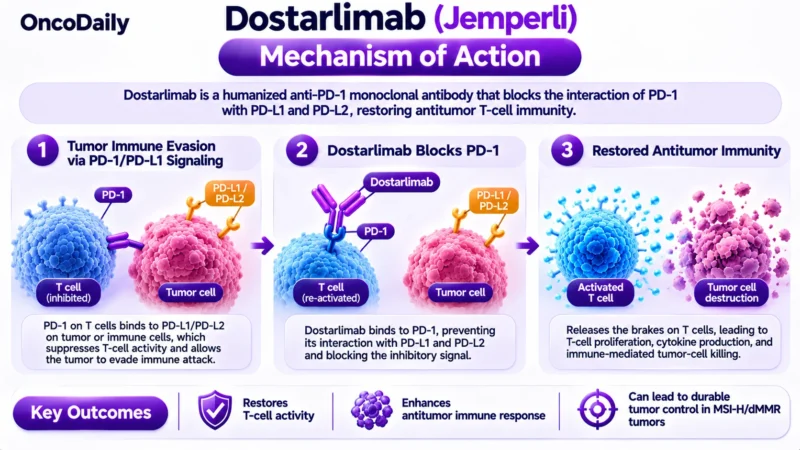
1. PD-1 Expression on T Cells
Activated T lymphocytes express PD-1, a receptor that normally limits excessive immune activation.
2. Tumor-Mediated Immune Suppression
Tumor cells and other cells in the tumor microenvironment may express PD-L1 or PD-L2.
Binding these ligands to PD-1 activates inhibitory signaling and reduces T-cell function.
3. Dostarlimab Binds PD-1
Dostarlimab binds PD-1 on the T-cell membrane, preventing PD-L1 and PD-L2 from engaging the receptor.
4. Restoration of Antitumor Immunity
Blocking PD-1 inhibitory signaling allows T cells to maintain proliferation, cytokine production, and cytotoxic activity.
5. Tumor-Cell Destruction
Activated cytotoxic T cells release perforin and granzymes and engage additional immune-mediated killing pathways.
This promotes cancer-cell apoptosis.
6. Durable Immune Responses
Some patients achieve prolonged disease control or complete tumor regression, although primary and acquired resistance remain possible.
Overall mechanism:
Dostarlimab → PD-1 blockade → prevention of PD-L1/PD-L2 inhibitory signaling → restored T-cell activity → immune-mediated tumor-cell destruction.
What Is the Recommended Dose of Dostarlimab?
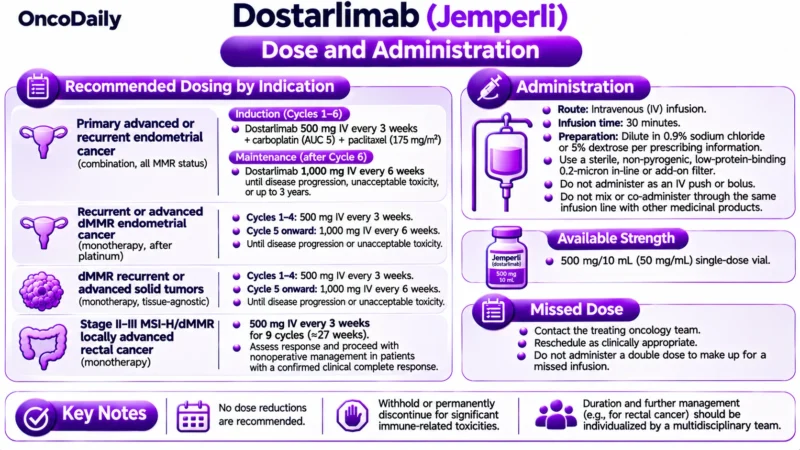
Dosing depends on the indication.
Primary Advanced or Recurrent Endometrial Cancer — Combination Treatment
Induction:
Dostarlimab 500 mg IV every three weeks for six cycles, combined with:
- Carboplatin AUC 5 mg/mL/min
- Paclitaxel 175 mg/m²
Maintenance:
Dostarlimab 1,000 mg IV every six weeks.
Continue until progression, unacceptable toxicity, or up to three years.
When chemotherapy and dostarlimab are administered on the same day, give dostarlimab first.
Recurrent or Advanced dMMR Endometrial Cancer — Monotherapy
For patients whose disease progressed on or after platinum-based therapy and who are not candidates for curative surgery or radiation:
- Cycles 1–4: 500 mg IV every three weeks
- Cycle 5 onward: 1,000 mg IV every six weeks
Continue until progression or unacceptable toxicity.
dMMR Recurrent or Advanced Solid Tumors — Monotherapy
For eligible patients who have progressed after prior treatment and lack satisfactory alternatives:
- Cycles 1–4: 500 mg IV every three weeks
- Cycle 5 onward: 1,000 mg IV every six weeks
Continue until progression or unacceptable toxicity.
Stage II–III MSI-H/dMMR Locally Advanced Rectal Cancer
500 mg IV every three weeks for nine cycles, unless progression or unacceptable toxicity occurs.
This dosing corresponds to the newly approved October 2026 regimen and differs from the longer-term maintenance schedules used for advanced endometrial and other solid tumors.
How Should Dostarlimab Be Administered?
Dostarlimab is administered as an intravenous infusion over 30 minutes.
It must not be administered as an IV push or bolus.
Each vial contains 500 mg in 10 mL (50 mg/mL).
Dilute the required dose using 0.9% sodium chloride or 5% dextrose according to the prescribing information. Use a sterile, non-pyrogenic, low-protein-binding 0.2-micron in-line or add-on filter.
Do not shake. Do not mix or co-administer through the same infusion line with other medicinal products.
Routine premedication is not required for every patient.
What Should You Do If a Dostarlimab Dose Is Missed?
- Contact the treating oncology team.
- Reschedule as clinically appropriate.
- Evaluate whether a toxicity caused the interruption.
- Resume using the revised treatment schedule.
Do not administer a double dose to compensate for a missed infusion.
How Are Dostarlimab Dose Modifications Managed?
Dose reductions are not recommended.
Treatment-related toxicities are managed through interruption, immune suppression, or permanent discontinuation.
Grade 1 Immune-Related Toxicity
Treatment may often continue with monitoring, depending on the organ involved.
Grade 2 Toxicity
Withhold treatment when indicated.
Consider systemic corticosteroids for clinically significant immune-mediated inflammation.
Grade 3 Toxicity
Generally withhold dostarlimab and initiate high-dose corticosteroids when indicated.
Severe or recurrent reactions may require permanent discontinuation.
Grade 4 Toxicity
Usually requires permanent discontinuation, with selected exceptions for endocrinopathies adequately controlled by hormone replacement.
Steroid-Refractory Toxicity
Additional immunosuppression may be necessary following specialist evaluation.
What Drug Interactions Are Important With Dostarlimab?
Dostarlimab is not primarily metabolized through CYP450 pathways.
Conventional CYP-mediated interactions are therefore not expected to be clinically important.
Important considerations include concomitant systemic immunosuppressants, cytotoxic chemotherapy, other immune checkpoint inhibitors, and medications that may complicate assessment of hepatic or renal toxicity.
Immune-related adverse reactions should be treated appropriately even when systemic corticosteroids or other immunosuppressive agents are required.
Does Dostarlimab Require Adjustment in Renal or Hepatic Impairment?
Renal Impairment
No routine dose adjustment is established for mild or moderate renal impairment.
Severe renal impairment has been less extensively studied.
Immune-mediated nephritis remains an important treatment-related risk.
Hepatic Impairment
No routine dose adjustment is established for mild hepatic impairment.
Experience in moderate or severe hepatic impairment is limited.
Baseline liver dysfunction must be distinguished from immune-mediated hepatitis developing during treatment.
What Is the Pharmacokinetic Profile of Dostarlimab?
Molecular Structure
Dostarlimab is a humanized IgG4 monoclonal antibody with a molecular weight of approximately 144 kDa.
Distribution
Mean steady-state volume of distribution:
5.8 L
Half-Life
Mean terminal elimination half-life:
23.5 days
Clearance
Mean steady-state clearance:
0.007 L/hour
Metabolism
Dostarlimab is catabolized into small peptides and amino acids rather than undergoing conventional CYP450 metabolism.
Immunogenicity
Anti-drug antibodies have been observed in a small proportion of patients, without a clearly established clinically significant effect on effectiveness or safety.
What Are the Clinical Uses of Dostarlimab?
Primary Advanced or Recurrent Endometrial Cancer
Dostarlimab with carboplatin and paclitaxel, followed by maintenance dostarlimab, is FDA approved for adults with primary advanced or recurrent endometrial cancer.
The combination indication applies regardless of MMR status.
However, the magnitude of benefit is substantially greater in patients with dMMR/MSI-H tumors.
Previously Treated dMMR Endometrial Cancer
Dostarlimab monotherapy is indicated for patients with recurrent or advanced dMMR endometrial cancer whose disease has progressed on or after platinum-containing chemotherapy and who are not candidates for curative surgery or radiation.
The GARNET study established durable activity in this population.
Recurrent or Advanced dMMR Solid Tumors
Dostarlimab has an accelerated, tissue-agnostic FDA indication for selected previously treated dMMR recurrent or advanced solid tumors when satisfactory alternatives are unavailable.
Relevant malignancies include colorectal, small intestinal, gastric, and other solid tumors, although response rates vary by histology.
Stage II–III MSI-H/dMMR Locally Advanced Rectal Cancer
The October 2026 approval is particularly important.
In selected patients with stage II–III MSI-H/dMMR rectal cancer, dostarlimab can induce complete clinical tumor regression without immediately proceeding to standard chemoradiotherapy or radical rectal surgery.
Patients achieving a confirmed clinical complete response can enter a rigorous nonoperative surveillance program.
A complete clinical response is not equivalent to a proven pathological
complete response. It requires careful multimodal assessment and continued monitoring, with standard local treatment considered for persistent or recurrent disease.
This is a potentially organ-preserving approach, but treatment requires an experienced multidisciplinary rectal cancer team.
What Biomarker Testing Is Required Before Dostarlimab?
Mismatch Repair Status
Mismatch repair testing is essential for the monotherapy indications.
IHC evaluates expression of:
- MLH1
- PMS2
- MSH2
- MSH6
Loss of one or more proteins in an appropriate pattern indicates defective mismatch repair.
Microsatellite Instability
MSI testing may be performed by PCR or validated NGS assays.
MSI-H often correlates with dMMR, but discordant findings should be investigated.
Endometrial Cancer Molecular Classification
In endometrial cancer, comprehensive molecular classification can include:
- POLE mutation testing
- MMR status
- p53 status
These findings contribute to prognosis and treatment decisions.
MMR testing remains highly informative even when it is not an eligibility requirement for first-line dostarlimab plus chemotherapy.
Rectal Cancer Assessment
Before selecting dostarlimab for locally advanced rectal cancer, confirm:
- Histologically established rectal adenocarcinoma
- Stage II–III disease
- MSI-H or dMMR by an appropriate test
- Baseline pelvic MRI staging
- Endoscopic tumor assessment
- Distant staging with appropriate imaging
Consider Lynch syndrome evaluation and germline genetic counseling when indicated.
What Did the Pivotal Clinical Trials Show?
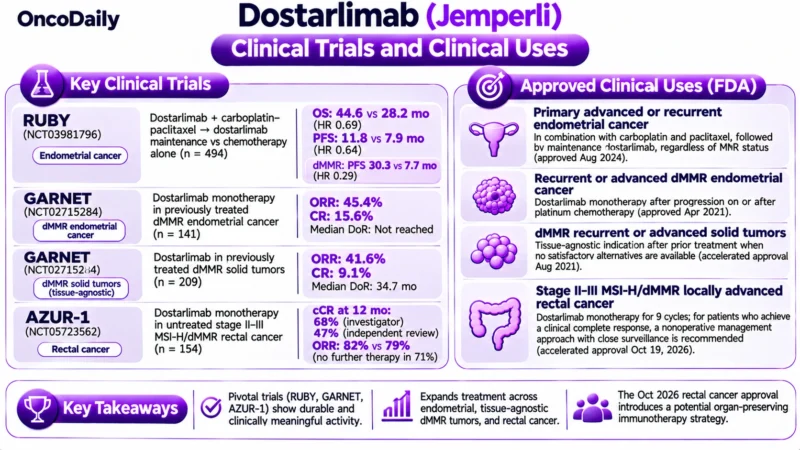
RUBY — First-Line Advanced or Recurrent Endometrial Cancer
RUBY (NCT03981796) was a randomized phase III trial comparing:
- Dostarlimab plus carboplatin–paclitaxel, followed by dostarlimab maintenance
- Placebo plus carboplatin–paclitaxel, followed by placebo
The study enrolled 494 patients, including patients with dMMR/MSI-H and pMMR/MSS disease.
Overall Population — Median Overall Survival
Dostarlimab + chemotherapy
44.6 months
Chemotherapy alone
28.2 months
OS HR: 0.69; p = 0.002
Overall Population — Median Progression-Free Survival
- Dostarlimab combination: 11.8 months
- Control: 7.9 months
PFS HR: 0.64
dMMR/MSI-H Population — Median Progression-Free Survival
- Dostarlimab combination: 30.3 months
- Control: 7.7 months
PFS HR: 0.29
The results demonstrated particularly substantial benefit in patients with dMMR/MSI-H endometrial cancer and supported the expansion of the first-line indication to the overall population.
RUBY — Four-Year Follow-Up
Longer-term follow-up demonstrated sustained benefit in the dMMR/MSI-H population.
At a median follow-up of approximately 55.6 months:
Four-Year Overall Survival
- Dostarlimab combination: 72.8%
- Control: 40.3%
OS HR: 0.34
These findings strengthen the evidence for durable benefit from dostarlimab-containing frontline treatment in dMMR/MSI-H endometrial cancer.
Watch More: RUBY: assessing secondary endpoints of dostarlimab in endometrial cancer.
GARNET — Recurrent or Advanced dMMR Endometrial Cancer
GARNET (NCT02715284) was a multicenter phase I trial evaluating dostarlimab in advanced solid tumors.
The regulatory efficacy analysis included 141 patients with previously treated dMMR endometrial cancer.
Overall Response Rate
45.4%
Complete Response Rate
15.6%
Median Duration of Response
Not reached
These findings supported dostarlimab monotherapy in previously treated dMMR endometrial cancer.
GARNET — Tissue-Agnostic dMMR Solid Tumors
The regulatory efficacy analysis included 209 patients with recurrent or advanced dMMR solid tumors.
Overall Response Rate
41.6%
Complete Response Rate
9.1%
Median Duration of Response
34.7 months
The study established clinically meaningful activity across several dMMR tumor types, supporting the tissue-agnostic accelerated approval.
AZUR-1 — Locally Advanced MSI-H/dMMR Rectal Cancer
AZUR-1 (NCT05723562) was a multicenter, single-arm trial of dostarlimab in 154 patients with untreated stage II–III MSI-H/dMMR locally advanced rectal cancer.
Patients received:
500 mg IV every three weeks for nine cycles.
The primary efficacy endpoint was a clinical complete response sustained for at least 12 months, assessed by independent central review.
Sustained Clinical Complete Response at 12 Months
Independent central review
47%
54 of 116 evaluable patients
Investigator assessment
68%
98 of 144 evaluable patients
Objective Response Rate
- Independent review: 79%
- Investigator assessment: 82%
At the interim analysis, 110 of 154 patients (71%) had received no further oncologic treatment after dostarlimab and had not experienced progression or relapse.
The different complete-response estimates reflect assessment methods and available follow-up. Some patients had achieved a clinical complete response but had not yet accumulated 12 months of follow-up.
AZUR-1 supported the October 19, 2026 accelerated FDA approval.
Read More: AZUR-1 at ESMO 2026: Dostarlimab Monotherapy in dMMR/MSI-H Locally Advanced Rectal Cancer by OncoDaily.
MSKCC Investigator-Initiated Study — dMMR Rectal Cancer
NCT04165772 was an investigator-led study that evaluated dostarlimab without routine chemoradiotherapy or surgery in untreated stage II–III dMMR rectal cancer.
The FDA-reviewed cohort included 50 patients.
Objective Response Rate
100%
Clinical Complete Response Sustained for 12 Months
93%
No patients underwent chemoradiation or rectal cancer surgery as part of the study’s treatment strategy.
Among the 27 patients followed for at least three years, one local recurrence was reported and managed with lymphadenectomy.
These findings demonstrated the potential of immune checkpoint blockade to transform organ preservation in molecularly selected rectal cancer. They must still be interpreted alongside the single-arm design, differing response-assessment methods, and need for long-term surveillance.
Does Dostarlimab Have CNS Activity?
Dostarlimab is not established as a standard CNS-directed treatment.
Its activity in brain metastases has not been systematically demonstrated across the approved indications.
Patients with active CNS disease require appropriate disease-specific multidisciplinary assessment, potentially including surgery, radiotherapy, or other systemic treatments.
Is Dostarlimab FDA Approved?
Yes.
Major milestones include:
- April 2021: Initial approval for previously treated dMMR endometrial cancer.
- August 2021: Accelerated tissue-agnostic approval for selected previously treated dMMR solid tumors.
- July 2023: Initial approval with carboplatin–paclitaxel for advanced/recurrent dMMR/MSI-H endometrial cancer.
- August 2024: Expanded first-line endometrial cancer combination indication regardless of MMR status.
- October 19, 2026: Accelerated approval for stage II–III MSI-H/dMMR locally advanced rectal cancer.
The October 2026 indication is an especially important development because dostarlimab may allow selected rectal cancer patients to avoid the immediate need for chemotherapy, radiotherapy, and radical surgery.
What Is the Current Clinical Role of Dostarlimab in 2026?
Dostarlimab now has three particularly important roles.
First, it is a frontline chemoimmunotherapy component in primary advanced or recurrent endometrial cancer.
Second, it provides a biomarker-driven monotherapy option in previously treated dMMR endometrial and other solid tumors.
Third, it offers an FDA-approved organ-preserving treatment strategy for stage II–III MSI-H/dMMR locally advanced rectal cancer.
The rectal cancer indication is rapidly evolving and requires multidisciplinary expertise, careful interpretation of clinical complete responses, and adherence to intensive surveillance.
What Are the Major Side Effects of Dostarlimab?
Immune-Mediated Pneumonitis
Inflammatory lung injury can cause cough, dyspnea, hypoxia, and chest discomfort.
Severe pneumonitis can be life-threatening.
Immune-Mediated Colitis
Symptoms include diarrhea, abdominal pain, gastrointestinal bleeding, and dehydration.
Severe cases may require corticosteroids or additional immunosuppressive treatment.
Immune-Mediated Hepatitis
Dostarlimab can cause elevations in AST, ALT, and bilirubin.
Clinicians should exclude other causes of hepatic dysfunction, including infection, biliary obstruction, liver metastases, and concomitant medication toxicity.
Endocrinopathies
Important endocrine adverse reactions include:
- Hypothyroidism
- Hyperthyroidism and thyroiditis
- Hypophysitis
- Adrenal insufficiency
- Type 1 diabetes mellitus
Some endocrine toxicities may require lifelong hormone replacement.
Immune-Mediated Nephritis
Immune-mediated renal inflammation can cause elevated creatinine and acute kidney injury.
Dermatologic Reactions
Common manifestations include rash and pruritus.
Rare serious reactions include Stevens–Johnson syndrome and toxic epidermal necrolysis.
Myocarditis and Neurological Toxicity
Although uncommon, myocarditis, encephalitis, peripheral neuropathy, myositis, and related inflammatory complications can be severe or fatal.
Infusion-Related Reactions
Symptoms may include fever, chills, rash, hypotension, and dyspnea.
Severe infusion reactions require treatment discontinuation and supportive care.
Chemotherapy-Associated Toxicity
When dostarlimab is combined with carboplatin and paclitaxel, additional adverse reactions can include:
- Anemia and neutropenia
- Thrombocytopenia
- Peripheral neuropathy
- Nausea and vomiting
- Alopecia
- Fatigue
These effects require consideration of both immunotherapy and chemotherapy contributions.
Complications of Allogeneic HSCT
PD-1 blockade before or after allogeneic stem cell transplantation may increase the risk of serious immune complications, including graft-versus-host disease.
Embryo-Fetal Toxicity
Dostarlimab may cause fetal harm.
Females of reproductive potential should use effective contraception during treatment and for four months after the last dose.
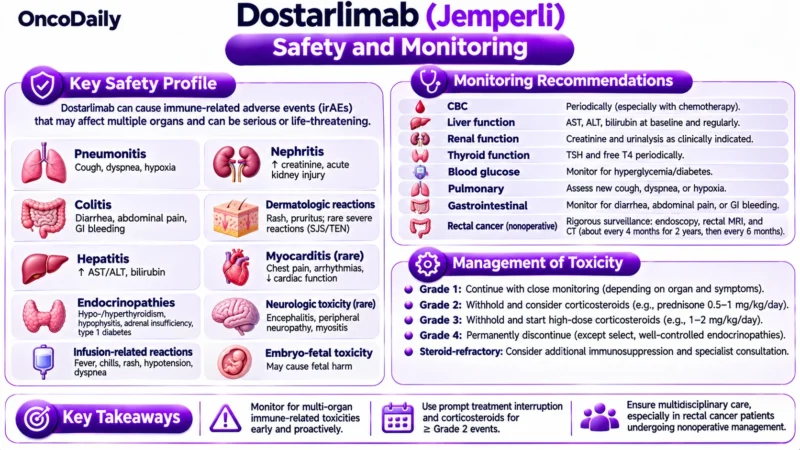
What Monitoring Is Required During Dostarlimab Treatment?
Complete Blood Count
Monitor hemoglobin, neutrophils, platelets, and other blood counts, particularly during chemotherapy-containing regimens.
Liver Function
Check AST, ALT, and bilirubin at baseline and periodically during treatment.
Renal Function
Monitor creatinine and evaluate new renal dysfunction.
Thyroid Function
Assess TSH and free T4 periodically.
Blood Glucose
Monitor for hyperglycemia and symptoms suggesting immune-mediated diabetes.
Pulmonary Monitoring
Investigate new cough, dyspnea, chest discomfort, or hypoxia.
Gastrointestinal Monitoring
Assess diarrhea, abdominal pain, gastrointestinal bleeding, and unexplained changes in bowel habits.
Cardiovascular and Neurological Monitoring
Investigate chest pain, palpitations, muscle weakness, confusion, and other unexplained neurological symptoms.
Rectal Cancer Response Assessment
Patients treated for MSI-H/dMMR locally advanced rectal cancer require particularly rigorous assessment.
The AZUR-1 approach incorporated:
- Endoscopic examination
- Rectal MRI
- CT imaging of the chest, abdomen, and pelvis
- Repeated assessment of clinical complete response
- Intensive nonoperative surveillance
In AZUR-1, surveillance following clinical complete response was performed approximately every four months during the first two years and every six months thereafter.
Any suspected persistent or recurrent disease must be evaluated promptly for appropriate salvage treatment.