


Cobimetinib (Cotellic): Understanding Its Mechanism, Dosing, Clinical Uses, and Role in BRAF V600–Mutated Melanoma and Histiocytic Neoplasms
Key takeaways
- Cobimetinib is an oral MEK1/MEK2 inhibitor.
- Standard dosing is 60 mg once daily on days 1–21 of each 28-day cycle.
- It may be taken with or without food.
- Dose reductions are 60 mg → 40 mg → 20 mg once daily.
- Cobimetinib is FDA approved with vemurafenib for BRAF V600E/K-mutated unresectable or metastatic melanoma.
- It is also FDA approved as monotherapy for adult histiocytic neoplasms, regardless of BRAF status.
- coBRIM demonstrated median PFS of 12.3 vs 7.2 months, median OS of 22.3 vs 17.4 months, and ORR of 70% vs 50% versus vemurafenib alone.
- In histiocytic neoplasms, PET-based ORR was 76.9%, with 61.5% complete responses in the FDA-label dataset.
- Cobimetinib exposure is strongly affected by CYP3A inhibitors and inducers.
- Important safety priorities include cardiomyopathy, hemorrhage, ocular toxicity, hepatotoxicity, rhabdomyolysis, severe skin toxicity, photosensitivity, and new malignancies.
- In 2026, cobimetinib has two particularly important roles: BRAF/MEK combination therapy in melanoma and MEK inhibition across adult histiocytic neoplasms.
Cobimetinib (Cotellic) is an oral, reversible inhibitor of MEK1 and MEK2, key kinases in the RAS–RAF–MEK–ERK/MAPK pathway. By suppressing MEK activity and downstream ERK signaling, cobimetinib reduces tumor-cell proliferation and survival in cancers that depend on MAPK-pathway activation.
In the United States, cobimetinib is FDA approved with vemurafenib for adults with unresectable or metastatic melanoma harboring a BRAF V600E or V600K mutation. It is also FDA approved as a single agent for adult patients with histiocytic neoplasms, regardless of BRAF mutation status. The current prescribing information was updated in July 2026.
Key Facts
- Generic name: Cobimetinib
- Brand name: Cotellic
- Drug class: MEK1/MEK2 inhibitor
- Route: Oral
- Initial US approval: 2015
- Primary targets: MEK1 and MEK2
- Standard dose: 60 mg orally once daily
- Schedule: Days 1–21 of each 28-day cycle
- Administration: With or without food
- Tablet strength: 20 mg
- Dose reductions: 60 mg → 40 mg → 20 mg once daily
- FDA melanoma indication: BRAF V600E/K unresectable or metastatic melanoma with vemurafenib
- FDA histiocytosis indication: Adult histiocytic neoplasms as monotherapy
- Major metabolism: CYP3A oxidation and UGT2B7 glucuronidation
- Half-life: Approximately 44 hours
- Important toxicities: Hemorrhage, cardiomyopathy, severe skin reactions, serous retinopathy, retinal vein occlusion, hepatotoxicity, rhabdomyolysis/CPK elevation, and severe photosensitivity
- Current US status: FDA approved.
What Is Cobimetinib?
Cobimetinib is a small-molecule inhibitor of:
MEK1 and MEK2
also known as:
MAP2K1 and MAP2K2.
MEK lies in the central MAPK signaling cascade:
RAS → RAF → MEK → ERK
which regulates:
- Cell proliferation
- Cell survival
- Differentiation
- Migration
- Gene transcription
In BRAF V600-mutated melanoma, mutant BRAF constitutively activates MEK1/2, resulting in persistent ERK signaling.
Cobimetinib interrupts this signaling downstream of BRAF.
In histiocytic neoplasms, MAPK-pathway alterations can involve several genes—not only BRAF—which helps explain why MEK inhibition can be effective across genetically diverse histiocytic disorders.
What Is the Mechanism of Action of Cobimetinib?
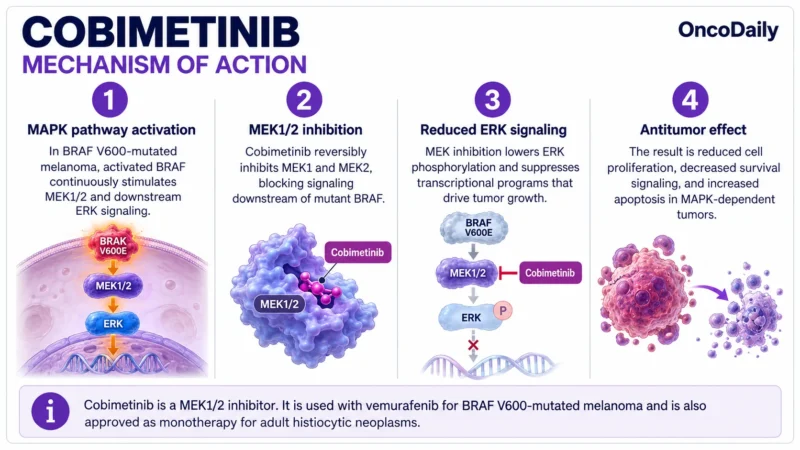
1. MAPK Signaling Drives Tumor Growth
In BRAF V600E- or V600K-mutated melanoma, activated BRAF continuously stimulates:
MEK1/2
which then activate:
ERK1/2.
This promotes:
- Tumor-cell proliferation
- Cell survival
- Migration
- Resistance to apoptosis
2. Cobimetinib Reversibly Inhibits MEK1 and MEK2
Cobimetinib is a:
Reversible MEK1/MEK2 inhibitor.
It suppresses MEK signaling and reduces downstream ERK activity.
3. ERK Signaling Falls
By inhibiting MEK1/2, cobimetinib reduces activation of:
ERK
and therefore suppresses transcriptional programs that support malignant growth.
4. Tumor-Cell Proliferation Is Reduced
MAPK-pathway suppression leads to:
- Reduced proliferation
- Reduced survival signaling
- Increased apoptosis
- Reduced tumor growth
5. Combination With Vemurafenib Produces Dual Pathway Blockade
Vemurafenib inhibits:
Mutant BRAF
while cobimetinib inhibits:
MEK1/2 downstream of BRAF.
Dual blockade produces stronger MAPK suppression than either agent alone and can increase apoptosis while limiting some forms of MAPK reactivation.
The mechanism can be summarized as:
Cobimetinib → MEK1/2 inhibition → reduced ERK signaling → decreased proliferation and survival → increased apoptosis.
What Is the Dose of Cobimetinib?
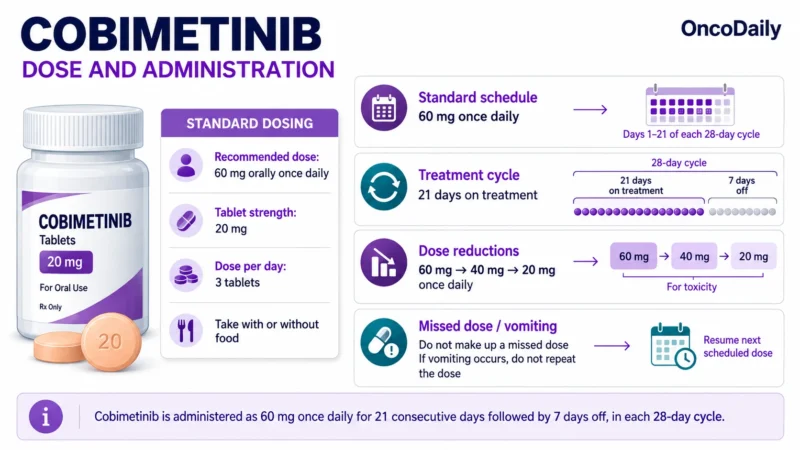
The standard recommended dose is:
60 mg orally once daily
for:
21 consecutive days
followed by:
7 days off treatment
in each:
28-day cycle.
Treatment continues until:
- Disease progression
- Unacceptable toxicity.
This dose applies both to:
- Melanoma when used with vemurafenib
- Adult histiocytic neoplasms when used as monotherapy.
How Is Cobimetinib Administered?
Cobimetinib is supplied as:
20 mg tablets.
The standard 60 mg dose therefore consists of:
Three 20 mg tablets once daily.
Cobimetinib may be taken:
With or without food.
A high-fat meal does not meaningfully change exposure.
What If a Dose Is Missed?
If a dose is missed:
Do not make up the missed dose.
Resume with the:
Next scheduled dose.
If vomiting occurs after taking cobimetinib:
Do not repeat the dose.
Take the next dose at the scheduled time.
How Are Cobimetinib Dose Reductions Made?
Starting dose:
60 mg once daily
First reduction:
40 mg once daily
Second reduction:
20 mg once daily
If the patient cannot tolerate:
20 mg once daily
cobimetinib should be:
Permanently discontinued.
Dose interruption, reduction, or discontinuation may be required for:
- Hemorrhage
- Cardiomyopathy
- Severe dermatologic reactions
- Ocular toxicity
- Hepatotoxicity
- Rhabdomyolysis or significant CPK elevation
- Severe photosensitivity
- Other clinically significant toxicity
What Are the Important Drug Interactions With Cobimetinib?
Cobimetinib is highly sensitive to:
CYP3A modulation.
Strong or Moderate CYP3A Inhibitors
These can substantially increase cobimetinib exposure.
For example, itraconazole increased:
- Cobimetinib AUC approximately 6.7-fold
- Cmax approximately 3.2-fold.
Strong or moderate CYP3A inhibitors should generally be:
Avoided.
If a moderate CYP3A inhibitor must be used for:
14 days or less
in a patient receiving cobimetinib 60 mg:
Reduce cobimetinib to:
20 mg once daily
during the interacting therapy.
After the moderate inhibitor is discontinued:
Resume the previous cobimetinib dose.
Strong or Moderate CYP3A Inducers
These can substantially reduce cobimetinib exposure.
Predicted exposure reductions are approximately:
- 83% with strong CYP3A induction
- 73% with moderate CYP3A induction.
Avoid agents such as:
- Rifampin
- Carbamazepine
- Phenytoin
- Efavirenz
- St. John’s wort.
Does Cobimetinib Require Renal or Hepatic Dose Adjustment?
Renal Impairment
No dose adjustment is recommended for:
Mild-to-moderate renal impairment
with creatinine clearance:
30–89 mL/min.
A recommended dose has not been established for:
Severe renal impairment.
Hepatic Impairment
No starting-dose adjustment is required for:
- Child-Pugh A
- Child-Pugh B
- Child-Pugh C.
Even in severe hepatic impairment, total cobimetinib exposure did not increase relative to patients with normal hepatic function.
What Is the Pharmacokinetic Profile of Cobimetinib?
Absorption
After a 60 mg oral dose, median:
Tmax is approximately 2.4 hours.
Absolute bioavailability is approximately:
46%.
Steady State
Steady state is generally reached by:
Day 9.
Mean accumulation is approximately:
2.4-fold.
Food Effect
A high-fat meal does not meaningfully change:
- AUC
- Cmax
so cobimetinib may be taken:
With or without food.
Protein Binding
Cobimetinib is approximately:
95% protein bound.
Volume of Distribution
Apparent volume of distribution is approximately:
806 L.
Half-Life
Mean elimination half-life is approximately:
44 hours
with a reported range of:
23–70 hours.
Metabolism
Major metabolic pathways include:
- CYP3A oxidation
- UGT2B7 glucuronidation.
Excretion
After radiolabeled dosing:
- Approximately 76% was recovered in feces
- Approximately 17.8% in urine.
What Are the Clinical Uses of Cobimetinib?
1. BRAF V600E/K-Mutated Unresectable or Metastatic Melanoma
Cobimetinib is FDA approved:
In combination with vemurafenib
for adults with unresectable or metastatic melanoma carrying:
- BRAF V600E
- BRAF V600K
mutations.
2. Adult Histiocytic Neoplasms
Cobimetinib is also FDA approved:
As a single agent
for:
Adult patients with histiocytic neoplasms.
Importantly, this indication is:
Not restricted to BRAF V600-mutated disease.
Clinical activity has been observed across histiocytic disorders with diverse MAPK-pathway alterations.
What Did Cobimetinib Clinical Trials Show?
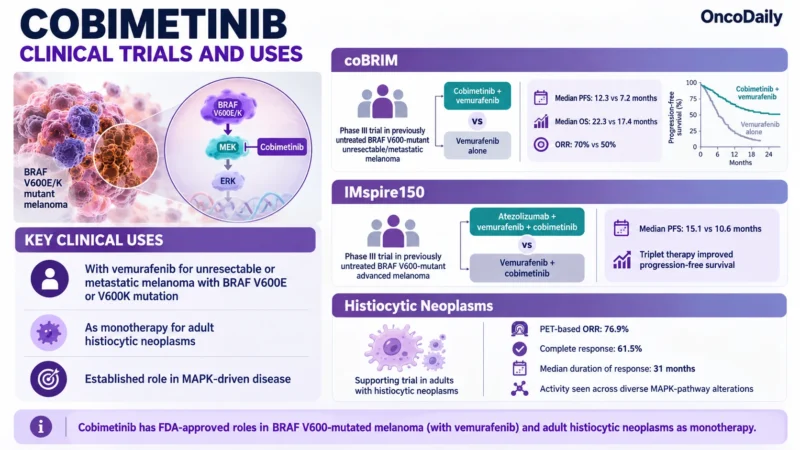
coBRIM — Cobimetinib + Vemurafenib in BRAF V600-Mutant Melanoma
The pivotal phase III coBRIM trial evaluated:
Cobimetinib + vemurafenib
versus:
Placebo + vemurafenib
in previously untreated BRAF V600-mutated unresectable or metastatic melanoma.
A total of:
495 patients
were randomized:
- Cobimetinib + vemurafenib: 247
- Placebo + vemurafenib: 248.
Progression-Free Survival
Median PFS was:
- 12.3 months with cobimetinib + vemurafenib
- 7.2 months with vemurafenib alone
Hazard ratio:
0.56
P < 0.001.
Overall Survival
Median OS was:
- 22.3 months
- 17.4 months
respectively.
Hazard ratio:
0.69.
Objective Response Rate
ORR was:
- 70% with combination therapy
- 50% with vemurafenib alone
Complete response:
- 16%
- 10%
respectively.
Median duration of response:
- 13.0 months
- 9.2 months.
These findings established combined BRAF/MEK blockade as superior to BRAF inhibition alone.
IMspire150 — Atezolizumab + Vemurafenib + Cobimetinib
The phase III IMspire150 trial tested whether adding immune checkpoint blockade to BRAF/MEK targeted therapy could improve outcomes.
A total of:
514 patients
with previously untreated BRAF V600-mutated advanced melanoma were randomized to:
- Atezolizumab + vemurafenib + cobimetinib
- Placebo + vemurafenib + cobimetinib.
Progression-Free Survival
Median PFS was:
- 15.1 months with atezolizumab-containing triplet therapy
- 10.6 months with vemurafenib + cobimetinib
Hazard ratio:
0.78
P = 0.025.
At the later interim analysis:
- Median OS: 39.0 months
- Control: 25.8 months
Hazard ratio:
0.84
P = 0.14
so the OS difference was not statistically significant at that analysis.
Cobimetinib in Histiocytic Neoplasms
A single-center trial supporting FDA approval evaluated cobimetinib in:
26 adults
with histiocytic neoplasms, including:
- Erdheim-Chester disease: 13
- Langerhans cell histiocytosis: 4
- Rosai-Dorfman disease: 4
- Xanthogranuloma: 2
- Mixed histiocytosis: 3.
The cohort included:
- BRAF V600-mutant disease: 6
- BRAF V600 wild-type disease: 20
and:
81% had received previous systemic therapy.
PET-Based Overall Response Rate
ORR was:
76.9%.
Complete Response
61.5%.
Partial Response
15.4%.
RECIST Response Rate
ORR by RECIST was:
46.2%.
Duration of Response
Median PET-based duration of response was:
31 months.
Earlier proof-of-concept data in 18 patients reported an ORR of:
89%
with responses across multiple MAPK-pathway genotypes, including alterations in:
- ARAF
- BRAF
- RAF1
- NRAS
- KRAS
- MAP2K1
- MAP2K2.
Is Cobimetinib FDA Approved?
Yes.
Cobimetinib received its initial US approval in:
2015.
Current FDA-approved indications include:
Melanoma
Cobimetinib + vemurafenib for BRAF V600E/K-mutated unresectable or metastatic melanoma.
Histiocytic Neoplasms
Cobimetinib monotherapy for adult patients with histiocytic neoplasms.
What Is the Current Clinical Role of Cobimetinib?
Melanoma
Cobimetinib remains an established MEK inhibitor for:
BRAF V600E/K-mutated advanced melanoma
when used with vemurafenib.
However, several BRAF/MEK combinations are available in modern melanoma care, including:
- Vemurafenib + cobimetinib
- Dabrafenib + trametinib
- Encorafenib + binimetinib
Treatment selection depends on factors such as:
- Prior therapy
- Toxicity profile
- Comorbidities
- CNS disease
- Need for rapid disease control
- Access and regional practice patterns
Immune checkpoint therapy is also central to modern melanoma treatment, so sequencing remains clinically important.
Histiocytic Neoplasms
This is a particularly important and distinctive contemporary role for cobimetinib.
Its FDA approval as monotherapy applies broadly to:
Adult histiocytic neoplasms
rather than to one histologic subtype or one mutation.
This reflects the dependence of many histiocytic neoplasms on:
MAPK/ERK signaling
even when BRAF V600E is absent.
Read more: OncoDaily’s discussion on BRAF/MEK inhibitor use in histiocytic malignancies, including the issue of treatment discontinuation and relapse after stopping targeted therapy.
Watch more: Explore OncoDaily’s discussion on melanoma and the evolving role of BRAF/MEK-targeted therapy.
What Are the Major Side Effects of Cobimetinib?
Important adverse effects include:
- Diarrhea
- Photosensitivity
- Nausea
- Fever
- Vomiting
- Increased CPK
- Liver enzyme abnormalities
- Rash
- Retinopathy
- Cardiac dysfunction
The safety profile differs somewhat between:
- Cobimetinib + vemurafenib in melanoma
- Cobimetinib monotherapy in histiocytic neoplasms
but the major labeled safety concerns remain similar.
New Primary Malignancies
Cobimetinib can be associated with:
- Cutaneous squamous-cell carcinoma
- Keratoacanthoma
- Basal-cell carcinoma
- Other cutaneous and noncutaneous malignancies
Patients should undergo:
Skin examination before treatment
and periodically during treatment.
The current label recommends monitoring for new malignancies:
During therapy and for up to 6 months after the final dose.
Hemorrhage
Major hemorrhagic events can occur.
Patients should be monitored for:
- Gastrointestinal bleeding
- Intracranial bleeding
- Hematuria
- Other clinically significant bleeding
Grade 3 hemorrhage generally requires:
Treatment interruption
and potential dose reduction.
Grade 4 hemorrhage requires:
Permanent discontinuation.
Cardiomyopathy
Cobimetinib may cause a reduction in:
Left ventricular ejection fraction.
The risk is increased when cobimetinib is given with vemurafenib compared with vemurafenib alone.
LVEF should be evaluated:
- Before treatment
- After 1 month
- Every 3 months thereafter.
Symptoms that warrant assessment include:
- Dyspnea
- Fatigue
- Peripheral edema
- Persistent cough
- Tachycardia
Severe Dermatologic Reactions
Cobimetinib may cause significant dermatologic toxicity.
Patients should be monitored for:
- Severe rash
- Blistering
- Skin peeling
- Other serious cutaneous reactions
Severe reactions may require:
- Treatment interruption
- Dose reduction
- Permanent discontinuation
depending on severity.
Serous Retinopathy and Retinal Vein Occlusion
MEK inhibition is associated with characteristic ocular toxicities.
Cobimetinib can cause:
- Serous retinopathy
- Retinal pigment epithelial changes
- Retinal vein occlusion
- Blurred vision
- Visual-field changes
Any new or worsening visual symptoms require:
Prompt ophthalmologic evaluation.
Hepatotoxicity
Cobimetinib can cause elevations in:
- ALT
- AST
- Alkaline phosphatase
- Bilirubin
Liver tests should be performed:
- Before treatment
- During treatment
- As clinically indicated
Dose modification may be required for clinically significant abnormalities.
Rhabdomyolysis and CPK Elevation
Cobimetinib may cause:
- Elevated creatine phosphokinase
- Myalgia
- Muscle weakness
- Rhabdomyolysis
CPK should be checked:
- Before treatment
- Periodically during therapy
- Whenever significant muscle symptoms occur.
Severe Photosensitivity
Photosensitivity is particularly relevant when cobimetinib is combined with:
Vemurafenib.
Patients should:
- Avoid excessive UV exposure
- Wear protective clothing
- Use broad-spectrum UVA/UVB sunscreen
- Use SPF ≥30
- Use protective lip balm.
Embryo-Fetal Toxicity
Cobimetinib can cause fetal harm.
Females of reproductive potential should use:
Effective contraception
during treatment and for:
At least 2 weeks after the final dose.
Breastfeeding is not recommended during treatment or for:
2 weeks after the last dose.
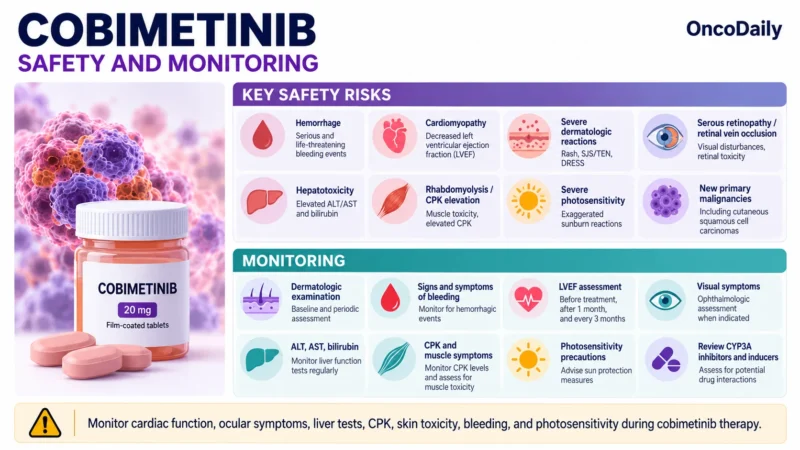
What Monitoring Is Required?
Monitoring during cobimetinib therapy should include:
- Confirm BRAF V600 status before melanoma treatment
- Dermatologic examination
- Signs and symptoms of bleeding
- LVEF before treatment
- LVEF after 1 month
- LVEF every 3 months
- Visual symptoms
- Ophthalmologic assessment when indicated
- ALT
- AST
- Bilirubin
- CPK
- Muscle pain or weakness
- Photosensitivity
- Renal function when clinically appropriate
- Review of CYP3A inhibitors
- Review of CYP3A inducers
- ECG and electrolytes when used with vemurafenib
- Pregnancy counseling.
FAQ
What Is Cobimetinib Used For?
- With vemurafenib for BRAF V600E/K-mutated advanced melanoma
- As monotherapy for adult histiocytic neoplasms.
What Is the Standard Dose?
Can Cobimetinib Be Taken With Food?
It may be taken:
With or without food.
What Are the Dose Reductions?
How Does Cobimetinib Work?
Why Is Cobimetinib Combined With Vemurafenib?
What Did coBRIM Show?
- 12.3 months with cobimetinib + vemurafenib
- 7.2 months with vemurafenib alone
and median OS was:
- 22.3 months
- 17.4 months, respectively.
Can Cobimetinib Be Used Without a BRAF Mutation?
Its FDA indication for:
Adult histiocytic neoplasms
does not require BRAF V600 mutation.
What Are the Most Important Safety Concerns?
Hemorrhage, cardiomyopathy, severe skin reactions, serous retinopathy, retinal vein occlusion, hepatotoxicity, rhabdomyolysis, and severe photosensitivity.
Is Cobimetinib Used in Children?
Not been established in pediatric patients.