





Cladribine: Understanding Its Mechanism, Dosing, and Clinical Role
Key takeaways
- Cladribine is a purine nucleoside analog and antimetabolite.
- It is converted intracellularly to the active metabolite 2-CdATP.
- 2-CdATP interferes with DNA synthesis and repair and promotes apoptosis.
- Cladribine is particularly active against hairy cell leukemia.
- A commonly used IV HCL regimen is 0.09 mg/kg/day by continuous infusion for 7 days.
- It can produce high complete-remission rates and prolonged disease control in HCL.
- Cladribine can be administered intravenously and, in selected protocols, subcutaneously.
- Major toxicities include myelosuppression, profound lymphopenia, and infection.
- Infection prophylaxis and monitoring are important because immunosuppression can persist after treatment.
- Cladribine has also been studied in other hematologic malignancies, but its principal oncology role remains HCL.
- An oral cladribine formulation has a separate indication in multiple sclerosis.
Cladribine is a purine nucleoside analog and antimetabolite used primarily in the treatment of hairy cell leukemia (HCL). It is a prodrug that is converted intracellularly to 2-chlorodeoxyadenosine triphosphate (2-CdATP), which interferes with DNA synthesis and repair and promotes apoptosis of susceptible lymphoid and myeloid cells.
This article aims to review cladribine’s mechanism of action, dose, administration, clinical uses, clinical-trial findings, pharmacokinetics, safety profile, and current clinical role.
Key Facts
- Generic name: Cladribine
- Also known as: 2-CdA; 2-chlorodeoxyadenosine
- Drug class: Purine nucleoside analog; antimetabolite
- Route: Intravenous; subcutaneous administration is also used in some regimens
- Primary oncology use: Hairy cell leukemia
- Typical HCL regimen: 0.09 mg/kg/day IV by continuous infusion for 7 consecutive days
- Active metabolite: 2-chlorodeoxyadenosine triphosphate (2-CdATP)
- Key mechanism: DNA incorporation and inhibition of DNA synthesis and repair
- Major toxicities: Myelosuppression, lymphopenia, infection, and fever
- Important monitoring: CBC, renal function, liver function, and infection
- Key feature: Selective accumulation of the active metabolite in lymphoid cells contributes to its activity
What Is Cladribine?
Cladribine is a synthetic purine nucleoside analog structurally related to deoxyadenosine.
It is relatively resistant to degradation by adenosine deaminase (ADA) because of the chlorine substitution at the 2-position of the purine ring.
After entering cells, cladribine is phosphorylated by deoxycytidine kinase to its active triphosphate metabolite:
2-CdATP
Cells with a relatively high deoxycytidine kinase activity and low 5′-nucleotidase activity can accumulate higher concentrations of the active metabolite.
This contributes to the pronounced activity of cladribine against lymphoid cells.
Fact: Fludarabine has historically been an important component of combination chemotherapy for CLL, including the FCR regimen (fludarabine, cyclophosphamide, and rituximab). Learn more about cyclophosphamide and its role in cancer treatment on OncoDaily.
What Is the Mechanism of Action of Cladribine?
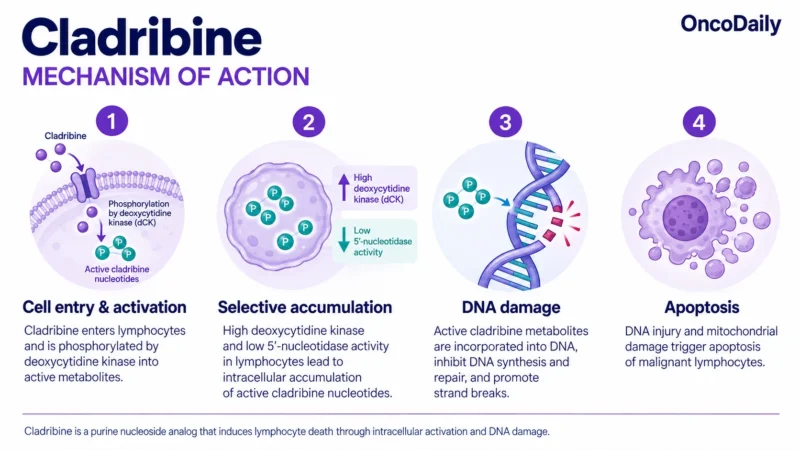
1. Cellular Uptake
Cladribine enters susceptible cells through nucleoside transport mechanisms.
2. Intracellular Activation
The drug is phosphorylated by deoxycytidine kinase:
Cladribine → 2-CdAMP → 2-CdADP → 2-CdATP
The triphosphate metabolite is the principal active form.
3. DNA Incorporation
2-CdATP can be incorporated into DNA during replication.
This interferes with normal DNA synthesis and contributes to DNA strand damage.
4. Inhibition of DNA Repair
Cladribine also interferes with DNA repair pathways and nucleotide metabolism.
5. Apoptosis
Accumulation of DNA damage ultimately triggers cell-cycle arrest and apoptosis.
The mechanism can be summarized as:
Cladribine → intracellular phosphorylation → 2-CdATP → DNA incorporation + inhibition of DNA synthesis/repair → DNA damage → apoptosis
What Is the Dose of Cladribine?
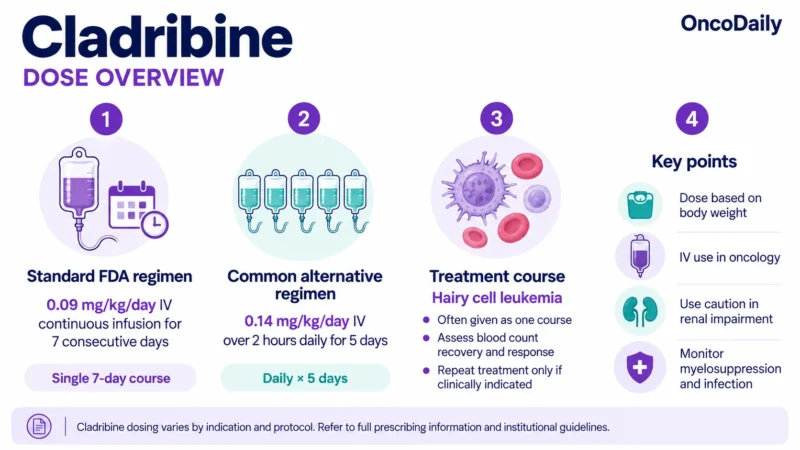
The dose depends on the formulation and treatment protocol.
Intravenous HCL Regimen
A commonly used FDA-labeled regimen for hairy cell leukemia is:
0.09 mg/kg/day by continuous IV infusion for 7 consecutive days
The total treatment course is therefore approximately:
0.63 mg/kg per cycle
Alternative schedules using intermittent IV or subcutaneous administration have also been studied and used clinically.
Because cladribine produces prolonged myelosuppression and lymphopenia, retreatment should be individualized.
How Is Cladribine Administered?
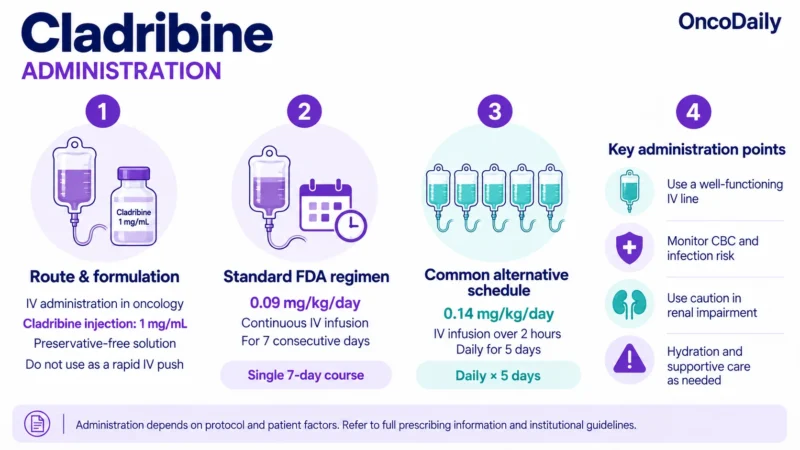
For the traditional HCL regimen, cladribine is administered:
Intravenously by continuous infusion
Typical schedule:
0.09 mg/kg/day → continuous IV infusion → 7 consecutive days
Some centers use subcutaneous cladribine, particularly in alternative HCL treatment protocols.
The exact formulation and schedule should follow the applicable prescribing information and institutional protocol.
Does Cladribine Require an In-Line Filter?
For IV administration, an in-line filter is not routinely required solely because of cladribine.
Preparation and administration should follow the specific product instructions and institutional chemotherapy procedures.
Does Cladribine Require Premedication?
There is no universal mandatory premedication regimen.
Supportive treatment may include:
- Antiemetics when clinically appropriate
- Antiviral prophylaxis
- Pneumocystis jirovecii prophylaxis in selected patients
- Antibacterial or antifungal prophylaxis according to the degree and duration of immunosuppression.
Because cladribine causes profound lymphocyte depletion, infection prophylaxis is particularly important.
Are Dose Reductions Used?
Dose modification may be necessary because of:
- Severe myelosuppression
- Serious infection
- Renal impairment
- Hepatic dysfunction
- Other significant toxicity.
Because cladribine has prolonged effects on lymphocytes, cytopenias and immunosuppression may persist after treatment.
What Is the Pharmacokinetic Profile of Cladribine?
Cladribine is distributed into tissues and enters cells through nucleoside transporters.
After phosphorylation, 2-CdATP accumulates intracellularly, particularly in cells with favorable kinase and phosphatase activity.
The intracellular metabolite has a much longer functional persistence than the parent drug in plasma.
Renal elimination is clinically important, and renal dysfunction can increase exposure.
Does Cladribine Require Renal or Hepatic Dose Adjustment?
Renal Impairment
Renal function should be assessed before treatment.
Because cladribine and its metabolites are substantially eliminated through the kidneys, significant renal impairment can increase systemic exposure.
Dose modification or avoidance may be required depending on the degree of renal dysfunction and the specific product labeling.
Hepatic Impairment
Patients with significant hepatic dysfunction should be treated cautiously because data are limited and cladribine can contribute to hepatic toxicity.
What Are the Clinical Uses of Cladribine?
Hairy Cell Leukemia
Hairy cell leukemia is the classic and principal oncology indication for cladribine.
A single course can produce high rates of complete remission and prolonged disease control.
Cladribine is particularly effective because HCL cells are highly susceptible to purine analogs.
Relapsed Hairy Cell Leukemia
Cladribine can also be used in selected patients with relapsed HCL, although treatment selection depends on the timing of relapse and previous therapy.
It may be combined or sequenced with other agents such as:
- Rituximab
- Pentostatin
- BRAF-targeted therapy in appropriate patients.
Other Hematologic Malignancies
Cladribine has been investigated in:
- Chronic lymphocytic leukemia
- Lymphomas
- Acute leukemias
- Other lymphoproliferative disorders.
However, these are not equivalent to its established HCL indication.
Multiple Sclerosis
An oral formulation of cladribine is also approved in some jurisdictions for highly active relapsing multiple sclerosis.
This is a different clinical application from its oncology use and uses a different formulation and dosing strategy.
Watch more: Hairy Cell Leukemia (HCL) – Cladribine Therapy | Hematology and Oncology
What Did Cladribine Clinical Studies Show?
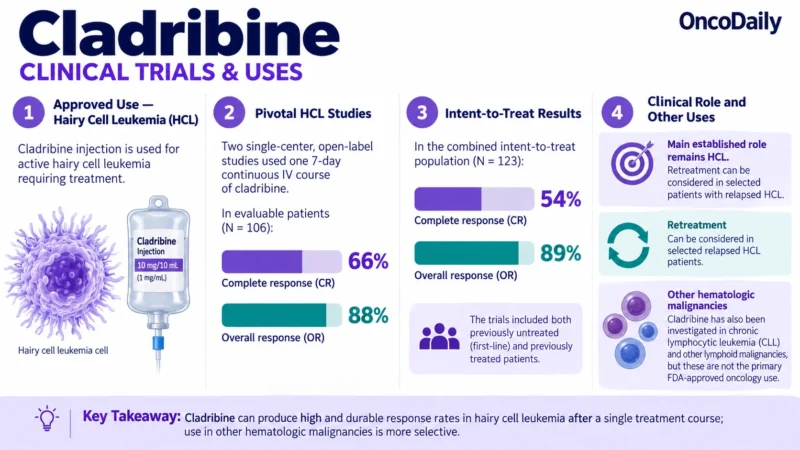
Hairy Cell Leukemia
Early clinical studies established cladribine as a highly active treatment for HCL.
In pivotal studies, treatment produced complete remission in the majority of patients, with many patients experiencing prolonged remission.
Cladribine’s activity was particularly notable because a single treatment course could provide durable disease control.
Cladribine Compared With Interferon-α
Clinical studies in HCL demonstrated substantially higher complete remission rates with cladribine than with historical interferon-based approaches.
These results helped establish purine analog therapy as a major treatment strategy for HCL.
Cladribine Plus Rituximab
Studies have evaluated combinations of cladribine and rituximab in HCL, particularly in patients with detectable minimal residual disease or relapsed disease.
Combination approaches can deepen molecular responses but also increase immunosuppression and require careful infection monitoring.
Is Cladribine FDA Approved?
Yes.
Cladribine injection is FDA approved for the treatment of active hairy cell leukemia.
The drug has also been developed in oral form for multiple sclerosis, where its mechanism involves selective lymphocyte depletion.
The oncology and multiple-sclerosis formulations should not be confused because their dosing schedules, indications, and treatment approaches differ substantially.
What Is the Current Clinical Role of Cladribine?
Cladribine remains an important treatment for hairy cell leukemia, where it can produce deep and durable remissions after a relatively short treatment course.
Its use is particularly attractive because of its high activity against HCL cells.
However, the profound and prolonged lymphopenia and immunosuppression associated with cladribine require careful infection prevention and monitoring.
In relapsed HCL, treatment may be individualized according to:
- Duration of previous remission
- BRAF mutation status
- Prior purine-analog exposure
- Availability of rituximab or targeted therapy
- Patient-specific comorbidities and infection risk.
What Are the Major Side Effects of Cladribine?
Myelosuppression
Cladribine can cause:
- Neutropenia
- Thrombocytopenia
- Anemia
- Pancytopenia.
Lymphopenia
Profound lymphopenia is an important characteristic of cladribine therapy.
CD4+ T-cell depletion may persist for months after treatment.
Infection
Because of prolonged immunosuppression, patients can develop:
- Bacterial infections
- Viral infections
- Fungal infections
- Opportunistic infections.
Fever
Fever is common during treatment and may reflect either drug-related effects or infection.
Hepatotoxicity
Liver enzyme abnormalities can occur.
Renal Toxicity
Renal toxicity is uncommon but clinically important, particularly in patients receiving high doses or with pre-existing renal dysfunction.
What Monitoring Is Required?
Monitoring should include:
- CBC with differential
- Absolute neutrophil count
- Lymphocyte count
- Platelet count
- Renal function
- Liver function
- Assessment for infection
- CD4 count when clinically appropriate.
Because lymphocyte recovery may be prolonged, monitoring should continue after completion of therapy.