


Cemiplimab-rwlc (Libtayo): Mechanism of Action, Dosing, Clinical Uses, Trials, and Side Effects
Key takeaways
- Cemiplimab is a fully human IgG4 anti-PD-1 monoclonal antibody.
- It blocks PD-1 interaction with PD-L1 and PD-L2.
- It restores antitumor T-cell function.
- It received initial FDA approval in 2018.
- It is approved for advanced CSCC, advanced BCC, and selected NSCLC settings.
- In October 2025, the FDA approved adjuvant treatment in high-risk CSCC after surgery and radiation.
- The standard dose is 350 mg IV every three weeks.
- C-POST demonstrated a 68% relative reduction in recurrence or death.
- EMPOWER-Lung 1 and 3 demonstrated overall survival benefits in advanced NSCLC.
- EMPOWER-Cervical 1 supported the EU indication in previously treated cervical cancer.
- Serious immune-related toxicities can involve virtually any organ system.
Cemiplimab-rwlc (Libtayo) is a fully human monoclonal antibody targeting programmed cell death protein 1 (PD-1), an inhibitory immune checkpoint receptor expressed on activated T lymphocytes. By blocking the interaction of PD-1 with its ligands PD-L1 and PD-L2, cemiplimab restores antitumor T-cell activity and promotes immune-mediated cancer-cell destruction.
Cemiplimab received its initial FDA approval on September 28, 2018, becoming the first systemic immunotherapy specifically approved for advanced cutaneous squamous cell carcinoma (CSCC).
Its indications subsequently expanded to basal cell carcinoma (BCC) and non-small cell lung cancer (NSCLC), both as monotherapy and in combination with platinum-based chemotherapy.
A major development occurred on October 8, 2025, when the FDA approved cemiplimab as adjuvant therapy for adults with CSCC at high risk of recurrence following surgery and radiation.
This approval was supported by the randomized phase III C-POST trial, which demonstrated a 68% reduction in the relative risk of disease recurrence or death.
Cemiplimab is also authorized in the European Union for selected patients with recurrent or metastatic cervical cancer after platinum-based chemotherapy, an indication that is not FDA approved in the United States.
Major studies include EMPOWER-CSCC 1, C-POST, Study 1620, EMPOWER-Lung 1, EMPOWER-Lung 3, and EMPOWER-Cervical 1.
Key Facts
- Generic name: Cemiplimab-rwlc
- Brand name: Libtayo
- Drug class: Immune checkpoint inhibitor
- Antibody type: Fully human IgG4 monoclonal antibody
- Target: PD-1 (CD279)
- Ligands blocked: PD-L1 and PD-L2
- Mechanism: Restoration of antitumor T-cell activity
- Initial FDA approval: September 28, 2018
- Adjuvant CSCC approval: October 8, 2025
- Administration: Intravenous infusion
- Standard dose: 350 mg IV every three weeks
- Alternative adjuvant schedule: 350 mg every three weeks initially, followed by 700 mg every six weeks
- Infusion duration: 30 minutes
- FDA indications: Advanced CSCC, high-risk adjuvant CSCC, advanced BCC, and specified first-line NSCLC settings
- EU additional indication: Previously treated recurrent/metastatic cervical cancer
- Pivotal trials: EMPOWER-CSCC 1, C-POST, Study 1620, EMPOWER-Lung 1, EMPOWER-Lung 3
- Biomarkers: PD-L1 TPS for NSCLC monotherapy; EGFR, ALK, ROS1 testing
- Common adverse reactions: Fatigue, musculoskeletal pain, rash, diarrhea, pruritus, and anemia
- Serious toxicities: Immune-mediated pneumonitis, colitis, hepatitis, endocrinopathies, nephritis, myocarditis, and neurological complications
- Monitoring: Liver function, kidney function, thyroid function, blood glucose, and immune-related symptoms
- Elimination half-life: Approximately 22 days
- Available strength: 350 mg/7 mL single-dose vial
What Is Cemiplimab?
Cemiplimab is a human IgG4 monoclonal antibody that inhibits PD-1-mediated immune suppression.
PD-1 is an immune checkpoint receptor that helps regulate immune activation and maintain tolerance to normal tissues.
When PD-L1 or PD-L2 binds PD-1, inhibitory signaling reduces the activity of cytotoxic T cells.
Some tumors exploit this mechanism by expressing PD-L1 or creating a microenvironment that suppresses antitumor immunity.
Cemiplimab binds PD-1 and blocks ligand engagement, allowing T cells to recover antitumor activity.
Unlike antibody–drug conjugates, cemiplimab does not contain a cytotoxic payload. Its principal antitumor effect depends on the patient’s immune system.
What Is the Mechanism of Action of Cemiplimab?
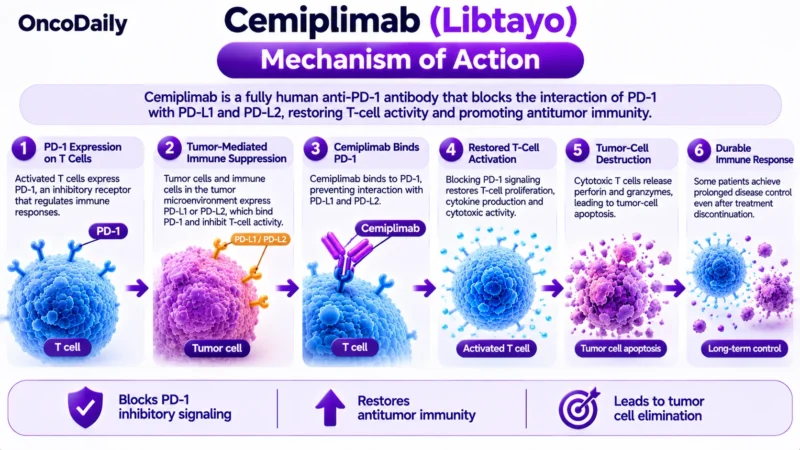
1. PD-1 Expression on T Cells
Activated T lymphocytes express PD-1 on their surface.
PD-1 normally acts as an inhibitory checkpoint, preventing excessive immune responses.
2. Tumor-Mediated Immune Suppression
Tumor cells or immune cells in the tumor microenvironment may express PD-L1 or PD-L2.
When these ligands bind PD-1, inhibitory signaling suppresses T-cell receptor activity.
This reduces:
- T-cell proliferation
- Cytokine production
- Cytotoxic activity
- Antitumor immune responses
3. Cemiplimab Binds PD-1
Cemiplimab binds the PD-1 receptor on T cells.
It prevents both PD-L1 and PD-L2 from engaging PD-1.
4. Restoration of T-Cell Activation
Blocking PD-1-associated inhibitory signaling restores T-cell function.
Activated T cells may increase proliferation and production of antitumor cytokines.
5. Cytotoxic Tumor-Cell Killing
Activated cytotoxic T cells release:
- Perforin
- Granzymes
These molecules and other immune pathways promote malignant-cell apoptosis.
6. Sustained Antitumor Immunity
Some patients experience prolonged responses even after treatment discontinuation.
However, not all patients respond, and primary or acquired resistance may occur.
Overall mechanism:
Cemiplimab → PD-1 blockade → inhibition of PD-L1/PD-L2 signaling → restoration of T-cell activity → immune-mediated tumor-cell destruction.
What Is the Recommended Dose of Cemiplimab?
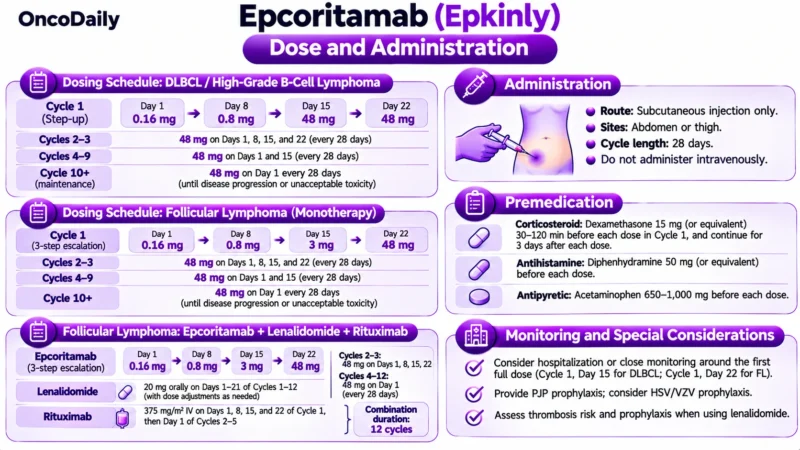
Advanced Cutaneous Squamous Cell Carcinoma
For locally advanced or metastatic CSCC not amenable to curative surgery or radiation:
350 mg IV every three weeks.
Treatment continues until:
- Disease progression
- Unacceptable toxicity
- A maximum of 24 months
Adjuvant Treatment of High-Risk CSCC
Following definitive surgery and radiation, two FDA-approved dosing schedules are available.
Option 1 — Extended-Interval Schedule
350 mg IV every three weeks for the first 12 weeks.
Then:
700 mg IV every six weeks.
Total maximum treatment duration:
48 weeks.
Option 2 — Every-Three-Week Schedule
350 mg IV every three weeks for up to 48 weeks.
Treatment stops earlier for recurrence or unacceptable toxicity.
Locally Advanced or Metastatic Basal Cell Carcinoma
For patients previously treated with a hedgehog pathway inhibitor (HHI), or when an HHI is not appropriate:
350 mg IV every three weeks.
Continue until progression, unacceptable toxicity, or up to 24 months.
NSCLC — First-Line Monotherapy
For eligible patients with PD-L1 TPS of at least 50% and without EGFR, ALK, or ROS1 alterations:
350 mg IV every three weeks.
Continue until progression or unacceptable toxicity.
NSCLC — Combination With Platinum-Based Chemotherapy
Cemiplimab 350 mg IV every three weeks, combined with histology-appropriate platinum-based chemotherapy.
In the pivotal trial, chemotherapy was administered for four cycles.
Maintenance pemetrexed was used for eligible nonsquamous NSCLC patients who received pemetrexed-containing induction chemotherapy.
Cemiplimab is continued according to the treatment protocol and prescribing information.
How Should Cemiplimab Be Administered?
Intravenous Administration
Cemiplimab is administered by intravenous infusion over:
30 minutes.
It must not be administered as an IV push or bolus.
Preparation
Each single-dose vial contains:
350 mg in 7 mL, equivalent to 50 mg/mL.
Dilute using 0.9% sodium chloride or 5% dextrose injection according to prescribing instructions.
For preparation of a 700-mg dose, two 350-mg vials are required.
Do not shake the vial.
Use a sterile, low-protein-binding 0.2- to 5-micron in-line or add-on filter as specified in the product label.
Premedication
Routine corticosteroid or antihistamine premedication is not required for every patient.
Premedication may be considered in patients with previous mild or moderate infusion reactions.
Combination With Chemotherapy
When used for NSCLC, administer cemiplimab before chemotherapy on the same day, following the regimen-specific instructions.
What Should You Do If a Cemiplimab Dose Is Missed?
If a scheduled dose is missed:
- Contact the treating oncology team.
- Reschedule the infusion when clinically appropriate.
- Reassess the reason for the delay.
- Continue treatment according to the revised schedule.
Do not double the next dose.
How Are Cemiplimab Dose Modifications Managed?
Dose reductions are not recommended.
Immune-related adverse reactions are managed by withholding treatment, corticosteroids, additional immunosuppression, or permanent discontinuation.
Grade 1 Immune-Related Toxicity
Treatment may often continue with close monitoring.
Certain cardiac, neurological, and hematologic toxicities require more cautious management.
Grade 2 Toxicity
Consider withholding cemiplimab.
For clinically significant inflammatory toxicity, corticosteroids may be required, commonly starting at prednisone 0.5–1 mg/kg/day, depending on the organ involved.
Grade 3 Toxicity
Withhold treatment and initiate systemic corticosteroids, generally prednisone 1–2 mg/kg/day or equivalent when indicated.
Consider specialist consultation and additional immunosuppressive treatment for steroid-refractory events.
Grade 4 Toxicity
Generally requires permanent discontinuation.
Selected endocrine toxicities controlled through hormone replacement may be exceptions.
Infusion Reactions
For mild or moderate infusion reactions:
- Interrupt or slow the infusion.
- Provide symptomatic management.
For Grade 3–4 infusion reactions:
Permanently discontinue cemiplimab.
What Drug Interactions Are Important With Cemiplimab?
Corticosteroids and Immunosuppressive Agents
Systemic immunosuppression may affect immune responses.
However, corticosteroids and other immunosuppressive medications remain essential for managing significant immune-related adverse reactions.
Cytotoxic Chemotherapy
Combining cemiplimab with chemotherapy increases the potential for:
- Neutropenia
- Anemia
- Fatigue
- Nausea
- Peripheral neuropathy
- Infection
These toxicities may arise from chemotherapy rather than immune checkpoint blockade alone.
Other Immune-Modulating Agents
Additional immunotherapies may increase immune-mediated toxicity.
CYP450 Interactions
Cemiplimab is a monoclonal antibody and does not undergo conventional CYP450 metabolism.
Clinically important CYP-mediated drug interactions are not expected.
Does Cemiplimab Require Dose Adjustment in Renal or Hepatic Impairment?
Renal Impairment
No routine dose adjustment is required for mild or moderate renal impairment.
Population pharmacokinetic analyses have not identified clinically significant effects of renal function on cemiplimab exposure.
Nevertheless, immune-mediated nephritis can occur during treatment.
Hepatic Impairment
No routine dose adjustment is established for mild or moderate hepatic impairment.
The pharmacokinetic effects of severe hepatic impairment are insufficiently characterized.
Patients with abnormal baseline liver function require individualized assessment.
What Is the Pharmacokinetic Profile of Cemiplimab?
Molecular Structure
Cemiplimab is a fully human IgG4 monoclonal antibody with an approximate molecular weight of:
146 kDa.
Distribution
The estimated volume of distribution is:
5.9 L.
Metabolism
Cemiplimab undergoes proteolytic catabolism to peptides and amino acids.
Half-Life
The elimination half-life is approximately:
22 days.
Clearance
Steady-state clearance is approximately:
0.22 L/day.
Steady State
Steady-state concentrations are generally reached after approximately:
Four months.
Immunogenicity
Anti-drug antibodies have been detected in a small proportion of patients.
Clinically significant effects on exposure have not been established in available studies.
What Are the Clinical Uses of Cemiplimab?
Locally Advanced or Metastatic Cutaneous Squamous Cell Carcinoma
Cemiplimab is an established treatment for adults with locally advanced or metastatic CSCC who are not candidates for curative surgery or radiation.
It is particularly relevant for tumors involving anatomically sensitive regions, including the head and neck, where extensive surgery may cause substantial functional or cosmetic impairment.
Patients can experience durable tumor regression, although response is not universal.
Adjuvant Treatment of High-Risk CSCC
Following the 2025 FDA approval, cemiplimab is indicated after surgery and radiation in adults with CSCC at high risk of recurrence.
The pivotal C-POST population included patients with features such as:
- Multiple involved lymph nodes
- Significant extranodal extension
- In-transit metastases
- Extensive perineural invasion
- Bone or skull-base invasion
- High-risk recurrent tumors
The aim is to reduce the risk of locoregional and distant recurrence.
This indication is distinct from treatment of unresectable or metastatic CSCC.
Advanced Basal Cell Carcinoma
Cemiplimab is approved for adults with locally advanced or metastatic BCC previously treated with a hedgehog pathway inhibitor, or when an HHI is inappropriate.
Hedgehog inhibitors include vismodegib and sonidegib.
Cemiplimab provides an immunotherapeutic option when targeted Hedgehog-pathway treatment is ineffective, poorly tolerated, or unsuitable.
First-Line NSCLC — High PD-L1 Expression
Cemiplimab monotherapy is approved for selected patients with locally advanced or metastatic NSCLC whose tumors demonstrate:
PD-L1 TPS ≥50%.
Tumors must not harbor EGFR, ALK, or ROS1 genomic alterations covered by the label’s exclusion criteria.
First-Line NSCLC — Combination With Chemotherapy
Cemiplimab plus platinum-based chemotherapy is approved for eligible locally advanced or metastatic NSCLC without EGFR, ALK, or ROS1 alterations.
The U.S. combination indication is not restricted to PD-L1-positive tumors.
This provides an important distinction from cemiplimab monotherapy.
Recurrent or Metastatic Cervical Cancer
Cemiplimab is authorized in the European Union for adults with recurrent or metastatic cervical cancer progressing during or after platinum-based chemotherapy.
The authorization is based on the phase III EMPOWER-Cervical 1 trial.
As of November 2026, cervical cancer is not an FDA-approved cemiplimab indication in the United States.
What Biomarker Testing Is Required Before Cemiplimab?
PD-L1 Expression
PD-L1 immunohistochemistry is required for the U.S. NSCLC monotherapy indication.
The threshold is:
TPS ≥50%.
PD-L1 testing is not a mandatory selection requirement for approved advanced CSCC or BCC treatment.
NSCLC Molecular Profiling
Before starting first-line cemiplimab, evaluate relevant genomic alterations.
Testing should include, as appropriate:
- EGFR
- ALK
- ROS1
- KRAS
- BRAF
- MET
- RET
- NTRK
- ERBB2
Broad molecular profiling helps avoid inappropriate selection of immunotherapy when molecularly targeted treatment is more suitable.
CSCC and BCC
Histopathologic confirmation is essential.
Biomarker testing is not routinely required to establish eligibility for the FDA-approved skin cancer indications.
For adjuvant CSCC, accurate pathological and clinical risk assessment is particularly important.
Baseline Clinical Assessment
Before treatment, evaluate organ function, autoimmune disease history, previous transplantation, medication use, and symptoms of preexisting inflammatory disease.
What Did the Pivotal Clinical Trials Show?
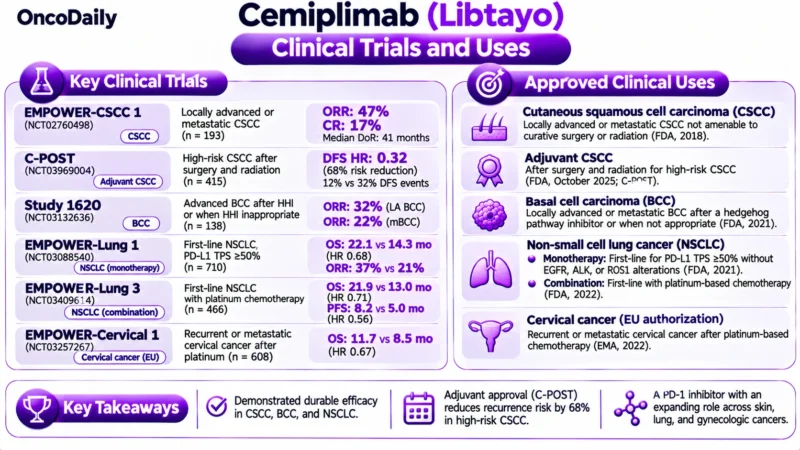
EMPOWER-CSCC 1 — Advanced Cutaneous Squamous Cell Carcinoma
The phase II Study 1540 (NCT02760498) evaluated cemiplimab in patients with locally advanced or metastatic CSCC.
The FDA final efficacy analysis included 193 patients.
Overall Response Rate
47%
Complete Response Rate
17%
Median Duration of Response
41 months
These findings demonstrated substantial and durable activity in advanced CSCC.
The response rates varied across locally advanced and metastatic cohorts, but clinically meaningful responses were observed in both populations.
C-POST — Adjuvant High-Risk Cutaneous Squamous Cell Carcinoma
C-POST was a randomized, double-blind phase III trial of cemiplimab versus placebo following surgery and radiation in patients with CSCC at high risk of recurrence.
A total of 415 patients were randomized.
Median Disease-Free Survival
- Cemiplimab: Not reached
- Placebo: 49.4 months
Hazard Ratio for DFS
HR: 0.32
p < 0.0001
Disease-Free Survival Events
- Cemiplimab: 12%
- Placebo: 32%
These results corresponded to a 68% relative reduction in the risk of recurrence or death.
Overall survival data were not mature at the initial regulatory analysis.
The results supported the October 2025 FDA approval.
Read More: Immunotherapy for Early-Stage Cutaneous Squamous Cell Carcinoma by OncoDaily.
Watch More: C-POST: adjuvant cemiplimab in high-risk cutaneous squamous cell carcinoma.
Study 1620 — Advanced Basal Cell Carcinoma
Study 1620 evaluated cemiplimab in patients with advanced BCC previously treated with a Hedgehog-pathway inhibitor or considered unsuitable for such treatment.
A total of 138 patients were included.
Locally Advanced BCC
- Overall response rate: 32%
- Complete response rate: 7%
Metastatic BCC
- Overall response rate: 22%
- Complete response rate: 1.9%
The trial demonstrated clinically meaningful responses in a population with limited treatment alternatives.
EMPOWER-Lung 1 — First-Line NSCLC Monotherapy
EMPOWER-Lung 1 was a randomized phase III trial comparing cemiplimab monotherapy with platinum-doublet chemotherapy in patients with advanced NSCLC and PD-L1 TPS ≥50%.
The FDA efficacy population included 710 patients.
Median Overall Survival
- Cemiplimab: 22.1 months
- Chemotherapy: 14.3 months
HR: 0.68
Median Progression-Free Survival
- Cemiplimab: 6.2 months
- Chemotherapy: 5.6 months
HR: 0.59
Objective Response Rate
- Cemiplimab: 37%
- Chemotherapy: 21%
The results established cemiplimab as a first-line monotherapy option for high-PD-L1 NSCLC without specified oncogenic driver alterations.
EMPOWER-Lung 3 — Cemiplimab Plus Platinum-Based Chemotherapy
The randomized phase III EMPOWER-Lung 3 trial evaluated cemiplimab plus platinum-based chemotherapy versus chemotherapy alone in advanced NSCLC.
The FDA efficacy analysis included 466 patients.
Median Overall Survival
- Cemiplimab + chemotherapy: 21.9 months
- Chemotherapy: 13.0 months
HR: 0.71; p = 0.014
Median Progression-Free Survival
- Cemiplimab + chemotherapy: 8.2 months
- Chemotherapy: 5.0 months
HR: 0.56
Objective Response Rate
- Cemiplimab + chemotherapy: 43%
- Chemotherapy: 23%
The results supported the expansion of cemiplimab into first-line chemoimmunotherapy for advanced NSCLC.
EMPOWER-Cervical 1 — Recurrent or Metastatic Cervical Cancer
The phase III EMPOWER-Cervical 1 trial compared cemiplimab with investigator’s choice of chemotherapy in patients with recurrent or metastatic cervical cancer after platinum-based treatment.
A total of 608 patients were randomized.
Median Overall Survival — Initial Analysis
- Cemiplimab: 12.0 months
- Chemotherapy: 8.5 months
HR: 0.69
Final Overall Survival Analysis
- Cemiplimab: 11.7 months
- Chemotherapy: 8.5 months
HR: 0.67
The final analysis confirmed a survival benefit across the overall population.
These findings supported European authorization for previously treated recurrent or metastatic cervical cancer.
Does Cemiplimab Have CNS Activity?
Cemiplimab is not specifically approved as a CNS-directed therapy.
In EMPOWER-Lung 1 and EMPOWER-Lung 3, selected patients with previously treated, stable brain metastases were eligible.
However, these studies do not establish cemiplimab as a substitute for surgery or radiotherapy in patients with symptomatic or unstable brain metastases.
CNS management should follow disease-specific recommendations and account for lesion size, neurological symptoms, corticosteroid requirements, and extracranial disease status.
Is Cemiplimab FDA Approved?
Yes.
Important milestones include:
- September 2018: Initial approval for advanced CSCC.
- February 2021: Approval for advanced BCC after HHI treatment or when HHI is inappropriate.
- February 2021: First-line NSCLC monotherapy approval for PD-L1-high tumors.
- November 2022: Approval with platinum-based chemotherapy in advanced NSCLC.
- October 8, 2025: Adjuvant approval for high-risk CSCC following surgery and radiation.
The current U.S. label includes CSCC, BCC, and NSCLC indications.
Cervical cancer remains an EU-authorized indication, not a U.S. FDA-approved indication.
What Is the Current Clinical Role of Cemiplimab in 2026?
Advanced CSCC
Cemiplimab remains a major systemic immunotherapy option for unresectable or metastatic cutaneous squamous cell carcinoma.
Adjuvant High-Risk CSCC
The C-POST results have expanded its role into curative-intent treatment following surgery and radiation.
This is particularly important for patients with high-risk nodal or non-nodal pathological features.
Advanced BCC
Cemiplimab is an established option following HHI therapy or when HHI use is inappropriate.
NSCLC
Cemiplimab is an alternative PD-1 inhibitor in first-line advanced NSCLC treatment.
Patient selection depends on PD-L1 expression, molecular alterations, clinical fitness, and the need for chemotherapy.
Cervical Cancer
In the European Union, cemiplimab provides an option after progression on platinum-based chemotherapy.
Its use must be distinguished from the U.S. regulatory framework.
What Are the Major Side Effects of Cemiplimab?
Immune-Mediated Pneumonitis
Cemiplimab may cause inflammatory lung injury.
Symptoms include cough, dyspnea, hypoxia, and chest discomfort.
Severe pneumonitis may be life-threatening.
Immune-Mediated Colitis
Symptoms include diarrhea, abdominal pain, blood or mucus in stool, and dehydration.
Severe cases may require corticosteroids, hospitalization, and additional immunosuppression.
Immune-Mediated Hepatitis
Cemiplimab may produce elevated liver enzymes and clinically significant liver inflammation.
Severe immune-mediated hepatitis can cause liver failure.
Endocrinopathies
Important endocrine complications include:
- Hypothyroidism
- Hyperthyroidism and thyroiditis
- Hypophysitis
- Adrenal insufficiency
- Type 1 diabetes mellitus
Some endocrine complications require lifelong hormone replacement.
Immune-Mediated Nephritis
Interstitial nephritis and other immune-mediated renal disorders may cause acute kidney injury.
Dermatologic Adverse Reactions
Rash and pruritus are common.
Rare serious complications include Stevens–Johnson syndrome and toxic epidermal necrolysis.
Myocarditis and Neurological Toxicity
Although uncommon, immune-mediated myocarditis, encephalitis, myositis, and other neurological complications can be life-threatening.
Infusion-Related Reactions
Symptoms may include fever, chills, hypotension, rash, and dyspnea.
Solid Organ Transplant Rejection
PD-1 blockade can increase the risk of organ transplant rejection.
Patients with prior transplantation require careful individual risk assessment.
Allogeneic HSCT Complications
Serious complications, including graft-versus-host disease, may occur when PD-1 blockade is administered before or after allogeneic HSCT.
Embryo-Fetal Toxicity
Cemiplimab may cause fetal harm.
Females of reproductive potential should use effective contraception during treatment and for four months after the final dose.
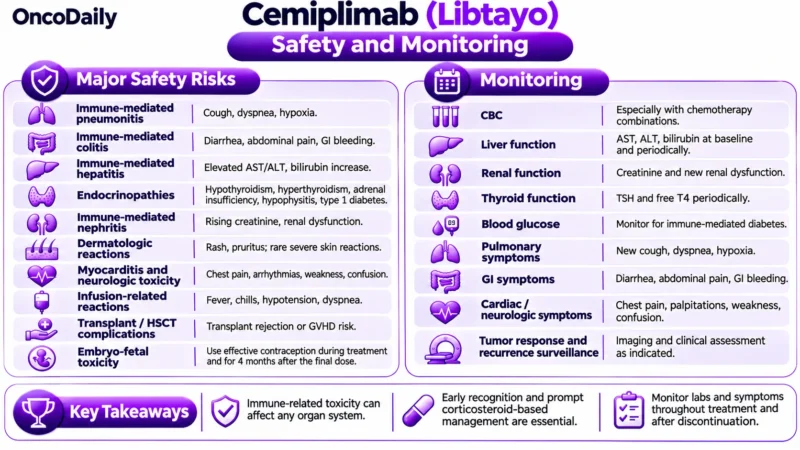
What Monitoring Is Required During Cemiplimab Treatment?
Complete Blood Count
Monitor for anemia, cytopenias, and treatment-related abnormalities, particularly with chemotherapy combinations.
Liver Function
Monitor AST, ALT, and bilirubin at baseline and periodically.
Renal Function
Monitor creatinine and evaluate new renal dysfunction.
Thyroid Function
Monitor TSH and free T4 periodically.
Blood Glucose
Assess for hyperglycemia and symptoms suggestive of immune-mediated diabetes.
Pulmonary Monitoring
Investigate new cough, dyspnea, and hypoxia.
Gastrointestinal Monitoring
Assess diarrhea, abdominal pain, and gastrointestinal bleeding.
Cardiovascular and Neurological Monitoring
Investigate chest pain, arrhythmias, weakness, confusion, and other unexplained neurological symptoms.
Tumor Response
Perform appropriate imaging and clinical assessment.
For adjuvant CSCC, surveillance should include examination of the skin, regional lymph nodes, and other sites according to recurrence risk.