Cutaneous squamous cell carcinoma (CSCC) is the second most common skin cancer worldwide and represents a growing public health challenge. Although the majority of patients are cured with surgery alone, a subset develops aggressive disease characterized by local recurrence, nodal metastases, and significant treatment-related morbidity. This burden is particularly evident among elderly individuals and immunosuppressed populations, including organ transplant recipients, who experience substantially higher incidence rates and poorer outcomes.
The remarkable success of immune checkpoint inhibitors in advanced CSCC has prompted investigators to explore whether immunotherapy could be moved into earlier disease stages. However, unlike melanoma, where perioperative immunotherapy is already well established, the optimal integration of immunotherapy into resectable CSCC remains uncertain. The review by Andrea Boutros and colleagues examines the rapidly evolving evidence supporting both adjuvant and neoadjuvant immunotherapy and discusses how these approaches may reshape treatment strategies in the future.
Why Current Risk Stratification Remains a Major Problem
One of the most important themes of the review is that the field still lacks a reliable method for identifying which patients truly require additional therapy after surgery. Existing staging systems—including AJCC, BWH, and UICC classifications—were largely developed before the immunotherapy era and frequently fail to capture key biological factors that influence prognosis. Important variables such as immunosuppression, tumor growth dynamics, anatomical location, and immune microenvironment characteristics are not adequately incorporated into current models.
As a result, patients categorized within the same stage may experience dramatically different clinical outcomes. This inconsistency has also complicated clinical trial design, producing heterogeneous patient populations and making direct comparisons between studies challenging. The authors argue that future progress will require a more biologically informed, CSCC-specific framework capable of identifying patients who are most likely to benefit from perioperative immunotherapy.
The Foundation: Success of PD-1 Blockade in Advanced Disease
The rationale for perioperative immunotherapy originates from the impressive activity observed in advanced CSCC. Cemiplimab and pembrolizumab have both demonstrated substantial and durable antitumor activity, establishing PD-1 blockade as the standard of care for patients who are not candidates for curative surgery or radiotherapy.
The pivotal studies reported:
- EMPOWER-CSCC-1 (cemiplimab): ORR approximately 47–50%, durable disease control 61%, median time to response 1.9 months
- KEYNOTE-629 (pembrolizumab): ORR 34% in recurrent, metastatic, or unresectable disease
These response rates are particularly notable given the advanced stage of disease in these populations and suggested that earlier intervention with immunotherapy might achieve even greater benefits.
Adjuvant Immunotherapy: Mixed Results Create Uncertainty
The adjuvant setting has produced conflicting evidence.
The phase III C-POST trial evaluated one year of adjuvant cemiplimab following surgery and radiotherapy in patients with very high-risk CSCC. The study demonstrated a striking reduction in recurrence risk, with disease-free survival clearly favoring cemiplimab. At 24 months, disease-free survival reached 87.1% compared with 64.1% in the placebo arm, corresponding to a hazard ratio of 0.32.
Key Results (C-POST)
- 24-month DFS: 87.1% vs 64.1%
- Hazard ratio: 0.32
- P < 0.001
However, overall survival data remain immature and no survival advantage has yet been demonstrated.
In contrast, the phase III KEYNOTE-630 trial failed to show a significant benefit for adjuvant pembrolizumab and was ultimately terminated for futility. Recurrence-free survival was not significantly improved, and overall survival remained unchanged.
Key Results (KEYNOTE-630)
- RFS HR: 0.76
- Primary endpoint not met (P=0.07)
- No OS improvement
The review suggests that differences in patient selection may largely explain these divergent outcomes. While C-POST focused on an exceptionally high-risk population, KEYNOTE-630 included a broader and potentially lower-risk cohort, increasing the likelihood that many patients were already adequately treated with surgery and radiotherapy alone.
Neoadjuvant Immunotherapy: The Most Exciting Development in CSCC
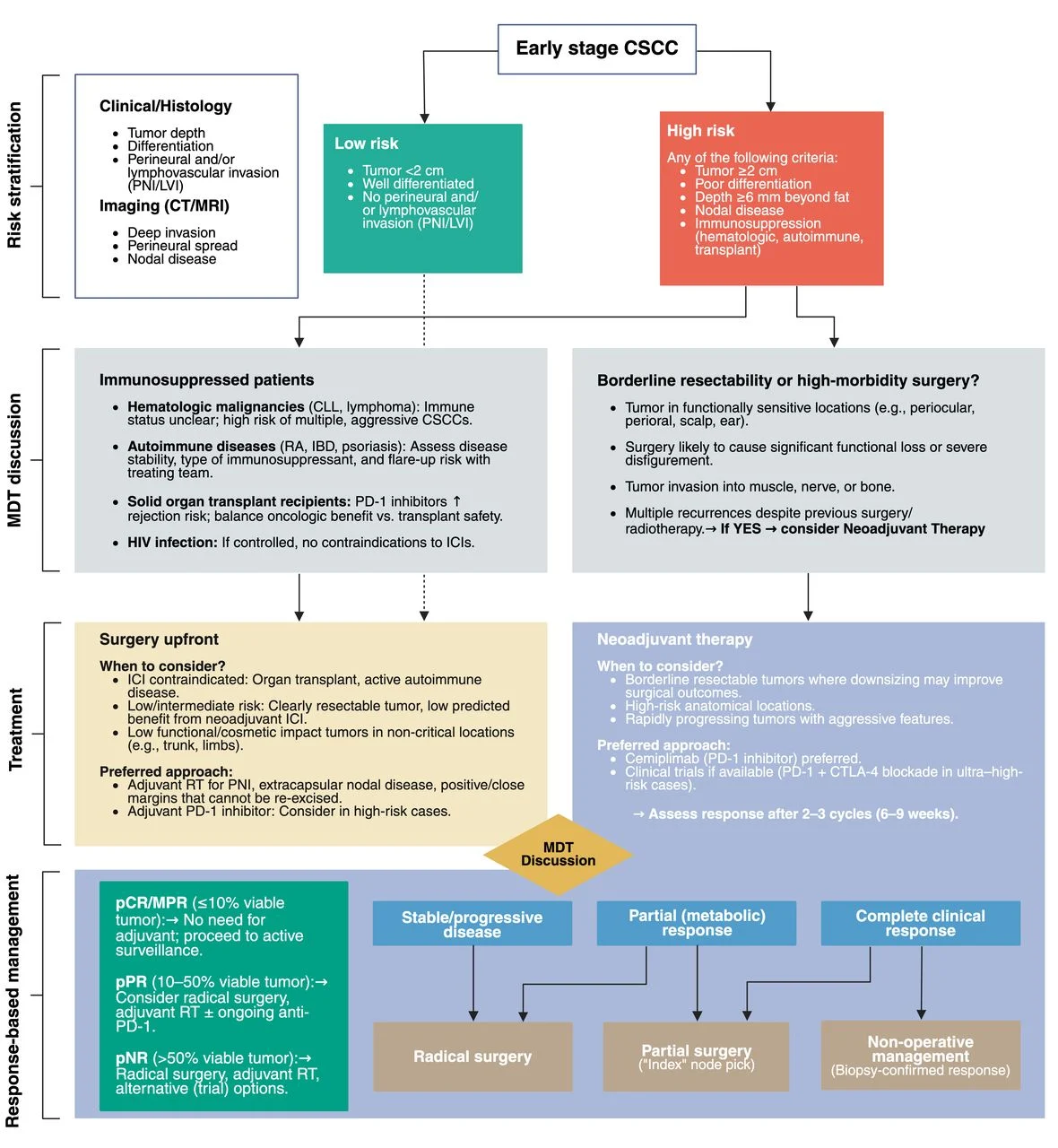
The strongest signal emerging from the literature comes from neoadjuvant immunotherapy. Across multiple studies, short courses of PD-1 blockade administered before surgery have consistently produced remarkably high pathological response rates.
Perhaps most importantly, these responses often occurred after only two to four treatment cycles, suggesting that profound immune activation can be achieved rapidly in CSCC.
The earliest cemiplimab study demonstrated major pathological responses in three-quarters of treated patients and complete pathological responses in more than half. Long-term follow-up showed durable disease control, even in many patients who did not receive routine postoperative immunotherapy.
Pilot Cemiplimab Study
- MPR: 75%
- pCR: 55%
- No recurrences after more than 30 months of follow-up
The larger multicenter cemiplimab trial confirmed these findings.
Multicenter Cemiplimab Study
- pCR: 51%
- MPR: 64%
One particularly important observation was the poor correlation between radiographic and pathological responses. Many patients who appeared to have only stable disease on imaging ultimately demonstrated near-complete eradication of viable tumor cells upon pathological examination. This finding emphasizes the importance of pathological assessment when evaluating neoadjuvant immunotherapy efficacy.
Could Immunotherapy Allow Surgery De-escalation?
A recurring theme throughout the review is the possibility that neoadjuvant immunotherapy could eventually reduce the need for extensive surgery and radiotherapy.
This concept is especially important because many CSCC tumors arise in anatomically complex head and neck locations where aggressive surgery can lead to significant functional and cosmetic consequences.
The MATISSE trial provided some of the most provocative evidence supporting this approach. Patients received nivolumab alone or nivolumab plus ipilimumab before planned surgery. Remarkably, a subset of patients experienced such profound clinical responses that surgery was ultimately omitted.
MATISSE Trial
- MPR with nivolumab: 40%
- MPR with nivolumab + ipilimumab: 53%
- Surgery omitted in 20% of patients
- Disease-free status maintained after median 34 months follow-up
Although these findings remain exploratory, they raise an important question: if immunotherapy can eradicate tumor cells and provide durable disease control, should radical surgery always remain mandatory?
Response-Adapted Treatment May Be the Future
Several studies are now moving beyond simple response measurement and using treatment response to guide subsequent management decisions.
The De-Squamate study represents one of the clearest examples of this strategy. Patients achieving complete clinical and metabolic responses were able to avoid surgery and radiotherapy altogether.
De-Squamate Trial
- Composite pCR/clinical complete response: 63%
- No recurrences among complete responders
Similarly, additional neoadjuvant studies have reported pCR rates approaching 40–60%, while simultaneously allowing radiotherapy de-escalation in selected patients.
Across the neoadjuvant literature, complete and major pathological responses consistently fall within the 50–70% range, making this one of the most reproducible findings in modern CSCC research.
Why the Authors Favor Neoadjuvant Over Adjuvant Therapy
The review ultimately presents a compelling argument that neoadjuvant immunotherapy may be biologically and clinically superior to adjuvant treatment.
Administering PD-1 blockade while the tumor remains intact exposes the immune system to a rich source of tumor antigens, potentially generating broader and more durable antitumor immune responses. Additionally, neoadjuvant therapy provides a direct measure of treatment sensitivity through pathological response assessment, allowing subsequent treatment decisions to be individualized.
In contrast, adjuvant therapy is administered after tumor removal, making it difficult to identify which patients truly require prolonged treatment and increasing the risk of overtreatment. The negative KEYNOTE-630 study further reinforces these concerns.
Immunotherapy for Skin Cancer: Types, Success Rate, Side Effects and More
Conclusion
This review highlights a major shift occurring in the management of early-stage CSCC. While adjuvant immunotherapy has produced inconsistent results, neoadjuvant PD-1 blockade has repeatedly generated pathological response rates exceeding 50%, with several studies reporting complete responses in approximately half of treated patients. These responses are increasingly being leveraged to reduce the intensity of surgery and radiotherapy, opening the door to organ-preserving and response-adapted treatment strategies.
Rather than applying treatment paradigms borrowed from melanoma or head and neck cancer, the authors argue that CSCC requires its own precision-medicine framework—one that integrates biology, pathological response, patient-specific factors, and functional outcomes into therapeutic decision-making. If future randomized trials confirm the promising early data, neoadjuvant immunotherapy may ultimately become the cornerstone of treatment for high-risk resectable CSCC.
Read Full Article Here