





Carboplatin: A Key Platinum Chemotherapy in Cancer Treatment
Key takeaways
- Carboplatin is a platinum-based cytotoxic chemotherapy and an established treatment for advanced ovarian cancer.
- It damages cancer-cell DNA through platinum-DNA binding and cross-link formation.
- Carboplatin treatment is commonly individualized according to renal function and target AUC.
- Myelosuppression, particularly thrombocytopenia, is its major dose-limiting toxicity.
- Compared with cisplatin, carboplatin generally has less prominent renal, neurologic, and gastrointestinal toxicity, but greater hematologic toxicity.
- Carboplatin remains an important backbone in ovarian cancer and several lung, gynecologic, breast, and other solid-tumor regimens.
Carboplatin is an intravenous platinum-based cytotoxic chemotherapy used extensively across oncology. It is FDA-approved for advanced ovarian carcinoma, and carboplatin-containing combinations are widely used in ovarian, lung, endometrial, cervical, breast, head and neck, and other cancers.
This article aims to review carboplatin, including its mechanism of action, dosing approach, administration, supportive care, dose modifications, pharmacokinetics, renal and hepatic considerations, clinical uses, safety profile, and current role in cancer treatment.
Carboplatin Key Facts
- Drug class: Platinum-containing cytotoxic chemotherapy
- Brand name: Paraplatin; newer U.S. product Kyxata
- Administration: Intravenous infusion
- FDA status: Approved
- FDA-labeled indication: Advanced ovarian carcinoma
- Mechanism: Platinum-DNA binding and DNA cross-link formation
- Dose approach: Commonly individualized according to renal function and target drug exposure
- Major toxicity: Bone-marrow suppression, particularly thrombocytopenia
- Other important toxicities: Anemia, neutropenia, nausea, vomiting, hypersensitivity, and renal toxicity
- Clinical role: Major component of platinum-based combination chemotherapy
The FDA labeling emphasizes that carboplatin can cause severe, dose-related bone-marrow suppression and requires administration under experienced oncology supervision.
What Is Carboplatin?
Carboplatin is a platinum coordination compound that damages cancer-cell DNA and interferes with DNA replication.
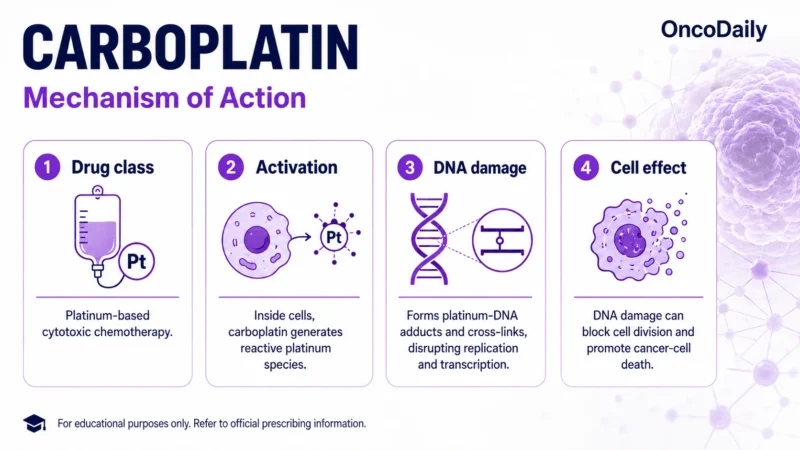
After entering cells, carboplatin generates reactive platinum species that bind to DNA. The resulting platinum-DNA adducts and cross-links interfere with normal DNA replication and transcription, ultimately preventing cell division and promoting cancer-cell death.
Carboplatin has a mechanism similar to cisplatin, but the two drugs have distinct toxicity profiles. Carboplatin generally produces less nephrotoxicity, neurotoxicity, and severe gastrointestinal toxicity than cisplatin, while myelosuppression—especially thrombocytopenia—is more prominent.
What Is the Dose of Carboplatin?
Carboplatin treatment is individualized according to the cancer type, combination regimen, renal function, previous therapy, and desired systemic exposure.
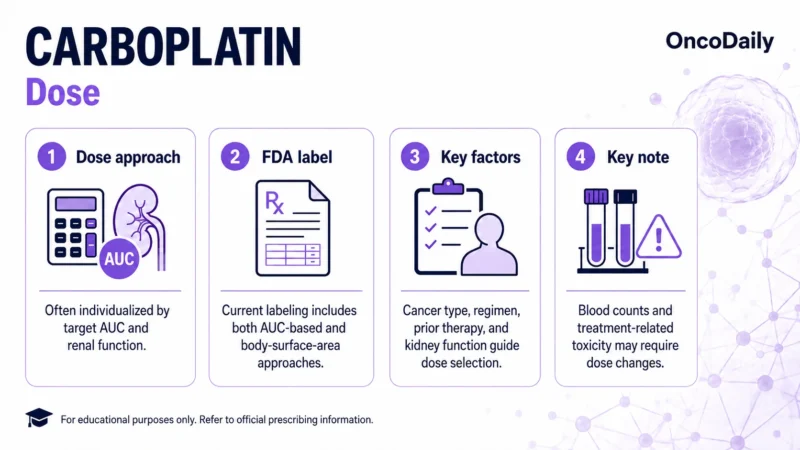
Unlike many chemotherapy agents that rely primarily on body-surface-area dosing, carboplatin is frequently prescribed using a target area under the concentration-time curve, or AUC, together with an estimate of kidney function.
Different treatment protocols use different target exposures and schedules. The current U.S. label includes both body-surface-area and AUC-based approaches for ovarian cancer.
Exact treatment amounts should follow the relevant oncology protocol and prescribing information.
How Is Carboplatin Administered?
Carboplatin is administered intravenously in a monitored oncology setting.
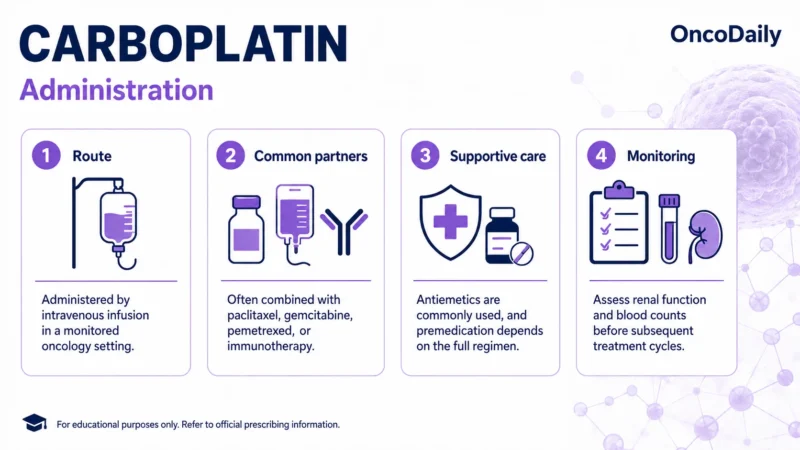
It may be given:
- As a single agent
- With paclitaxel
- With gemcitabine
- With pemetrexed
- With immunotherapy
- As part of other disease-specific multidrug regimens
For example, carboplatin plus paclitaxel is an established chemotherapy combination used across several malignancies, including ovarian, endometrial, cervical, and non-small cell lung cancers.
Renal function and blood counts are assessed before subsequent treatment because carboplatin clearance and hematologic toxicity are strongly influenced by kidney function and prior exposure.
Does Carboplatin Require an In-Line Filter?
Carboplatin preparation and administration should follow the specific product labeling and institutional chemotherapy protocol.
A universal filtration requirement should not be assumed across formulations. Administration equipment, compatible solutions, preparation procedures, and any filtration requirements should be verified against the manufacturer’s instructions for the formulation being used.
Is Premedication Required?
Carboplatin does not have one universal drug-specific premedication regimen.
However, antiemetic prophylaxis is commonly used because nausea and vomiting can occur with carboplatin-containing chemotherapy. Additional premedications depend on the accompanying agents.
For example, regimens containing paclitaxel require their own hypersensitivity-related premedication considerations.
Carboplatin itself can also cause hypersensitivity reactions, with the risk generally increasing after repeated platinum exposure.
Are Dose Reductions Used?
Yes. Treatment may be delayed, reduced, or discontinued according to toxicity and recovery between cycles.
Important considerations include:
- Thrombocytopenia
- Neutropenia
- Anemia
- Reduced renal function
- Severe infection
- Significant nonhematologic toxicity
- Previous treatment-related bone-marrow suppression
- Hypersensitivity
The carboplatin label emphasizes that bone-marrow suppression is dose-related and may be severe enough to result in bleeding or infection. Anemia can become cumulative with repeated therapy.
What Is Known About Carboplatin Pharmacokinetics?
Carboplatin pharmacokinetics are closely linked to renal function.
A substantial proportion of circulating platinum after carboplatin remains in an ultrafilterable form initially, and renal clearance is an important determinant of systemic drug exposure. This relationship is the basis for AUC-based carboplatin dosing.
Compared with cisplatin, carboplatin is less extensively protein-bound early after administration and has a different renal and toxicity profile.
Because systemic exposure correlates with both efficacy and hematologic toxicity, renal-function assessment is particularly important when planning carboplatin therapy.
Are Renal or Hepatic Dose Adjustments Required?
Renal Function
Renal function is particularly important for carboplatin.
Reduced kidney function decreases carboplatin clearance and can increase systemic exposure and hematologic toxicity. Treatment therefore commonly requires adjustment according to estimated renal function and target AUC.
Hepatic Function
Carboplatin elimination depends much more strongly on renal than hepatic function.
There is no similarly established liver-function-based dosing method comparable with the renal/AUC approach. However, overall hepatic function and treatment tolerance remain relevant when carboplatin is administered as part of combination chemotherapy.
What Are the Clinical Uses of Carboplatin?
Ovarian Cancer
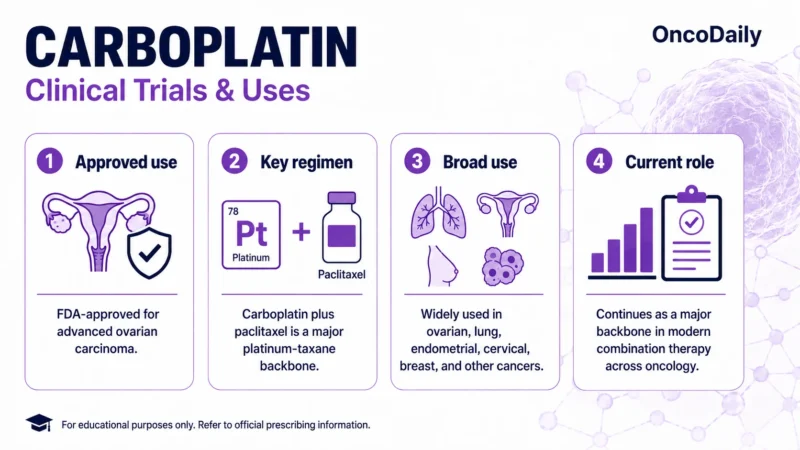
Advanced ovarian carcinoma is a core FDA-approved indication for carboplatin.
The drug can be incorporated into initial platinum-based treatment and recurrent-disease strategies. Current FDA labeling for carboplatin products includes initial treatment of advanced ovarian carcinoma, while carboplatin has also demonstrated activity as a single agent in recurrent ovarian cancer.
Carboplatin plus paclitaxel has become one of the most recognizable platinum-taxane combinations in gynecologic oncology.
The Phase 3 GOG-262 trial, NCT01167712 evaluated different paclitaxel schedules in combination with carboplatin in newly diagnosed advanced ovarian cancer.
Read more: ovarian cancer treatment and evolving therapeutic strategies on OncoDaily.
Non-Small Cell Lung Cancer
Carboplatin-containing doublets are widely used in non-small cell lung cancer, including carboplatin plus paclitaxel and carboplatin plus pemetrexed-containing regimens.
Carboplatin is also incorporated into several modern immunotherapy-containing combinations, demonstrating its continued role as a chemotherapy backbone in the immunotherapy era.
Endometrial and Cervical Cancer
Carboplatin plus paclitaxel is used in endometrial cancer and has roles in selected cervical-cancer treatment settings.
The Phase 3 RUBY trial, NCT03981796 evaluated dostarlimab with carboplatin and paclitaxel followed by maintenance dostarlimab in advanced or recurrent endometrial cancer.
Breast Cancer
Carboplatin is also incorporated into selected breast-cancer regimens, particularly in settings where platinum sensitivity is clinically relevant.
Other Malignancies
Carboplatin-based chemotherapy has additionally been used or investigated in:
- Small-cell lung cancer
- Head and neck cancers
- Thymic malignancies
- Germ-cell tumors in selected settings
- Carcinoma of unknown primary
- Other platinum-sensitive solid tumors
Its generally more manageable renal and neurologic toxicity compared with cisplatin can make carboplatin an important alternative when cisplatin is not suitable.
Watch more: Learn about carboplatin, its mechanism of action, and its role in cancer treatment in this discussion with a gynecologic oncologist.
What Are the Side Effects of Carboplatin?
The most important adverse effect is bone-marrow suppression.
Reported toxicities include:
- Thrombocytopenia
- Neutropenia
- Leukopenia
- Anemia
- Nausea
- Vomiting
- Fatigue
- Electrolyte abnormalities
- Renal dysfunction
- Liver-test abnormalities
- Peripheral neuropathy
- Ototoxicity
- Hypersensitivity reactions
Thrombocytopenia is particularly characteristic of carboplatin toxicity. Severe bone-marrow suppression can result in infection or bleeding, while anemia may become cumulative with repeated treatment.
Rare but severe hypersensitivity reactions can occur, particularly after repeated exposure to platinum chemotherapy.
What Is the Current Status of Carboplatin?
Carboplatin remains FDA-approved and is one of the most important platinum chemotherapy agents in modern oncology.
It continues to serve as a chemotherapy backbone across numerous treatment strategies and is frequently combined with taxanes, gemcitabine, pemetrexed, targeted therapies, antibody-drug conjugates, and immune-checkpoint inhibitors.
Its broad use reflects a balance between established antitumor activity and a toxicity profile that differs meaningfully from cisplatin.
Written by Mirna Antabian, MD