





Cabazitaxel: Understanding Its Mechanism, Dosing, and Clinical Role in Prostate Cancer
Key takeaways
- Cabazitaxel is a next-generation taxane chemotherapy with activity in metastatic castration-resistant prostate cancer after docetaxel treatment.
- Its mechanism involves microtubule stabilization, mitotic spindle disruption, and cancer-cell death.
- The FDA-recommended dose is 20 mg/m² IV over 1 hour every 3 weeks, with prednisone 10 mg daily.
- A 25 mg/m² dose may be used in selected patients but carries a greater risk of hematologic toxicity.
- Intravenous antihistamine, corticosteroid, and H2 antagonist premedication are required.
- Administration requires a 0.22-micron in-line filter.
- Severe neutropenia and hypersensitivity are the principal boxed warnings.
- G-CSF prophylaxis is important, particularly in high-risk patients and those receiving 25 mg/m².
- - The TROPIC, PROSELICA, and CARD trials established cabazitaxel's efficacy, dosing, and role in treatment sequencing.
Cabazitaxel (Jevtana) is a next-generation taxane chemotherapy used in the treatment of metastatic castration-resistant prostate cancer (mCRPC). It was developed to address some of the limitations of earlier taxanes, particularly resistance to docetaxel.
Like paclitaxel and docetaxel, cabazitaxel interferes with microtubule dynamics and prevents cancer cells from completing mitosis. However, cabazitaxel has reduced susceptibility to certain drug-efflux mechanisms associated with taxane resistance, allowing it to retain antitumor activity in some tumors that have progressed after docetaxel treatment.
Cabazitaxel received FDA approval in 2010 and remains an established treatment option for patients with mCRPC previously treated with a docetaxel-containing regimen. Its clinical role is supported by several phase III studies, particularly TROPIC, PROSELICA, and CARD.
Key Facts
- Generic name: Cabazitaxel
- Brand name: Jevtana
- Drug class: Taxane; microtubule inhibitor
- Route: Intravenous infusion
- Initial FDA approval: June 2010
- FDA-approved indication: Metastatic castration-resistant prostate cancer following a docetaxel-containing treatment regimen
- Recommended dose: 20 mg/m² IV every 3 weeks
- Alternative dose: 25 mg/m² IV every 3 weeks in selected patients
- Infusion duration: 1 hour
- Combination: Prednisone 10 mg orally daily
- Major mechanism: Microtubule stabilization and inhibition of mitosis
- Premedication: Intravenous antihistamine, corticosteroid, and H2 antagonist
- In-line filter: Required; 0.22-micron nominal pore size
- Major toxicities: Neutropenia, febrile neutropenia, diarrhea, anemia, fatigue, and hypersensitivity
- Important monitoring: CBC, renal and hepatic function, infection, gastrointestinal toxicity, and peripheral neuropathy
- Boxed warning: Neutropenia and hypersensitivity reactions.
What Is Cabazitaxel?
Cabazitaxel is a semisynthetic taxane developed from the docetaxel molecular structure.
It belongs to the same general chemotherapy class as paclitaxel and docetaxel but has structural modifications that influence its interaction with drug-efflux transporters.
One important mechanism of resistance to conventional taxanes involves P-glycoprotein, an ATP-dependent transporter encoded by the ABCB1 gene.
P-glycoprotein can actively transport anticancer drugs out of malignant cells, reducing their intracellular concentrations.
Cabazitaxel has demonstrated lower susceptibility to P-glycoprotein-mediated resistance than some earlier taxanes in experimental models.
This helps explain why cabazitaxel can remain active in selected tumors previously exposed to docetaxel. However, resistance mechanisms overlap, and cabazitaxel is not universally effective in docetaxel-resistant disease.
What Is the Mechanism of Action of Cabazitaxel?
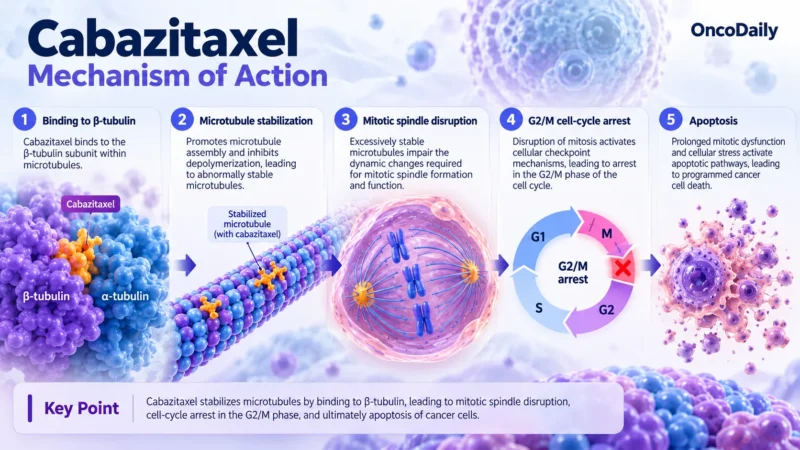
Cabazitaxel produces its cytotoxic effects through microtubule stabilization and disruption of mitosis.
1. Binding to Tubulin
Cabazitaxel binds to β-tubulin within microtubules.
Microtubules normally undergo continuous assembly and disassembly, allowing cells to reorganize their cytoskeleton during division.
2. Microtubule Stabilization
Cabazitaxel promotes microtubule assembly and inhibits their normal depolymerization.
This produces excessively stable microtubules that cannot undergo the dynamic changes required for mitosis.
3. Mitotic Spindle Disruption
The mitotic spindle depends on precisely regulated microtubule dynamics.
Cabazitaxel disrupts spindle function and interferes with chromosome separation.
4. Cell-Cycle Arrest
Disruption of mitosis activates cellular checkpoint mechanisms and can produce prolonged arrest in the G2/M phase of the cell cycle.
5. Apoptosis
Prolonged mitotic dysfunction and cellular stress can activate programmed cell-death pathways.
The mechanism can be summarized as:
Cabazitaxel → β-tubulin binding → microtubule stabilization → mitotic spindle disruption → G2/M arrest → apoptosis.
An additional characteristic of cabazitaxel is its relatively reduced cross-resistance with some earlier taxanes in preclinical models, although acquired cabazitaxel resistance can still occur.
What Is the Dose of Cabazitaxel?
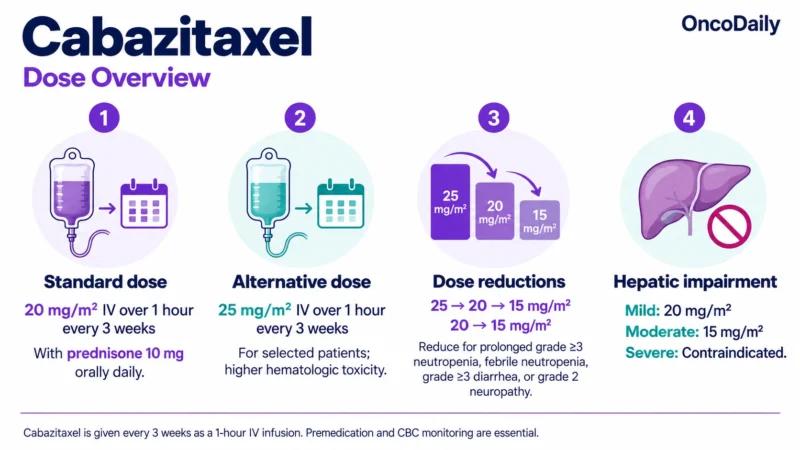
Cabazitaxel dosing is based on body surface area.
Standard FDA-Recommended Dose
Cabazitaxel 20 mg/m² IV over 1 hour every 3 weeks.
It is administered in combination with:
Prednisone 10 mg orally daily throughout cabazitaxel treatment.
Alternative Dose
In selected patients, the treating physician may use:
Cabazitaxel 25 mg/m² IV over 1 hour every 3 weeks.
The 25 mg/m² dose has demonstrated antitumor activity but is associated with greater hematologic toxicity.
The choice between 20 and 25 mg/m² depends on the patient’s clinical characteristics, previous treatment, treatment tolerance, and risk of chemotherapy-related complications.
Dose Reduction
For patients receiving 25 mg/m² who require a dose reduction:
25 mg/m² → 20 mg/m².
An additional reduction to 15 mg/m² may be considered when indicated.
For patients receiving the standard 20 mg/m² dose:
20 mg/m² → 15 mg/m².
Dose reduction or treatment interruption may be required for:
- Prolonged Grade ≥3 neutropenia
- Febrile neutropenia or neutropenic infection
- Grade ≥3 diarrhea
- Persistent diarrhea despite appropriate treatment
- Grade 2 peripheral neuropathy.
Grade ≥3 peripheral neuropathy requires discontinuation under the US prescribing information.
How Is Cabazitaxel Administered?
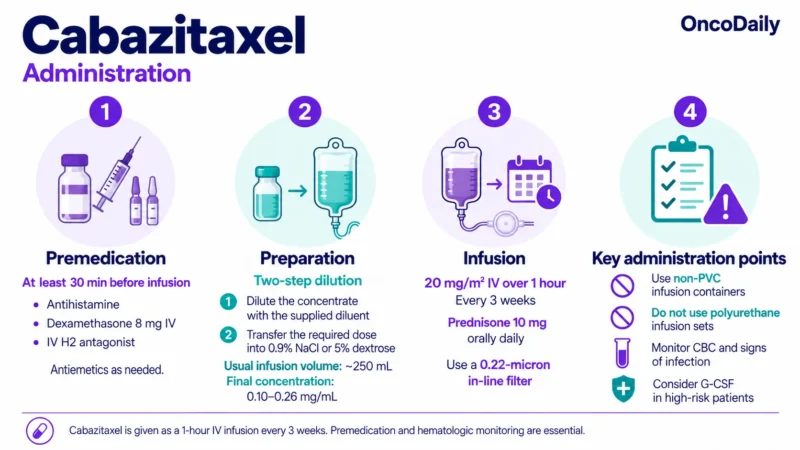
Cabazitaxel is administered by intravenous infusion over:
1 hour.
The branded Jevtana kit requires two dilution steps before administration.
Available Formulation
Jevtana is supplied as:
60 mg/1.5 mL, with a separate diluent vial.
The concentrate contains cabazitaxel at 40 mg/mL before the first dilution.
First Dilution
The entire contents of the supplied diluent are added to the cabazitaxel concentrate.
The resulting solution contains approximately:
10 mg/mL cabazitaxel.
The solution should be mixed gently by repeated inversion. It should not be shaken.
The second dilution should be performed within 30 minutes.
Second Dilution
The required dose is withdrawn and further diluted in an appropriate infusion container containing:
- 0.9% sodium chloride, or
- 5% dextrose.
The usual infusion volume is approximately:
250 mL.
For doses exceeding 65 mg, a larger infusion volume should be used.
The final concentration should remain between:
0.10–0.26 mg/mL.
These preparation instructions apply to the Jevtana two-vial kit. Other cabazitaxel presentations may have different preparation requirements and should be prepared according to their own prescribing information.
Stability
The prepared Jevtana infusion solution should be used within:
- 8 hours at ambient temperature, including the infusion time.
- 24 hours under refrigerated conditions, including the infusion time.
Unused solution should be discarded.
Does Cabazitaxel Require an In-Line Filter?
Yes.
Jevtana requires an in-line filter with a nominal pore size of:
0.22 microns (0.2 microns).
The prescribing information also specifies that PVC infusion containers and polyurethane infusion sets should not be used for preparation and administration.
Does Cabazitaxel Require Premedication?
Yes. Premedication is required before every cabazitaxel infusion.
The US prescribing information recommends administering the following intravenous medications at least 30 minutes before treatment.
Antihistamine
Diphenhydramine 25 mg IV
or an equivalent antihistamine, such as dexchlorpheniramine 5 mg.
Corticosteroid
Dexamethasone 8 mg IV
or an equivalent corticosteroid.
H2 Antagonist
An intravenous H2-receptor antagonist.
Antiemetic prophylaxis may also be administered as clinically indicated.
Premedication reduces the risk and severity of hypersensitivity reactions but does not completely eliminate the possibility of a severe reaction.
Is G-CSF Prophylaxis Required?
G-CSF prophylaxis is an important consideration during cabazitaxel treatment.
The prescribing information recommends primary prophylaxis in patients with high-risk clinical features, including:
- Older age
- Poor performance status
- Previous febrile neutropenia
- Extensive previous radiation
- Poor nutritional status
- Serious comorbidities.
Primary G-CSF prophylaxis should also be considered for all patients receiving cabazitaxel at 25 mg/m².
The CARD trial administered cabazitaxel 25 mg/m² with primary G-CSF prophylaxis.
Despite prophylaxis, neutropenia and serious infections remain important treatment risks.
What Is the Pharmacokinetic Profile of Cabazitaxel?
Distribution
Cabazitaxel demonstrates extensive tissue distribution.
The reported mean steady-state volume of distribution is approximately:
4,864 L.
In vitro plasma protein binding is approximately:
89–92%.
Metabolism
Cabazitaxel is extensively metabolized in the liver.
The principal enzymes involved are:
CYP3A4 and CYP3A5, accounting for approximately 80–90% of metabolism.
CYP2C8 contributes to a lesser extent.
Elimination
Cabazitaxel is eliminated predominantly through fecal excretion.
Approximately:
- 76% of the administered dose is recovered in feces.
- 3.7% is recovered in urine, including approximately 2.3% as unchanged cabazitaxel.
Half-Life
Cabazitaxel demonstrates multiphasic elimination.
The reported terminal elimination half-life is approximately:
95 hours.
Does Cabazitaxel Require Renal or Hepatic Dose Adjustment?
Renal Impairment
Cabazitaxel undergoes minimal renal elimination.
No routine dose adjustment is required solely on the basis of renal impairment, although patients with end-stage renal disease require careful monitoring because clinical data are limited.
Renal function remains clinically important because dehydration, diarrhea, sepsis, and urinary obstruction can contribute to acute kidney injury during treatment.
Hepatic Impairment
Cabazitaxel is extensively metabolized in the liver.
The US prescribing information provides the following recommendations:
Mild hepatic impairment:
Total bilirubin >1 to ≤1.5 × ULN, or AST >1.5 × ULN.
Recommended dose:
20 mg/m².
Moderate hepatic impairment:
Total bilirubin >1.5 to ≤3 × ULN.
Recommended dose:
15 mg/m².
The efficacy of this reduced dose in patients with moderate hepatic impairment is not established.
Severe hepatic impairment:
Total bilirubin >3 × ULN.
Cabazitaxel is contraindicated.
Drug Interactions
Strong CYP3A inhibitors may increase cabazitaxel exposure.
Coadministration should generally be avoided.
If a strong CYP3A inhibitor cannot be avoided, the prescribing information recommends considering a 25% cabazitaxel dose reduction.
Strong CYP3A inducers may reduce cabazitaxel exposure and should also be avoided where possible.
What Are the Clinical Uses of Cabazitaxel?
Metastatic Castration-Resistant Prostate Cancer
Cabazitaxel is FDA-approved in combination with prednisone for patients with mCRPC who have previously received a docetaxel-containing regimen.
Castration-resistant prostate cancer is characterized by disease progression despite castrate testosterone levels.
Cabazitaxel is used as an additional systemic treatment after prior docetaxel exposure, particularly in patients whose disease has also progressed following androgen receptor pathway inhibitors.
Disease Progression After Docetaxel
Docetaxel is commonly used in both metastatic hormone-sensitive and castration-resistant prostate cancer.
Cabazitaxel provides another chemotherapy option following disease progression after docetaxel.
Its clinical activity following prior docetaxel treatment was demonstrated in the TROPIC trial.
Disease Progression After Androgen Receptor Pathway Inhibitors
Androgen receptor pathway inhibitors include agents such as:
- Abiraterone
- Enzalutamide
- Apalutamide
- Darolutamide.
For patients previously treated with docetaxel and an androgen receptor pathway inhibitor, cabazitaxel may be considered according to prior treatment sequence, disease characteristics, patient fitness, and access to other therapies.
The CARD trial provides important evidence supporting cabazitaxel in patients whose disease progressed within 12 months on abiraterone or enzalutamide after receiving docetaxel.
These findings are particularly relevant when considering whether to administer cabazitaxel or switch from one androgen receptor pathway inhibitor to another.
What Did Cabazitaxel Clinical Trials Show?
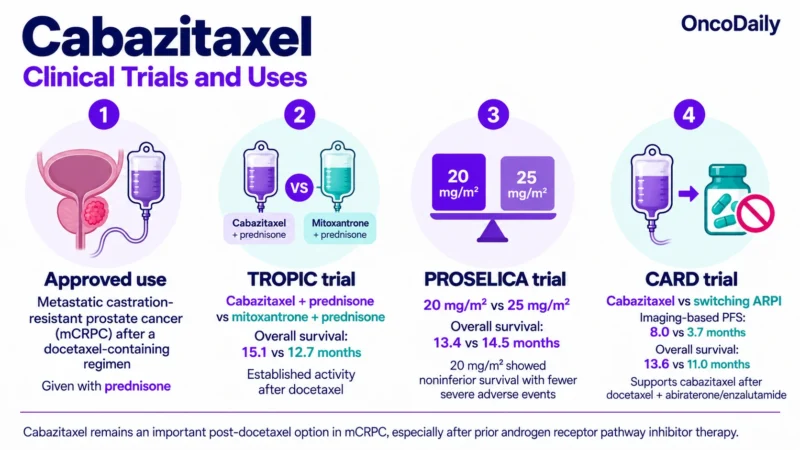
TROPIC: Cabazitaxel After Docetaxel
The phase III TROPIC trial evaluated cabazitaxel plus prednisone versus mitoxantrone plus prednisone in patients with mCRPC who had previously received docetaxel.
The trial enrolled 755 patients.
Patients received:
- Cabazitaxel 25 mg/m² every three weeks plus prednisone.
- Mitoxantrone 12 mg/m² every three weeks plus prednisone.
Median overall survival:
- Cabazitaxel: 15.1 months
- Mitoxantrone: 12.7 months.
Median progression-free survival:
- Cabazitaxel: 2.8 months
- Mitoxantrone: 1.4 months.
The hazard ratio for overall survival was 0.70, corresponding to a 30% relative reduction in the hazard of death.
However, cabazitaxel was associated with substantial toxicity, particularly severe neutropenia and febrile neutropenia.
The TROPIC trial established cabazitaxel as an active treatmentfollowing docetaxel and supported its initial FDA approval.
PROSELICA: Cabazitaxel 20 mg/m² Versus 25 mg/m²
The phase III PROSELICA trial compared two cabazitaxel doses in patients with mCRPC previously treated with docetaxel.
The study enrolled 1,200 patients.
Median overall survival:
- Cabazitaxel 20 mg/m²: 13.4 months
- Cabazitaxel 25 mg/m²: 14.5 months.
The lower dose met the prespecified noninferiority criterion for overall survival.
Grade 3–4 treatment-emergent adverse events:
- 20 mg/m²: 39.7%
- 25 mg/m²: 54.5%.
PSA response rates were higher with 25 mg/m², but the 20 mg/m² regimen was associated with fewer severe adverse events.
These results contributed to the current recommended starting dose of 20 mg/m² every three weeks, with 25 mg/m² remaining an option in selected patients.
CARD: Cabazitaxel Versus Switching Hormonal Therapy
The phase III CARD trial evaluated cabazitaxel against switching to another androgen receptor pathway inhibitor.
The trial enrolled 255 patients with mCRPC previously treated with docetaxel who experienced disease progression within 12 months while receiving abiraterone or enzalutamide.
Patients received cabazitaxel or the alternative androgen receptor pathway inhibitor.
Median imaging-based progression-free survival:
- Cabazitaxel: 8.0 months
- Alternative androgen receptor pathway inhibitor: 3.7 months.
Median overall survival:
- Cabazitaxel: 13.6 months
- Alternative androgen receptor pathway inhibitor: 11.0 months.
PSA response:
- Cabazitaxel: 35.7%
- Alternative androgen receptor pathway inhibitor: 13.5%.
Cabazitaxel improved both imaging-based progression-free survival and overall survival in this previously treated population.
The trial is an important foundation for cabazitaxel treatment sequencing in contemporary mCRPC.
Watch more: CARD Trial: Cabazitaxel vs Abiraterone or Enzalutamide in Metastatic Castration-Resistant Prostate Cancer — Prof. Ronald de Wit, ESMO 2019.
FIRSTANA: Cabazitaxel Versus Docetaxel
The phase III FIRSTANA trial compared cabazitaxel 20 mg/m², cabazitaxel 25 mg/m², and docetaxel 75 mg/m² in chemotherapy-naive patients with mCRPC.
The study enrolled 1,168 patients.
Median overall survival was:
- Cabazitaxel 20 mg/m²: 24.5 months
- Cabazitaxel 25 mg/m²: 25.2 months
- Docetaxel 75 mg/m²: 24.3 months.
Neither cabazitaxel dose demonstrated superiority over docetaxel for overall survival.
The trial also identified differences in the toxicity profiles of the two taxanes.
Is Cabazitaxel FDA Approved?
Yes.
Cabazitaxel received its initial FDA approval in June 2010.
The approved indication is treatment, in combination with prednisone, of patients with metastatic castration-resistant prostate cancer previously treated with a docetaxel-containing regimen.
It is not FDA-approved as a general substitute for docetaxel across all solid tumors.
What Is the Current Clinical Role of Cabazitaxel?
Cabazitaxel remains an established chemotherapy option in metastatic castration-resistant prostate cancer following docetaxel treatment.
Its role is particularly relevant in patients previously treated with both docetaxel and an androgen receptor pathway inhibitor.
Treatment sequencing has become increasingly complex with the availability of PARP inhibitors, radioligand therapy, additional androgen receptor pathway inhibitors, and biomarker-directed approaches.
The choice of subsequent treatment depends on factors such as previous therapies, homologous recombination repair alterations, PSMA expression, symptoms, disease distribution, and treatment tolerance.
Cabazitaxel is an important treatment option following docetaxel in metastatic castration-resistant prostate cancer, particularly after progression on androgen receptor pathway inhibitors. Learn more about chemotherapy in prostate cancer and the evolving roles of docetaxel and cabazitaxel on OncoDaily.
What Are the Major Side Effects of Cabazitaxel?
Cabazitaxel can cause substantial hematologic and nonhematologic toxicity.
Common adverse reactions include:
- Neutropenia
- Febrile neutropenia
- Anemia
- Thrombocytopenia
- Diarrhea
- Nausea and vomiting
- Fatigue
- Asthenia
- Peripheral neuropathy
- Abdominal pain
- Hematuria
- Reduced appetite
- Constipation
- Alopecia
- Hypersensitivity reactions.
The severity of toxicity depends on dose, previous treatment, comorbidities, and supportive care.
Myelosuppression
Severe neutropenia is one of the most important dose-limiting toxicities of cabazitaxel.
It can lead to febrile neutropenia, sepsis, and treatment-related death.
In TROPIC, Grade ≥3 neutropenia occurred in 82% of patients receiving cabazitaxel 25 mg/m², and febrile neutropenia occurred in approximately 8%.
Treatment should not be administered when:
ANC ≤1,500 cells/mm³.
Febrile Neutropenia and Infections
Cabazitaxel-associated neutropenia increases susceptibility to serious bacterial and fungal infections.
Potential complications include:
- Pneumonia
- Bacteremia
- Sepsis
- Septic shock.
Patients should be monitored closely for fever and signs of infection, particularly during the first treatment cycle.
Diarrhea
Diarrhea is a common nonhematologic toxicity.
Severe cases can cause:
- Dehydration
- Electrolyte abnormalities
- Acute kidney injury
- Hospitalization.
Severe or persistent diarrhea may require treatment interruption and dose reduction.
Gastrointestinal Complications
Rare but potentially fatal complications include:
- Gastrointestinal hemorrhage
- Gastrointestinal perforation
- Ileus
- Enterocolitis
- Neutropenic enterocolitis.
Abdominal pain, fever, gastrointestinal bleeding, or severe diarrhea should prompt urgent evaluation.
Hypersensitivity Reactions
Cabazitaxel can cause severe hypersensitivity reactions, including:
- Rash
- Erythema
- Hypotension
- Bronchospasm
- Dyspnea
- Anaphylaxis.
The formulation contains polysorbate 80, which contributes to hypersensitivity risk.
Patients with previous severe hypersensitivity to cabazitaxel or other drugs formulated with polysorbate 80 should not receive cabazitaxel.
Peripheral Neuropathy
Cabazitaxel may cause sensory and motor neuropathy.
Symptoms can include:
- Numbness
- Tingling
- Burning sensations
- Sensory loss
- Weakness.
Dose reduction or discontinuation may be required depending on severity.
Renal Failure
Renal failure has been reported during cabazitaxel treatment.
It may occur in association with:
- Dehydration
- Severe diarrhea
- Sepsis
- Obstructive uropathy.
Renal function and hydration status should be monitored throughout treatment.
Urinary Toxicity
Hematuria, cystitis, and radiation cystitis have been reported.
Patients who previously received pelvic radiotherapy may be particularly susceptible to urinary complications.
Alopecia
Hair loss can occur with cabazitaxel.
The frequency varies with dose and treatment history.
Fatigue and Asthenia
Fatigue is common and may be related to anemia, systemic treatment effects, reduced nutritional intake, and progressive cancer.
Significant fatigue may require evaluation for reversible causes and treatment modification.
Reproductive Toxicity
Cabazitaxel may cause fetal harm and can affect male fertility.
The US label recommends effective contraception for male patients with female partners of reproductive potential during treatment and for four months after the final dose.
What Monitoring Is Required?
Monitoring should include:
- CBC with differential
- Neutrophil count
- Hemoglobin and platelets
- Renal function
- Liver function
- Hydration and electrolyte status
- Peripheral neuropathy assessment
- Gastrointestinal symptoms
- Assessment for fever and infection
- Hypersensitivity monitoring during infusion
- PSA and appropriate imaging for treatment response.
CBC monitoring is particularly important during the first treatment cycle and before subsequent cycles.