


Bevacizumab (Avastin): Mechanism of Action, Dosing, Clinical Uses, Trials, and Side Effects
Key takeaways
- Bevacizumab is a humanized anti-VEGF-A monoclonal antibody.
- It inhibits tumor angiogenesis by preventing VEGF-A from activating VEGF receptors.
- It received initial FDA approval in 2004.
- Standard doses range from 5–15 mg/kg IV, depending on the indication.
- It has approved roles across colorectal, lung, brain, renal, cervical, ovarian, and liver cancers.
- AVF2107g established improved overall survival in metastatic colorectal cancer.
- ECOG E4599 demonstrated survival benefit in non-squamous NSCLC.
- GOG-0218 and AURELIA demonstrated benefits in ovarian cancer.
- GOG-0240 established an overall survival benefit in advanced cervical cancer.
- IMbrave150 demonstrated the efficacy of atezolizumab plus bevacizumab in HCC.
- Major risks include hypertension, proteinuria, bleeding, thrombosis, gastrointestinal perforation, and impaired wound healing.
- Routine blood-pressure and urine-protein monitoring are essential.
Bevacizumab (Avastin) is a recombinant humanized monoclonal antibody targeting vascular endothelial growth factor A (VEGF-A), a key regulator of angiogenesis. By binding circulating VEGF-A, bevacizumab prevents its interaction with VEGF receptors on endothelial cells, suppressing the formation of new blood vessels that support tumor growth and progression.
First approved by the FDA in February 2004, bevacizumab became the first widely adopted antiangiogenic monoclonal antibody in oncology. Its indications subsequently expanded to several malignancies, including metastatic colorectal cancer, non-squamous non-small cell lung cancer (NSCLC), recurrent glioblastoma, metastatic renal cell carcinoma, cervical cancer, ovarian cancer, and hepatocellular carcinoma.
Bevacizumab is administered intravenously at doses ranging from 5–15 mg/kg, generally every two or three weeks, depending on the indication and combination regimen.
Its clinical efficacy has been demonstrated in landmark studies including AVF2107g, ECOG E4599, GOG-0218, AURELIA, GOG-0240, and IMbrave150.
Key Facts
- Generic name: Bevacizumab
- Brand name: Avastin
- Drug class: Antiangiogenic monoclonal antibody
- Antibody type: Humanized IgG1
- Molecular target: VEGF-A
- Mechanism: Inhibition of VEGF-A-mediated angiogenesis
- Initial FDA approval: February 2004
- Administration: Intravenous infusion
- Common doses: 5 mg/kg or 10 mg/kg every 2 weeks; 7.5 mg/kg or 15 mg/kg every 3 weeks
- Available strengths: 100 mg/4 mL and 400 mg/16 mL
- Major indications: Metastatic colorectal cancer, non-squamous NSCLC, recurrent glioblastoma, renal cell carcinoma, cervical cancer, ovarian cancer, and hepatocellular carcinoma
- Combination partners: Chemotherapy, interferon alfa, or atezolizumab, depending on indication
- Essential biomarker: No universal predictive molecular biomarker required
- Pivotal trials: AVF2107g, E4599, GOG-0218, AURELIA, GOG-0240, IMbrave150
- Major adverse reactions: Hypertension, proteinuria, bleeding, fatigue, and epistaxis
- Serious toxicities: Gastrointestinal perforation, fistulae, arterial and venous thrombosis, impaired wound healing, and severe hemorrhage
- Important monitoring: Blood pressure, urine protein, renal function, bleeding, and wound healing
- Metabolism: Proteolytic catabolism
- Biosimilars: Multiple FDA-approved bevacizumab biosimilars are available
What Is Bevacizumab?
Bevacizumab is a humanized monoclonal antibody designed to inhibit tumor-associated angiogenesis.
Angiogenesis is the process through which new blood vessels develop from existing vasculature.
Tumors rely on angiogenesis to obtain oxygen and nutrients, support growth, and facilitate progression.
A central mediator is:
Vascular endothelial growth factor A (VEGF-A).
VEGF-A binds receptors on endothelial cells, particularly:
- VEGFR-1
- VEGFR-2
Activation of these receptors stimulates endothelial proliferation, migration, vascular permeability, and new blood-vessel formation.
Bevacizumab neutralizes extracellular VEGF-A, reducing its availability for receptor binding.
Unlike tyrosine kinase inhibitors, bevacizumab does not directly inhibit the intracellular kinase domains of VEGFR receptors.
What Is the Mechanism of Action of Bevacizumab?
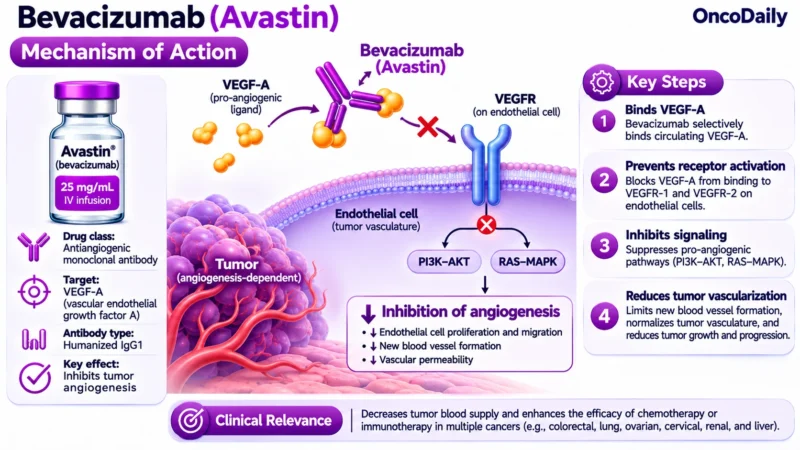
1. Tumors Produce VEGF-A
Cancer cells and stromal cells release VEGF-A, particularly under hypoxic conditions.
VEGF-A stimulates endothelial cells to form new blood vessels.
These vessels support tumor growth and progression.
2. Bevacizumab Binds VEGF-A
Bevacizumab selectively binds soluble VEGF-A.
This prevents VEGF-A from interacting with VEGFR-1 and VEGFR-2.
3. Angiogenic Signaling Is Suppressed
Blocking VEGF-A reduces activation of endothelial signaling pathways involved in:
- Endothelial-cell proliferation
- Cell migration
- Vascular permeability
- New blood-vessel formation
4. Tumor Angiogenesis Is Inhibited
Reduced VEGF signaling limits the development of tumor-associated blood vessels.
Anti-VEGF treatment may also transiently normalize abnormal tumor vasculature, potentially improving the delivery of other systemic treatments in certain biological contexts.
5. Tumor Progression Is Reduced
In appropriately selected clinical settings, bevacizumab enhances the antitumor activity of chemotherapy or immunotherapy.
Overall mechanism:
Bevacizumab → VEGF-A binding → blockade of VEGFR activation → suppression of angiogenesis → reduced tumor vascular support and progression.
What Is the Recommended Dose of Bevacizumab?
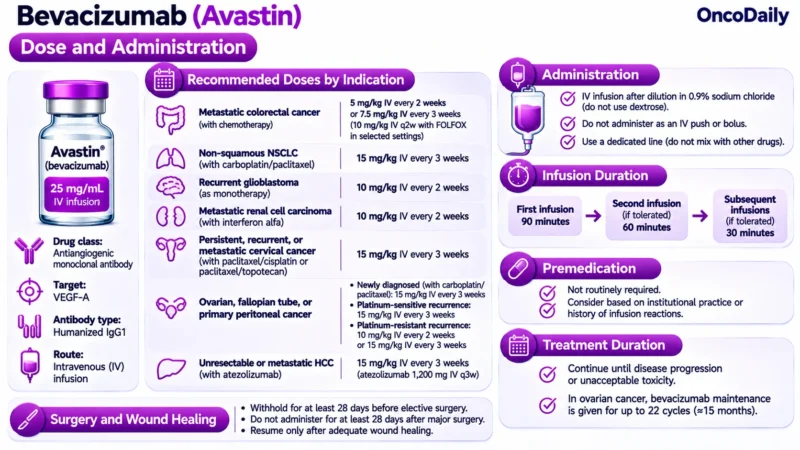
Bevacizumab dosing depends on the malignancy and combination regimen.
Metastatic Colorectal Cancer
Common FDA-labeled schedules include:
5 mg/kg IV every 2 weeks
with irinotecan/fluorouracil-based chemotherapy.
Alternatively:
10 mg/kg IV every 2 weeks
with FOLFOX4 in the specified second-line setting.
Following progression on prior bevacizumab-containing first-line treatment:
- 5 mg/kg every 2 weeks, or
- 7.5 mg/kg every 3 weeks
with an appropriate fluoropyrimidine-based chemotherapy regimen.
Non-Squamous Non-Small Cell Lung Cancer
15 mg/kg intravenously every 3 weeks
with carboplatin and paclitaxel.
After combination chemotherapy, bevacizumab may continue until progression or unacceptable toxicity.
Recurrent Glioblastoma
10 mg/kg intravenously every 2 weeks.
Metastatic Renal Cell Carcinoma
10 mg/kg intravenously every 2 weeks
with interferon alfa.
Persistent, Recurrent, or Metastatic Cervical Cancer
15 mg/kg intravenously every 3 weeks
with paclitaxel/cisplatin or paclitaxel/topotecan.
Ovarian, Fallopian Tube, or Primary Peritoneal Cancer
Newly Diagnosed Stage III–IV Disease
15 mg/kg IV every 3 weeks
with carboplatin/paclitaxel, followed by bevacizumab maintenance for a total of up to 22 cycles.
Platinum-Sensitive Recurrent Disease
15 mg/kg IV every 3 weeks
with carboplatin/paclitaxel or carboplatin/gemcitabine, followed by maintenance.
Platinum-Resistant Recurrent Disease
10 mg/kg every 2 weeks
with weekly paclitaxel, pegylated liposomal doxorubicin, or weekly topotecan.
Alternatively:
15 mg/kg every 3 weeks
with topotecan administered every three weeks.
Unresectable or Metastatic Hepatocellular Carcinoma
15 mg/kg IV every 3 weeks
with:
Atezolizumab 1,200 mg IV every 3 weeks.
Bevacizumab is administered after atezolizumab when both are given on the same day.
How Should Bevacizumab Be Administered?
Intravenous Administration
Bevacizumab must be administered as a diluted intravenous infusion.
Do not administer as an intravenous push or bolus.
Infusion Duration
First Infusion
90 minutes.
Second Infusion
If the first infusion is tolerated:
60 minutes.
Subsequent Infusions
If the second infusion is tolerated:
30 minutes.
Preparation
Bevacizumab is diluted in:
0.9% sodium chloride.
Do not mix or administer with dextrose-containing solutions.
Surgery Precautions
Because VEGF inhibition impairs wound healing:
- Withhold bevacizumab for at least 28 days before elective surgery.
- Do not administer for at least 28 days after major surgery.
- Resume only after adequate wound healing.
Longer preoperative intervals are frequently used in practice because of bevacizumab’s prolonged half-life and the nature of the planned procedure.
What Should You Do If a Bevacizumab Dose Is Missed?
If a scheduled infusion is missed:
- Contact the oncology team.
- Administer the delayed dose when clinically appropriate.
- Adjust subsequent infusions according to the treatment schedule.
- Evaluate any toxicity responsible for the delay.
There is no recommendation to double the next dose.
How Are Bevacizumab Dose Modifications Managed?
Bevacizumab generally does not require stepwise dose reductions.
Treatment is withheld or permanently discontinued according to toxicity.
Hypertension
For severe hypertension not adequately controlled with medication:
Withhold bevacizumab.
Resume when blood pressure is adequately controlled.
Permanently discontinue for hypertensive crisis or hypertensive encephalopathy.
Proteinuria
For proteinuria of:
2 g or more per 24 hours
withhold bevacizumab.
Resume when proteinuria decreases below 2 g/24 hours.
Permanently discontinue for nephrotic syndrome.
Gastrointestinal Perforation
Permanently discontinue bevacizumab.
Serious Hemorrhage
Grade 3–4 hemorrhage requires permanent discontinuation.
Thromboembolic Events
Permanently discontinue following severe arterial thromboembolic events.
Grade 4 venous thromboembolism, including pulmonary embolism, requires discontinuation.
Wound-Healing Complications
Withhold treatment until adequate healing.
The safety of restarting after a significant wound-healing complication is not firmly established.
What Drug Interactions Are Important With Bevacizumab?
Cytotoxic Chemotherapy
Bevacizumab is commonly combined with cytotoxic agents.
Combination treatment may increase:
- Myelosuppression
- Bleeding
- Gastrointestinal complications
- Thrombotic events
Anticoagulants and Antiplatelet Agents
Concomitant therapy may increase bleeding concerns.
Anticoagulation is not universally contraindicated, but patient-specific bleeding and thrombotic risks must be evaluated.
Other Antiangiogenic Therapies
Combining bevacizumab with other agents affecting angiogenesis may increase vascular or renal toxicity.
CYP450 Interactions
Bevacizumab is not primarily metabolized through CYP450 pathways.
Conventional CYP-mediated drug interactions are not major determinants of its exposure.
Does Bevacizumab Require Dose Adjustment in Renal or Hepatic Impairment?
Renal Impairment
Bevacizumab is not primarily eliminated through renal excretion.
Routine dose adjustment is generally not required based solely on renal function.
However, bevacizumab can cause proteinuria, thrombotic microangiopathy, and renal injury.
Hepatic Impairment
Bevacizumab undergoes antibody catabolism rather than conventional hepatic CYP metabolism.
No established hepatic dose-adjustment algorithm is available.
In hepatocellular carcinoma, clinical assessment should include liver function, portal hypertension, and bleeding risk.
What Is the Pharmacokinetic Profile of Bevacizumab?
Half-Life
The elimination half-life is approximately:
20 days.
Distribution
Bevacizumab distributes primarily within vascular and extracellular compartments.
Metabolism
Bevacizumab undergoes:
Proteolytic catabolism
into peptides and amino acids.
Clearance
Clearance occurs through nonspecific antibody catabolism and related biological pathways.
Steady State
Steady-state concentrations are reached after repeated administration, depending on dose and treatment schedule.
What Are the Clinical Uses of Bevacizumab?
Metastatic Colorectal Cancer
Bevacizumab is widely used with chemotherapy in first-line and subsequent treatment settings.
Unlike anti-EGFR antibodies, bevacizumab does not require RAS wild-type status.
It may be used in both RAS wild-type and RAS-mutated disease when clinically appropriate.
Non-Squamous NSCLC
Bevacizumab is used with chemotherapy in selected advanced non-squamous NSCLC.
It is generally avoided in squamous histology because of serious pulmonary bleeding risk.
Recurrent Glioblastoma
Bevacizumab may reduce contrast enhancement and vasogenic edema.
It can improve progression-free survival or symptom control in selected settings, but an overall survival benefit has not been consistently demonstrated.
Renal Cell Carcinoma
Bevacizumab with interferon alfa has an approved historical role.
Modern treatment has largely shifted toward immune checkpoint inhibitors and VEGFR-targeted combinations.
Cervical Cancer
Bevacizumab improves outcomes when added to selected chemotherapy regimens in persistent, recurrent, or metastatic cervical cancer.
Ovarian Cancer
Bevacizumab is used in selected newly diagnosed, platinum-sensitive recurrent, and platinum-resistant recurrent ovarian cancers.
Its contribution includes improved progression-free survival and delayed disease progression.
Hepatocellular Carcinoma
Bevacizumab combined with atezolizumab is an approved first-line treatment for selected patients with unresectable or metastatic HCC.
Assessment and management of esophageal or gastric varices are particularly important before treatment.
What Molecular Testing Is Required Before Bevacizumab?
Unlike anti-EGFR therapies, bevacizumab does not require a specific oncogenic mutation or molecular alteration.
There is no validated universal biomarker that reliably predicts benefit from bevacizumab across its indications.
However, comprehensive tumor profiling remains important for selecting the overall treatment strategy.
Examples include:
- RAS, BRAF, and MSI/MMR in colorectal cancer
- Driver alterations and PD-L1 in NSCLC
- Molecular and homologous recombination characteristics in ovarian cancer
These biomarkers guide treatment sequencing but do not directly determine bevacizumab eligibility.
What Did the Pivotal Clinical Trials Show?
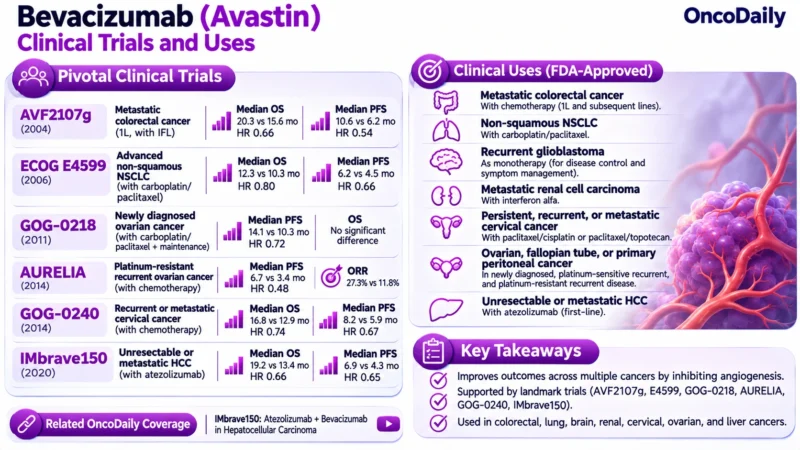
AVF2107g — First-Line Metastatic Colorectal Cancer
This phase III trial evaluated bevacizumab with irinotecan, fluorouracil, and leucovorin (IFL) versus chemotherapy alone.
Median Overall Survival
- Bevacizumab + IFL: 20.3 months
- IFL alone: 15.6 months
HR: 0.66
Median Progression-Free Survival
- 10.6 versus 6.2 months
HR: 0.54
The study established the survival benefit of VEGF inhibition in metastatic colorectal cancer.
ECOG E4599 — Non-Squamous NSCLC
This phase III trial compared carboplatin/paclitaxel with or without bevacizumab.
Median Overall Survival
- Bevacizumab combination: 12.3 months
- Chemotherapy alone: 10.3 months
HR: 0.80
- Median Progression-Free Survival
6.2 versus 4.5 months
HR: 0.66
The results supported bevacizumab use in selected advanced non-squamous NSCLC.
GOG-0218 — Newly Diagnosed Ovarian Cancer
This phase III trial evaluated bevacizumab with carboplatin/paclitaxel followed by bevacizumab maintenance.
The primary analysis demonstrated significantly improved progression-free survival with bevacizumab throughout treatment.
Long-term analyses did not establish an overall survival advantage in the entire study population.
The trial supported bevacizumab’s role in initial ovarian cancer treatment.
AURELIA — Platinum-Resistant Recurrent Ovarian Cancer
The phase III AURELIA trial evaluated chemotherapy with or without bevacizumab.
Median Progression-Free Survival
- Bevacizumab combination: 6.7 months
- Chemotherapy alone: 3.4 months
HR: 0.48
Objective Response Rate
- 27.3% versus 11.8% by RECIST in the primary publication
No statistically significant overall survival improvement was demonstrated.
Watch More: AURELIA: Phase 3 Trial of Bevacizumab Combined With Chemotherapy for Ovarian Cancer.
GOG-0240 — Recurrent or Metastatic Cervical Cancer
The phase III GOG-0240 trial evaluated adding bevacizumab to chemotherapy.
Median Overall Survival
- Bevacizumab combination: 16.8 months
- Chemotherapy alone: 12.9 months
HR: 0.74
The study established an overall survival benefit from bevacizumab in advanced cervical cancer.
IMbrave150 — Unresectable or Metastatic HCC
IMbrave150 compared:
- Atezolizumab + bevacizumab
- Sorafenib
in previously untreated unresectable or metastatic HCC.
Updated Median Overall Survival
- Atezolizumab + bevacizumab: 19.2 months
- Sorafenib: 13.4 months
HR: 0.66
- Updated Median Progression-Free Survival
6.9 versus 4.3 months
HR: 0.65
These results established atezolizumab plus bevacizumab as an important first-line HCC regimen.
Does Bevacizumab Have CNS Activity?
Bevacizumab has an established role in recurrent glioblastoma.
Although monoclonal antibody penetration across an intact blood–brain barrier is limited, glioblastoma-associated vascular abnormalities permit effects on tumor vasculature and vascular permeability.
Bevacizumab can reduce:
- Vasogenic edema
- Contrast enhancement
- Corticosteroid requirements
- Certain neurological symptoms
However, reduction in MRI enhancement may reflect decreased vascular permeability rather than true tumor regression.
This phenomenon is called:
Pseudoresponse.
Bevacizumab has not demonstrated a consistent overall survival advantage in glioblastoma.
Is Bevacizumab FDA Approved?
Yes.
Bevacizumab received its initial FDA approval in:
February 2004.
Its approved indications include selected settings in:
- Metastatic colorectal cancer
- Non-squamous NSCLC
- Recurrent glioblastoma
- Metastatic renal cell carcinoma
- Cervical cancer
- Ovarian, fallopian tube, and primary peritoneal cancer
- Unresectable or metastatic HCC with atezolizumab
Bevacizumab is not approved for adjuvant colon cancer treatment.
Several biosimilars are available, including Mvasi, Zirabev, Alymsys, and Vegzelma.
What Is the Current Clinical Role of Bevacizumab in 2026?
Colorectal Cancer
Bevacizumab remains a major component of chemotherapy-based treatment in metastatic colorectal cancer.
Its use is influenced by tumor sidedness, molecular characteristics, treatment goals, and previous therapy.
Lung Cancer
Immunotherapy and targeted agents have changed the treatment landscape.
Bevacizumab remains relevant in selected non-squamous NSCLC combinations but is not appropriate for every patient.
Ovarian and Cervical Cancer
Bevacizumab continues to provide progression-free survival or survival benefits in selected gynecological malignancies.
Treatment selection must balance efficacy against bleeding, bowel perforation, fistula, and hypertension risks.
Hepatocellular Carcinoma
Atezolizumab–bevacizumab remains an important option, although newer immunotherapy combinations have expanded first-line treatment choices.
Bleeding risk and portal hypertension must be evaluated carefully.
Read More: TALENTOP: Liver Resection After Atezolizumab and Bevacizumab in Locally Advanced HCC by OncoDaily.
Glioblastoma
Bevacizumab retains a role in recurrent glioblastoma, particularly for edema reduction and symptomatic improvement, despite the absence of a demonstrated overall survival benefit.
What Are the Major Side Effects of Bevacizumab?
Hypertension
Hypertension is among the most characteristic adverse reactions.
It may become severe or result in hypertensive crisis.
Proteinuria
Bevacizumab can cause:
- Proteinuria
- Nephrotic syndrome
- Renal thrombotic microangiopathy
Routine urine-protein monitoring is essential.
Hemorrhage
Bleeding may include:
- Epistaxis
- Gastrointestinal bleeding
- Pulmonary hemorrhage
- Intracranial hemorrhage
- Vaginal bleeding
Severe or fatal hemorrhage can occur.
Gastrointestinal Perforation and Fistulae
Serious and occasionally fatal gastrointestinal perforation occurs in approximately 0.3–3% of patients across clinical studies.
Risk is especially important in patients with bowel involvement, previous pelvic radiation, obstruction, or other gastrointestinal risk factors.
Impaired Wound Healing
VEGF inhibition interferes with normal tissue repair.
Serious postoperative complications, wound dehiscence, and necrotizing fasciitis have been reported.
Arterial and Venous Thrombosis
Potential complications include:
- Stroke
- Myocardial infarction
- Deep vein thrombosis
- Pulmonary embolism
Posterior Reversible Encephalopathy Syndrome
PRES is rare but potentially serious.
Symptoms may include:
- Headache
- Seizures
- Visual disturbances
- Altered mental status
Ovarian Failure
Bevacizumab may impair ovarian function and fertility.
Patients should receive appropriate reproductive counseling before treatment.
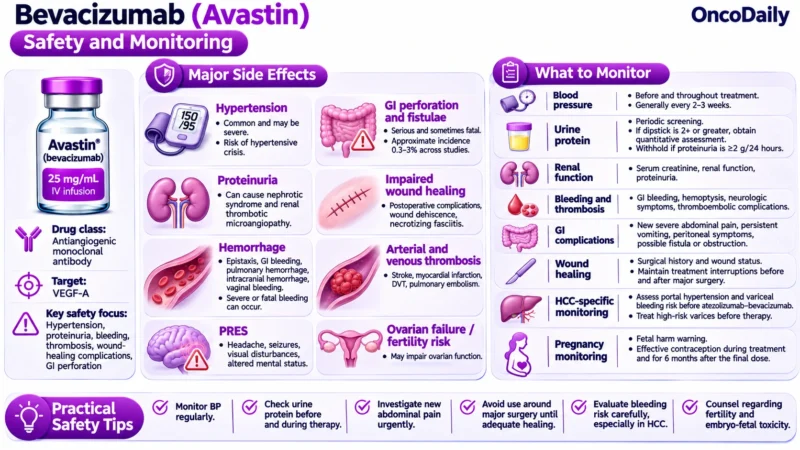
What Monitoring Is Required During Bevacizumab Treatment?
Blood Pressure
Monitor:
Before and throughout treatment, generally every 2–3 weeks.
Treat hypertension promptly.
Urine Protein
Perform urine-protein screening periodically.
If dipstick proteinuria is 2+ or greater, obtain quantitative assessment.
Withhold bevacizumab for proteinuria of at least:
2 g/24 hours.
Renal Function
Monitor:
- Serum creatinine
- Renal function
- Proteinuria
partiularly in patients with hypertension or renal comorbidities.
Bleeding and Thrombosis
Assess for:
- Gastrointestinal bleeding
- Hemoptysis
- Neurological symptoms
- Thromboembolic complications
Gasrointestinal Complications
Investigate:
- New severe abdominal pain
- Persistent vomiting
- Peritoneal symptoms
- Suspected fistula or obstruction
Wound Healing
Assess surgical history and wound status.
Maintain appropriate treatment interruptions before and after major surgery.
HCC-Specific Monitoring
Before atezolizumab–bevacizumab:
- Assess portal hypertension and variceal bleeding risk.
- Perform appropriate endoscopic assessment when indicated.
- Treat high-risk varices before therapy.
- Monitor liver function and bleeding symptoms.
Pregnancy Monitoring
Bevacizumab can cause fetal harm.
Females of reproductive potential should use effective contraception during treatment and for:
6 months after the final dose.