





Atezolizumab: Understanding Its Mechanism, Dosing, and Clinical Role in Cancer
Key takeaways
- Atezolizumab is a PD-L1-blocking immune checkpoint inhibitor.
- It blocks PD-L1 interactions with PD-1 and B7.1, restoring antitumor T-cell activity.
- Standard adult IV schedules are 840 mg q2w, 1,200 mg q3w, or 1,680 mg q4w.
- The first IV infusion is given over 60 minutes; subsequent tolerated infusions can be given over 30 minutes.
- A subcutaneous formulation, Tecentriq Hybreza, is also available.
- Atezolizumab has current roles in NSCLC, SCLC, HCC, melanoma, ASPS, and ctDNA MRD-positive MIBC.
- The 2026 MIBC approval is especially notable because it uses ctDNA molecular residual disease to select patients for adjuvant immunotherapy.
- There are no standard dose reductions for immune-mediated toxicity; treatment is withheld or permanently discontinued according to severity.
- Major risks include pneumonitis, colitis, hepatitis, endocrinopathies, nephritis, severe skin reactions, neurologic toxicity, myocarditis, and infusion reactions.
- Baseline and periodic liver enzymes, creatinine, and thyroid function are particularly important.
Atezolizumab (Tecentriq) is a monoclonal antibody immune checkpoint inhibitor that targets programmed death-ligand 1 (PD-L1). By blocking PD-L1 interactions with PD-1 and B7.1, atezolizumab releases inhibitory signaling that suppresses antitumor T-cell activity and helps restore immune-mediated tumor killing.
Its current US indications span several malignancies, including non-small cell lung cancer (NSCLC), extensive-stage small cell lung cancer (ES-SCLC), hepatocellular carcinoma (HCC), BRAF V600-mutated melanoma, alveolar soft part sarcoma (ASPS), and—since May 2026—ctDNA MRD-positive muscle-invasive bladder cancer after cystectomy.
Key Facts
- Generic name: Atezolizumab
- Brand name: Tecentriq
- Drug class: PD-L1 immune checkpoint inhibitor
- Route: Intravenous
- Subcutaneous formulation: Atezolizumab + hyaluronidase-tqjs (Tecentriq Hybreza)
- Initial US approval: 2016
- Standard adult IV schedules: 840 mg every 2 weeks, 1,200 mg every 3 weeks, or 1,680 mg every 4 weeks
- Initial IV infusion: 60 minutes
- Subsequent infusions: May be given over 30 minutes if the first is tolerated
- Subcutaneous dose: 1,875 mg atezolizumab + 30,000 units hyaluronidase every 3 weeks
- Major mechanism: PD-L1 blockade and restoration of antitumor T-cell activity
- No routine dose reductions: Toxicity is generally managed by withholding or permanently discontinuing treatment
- Major safety concern: Immune-mediated adverse reactions
- Terminal half-life: Approximately 27 days.
What Is Atezolizumab?
Atezolizumab is an Fc-engineered humanized IgG1 monoclonal antibody directed against PD-L1.
PD-L1 may be expressed on:
- Tumor cells
- Tumor-infiltrating immune cells
- Other cells within the tumor microenvironment
When PD-L1 binds to PD-1 on activated T cells, it produces inhibitory signaling that reduces T-cell proliferation, cytokine production, and cytotoxic activity.
PD-L1 can also interact with B7.1, contributing further to immune suppression.
Atezolizumab blocks both interactions and therefore helps re-establish an active immune response against tumor cells.
What Is the Mechanism of Action of Atezolizumab?
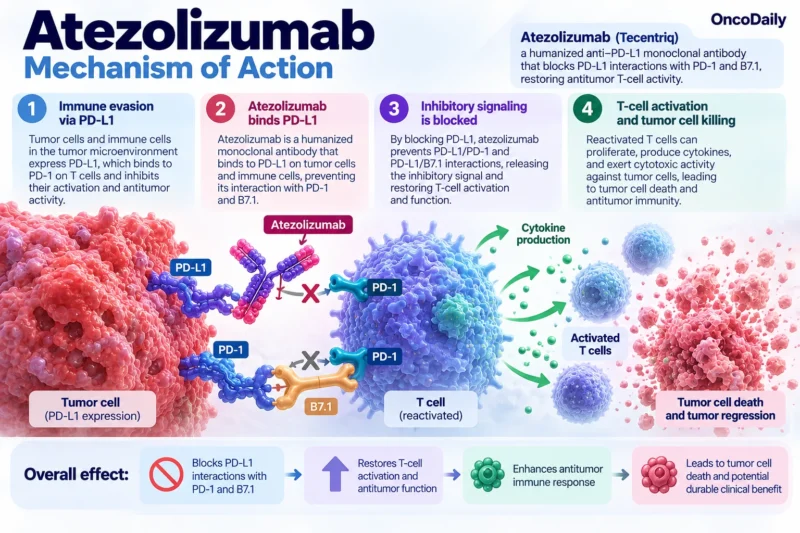
1. Tumor-Mediated PD-L1 Signaling
Many cancers exploit the PD-1/PD-L1 pathway to avoid immune destruction.
Tumor or immune-cell PD-L1 binds PD-1 and reduces T-cell activation.
2. Atezolizumab Binds PD-L1
Atezolizumab binds directly to:
PD-L1
and prevents its interaction with:
PD-1 and B7.1.
3. The Immune Brake Is Released
Blocking PD-L1 reduces inhibitory signaling to cytotoxic T cells.
This can increase:
- T-cell activation
- Proliferation
- Cytokine production
- Recognition of malignant cells
4. Antitumor Immunity Is Restored
Activated T cells can again recognize and attack tumor cells.
5. Tumor Growth May Be Suppressed
The resulting immune response can produce tumor regression or prolonged disease control in responsive cancers.
The mechanism can be summarized as:
Atezolizumab → PD-L1 blockade → interruption of PD-L1/PD-1 and PD-L1/B7.1 signaling → T-cell reactivation → antitumor immune response → tumor control.
What Is the Dose of Atezolizumab?
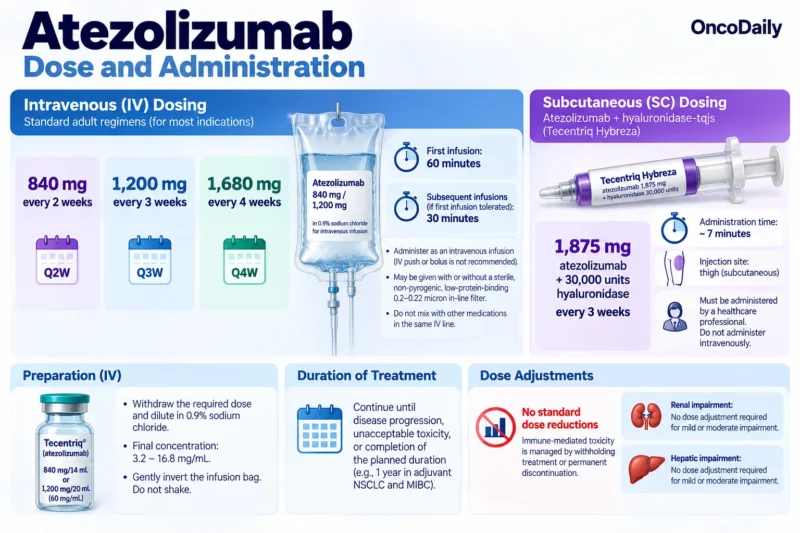
For most adult indications, intravenous atezolizumab may be given using any of three equivalent schedules:
840 mg IV every 2 weeks
or
1,200 mg IV every 3 weeks
or
1,680 mg IV every 4 weeks.
Adjuvant NSCLC
Following complete resection and platinum-based chemotherapy:
840 mg every 2 weeks, 1,200 mg every 3 weeks, or 1,680 mg every 4 weeks
for up to:
1 year
unless disease recurrence or unacceptable toxicity occurs.
Metastatic NSCLC
The same three schedules may be used:
840 mg q2w / 1,200 mg q3w / 1,680 mg q4w
until progression or unacceptable toxicity.
When administered with chemotherapy and bevacizumab, atezolizumab should be given before the other agents when administered on the same day.
Extensive-Stage Small Cell Lung Cancer
The same adult dosing schedules are used.
During first-line induction, atezolizumab is administered with:
Carboplatin + etoposide
and is given before chemotherapy on the same day.
Following induction, maintenance treatment may include atezolizumab alone or, under the current US indication, atezolizumab plus lurbinectedin in patients whose disease has not progressed.
Hepatocellular Carcinoma
Atezolizumab is administered with:
Bevacizumab 15 mg/kg IV every 3 weeks.
Atezolizumab should be administered first when both drugs are given on the same day.
Alveolar Soft Part Sarcoma
Adults receive one of the standard fixed-dose schedules.
For pediatric patients 2 years and older:
15 mg/kg IV every 3 weeks
up to a maximum dose of:
1,200 mg.
Muscle-Invasive Bladder Cancer
For adults with ctDNA MRD after cystectomy:
840 mg every 2 weeks, 1,200 mg every 3 weeks, or 1,680 mg every 4 weeks
for up to:
1 year
unless recurrence or unacceptable toxicity occurs.
How Is Atezolizumab Administered?
Atezolizumab is administered as an intravenous infusion.
First Infusion
The initial dose should be given over:
60 minutes.
Subsequent Infusions
If the first infusion is tolerated:
Subsequent doses may be infused over 30 minutes.
Preparation
Tecentriq is supplied at:
60 mg/mL
in single-dose vials containing:
- 840 mg/14 mL
- 1,200 mg/20 mL.
The required dose is withdrawn and diluted in:
0.9% sodium chloride
to a final atezolizumab concentration between:
3.2 and 16.8 mg/mL.
The infusion bag should be gently inverted.
Do not shake.
Does Atezolizumab Require an In-Line Filter?
The current US label allows administration:
With or without a sterile, non-pyrogenic, low-protein-binding 0.2–0.22 micron in-line filter.
Atezolizumab should not be administered as an IV push or bolus, and other medications should not be infused through the same IV line simultaneously.
Is There a Subcutaneous Form of Atezolizumab?
Yes.
Tecentriq Hybreza combines atezolizumab with hyaluronidase-tqjs.
The recommended dose is:
1,875 mg atezolizumab + 30,000 units hyaluronidase
administered as a:
15 mL subcutaneous injection into the thigh every 3 weeks.
Administration takes approximately:
7 minutes.
It must be administered by a healthcare professional and must not be given intravenously.
Does Atezolizumab Require Dose Reduction?
Unlike many cytotoxic drugs and TKIs:
Atezolizumab generally does not use dose reductions.
Immune-mediated toxicity is managed by:
- Continuing treatment with monitoring for mild events
- Temporarily withholding treatment
- Corticosteroid treatment when appropriate
- Permanently discontinuing atezolizumab for selected severe or life-threatening toxicities.
For many immune-mediated events requiring treatment interruption, systemic corticosteroids equivalent to approximately prednisone 1–2 mg/kg/day may be required, followed by a gradual taper after improvement.
Does Atezolizumab Require Renal or Hepatic Dose Adjustment?
Renal Impairment
No clinically meaningful difference in atezolizumab exposure has been observed in patients with:
Mild or moderate renal impairment — eGFR 30–89 mL/min/1.73 m².
Routine dose adjustment is therefore not required in these groups.
Data are more limited in severe renal impairment.
Hepatic Impairment
Mild and moderate hepatic impairment have not shown clinically meaningful effects on atezolizumab exposure.
Routine pharmacokinetic dose adjustment is therefore not required for these groups.
However, this does not eliminate the need to monitor for immune-mediated hepatitis during treatment.
What Is the Pharmacokinetic Profile of Atezolizumab?
Distribution
The steady-state volume of distribution is approximately:
6.9 L.
Clearance
Estimated clearance is approximately:
0.2 L/day.
Half-Life
The terminal half-life is approximately:
27 days.
Steady State
Steady-state exposure is typically reached after approximately:
6–9 weeks of repeated treatment.
As a monoclonal antibody, atezolizumab is not handled like a conventional CYP-metabolized small molecule, so traditional CYP-mediated drug interactions are not a major pharmacokinetic issue.
What Are the Clinical Uses of Atezolizumab?
Non-Small Cell Lung Cancer
Atezolizumab has several FDA-approved NSCLC settings.
Adjuvant NSCLC
It is approved after complete resection and platinum-based chemotherapy for adults with:
Stage II–IIIA NSCLC with PD-L1 expression ≥1% of tumor cells.
First-Line Metastatic NSCLC — High PD-L1
As monotherapy, atezolizumab is approved for metastatic NSCLC with:
- PD-L1 ≥50% on tumor cells, or
- PD-L1-positive immune cells occupying ≥10% of tumor area
and no EGFR or ALK genomic aberrations.
First-Line Combination Therapy
Approved combinations include:
Atezolizumab + bevacizumab + carboplatin + paclitaxel
and:
Atezolizumab + carboplatin + nab-paclitaxel
for selected metastatic non-squamous NSCLC without EGFR or ALK aberrations.
Previously Treated Metastatic NSCLC
Atezolizumab is also approved after progression during or following platinum-containing chemotherapy, with appropriate prior targeted therapy required in EGFR- or ALK-driven disease.
Extensive-Stage Small Cell Lung Cancer
Atezolizumab with:
Carboplatin + etoposide
is FDA-approved for first-line ES-SCLC.
This indication was established by IMpower133.
In 2025, the US indication expanded to allow lurbinectedin + atezolizumab maintenance after successful first-line induction therapy with atezolizumab, carboplatin, and etoposide.
Hepatocellular Carcinoma
Atezolizumab plus bevacizumab is approved for:
Unresectable or metastatic HCC in patients who have not received prior systemic therapy.
This combination became an important first-line option following the IMbrave150 trial.
Melanoma
Atezolizumab is approved with:
Cobimetinib + vemurafenib
for BRAF V600 mutation-positive unresectable or metastatic melanoma.
Alveolar Soft Part Sarcoma
Atezolizumab is approved as monotherapy for:
Unresectable or metastatic ASPS in adults and pediatric patients aged ≥2 years.
This is particularly important because ASPS is an ultra-rare sarcoma with historically limited systemic treatment options.
In the pivotal study, the objective response rate was approximately:
24%.
Responses were often prolonged; among responders, 67% had responses lasting at least 6 months and 42% at least 12 months.
Muscle-Invasive Bladder Cancer
This is an important new 2026 indication.
On May 15, 2026, the FDA approved atezolizumab as adjuvant therapy after cystectomy for adults with:
Muscle-invasive bladder cancer and detectable circulating tumor DNA molecular residual disease.
Treatment selection is based on an FDA-authorized ctDNA MRD assay. U.S.
What Did Atezolizumab Clinical Trials Show?
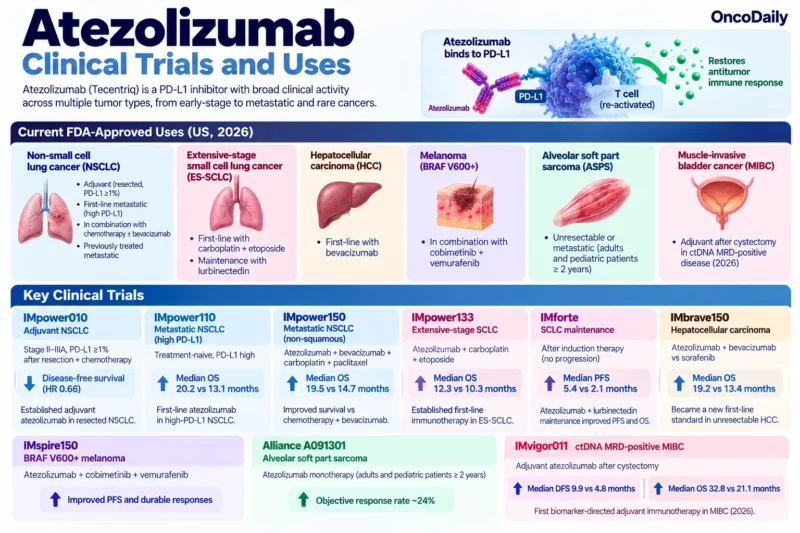
IMpower010 — Adjuvant NSCLC
IMpower010 evaluated adjuvant atezolizumab following complete resection and cisplatin-based chemotherapy.
Among patients with stage II–IIIA NSCLC and PD-L1 expression ≥1%:
Disease-free survival favored atezolizumab, with a hazard ratio of approximately:
0.66
versus best supportive care.
The benefit was particularly notable in more strongly PD-L1-expressing disease and established atezolizumab as an adjuvant treatment option in resected NSCLC.
IMpower110 — High PD-L1 Metastatic NSCLC
In treatment-naive metastatic NSCLC with high PD-L1 expression:
Median overall survival:
- Atezolizumab: 20.2 months
- Platinum-based chemotherapy: 13.1 months
This trial established first-line single-agent atezolizumab in high-PD-L1 metastatic NSCLC.
IMpower150 — Metastatic Non-Squamous NSCLC
The phase III IMpower150 study evaluated atezolizumab with bevacizumab and chemotherapy.
In the EGFR/ALK wild-type population:
Median overall survival:
- Atezolizumab + bevacizumab + carboplatin + paclitaxel: 19.5 months
- Bevacizumab + carboplatin + paclitaxel: 14.7 months
The survival benefit remained evident with longer follow-up.
IMpower133 — Extensive-Stage SCLC
IMpower133 randomized patients to carboplatin/etoposide with atezolizumab or placebo.
Median overall survival:
- Atezolizumab combination: 12.3 months
- Chemotherapy alone: 10.3 months
Median progression-free survival:
- 5.2 vs 4.3 months
The study established immune checkpoint inhibition as part of first-line treatment for ES-SCLC.
Watch more: IMpower133: Atezolizumab, Carboplatin Plus Etoposide for SCLC — Martin Reck, MD, PhD, discussing the updated overall-survival analysis of first-line atezolizumab plus carboplatin and etoposide in extensive-stage small cell lung cancer at ESMO 2019.
IMforte — Maintenance ES-SCLC
After induction with atezolizumab, carboplatin, and etoposide, patients without progression were randomized to atezolizumab alone or atezolizumab plus lurbinectedin.
From maintenance randomization:
Median PFS:
- Atezolizumab + lurbinectedin: 5.4 months
- Atezolizumab: 2.1 months
Median OS:
- 13.2 vs 10.6 months
The trial led to the current maintenance indication. FDA Access Data
IMbrave150 — Unresectable HCC
Atezolizumab plus bevacizumab was compared with sorafenib.
With updated follow-up:
Median overall survival:
- Atezolizumab + bevacizumab: 19.2 months
- Sorafenib: 13.4 months
Median PFS:
- 6.9 vs 4.3 months
The study fundamentally changed first-line treatment of unresectable HCC.
IMvigor011 — ctDNA-Guided Adjuvant MIBC
The phase III IMvigor011 trial enrolled patients after cystectomy and used serial ctDNA testing to identify molecular residual disease.
Among ctDNA MRD-positive patients:
Median disease-free survival:
- Atezolizumab: 9.9 months
- Placebo: 4.8 months
Median overall survival:
- Atezolizumab: 32.8 months
- Placebo: 21.1 months
This biomarker-directed trial led to the new 2026 adjuvant MIBC indication.
Is Atezolizumab FDA Approved?
Yes.
Atezolizumab received its initial US approval in:
2016.
Its regulatory history has subsequently expanded across multiple tumor types and treatment settings.
As of 2026, major US indications include:
- Resected PD-L1-positive stage II–IIIA NSCLC after chemotherapy
- High-PD-L1 metastatic NSCLC
- Selected combination regimens for metastatic non-squamous NSCLC
- Previously treated metastatic NSCLC
- First-line ES-SCLC
- ES-SCLC maintenance with lurbinectedin
- Unresectable/metastatic HCC with bevacizumab
- BRAF V600-positive advanced melanoma with targeted therapy
- Unresectable/metastatic ASPS
- ctDNA MRD-positive MIBC after cystectomy.
What Is the Current Clinical Role of Atezolizumab?
Atezolizumab now has a particularly broad role because it is used in early-stage, locally advanced, metastatic, and molecular-residual-disease settings.
Its clinical development illustrates several major directions in modern oncology:
- Biomarker-selected immunotherapy using PD-L1
- Immunotherapy combined with chemotherapy
- Immunotherapy combined with antiangiogenic therapy
- Immunotherapy combined with targeted therapy
- Maintenance immunotherapy strategies
- Treatment of rare cancers such as ASPS
- ctDNA-guided adjuvant treatment, exemplified by the 2026 MIBC approval.
The IMvigor011 result is particularly important conceptually because treatment is triggered by molecular residual disease rather than radiographically visible recurrence, representing a developing direction in precision immuno-oncology.
Atezolizumab is also part of a new ctDNA-guided adjuvant strategy in muscle-invasive bladder cancer. Read more about the IMvigor011 trial and ctDNA-guided atezolizumab on OncoDaily.
What Are the Major Side Effects of Atezolizumab?
Because atezolizumab activates antitumor immunity, its most clinically important adverse effects are immune-mediated toxicities.
Common adverse effects vary substantially according to the cancer type and combination regimen, but may include:
- Fatigue
- Reduced appetite
- Nausea
- Cough
- Dyspnea
- Diarrhea
- Rash
- Arthralgia
- Pyrexia.
The safety profile becomes broader when atezolizumab is combined with chemotherapy, bevacizumab, targeted therapy, or lurbinectedin.
Immune-Mediated Pneumonitis
Atezolizumab can cause pneumonitis.
With single-agent therapy, immune-mediated pneumonitis occurred in approximately:
3% of patients.
The risk may be greater in patients who have previously received thoracic radiation.
Symptoms include:
- New or worsening cough
- Dyspnea
- Chest discomfort
- Fever
- New pulmonary infiltrates.
Grade 2 pneumonitis generally requires treatment interruption, while Grade 3–4 pneumonitis requires permanent discontinuation.
Immune-Mediated Colitis
Possible manifestations include:
- Diarrhea
- Abdominal pain
- Blood or mucus in the stool
- Lower GI bleeding.
Persistent diarrhea during immunotherapy should not automatically be assumed to be ordinary gastrointestinal toxicity because immune-mediated colitis can require corticosteroid treatment.
Immune-Mediated Hepatitis
Atezolizumab can cause clinically important elevations in:
- ALT
- AST
- Bilirubin
and, rarely, severe hepatitis.
Liver tests should be monitored at baseline and periodically throughout treatment.
Endocrine Toxicity
Potential immune-mediated endocrinopathies include:
- Hypothyroidism
- Hyperthyroidism
- Thyroiditis
- Adrenal insufficiency
- Hypophysitis
- Type 1 diabetes mellitus.
Some endocrine toxicities may require long-term hormone replacement even after immunotherapy is stopped.
Nephritis
Immune-mediated nephritis can cause:
- Increased creatinine
- Renal dysfunction
- Acute kidney injury.
Renal function should be monitored during treatment.
Dermatologic Toxicity
Immune-mediated skin reactions range from mild rash and pruritus to rare severe conditions including:
- Stevens–Johnson syndrome
- Toxic epidermal necrolysis
- DRESS.
Confirmed severe exfoliative reactions generally require permanent discontinuation.
Neurologic and Cardiac Toxicities
Rare but serious immune-related events include:
- Myocarditis
- Pericarditis
- Encephalitis
- Meningitis
- Myelitis
- Guillain–Barré syndrome
- Myasthenia gravis
- Autoimmune neuropathy.
Although uncommon, these events can become rapidly life-threatening.
Infusion-Related Reactions
Infusion reactions can occur.
For Grade 1–2 reactions, the infusion may need to be:
Interrupted or slowed.
Grade 3–4 infusion reactions require:
Permanent discontinuation.
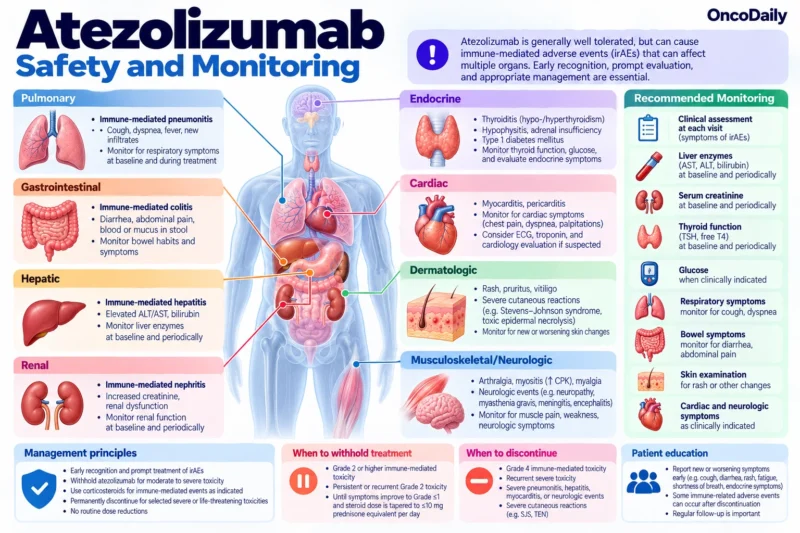
What Monitoring Is Required?
Before and during treatment, monitoring should include:
- Clinical assessment for immune-related symptoms
- Liver enzymes
- Serum creatinine
- Thyroid function
- Respiratory symptoms
- Bowel function and diarrhea
- Skin changes
- Glucose when clinically indicated
- Endocrine symptoms
- Neurologic symptoms
- Cardiac symptoms when suspected
- Infusion reactions.
The current prescribing information specifically emphasizes evaluation of liver enzymes, creatinine, and thyroid function at baseline and periodically during treatment.
Patients should also be advised that immune-related adverse events can sometimes occur after treatment has already been discontinued.
FAQ
What Is Atezolizumab Used For?
How Does Atezolizumab Work?
What Is the Standard Dose?
How Long Does an Atezolizumab Infusion Take?
If tolerated, subsequent infusions may be given over: 30 minutes.