Key takeaways
- Refer early at relapse or refractoriness, ideally before another line of therapy is started.
- Age, performance status, or organ dysfunction should not automatically exclude referral for advanced cellular therapy evaluation.
- Shared care works best when community and academic centers clearly define who is responsible at each phase of treatment.
- Community teams need to recognize CRS and ICANS and know exactly where patients should go and whom to contact if toxicity develops.
- Bispecific antibodies may offer one of the fastest opportunities to expand shared care into outpatient and community settings.
At the Community Oncology Global Congress (COGC 2026), organized by OncoDaily, Wajeeha Aiman, Hematology and Medical Oncology Fellow at Roswell Park Comprehensive Cancer Center, focused on a problem that begins before CAR T-cell therapy, transplantation, or bispecific antibodies are ever delivered: eligible patients may never reach the center that can offer them.
Most patients with common hematologic malignancies such as lymphoma and multiple myeloma begin and continue much of their care in the community. But when advanced therapy becomes necessary, referral may happen too late – after additional treatment lines, further disease progression, or worsening clinical status have already narrowed the options.
Aiman’s presentation centered on a practical question: how can community and academic centers divide responsibility without fragmenting care?
Refer Early – Before the Window Starts to Close
“The core problem is that some eligible patients are not reaching these therapies.
Many patients with non-Hodgkin lymphoma or multiple myeloma are being treated by community oncologists. The question is: are they never being referred, or are they being referred too late, when the disease has already advanced and their eligibility for CAR T-cell therapy or other advanced treatments has changed?
We have seen similar gaps with transplantation. In the Connect Myeloid Disease Registry, patients with higher-risk MDS or AML treated at community or government sites were less likely to be considered potentially eligible for hematopoietic cell transplantation than those treated at academic centers – approximately 28% versus 44%. Across all sites, 17.4% were never assessed for transplant eligibility at all.
Referral delays, insurance and coverage gaps, distance, caregiver availability, financial concerns, and other social determinants of health can all compound into unequal access to potentially curative therapy.
So the first principle is simple: refer early at relapse or refractoriness.
Once the disease is considered relapsed or is not responding to first-line treatment, referral should happen preferably before the next line of therapy is started.
And no single factor – age, performance status, or organ dysfunction – should automatically prevent referral. The cellular therapy team should assess those factors because eligibility criteria may be different from what the community clinician expects.
In large B-cell lymphoma, for example, primary refractory disease or relapse within 12 months should immediately trigger consideration of CAR T-cell therapy.
You do not need to know every new therapy coming through the pipeline. But you do need to know the modern decision points – when the patient should be referred before another opportunity is lost.”
Care Should Begin – and End – in the Community
“So how do we build a shared-care model?
My view is that care should begin and end in the community whenever possible. That is better for the patient, and it also reduces unnecessary burden on the academic center.
The academic center owns the acute period when specialized cellular therapy expertise and infrastructure are most important. But the entire journey does not have to remain there.
The key is that everyone knows who owns which part of the care and when the handoff occurs.
I would divide that pathway into a few practical phases.
1. Identify and refer
The community oncologist recognizes eligibility and refers the patient at relapse or treatment failure.
The academic center confirms eligibility and counsels the patient and caregiver about the treatment, potential barriers, and available resources.
2. Bridge and treat
The community practice may provide holding or bridging therapy according to the academic center’s plan.
The cellular therapy center takes responsibility for processes such as apheresis, manufacturing, lymphodepletion, and infusion.
3. Manage the acute toxicity window
Early complications such as cytokine release syndrome and immune effector cell-associated neurotoxicity syndrome – CRS and ICANS – may require the resources of the academic center, particularly during the first few weeks.
But if a community practice is going to co-manage these patients, its team also needs to recognize those toxicities and know exactly what first-line steps to take.
4. Bring the patient back
Long-term primary oncology care should return to the community, including monitoring for cytopenias, infections, and other ongoing problems.
The academic center can remain involved for disease reassessment, late-effect surveillance, and periodic follow-up.
It does not need to be an all-or-nothing model. The patient can return home while the expertise remains connected.”
Shared Care Starts Before the Emergency
“Co-management needs infrastructure, and the multidisciplinary team is probably the single most important component.
That includes:
- Cellular therapy physicians,
- Advanced practice providers,
- Coordinators,
- Pharmacists,
- Nurses,
- Social workers,
- Financial navigators.
Every person is a key part of the pathway.
There should be a physician champion at both the community and academic sites, and there should be clear communication between them.
Electronic medical records should include appropriate order sets, alerts, and CAR T-cell or bispecific therapy flags so that anyone who encounters the patient – including an emergency physician – immediately knows what treatment that patient has received and whom to contact.
Community practices also need a formal relationship with a hospital that is prepared to manage these patients.
If a delayed toxicity occurs, the patient should already know which emergency department to go to. The emergency department and ICU should know whom to call. There should be a 24/7 point of contact and protocols for access to therapies such as tocilizumab when required.
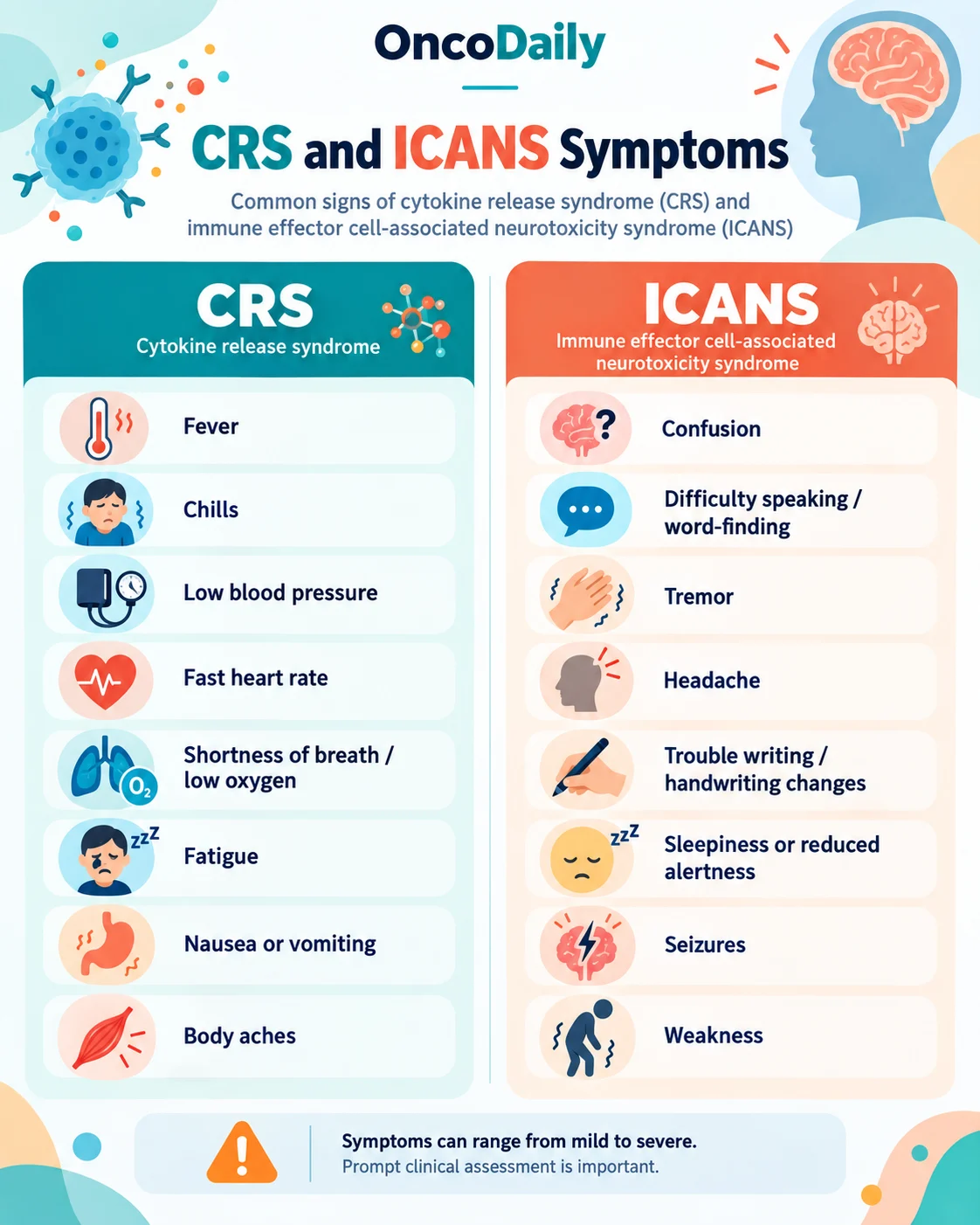
CRS may present with fever, hypotension, or hypoxia after cellular therapy, while ICANS can present with neurologic changes. These complications can resemble sepsis or encephalopathy, so the emergency team needs to recognize that this is a patient receiving cellular therapy and that the response pathway is different.
You do not want to build that communication system when the patient is already in the emergency department.
It needs to exist before the toxicity happens.”
Bispecifics May Be the Fastest Shared-Care Opportunity
“Bispecific antibodies may be one of the fastest-growing opportunities for shared care.
They are increasingly deliverable in outpatient and community settings when there is appropriate planning, a clear protocol, and safeguards around step-up dosing.
But outpatient treatment still requires the right patient and the right infrastructure.
We need a reliable caregiver, access to a capable hospital, and comorbidities that are sufficiently controlled.
Long-term care also means thinking beyond the infusion itself. These patients may require infection prophylaxis, immunoglobulin replacement for hypogammaglobulinemia, and monitoring for treatment-specific toxicities.
So if I had to turn all of this into a practical checklist for building a shared-care program, I would start with seven things:
- Define the referral trigger in writing. Everyone in the community practice should know who needs referral and when.
- Name a coordinator and physician champion at each site.
- Create a shared-care agreement that clearly defines phase ownership and handoff timing.
- Build the workflow into the EMR, with order sets, alerts, and cellular therapy flags.
- Formalize the relationship with the emergency department, hospital, and ICU.
- Standardize education for clinicians, staff, patients, and caregivers.
- Embed financial navigation so that coverage and structural barriers are addressed rather than discovered too late.
Those are the steps that can convert good intentions into a functioning program.
Advanced therapy does not have to mean that the community oncologist disappears from the patient’s care. The better model is one where referral happens early, the academic center takes responsibility when its specialized resources are needed, and the patient returns to the community with a clear plan.
The goal is not simply to refer more patients. It is to make sure the right patient reaches the right therapy while there is still time to benefit from it.”
Written by Eliz Baloyan, MD, Features Writer and Editor at OncoDaily and CancerWorld