Key takeaways
- Chronological age alone should not determine systemic therapy intensity in older adults.
- Geriatric assessment can uncover vulnerabilities that ECOG performance status may miss.
- Assessment only matters if the findings lead to action, such as nutritional support, medication review, caregiver involvement, or closer monitoring.
- Both overtreatment and undertreatment should be avoided by matching treatment intensity to vulnerability, goals, and expected benefit.
- In community oncology, geriatric care does not need to be perfect or highly specialized - it needs to be feasible and actionable.
At the Community Oncology Global Congress (COGC 2026), organized by OncoDaily, Viviane Basílio, Clinical Oncologist at Oncologia D’Or, focused on how geriatric assessment can help personalize systemic therapy for older adults with cancer.
She opened with two patients, both 78 years old, with the same type of cancer and the same indication for systemic therapy. One was independent and active; the other had recently fallen, was losing weight, took eight medications, and lived alone.
The contrast raised the central question of the presentation: should two patients receive the same treatment intensity simply because they are the same age?
Same Age, Very Different Vulnerability
“Two patients of the same age can have completely different physiological reserves, and ECOG alone does not solve this problem.
A patient can have an ECOG performance status of 1 and still have cognitive impairment, malnutrition, polypharmacy, or limited social support – all factors that may affect treatment tolerance.
So when I am deciding on systemic therapy, the question is not simply, ‘How old is this patient?’
It is: how vulnerable is this patient to the treatment I am considering?
Geriatric assessment helps us identify vulnerabilities that routine oncology assessment may miss.
It can reveal problems that may remain invisible during a conventional oncology visit, including limitations in physical function, cognition, nutrition, medication use, social support, and other factors that influence treatment tolerance.”
Assessment Is Only Useful If It Changes Care
“For medical oncologists, assessment is the starting point, not the end point.
Some vulnerabilities are reversible and should be optimized. Others tell us that the patient needs closer monitoring or additional support, and some may ultimately justify adapting the treatment itself.
But an abnormal assessment should never automatically translate into less cancer treatment.
The purpose of geriatric assessment is not simply to generate another score. It is to identify what can be improved and what information should influence treatment decisions.
Weight loss may prompt nutritional support. Polypharmacy may require medication review. A recent fall may point toward closer evaluation and monitoring. Limited support at home may require greater caregiver involvement.
Only after we understand those vulnerabilities should we decide whether the anticancer treatment itself needs to change.”
Acting on Vulnerability Can Improve Outcomes
“We now have randomized evidence that acting on these vulnerabilities can change outcomes.
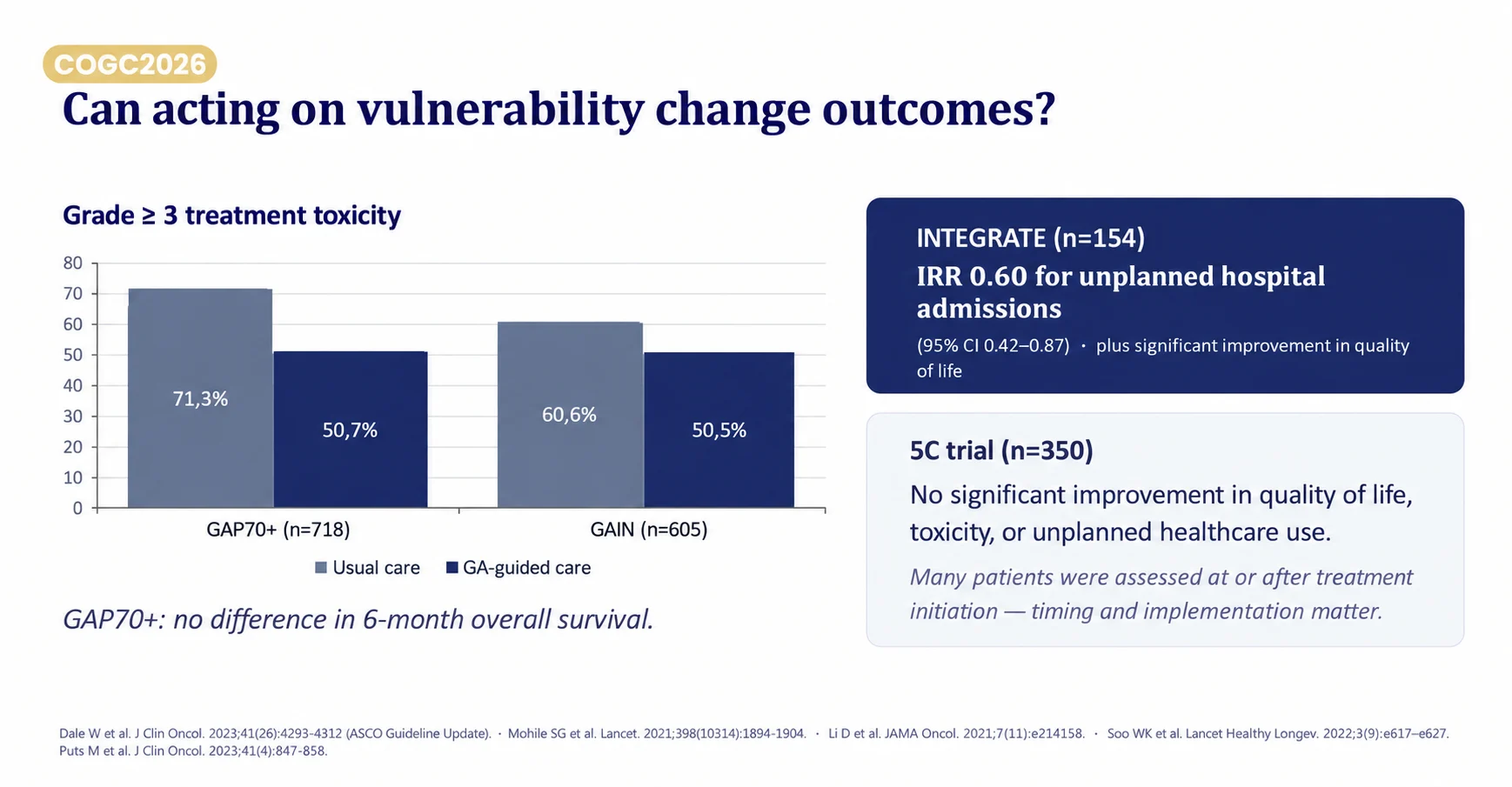
In GAP70+, geriatric assessment-guided management reduced grade 3–5 toxicity from approximately 71% to 51%, without compromising 6-month overall survival.
In GAIN, there was a similar reduction, from approximately 61% to 51%.
INTEGERATE also showed fewer unplanned hospital admissions and better quality of life with integrated oncogeriatric care.
But not every trial has shown the same benefit. In the 5C trial, geriatric assessment and management did not improve quality of life, toxicity, or unplanned healthcare use.
Importantly, many patients were assessed at or after treatment initiation, so timing may matter. Assessment only helps if we have the information early enough to act on it.
It is also worth noting that GAP70+, the trial with the largest effect, did not require every patient to be managed by a dedicated multidisciplinary geriatric oncology team. The recommendations went directly to community oncologists, who acted on them.
That matters for many of us because this approach can still work where access to multidisciplinary geriatric care is limited.
So the message is not simply to perform an assessment. The real question is: how do we use that information to make better treatment decisions?”
Personalization Does Not Always Mean Less Treatment
“This is where personalization actually happens.
Finding vulnerability does not necessarily mean reducing the dose. Sometimes the best intervention is to optimize nutrition or medications while keeping standard treatment. Sometimes we keep the regimen but increase monitoring or caregiver support.
And sometimes the vulnerability is significant enough that we should adapt the dose, schedule, or regimen itself.
The important point is that decisions should be driven by the patient’s vulnerability, expected treatment benefit, and goals – not by age alone.
A vulnerability may lead to supportive care rather than a change in cancer therapy. Another vulnerability may justify modifying the treatment itself.
The response has to depend on the individual patient, what we find in the assessment, and the balance between treatment benefit and burden.”
How Assessment Changes the Treatment Plan
“Now let’s go back to Mrs. Rose.
If I look only at age and ECOG, I might simply label her as a 78-year-old patient with ECOG 1 and prescribe standard treatment.
But now I know much more.
She has:
- Recent weight loss
- A recent fall
- Eight medications
- Limited support at home
None of those findings automatically tells me to reduce her treatment. But they tell me what I need to address: nutrition, medications, fall risk, social support, and closer toxicity monitoring.
After that, standard treatment may still be appropriate.
Treatment modification should come when her vulnerability, tolerance, goals, or expected benefit justifies it – not simply because she is 78 years old.
The assessment does not automatically tell us to de-escalate therapy. It tells us what needs to be addressed so that treatment can be made safer and more individualized.”
Personalizing Care Without Overtreating or Undertreating
“This personalization works in both directions.
We want to avoid overtreatment, when the burden of treatment is disproportionate to the expected benefit. But we also need to avoid undertreatment.
A fit older adult should not lose access to an effective therapy simply because of the date on their birth certificate.
Personalizing systemic therapy does not mean treating older adults less aggressively. It means matching treatment intensity to vulnerability, patient goals, and expected benefit.
Of course, this becomes more challenging in community oncology. In many community settings, including those I know from clinical practice in Brazil, access to dedicated geriatric oncology teams is limited.
But that does not mean we cannot personalize treatment.
We can start with what is available: brief screening, medication review, caregiver involvement, basic nutritional support, and closer follow-up.
Some patients may need treatment adaptation. Others may still be appropriate candidates for exactly the same effective treatment we would offer a younger patient.
And when a vulnerability cannot be fully corrected, the treatment plan itself may become one of the variables we adjust.
We do not need a perfect model before we start. It needs to be feasible and actionable.
Even without a dedicated geriatric oncology service, we can identify meaningful vulnerabilities early enough to influence care and make treatment safer.”
Treat Vulnerability, Not Age
“So I would leave you with three messages.
- Look beyond chronological age.
- Assessment only matters if we act on what we find.
- Treatment should respond to vulnerability, not to age itself.
Some older adults need less intensive treatment. Others should receive exactly the same effective treatment we would offer a younger patient.
Our goal is not to treat older adults less. It is to give the right treatment to the right patient.”
Written by Eliz Baloyan, MD, Features Writer and Editor at OncoDaily and CancerWorld