
Key takeaways
- Affordability, accessibility, and treatment adherence remain major determinants of kidney cancer outcomes in LMICs.
- First-line treatment selection should balance clinical efficacy, disease burden, toxicity, and financial sustainability.
- TKI monotherapy remains an option for selected patients but may be suboptimal for intermediate- and poor-risk disease.
- Biosimilars and alternative checkpoint inhibitors could substantially reduce immunotherapy costs.
- Locally driven clinical research is critical to developing evidence-based solutions for resource-constrained healthcare systems.
Vivek Agarwala, Director of Medical Oncology and Hemato-Oncology at Narayana Health, explored the challenges of delivering first-line treatment for advanced clear cell renal cell carcinoma (ccRCC) in low- and middle-income countries (LMICs) during his presentation at VIRO 2026 – Global Voices in Renal Oncology by OncoDaily.
While the global debate over first-line treatment often revolves around response rates, survival benefits, treatment sequencing, and toxicity profiles, another factor frequently determines clinical outcomes in resource-constrained settings: whether patients can afford to receive and continue treatment in the first place.
The challenge is not necessarily a lack of awareness of international standards, but the difficulty of implementing them across healthcare systems with vastly different resources.
Drawing on international clinical trials, pharmacoeconomic studies, prospective research from India, and a survey of Indian medical oncologists, Agarwala examined how modern kidney cancer treatment could become more accessible, affordable, and sustainable without compromising the principles of evidence-based medicine.
IO-IO vs. IO-TKI: Two Different Treatment Philosophies
International treatment guidelines have established several immunotherapy-based combinations for the first-line management of advanced clear cell RCC:
- Pembrolizumab plus axitinib
- Nivolumab plus cabozantinib
- Pembrolizumab plus lenvatinib
- Nivolumab plus ipilimumab, particularly for intermediate- and poor-risk disease
The choice between dual immunotherapy (IO-IO) and an immunotherapy-tyrosine kinase inhibitor (IO-TKI) combination reflects different therapeutic objectives.
Nivolumab plus ipilimumab offers the possibility of durable, treatment-free responses in a proportion of patients. However, early disease progression and immune-related adverse events remain important considerations.
IO-TKI combinations generally offer higher response rates and more rapid disease control, making them particularly relevant for patients with bulky, symptomatic, or rapidly progressing disease. These benefits must be balanced against chronic TKI-associated toxicities and the challenges of long-term treatment adherence.
Although emerging molecular classifications may eventually help personalize treatment selection, their integration into routine clinical practice remains investigational.
In LMICs, clinical and biological characteristics are accompanied by three additional considerations: affordability, accessibility, and treatment adherence.
“The focus should not be only on just picking the regimen and choosing the regimen. Optimal delivery is also very important.”
The Gap Between Treatment Guidelines and Clinical Practice
To better understand how international recommendations are being adopted in India, Agarwala conducted an informal survey among Indian medical oncologists.
In the absence of financial or accessibility barriers, more than 80% of respondents preferred an IO-TKI combination for patients with favorable-risk metastatic RCC, with pembrolizumab plus axitinib emerging as the most frequently selected regimen.
For intermediate- and poor-risk disease, oncologists were more inclined to individualize treatment according to disease burden and symptom severity.
However, when asked which factors most influenced their actual first-line treatment decisions, respondents identified out-of-pocket drug costs and access to immunotherapy as leading considerations.
The survey, while exploratory, illustrates an important distinction between clinicians’ preferred treatment choices and the treatments they can realistically deliver.
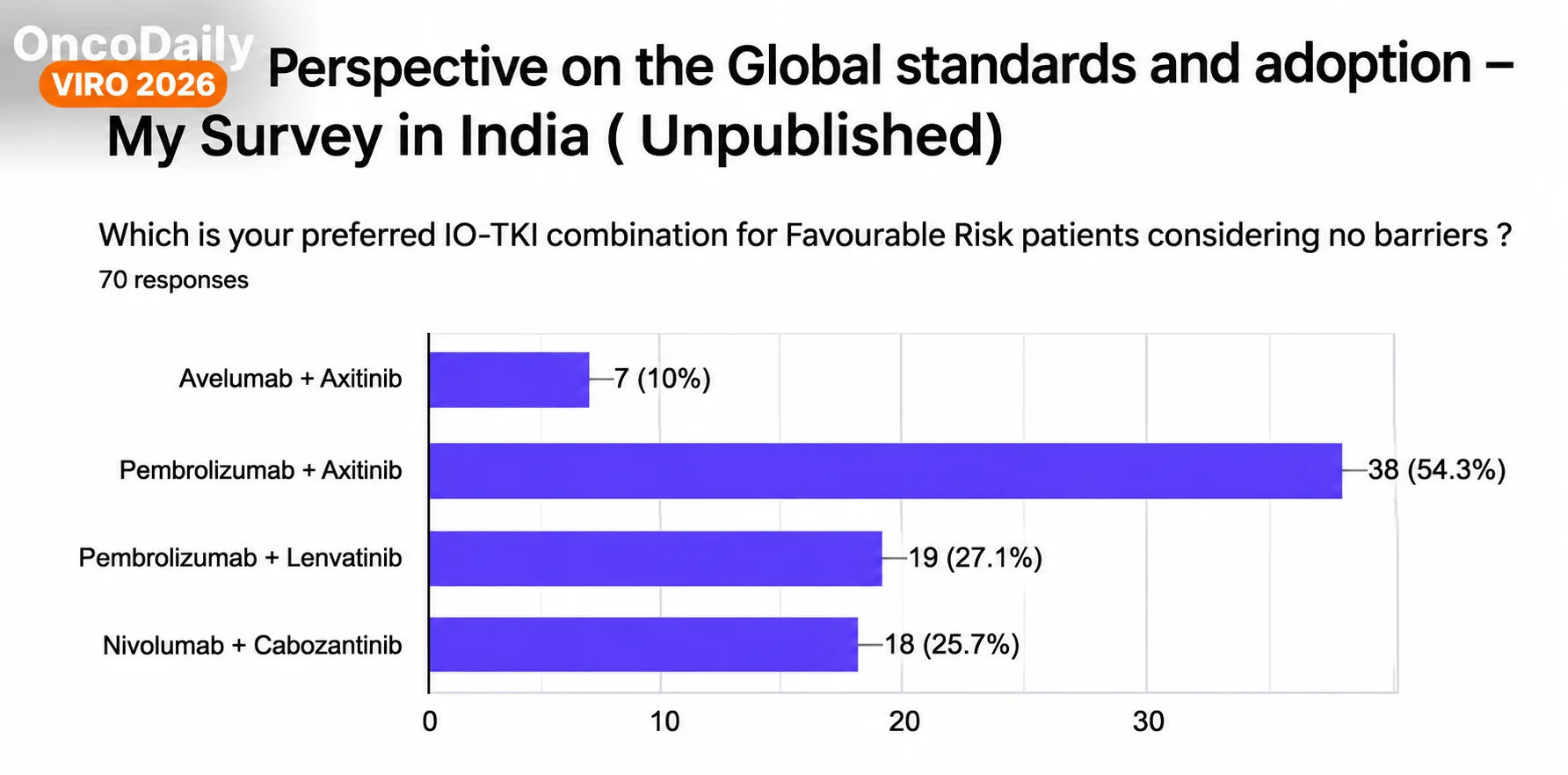
Data from Tata Memorial Hospital in Mumbai, cited during the presentation, further illustrated the extent of this disparity:
- Less than 5% of eligible patients in one resource-limited oncology setting accessed full-dose immune checkpoint inhibitors.
- In an emerging dataset focused specifically on intermediate- and poor-risk metastatic RCC, only approximately 20% of patients accessed standard-dose immunotherapy at any point during treatment.
- Access to immunotherapy in the first-line setting may therefore be even more limited.
“We have to understand that a treatment cannot be effective or a standard if patients cannot start it or afford to continue it.”
The True Cost of Kidney Cancer Treatment
The acquisition price of an anticancer drug represents only one component of its overall financial burden.
According to the estimates presented by Agarwala, a cycle of standard immunotherapy-based treatment can cost approximately $2,000-$3,000. Even with patient assistance programs, annual drug expenditure may reach $11,000-$13,000 in the settings he described.
Beyond the medication itself, patients and their families must account for:
- Diagnostic investigations and surveillance imaging
- Hospitalization and infusion-related expenses
- Travel and accommodation
- Repeated medical consultations
- Lost wages and caregiver time
- Management of treatment-related toxicities
- These additional expenses can determine whether treatment remains financially sustainable over time.
A 2023 study published in JCO Global Oncology evaluated the cost-effectiveness of four first-line treatment strategies for metastatic RCC in India.
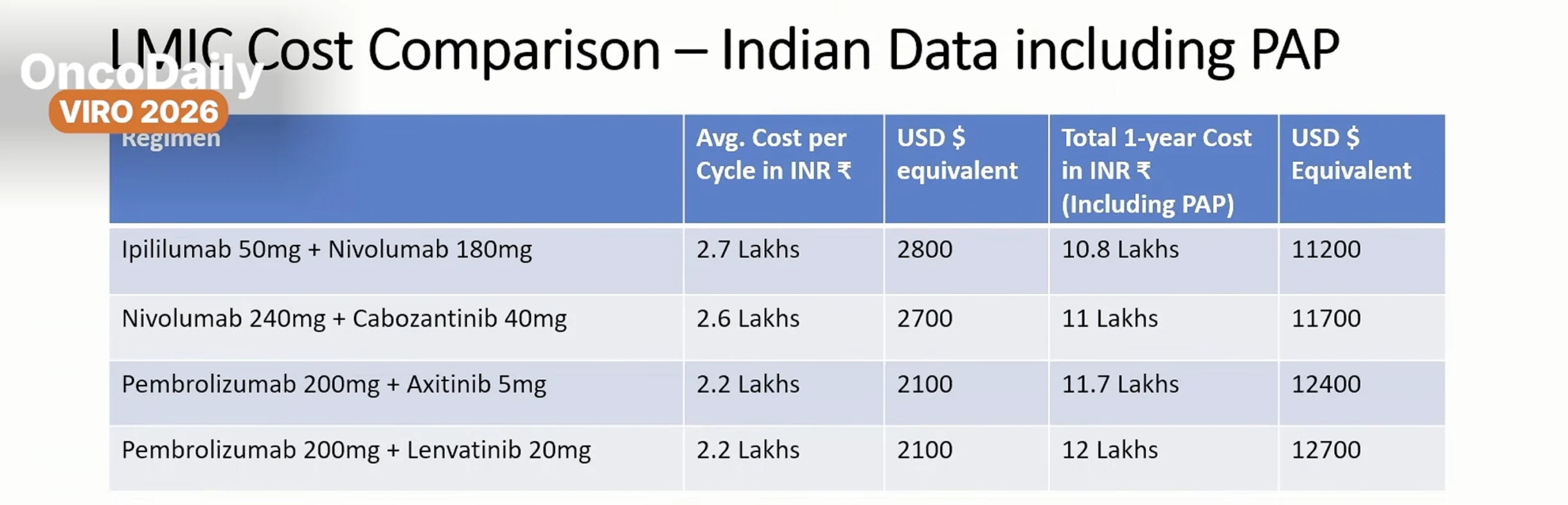
Although pembrolizumab plus lenvatinib provided the greatest modeled health benefit, sunitinib was the most cost-effective option at the willingness-to-pay threshold used in the Indian healthcare context.
The findings reflect the prices and assumptions of the economic model at the time of publication, rather than contemporary treatment costs.
They also demonstrate why clinical effectiveness and cost-effectiveness are fundamentally different measures. A regimen may offer superior clinical outcomes while remaining economically inaccessible to much of the population.
Is TKI Monotherapy an Adequate Alternative?
International guidelines retain TKI monotherapy as an option when immunotherapy-based combinations are unavailable or contraindicated.
However, Agarwala questioned whether this approach adequately addresses the needs of patients with intermediate- and poor-risk disease.
While TKI monotherapy remains a reasonable option for selected patients, particularly those with favorable-risk disease, the survival benefits demonstrated by immunotherapy-based combinations in higher-risk populations make restricted access particularly consequential.
Another consideration is whether immunotherapy can simply be deferred until disease progression.
Across the studies discussed by Agarwala, approximately 30-50% of patients did not receive second-line treatment. For a substantial proportion of patients, the first-line regimen may therefore represent their only opportunity to receive systemic therapy.
Moreover, survival outcomes reported in historical TKI trials may partly reflect subsequent access to immunotherapy, an opportunity that cannot be assumed in resource-constrained settings.
For Agarwala, this is where international recommendations should support investigation into locally relevant alternatives rather than discourage it.
“The guidelines cannot be looked at, you know, as handcuffs. They should not be limiting us. Rather, they should be used as guardrails.”
Expanding Access Through Alternative Checkpoint Inhibitors
The development of additional immune checkpoint inhibitors may introduce opportunities for more affordable treatment combinations.
One example is toripalimab, an anti-PD-1 monoclonal antibody developed in China.
The randomized phase III RENOTORCH trial evaluated toripalimab plus axitinib against sunitinib in 421 previously untreated patients with intermediate- or poor-risk advanced RCC.
At a median follow-up of 14.6 months, the independently assessed results demonstrated:
Median progression-free survival: 18.0 vs. 9.8 months.
Objective response rate: 56.7% vs. 30.8%.
Hazard ratio for disease progression or death: 0.65 (95% CI, 0.49–0.86; P = 0.0028).
An early overall survival signal also favored the combination.
The study provides randomized evidence supporting the antitumor activity of an alternative IO-TKI combination, although its availability, regulatory status, and affordability vary across healthcare systems.
Agarwala also discussed emerging research involving tislelizumab plus lenvatinib in the neoadjuvant setting for locally advanced clear cell RCC.
Such studies broaden the range of immunotherapy agents under investigation, although evidence generated in the neoadjuvant setting cannot directly establish their efficacy in metastatic disease.
Nivolumab Biosimilars: An Opportunity to Reduce Financial Toxicity
On January 22, 2026, Zydus Lifesciences launched Tishtha, a nivolumab biosimilar, in India at approximately one-quarter of the reference drug’s reported retail price.
The introduction of biosimilar immune checkpoint inhibitors represents an important development for healthcare systems where the cost of biologic medicines has historically restricted treatment access.
According to Agarwala, the availability of biosimilar nivolumab has already begun influencing clinical practice in India, particularly for patients with limited financial resources.
In his survey, more than 75% of respondents expressed willingness to use biosimilar nivolumab in patients facing financial barriers.
Unlike experimental dose-reduction strategies, biosimilars seek to improve affordability through the introduction of products demonstrated to be highly similar to their reference biologics, subject to regulatory evaluation.
Their wider availability could make established immunotherapy combinations financially feasible for more patients.
Can Low-Dose Nivolumab Make Immunotherapy More Accessible?
A different approach to reducing treatment costs involves investigating whether lower doses of immune checkpoint inhibitors can retain clinically meaningful antitumor activity.
Agarwala cited pharmacokinetic and pharmacodynamic research from India suggesting substantial PD-1 receptor occupancy at nivolumab doses considerably below conventional dosing.
However, receptor occupancy alone does not establish therapeutic equivalence. Prospective clinical evidence is necessary to determine whether reduced dosing can produce adequate and durable outcomes.
Agarwala and colleagues investigated this question in a prospective multicenter study involving 38 patients with intermediate- or poor-risk metastatic RCC across three Indian centers.
The investigational regimen consisted of nivolumab at a fixed dose of 20 mg every three weeks in combination with cabozantinib.
Baseline risk distribution included:
Intermediate-risk disease: 76%.
Poor-risk disease: 24%.
At a median follow-up of approximately 19 months, Agarwala reported the following outcomes:
Median progression-free survival: 14 months.
Objective response rate: 40%.
Median overall survival: Not reached.
12-month overall survival: Greater than 70%.
Response rates approached 50% in the intermediate-risk subgroup.
From an economic perspective, Agarwala estimated that reduced-dose approaches could bring drug expenditure down to approximately 15-20% of the cost of conventional regimens.
These preliminary findings are particularly relevant in settings where the alternative may be no immunotherapy at all.
Nevertheless, the study’s small sample size and absence of a randomized standard-dose comparator prevent conclusions regarding noninferiority or therapeutic equivalence.
Low-dose nivolumab in metastatic RCC remains an investigational strategy rather than an established replacement for standard dosing.
Similar efforts to investigate affordable immunotherapy delivery are emerging elsewhere, including the AFFORD-IO research initiative in Uganda, which Agarwala discussed as an example of locally relevant prospective research.
Treatment Continuity Is Part of Treatment Effectiveness
Reducing drug prices addresses only one dimension of treatment access.
Patients receiving IO-TKI combinations must also be able to tolerate and sustain treatment over extended periods.
Dose reductions are common in pivotal RCC trials. As Agarwala illustrated, the median daily dose delivered during clinical studies was approximately 14 mg for lenvatinib, compared with a starting dose of 20 mg; 30 mg for cabozantinib, compared with 40 mg; and 8 mg for axitinib, compared with 10 mg.
In resource-constrained settings, maintaining treatment continuity is further complicated by financial self-rationing, delayed reporting of adverse events, nutritional challenges, polypharmacy, and limited access to supportive care.
Agarwala argued that maintaining a tolerable, sustainable treatment regimen may be more valuable than pursuing high relative dose intensity at the expense of premature discontinuation.
This requires individualized dose modifications, patient education, early recognition of toxicities, and proactive supportive care.
It does not, however, establish that empirically reduced starting doses are equivalent to approved starting doses across all patients or treatment regimens.
Beyond Systemic Therapy: The Role of Multidisciplinary Care
Financial barriers are not the only factors influencing kidney cancer outcomes in LMICs. Fragmented care pathways can also lead to suboptimal treatment decisions.
Agarwala identified delayed referral to medical oncologists and potentially inappropriate upfront cytoreductive nephrectomy as challenges, particularly when patients are managed outside specialized cancer centers.
In the contemporary immunotherapy era, cytoreductive nephrectomy requires careful patient selection and consideration of the timing of systemic treatment.
Structured multidisciplinary teams can help coordinate decisions regarding surgery, systemic therapy, disease monitoring, and supportive care.
Another frequently overlooked dimension is hereditary kidney cancer assessment.
Younger patients, individuals with a relevant family history, and patients meeting other guideline-based indications may benefit from genetic risk evaluation. However, Agarwala’s survey suggested limited adherence to these recommendations.
Improving multidisciplinary collaboration could address both gaps without necessarily requiring significant investment in new therapeutic technologies.
Who Generates the Evidence Behind Global Treatment Standards?
The geographical distribution of clinical research remains another obstacle to equitable kidney cancer care.
According to an analysis presented at ASCO GU and referenced by Agarwala, approximately 76% of RCC clinical trials were conducted exclusively in high-income countries, with almost no representation from low-income countries.
This imbalance has consequences beyond access to investigational therapies.
When clinical research is concentrated in wealthier healthcare systems, questions concerning affordability, nutritional status, infrastructure limitations, treatment adherence, and alternative delivery models may receive insufficient attention.
Research originating in LMICs can help address questions that conventional drug development programs are not necessarily designed to answer.
Biosimilars, alternative checkpoint inhibitors, optimized treatment duration, investigational lower-dose strategies, and locally adapted supportive care models all warrant further evaluation.
For renal oncology, the next challenge is not simply developing more effective drugs. It is generating the evidence needed to ensure that effective treatments can be delivered across markedly different healthcare systems.
Scientific innovation and affordability should not be competing priorities. Both are necessary to improve real-world outcomes for patients with kidney cancer.
Written by Eliz Baloyan, MD, Features Writer and Editor at OncoDaily and CancerWorld