Key takeaways
- AI should solve a specific workflow problem, not simply add another tool or dashboard.
- Practices should ask whether AI truly reduces work or merely shifts it to someone else.
- Useful AI can improve prior authorization, documentation, molecular testing, patient navigation, and trial matching.
- Integration with the EMR and a clear fallback when AI is wrong are essential.
- Clinical trial AI can support pre-screening, but final eligibility decisions must remain clearly defined.
At the Community Oncology Global Congress (COGC 2026), organized by OncoDaily, Vinona Bhatia, hematologist-oncologist, Founder of Partnering for Cancer Innovation (P4CI), and Venture Partner at CANCER FUND, focused on a practical question that many oncology practices are now facing: with so many artificial intelligence tools entering the market, how do you know which ones are actually worth buying?
Whether the problem is prior authorization, documentation, molecular testing, patient navigation, clinical trial matching, or infusion operations, the value of AI depends on whether it truly removes that bottleneck – or simply shifts the burden somewhere else.
“AI should make your life easier, not harder.”
Define the Problem Before Choosing the AI
“The first question you should ask is: what are the bottlenecks in your clinic and the struggles that you and your team have on a daily basis?
Before adopting and paying for AI tools, you need to understand exactly what kind of problem they are supposed to solve.
That is especially important because some AI tools are being adopted by payers and health plans, which means practices may simply have to adapt to a new external workflow. Other tools can actually be adopted within the clinic to streamline existing processes.
The important questions are very practical.
- What exactly is being automated? Is it verification, document collection, submission, follow-up, peer-to-peer review, appeals, or something else?
- Whose queue is actually being helped? Is the tool reducing work, or simply shifting that work from one person to another?”
AI Should Reduce Friction Across the Workflow
“Administrative overload is one of the clearest areas where AI may help. These systems can support intake and referral workflows, coding, revenue cycle management, prior authorization, and claims management.
In one quality-improvement study involving more than 6,500 radiation oncology cases, an automated prior authorization system was associated with a 65% mean reduction in denial rates and a 34% decrease in median authorization time, along with improved staff satisfaction.
Documentation is another major opportunity. AI-based chart intelligence can support:
- Ambient note generation,
- Summarize information already in the medical record,
- Abstract data for clinical or research use,
- Manage inboxes,
- Triage messages,
- Draft patient letters,
- Prepare prior authorization packets.
But the practical question is whether the tool truly integrates into the electronic medical record and existing workflow – or whether it simply creates another dashboard that somebody has to monitor. Practices should also know what happens when the AI is wrong or uncertain, and whether there is a clear fallback process.
In one ASCO oncology practice pilot of an ambient AI scribe, adoption reached 77%, note turnaround fell to under three minutes, providers saved approximately 1.5 hours per week of EHR time, and 60% of physicians reported improved documentation quality.
The same principle applies to precision oncology. The question is not simply which molecular testing company to choose, but how the right test gets ordered, returned, and incorporated into the medical record.
Results need to be visible, trackable, and usable within the clinical workflow rather than remaining buried in PDFs or external portals. If a result is delayed or cannot be found when a treatment decision needs to be made, then the value of ordering the test is lost.
Across all of these areas, the measure of a useful AI tool is not whether it uses AI. It is whether it reduces delays, administrative work, and time spent outside patient care – and gets the right information to the clinician when it is actually needed.”
Patient Navigation: Who Responds When AI Raises a Flag?
“AI is also expanding into patient navigation – everything from clinical trial optimization to home care services.
These systems may help connect patients with transportation, supportive services, or resources addressing social determinants of health. Remote patient monitoring and remote symptom management may also identify symptoms earlier and potentially prevent hospitalizations.
But again, the operational questions matter:
- Does the tool add another communication layer for the patient and provider, or does it actually simplify access?
- Does it connect patients to services more effectively than what the clinic is already doing?
- And if a red flag comes in at 2 a.m., who is responsible for responding to it?
- Is that responsibility with the practice, or is the vendor providing clinical coverage?
In a non-randomized controlled study involving almost 6,000 patients with cancer, remote symptom management was associated with fewer hospitalizations compared with historical controls, but emergency department visits and ICU admissions were not significantly different.
So the evidence is still mixed, and practices need to understand exactly what problem a remote monitoring tool has demonstrated that it can solve.”
Clinical Trial Matching at the Point of Care
“Clinical trial matching is another area where AI can be particularly useful.
A system can pre-screen the patients on your daily schedule so that, before they even walk into the clinic, you already know which studies they may potentially qualify for.
Natural language processing can also extract information from unstructured clinical data – pathology reports, genomic studies, outside clinic notes, and other documents that may not be neatly integrated into the EHR.
There are also conversational AI-based matching tools that can be used by providers and sometimes by patients themselves, potentially making trial searches easier to navigate than traditional databases.
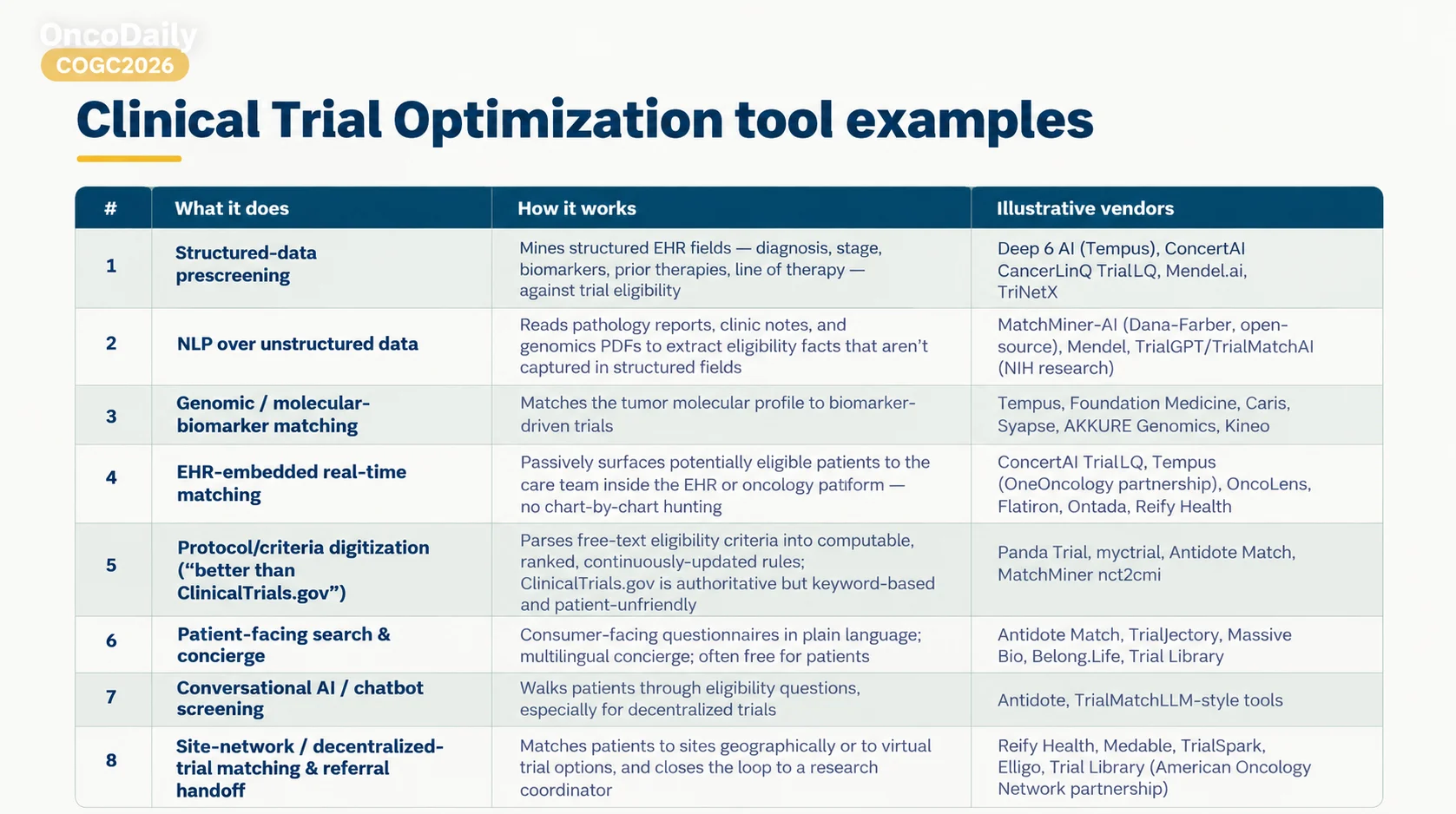
But the final question remains important: who makes the eligibility decision?
AI can help with pre-screening, but the responsibility for confirming whether a patient truly qualifies for a clinical trial still needs to remain clearly defined within the clinical workflow.”
Infusion and Pharmacy Need Their Own AI Questions
“AI can also support infusion scheduling, chair optimization, demand forecasting, drug inventory and acquisition, and the broader design of care delivery.
But in this area, I would ask the clinical team as much as I would ask the vendor.
- What support do we actually need?
- Where could AI introduce a new error?
- What happens when the AI is wrong?
Those questions are essential when the technology begins touching workflows involving medication delivery, infusion capacity, scheduling, and patient follow-up.
The goal is not to automate every possible process. It is to identify the places where automation can make care safer, faster, or easier without creating a new problem somewhere else.”
AI Should Give Clinicians Time Back
“At the end of the day, AI should give you some of your time back.
That is why practices need to choose these tools carefully.
Do not start by asking which AI product is the most impressive. Start by asking what is making your clinic inefficient, where patients or staff are getting stuck, and whether the technology actually improves that process.
If a tool creates another dashboard, another queue, another communication channel, or another task for somebody to monitor, then it may not be solving the problem at all.
The question clinicians should keep asking before they buy is simple: does this tool make the workflow better than the one we already have?”
Written by Eliz Baloyan, MD, Features Writer and Editor at OncoDaily and CancerWorld