Key takeaways
- A molecular tumor board is a multidisciplinary team that reviews a patient’s genomic results and helps translate them into treatment options, clinical trials, or further testing.
- Not every genetic variant is actionable, even when it is pathogenic.
- Genetic counselors play a key role in interpretation, hereditary risk assessment, and patient communication.
- Access to genomic testing, targeted therapies, and clinical trials remains uneven.
- Precision medicine depends on teamwork as much as it depends on sequencing technology.
At the Community Oncology Global Congress (COGC 2026), organized by OncoDaily, Soham Banerjee, Senior Consultant Genetic Counselor and Medical Geneticist and Head of the Department of Medical Genetics and Genetic Counselling at Sharanya Super Speciality Hospital, focused on how genomic findings can be translated into meaningful clinical decisions.
His presentation, “Molecular Tumour Boards: Turning Genomic Results into Clinical Decisions,” looked at the challenges of interpreting complex genomic data, identifying what is truly actionable, and connecting those findings to treatment, hereditary risk, and patient care.
At the center of the discussion was a simple question: how do we move from finding a genetic variant to knowing what it actually means for the patient?
How Does Genomic Data Become a Clinical Decision?
Cancer care is becoming increasingly driven by genetic information. Around 10–15% of cancers may be associated with hereditary cancer syndromes, but genetic alterations also play a role far beyond inherited disease.
Next-generation sequencing can identify hundreds of variants from a single tumor, but finding a variant does not automatically make it clinically important. Some alterations have clear evidence behind them, while others may have uncertain significance or little relevance to the cancer being treated.
That is where the molecular tumor board becomes important.
The goal is to take a large amount of molecular information and turn it into something clinically useful: which alteration is actually driving the cancer, whether there is a therapy that matches it, whether a clinical trial may be appropriate, and whether the finding could also have implications for the patient’s family.
Who Belongs at the Table?
A molecular tumor board brings together expertise that no single specialist can provide alone.
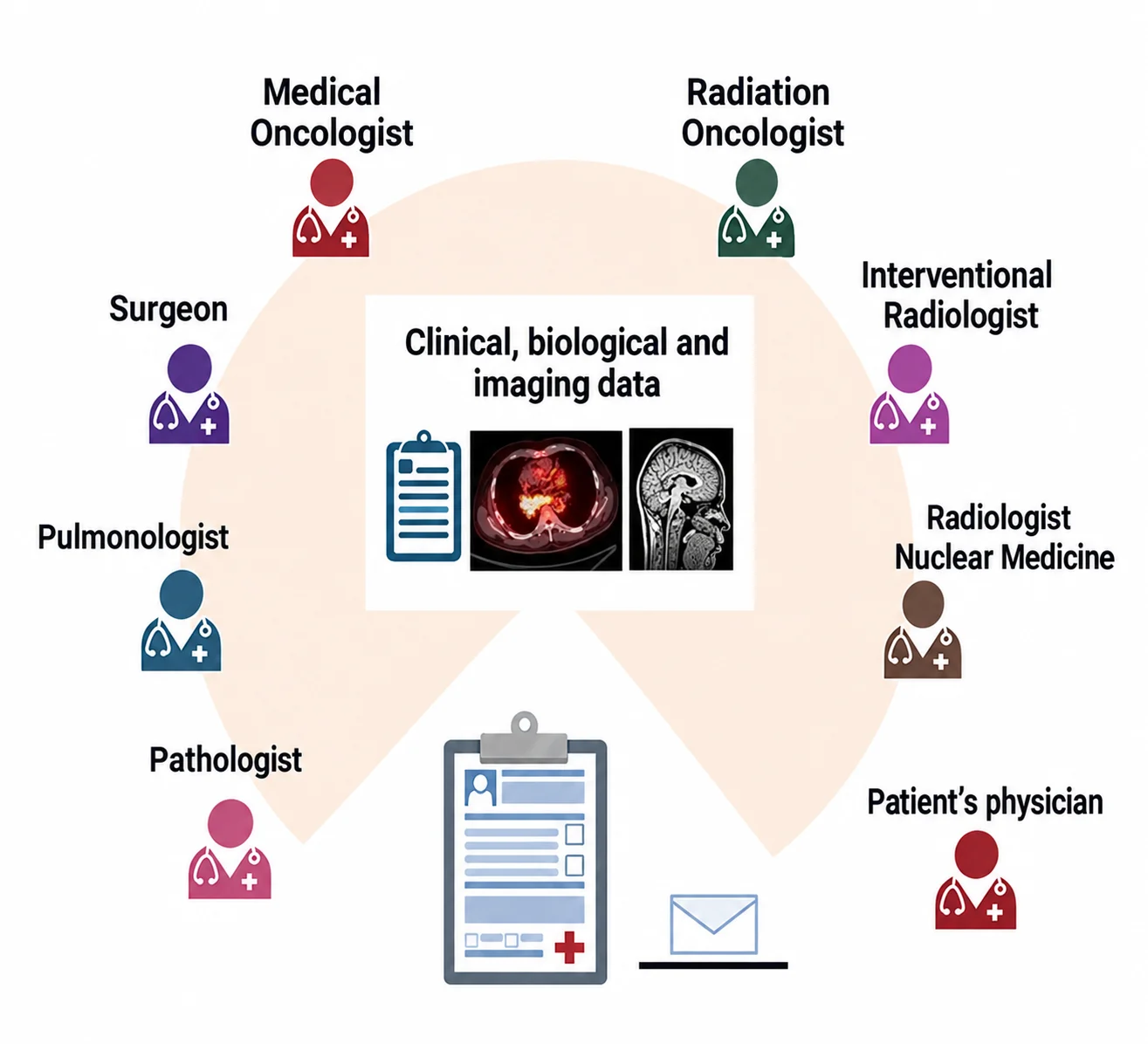
The medical oncologist brings the clinical picture and treatment options.
Pathologists and molecular pathologists help determine what is happening within the tumor and whether a molecular finding is biologically meaningful.
Geneticists and genetic counselors look at hereditary risk, family history, and the possible germline implications of a result.
Bioinformaticians analyze and curate complex sequencing data, while pharmacology expertise can help connect actionable findings with available drugs and treatment guidelines.
“The goal is to get the genomic information, to the right clinical decision, for the right patient.”
That may mean matching a patient to a targeted therapy, identifying a clinical trial, recommending additional testing, or deciding that the available evidence is still too limited to justify action.
From the Tumor Sample to a Treatment Plan
The molecular data journey starts with the tumor sample. DNA and/or RNA is extracted from the sample and then sequenced.
From there, bioinformatics is used to identify and annotate the variants found in the tumor. The team reviews the next-generation sequencing report closely, looking for mutations that may be targeted by specific drugs.
The findings then move into clinical interpretation and evidence review. This is where the team asks which variants are actually meaningful, whether there is enough evidence to act on them, and whether an available therapy matches the alteration.
The molecular tumor board can then:
- Find actionable targets that may respond to specific drugs
- Match patients with clinical trials based on their molecular findings
- Guide the treating team in difficult or complex cancers
- After the molecular tumor board discussion, the goal is to arrive at a treatment recommendation and determine whether any additional testing or family follow-up is needed.
The Genetic Counselor as the Bridge
A major part of the presentation focused on the genetic counselor’s role before, during, and after molecular testing.
Before testing, that begins with the patient’s personal and family history. Multiple cancer diagnoses in a family, age at diagnosis, patterns of disease, and other details can help determine whether an underlying hereditary cancer syndrome should be considered.
Patients also need to understand why tumor or germline testing is being performed, what the testing can and cannot answer, and the possibility of incidental or secondary findings.
During the molecular tumor board, the genetic counselor can flag findings that may require germline confirmation, help distinguish somatic alterations from potentially inherited ones, and connect the molecular result with the patient’s phenotype and family history.
Afterward, the results need to be explained in language the patient and family can understand. Confirmatory germline testing may need to be arranged, inheritance and recurrence risks discussed, and cascade testing offered to relatives who may also be at risk.
Psychosocial concerns and uncertainty also have to be addressed.
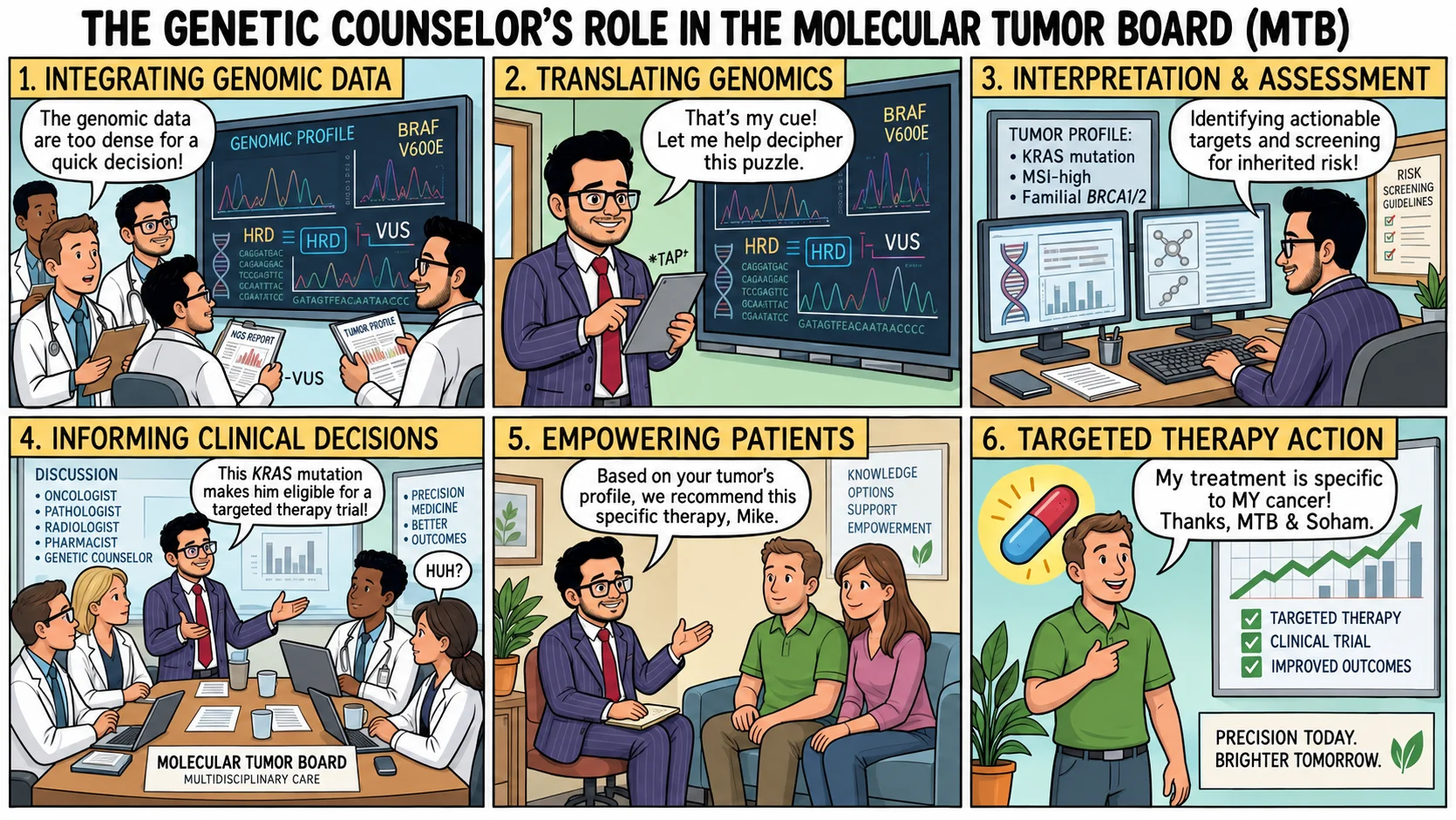
In that sense, the genetic counselor becomes a bridge between complex genomic information, the clinical team, the patient, and the family.
When a Genetic Finding Can – and Cannot – Guide Treatment
One of the biggest challenges in precision oncology is that not every molecular finding leads to a clear treatment decision. Variants of uncertain significance are common, and rare variants may have very little supporting evidence. Even when an alteration is known to be pathogenic, that does not automatically mean there is a therapy that can target it.
Actionability and pathogenicity are not the same thing.
The evidence behind a finding can range from an approved standard-of-care biomarker with an established therapy to emerging clinical data, early trials, biological rationale, or preclinical evidence. Guidelines from organizations such as NCCN, ASCO, and ESMO can help place those findings into context, but each result still has to be interpreted for the individual patient.
That also means being clear about the limits of what is known: if the evidence is not strong enough to support a clinical decision, that uncertainty should be made clear rather than forcing a finding into a treatment plan.
Making Genomic Medicine Reach the Patient
Even when the science is clear, access can still stand in the way. Genomic testing is not equally available across countries and health systems, and many patients may not have easy access to laboratories that can perform advanced molecular testing. Cost and turnaround time can create further delays.
And finding a relevant mutation does not solve the problem on its own. The targeted therapy or clinical trial linked to that finding still has to be available, accessible, and affordable.
Precision medicine therefore depends on more than sequencing technology. It depends on whether a health system can turn a molecular result into a real treatment opportunity for the patient.
That also requires collaboration. Genomics, pathology, oncology, genetics, bioinformatics, counseling, and patient care each contribute a different part of the decision-making process.
“It’s not a one-person job. It’s a team effort.”
Only when access, interpretation, and teamwork come together can genomic information truly guide care.
Written by Eliz Baloyan, MD, Features Writer and Editor at OncoDaily and CancerWorld
Watch the full video on YouTube.