Key takeaways
- Breast cancer is rising fastest where resources are most limited - and mortality remains disproportionately high.
- Awareness and earlier diagnosis can change outcomes before expensive technology ever enters the picture.
- Diagnostic mammography and immunohistochemistry still matter more than sophisticated testing when the basics are missing.
- Approval does not equal access - essential medicines still have to be affordable, available, and included in national systems.
- Clinical trials and compassionate-use programs should be viewed as tools for access, not luxuries reserved for high-income settings.
At the Community Oncology Global Congress (COGC 2026), organized by OncoDaily, Sana Al Sukhun, Director of Medical Oncology and Hematology Practice and Medical Oncology/Hematology Consultant, Co-Chair of ASCO’s RSG Committee for Metastatic Breast Cancer, focused on what breast cancer care should prioritize when resources are limited.
Her presentation was built around four practical priorities: addressing the rising breast cancer burden through awareness and prevention, diagnosing disease earlier, ensuring access to accurate basic diagnostics, and making appropriate treatment available.
Priority 1: Address the Rising Breast Cancer Burden
“Breast cancer incidence is growing, and the burden is increasing worldwide.
According to GLOBOCAN 2024 statistics, two-thirds of new cancer cases were diagnosed in countries with limited resources, compared with 50% in 2008.
Over the last two decades, there has been a 60% increase in incidence, driven by a 160% increase in countries with limited resources, compared with only a 32% increase in high-income countries.
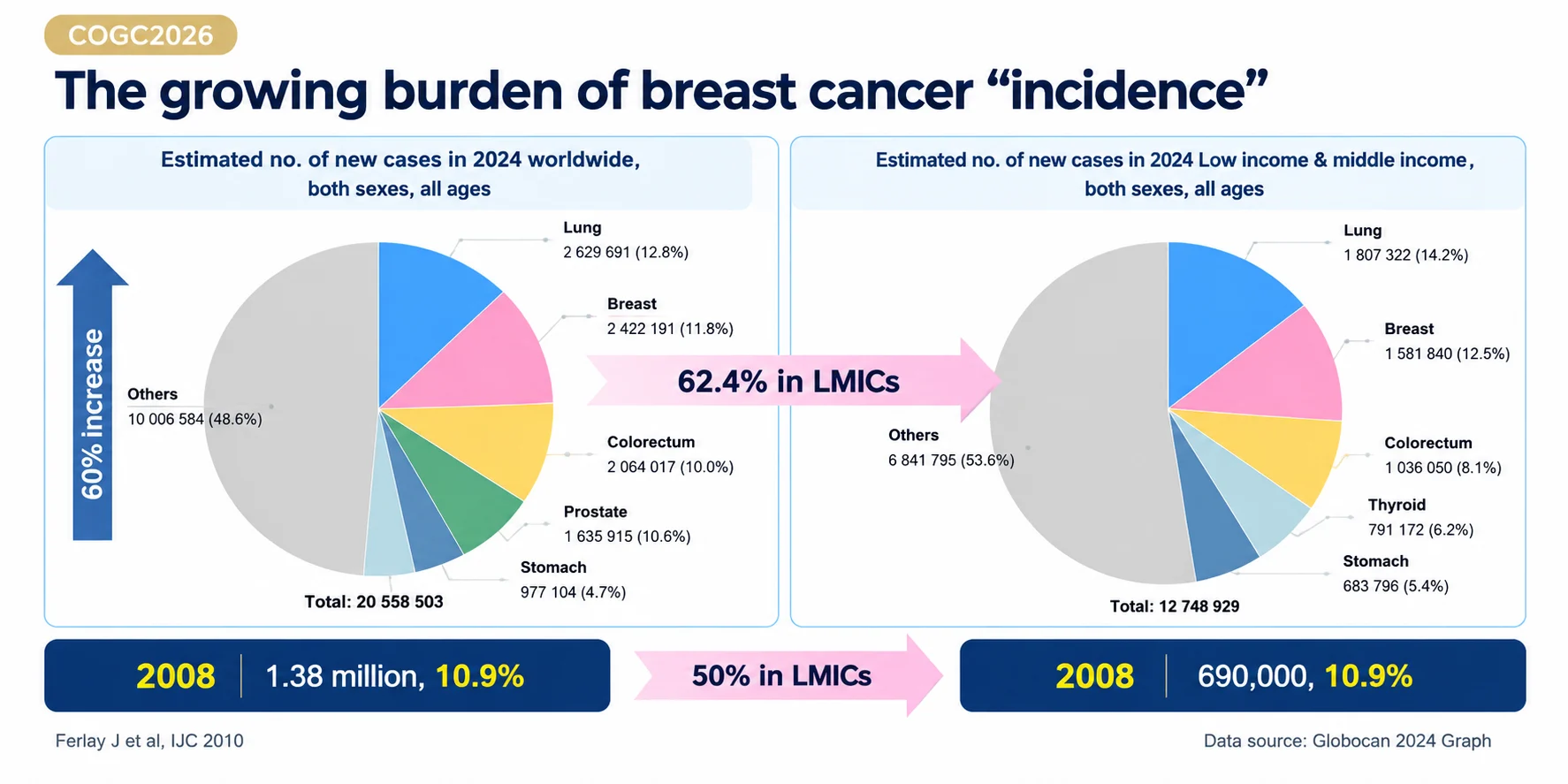
Keep in mind that, according to UICC, incidence is accurately reported in only about one in three countries, mostly high-income countries. So even these numbers may underestimate what is happening in limited-resource settings.
When it comes to mortality, 73% of recorded deaths occur in countries with limited resources, compared with 60% in 2008.
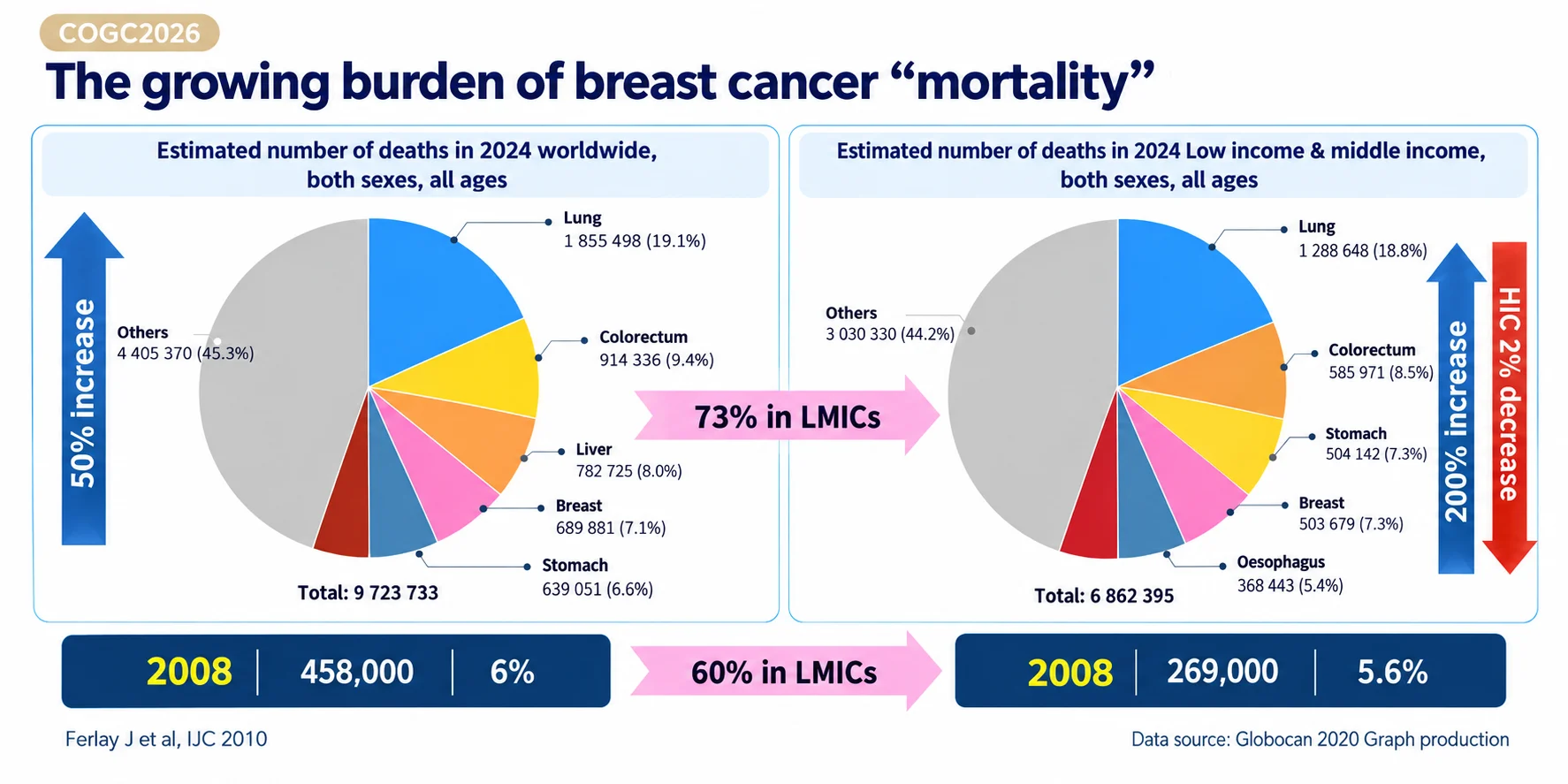
And there is another important difference. The age-standardized incidence rate may be relatively similar, but the age-standardized mortality rate is about three times what we see in high-income countries.
When you also keep in mind that a large proportion of the population in these countries is young, we are talking about a huge mortality burden among women in the prime of their lives.
There is also a significant increase in premenopausal breast cancer worldwide, particularly across Africa, South America, the Middle East, and Southeast Asia, together with a parallel increase in postmenopausal breast cancer. So we are seeing an increasing trend in both premenopausal and postmenopausal women, with a disproportionate increase in incidence and mortality compared with high-income countries.
These trends make the first priority clear: we need to understand what is driving the rise in breast cancer.
We have known for years that some of the changes that come with socioeconomic development can also influence breast cancer risk. Longer life expectancy and greater reproductive control have brought enormous benefits, but they have also been accompanied by delayed pregnancy, fewer childbirths, dietary changes, less physical activity, and more smoking.
All of these, of course, can contribute to increased risk of developing breast cancer.
But how do we begin to address this?
Awareness.
We need communities, patients, and policymakers to understand how the risk is changing and why it matters.”
Priority 2: Diagnose Breast Cancer Earlier
“The second priority is to diagnose early.
A major challenge in countries with limited resources is late presentation, and we know that socioeconomic factors contribute to it.
In one study, health literacy and cancer stigma stood out as major barriers to early detection. That is not going to be fixed by national screening mammography alone.
When screening mammography was introduced in the United States, it led to a clear increase in the detection of early-stage breast cancer, but it had much less impact on the burden of metastatic disease. So screening mammography alone is not the answer. We also need to recognize metastatic breast cancer as a major burden – one that can still be treated, with many patients living for years after diagnosis.
Downstaging is extremely important. Raising awareness and improving access to diagnostic mammography can make a meaningful difference, even before we begin talking about more sophisticated treatment.
That matters especially in limited-resource settings, where many women are diagnosed at a younger age. Around half of patients are diagnosed before the age of 50, often while they are in the middle of working, raising families, and caring for others.
The impact of late diagnosis therefore extends far beyond the individual patient. It affects families, children, and communities.
And even when women present with metastatic disease, treatment still matters. Patients can live for years, and sometimes even one additional year can make an enormous difference to a family.”
Priority 3: Improve Access to Accurate Diagnostics
“Very important is the focus on simple diagnostics.
We talk a lot about sophisticated diagnostics, and I am very interested in them as well, but let us first talk about the basics.
Diagnostic mammography and immunohistochemistry are key before we talk about the fancy diagnostics in countries with limited resources.”
Priority 4: Make Appropriate Treatment Accessible
“Appropriate treatment does not only mean innovative treatment.
Appropriate treatment means solving the puzzle of proper infrastructure: hospitals, medical centers, cancer centers, and an appropriately trained workforce – surgeons, radiation therapists, nurses, pharmacists, and medical oncologists.
The projected need for the surgery and anesthesia workforce by 2040 compared with 2018 is more than triple, and that need is largely in countries with limited resources. That is mostly what we see in middle-income countries, where many pieces of the puzzle are already there and medications are what is needed to complete it.
So another major priority is access to appropriate treatment.”
How Do We Make It Happen?
“1. Resource-stratified guidelines should not be viewed as offering patients a lower standard of treatment. They are about giving patients the best chance under the current circumstances. They help health systems and policymakers prioritize resources, plan how to expand infrastructure, strengthen multidisciplinary care, and can also facilitate drug approval and access.
2. Medicines need to be included on national essential medicines lists so they can be publicly procured and made available to patients. Because approval does not mean access.
And we are not necessarily talking about sophisticated new treatments.
In a survey of oncologists across 82 countries, fewer than half of the cornerstone medications considered essential for cancer treatment were consistently available. We are talking about anthracyclines, taxanes, platinums – relatively inexpensive medicines that make a huge difference for patients. We need to work on those before we can even dream of the innovative medications.
3. We need to work on equitable pricing and differential pricing – charging different prices for the same product in different markets – as well as reducing taxes and profit margins. Because for newer therapies, pricing becomes another major part of the access equation.
Generics and biosimilars are important because they increase competition and help bring prices down, but they are not enough.
4. Bulk procurement can also make a huge difference. In South America, when countries joined forces with Brazil, they were able to obtain products at prices that were around 80% lower.
And finally,
5. We need to stop thinking about clinical trials as a luxury in countries with limited resources.
We need to think about compassionate-use programs and clinical trials as a cornerstone of improving outcomes and improving access to innovative medications for patients worldwide.”
Written by Eliz Baloyan, MD, Features Writer and Editor at OncoDaily and CancerWorld
Watch the full video on YouTube.