
In colorectal cancer, deciding which treatment to give is only part of the challenge. Another, sometimes harder question comes once treatment has already begun: is the disease actually responding in a way that justifies staying the course, or is it time to reconsider the plan?
For many patients, those decisions still depend on factors established before treatment starts. Stage, pathology and imaging help determine the initial strategy, while chemotherapy and immunotherapy are often delivered according to durations established in clinical trials.
But cancer does not necessarily follow a predetermined timeline. Some patients may clear residual disease quickly, while in others, molecular evidence of cancer may persist despite months of treatment.
That creates an important gap between the treatment plan and what may actually be happening biologically in an individual patient.
That is where ctDNA has become increasingly relevant. A positive or negative result can offer one piece of information, but repeated testing opens a different possibility: understanding how that molecular picture changes over time.
For Robert Lentz, Medical Director for Oncology at Natera, that distinction was central to the colorectal cancer data presented at ASCO 2026 and ESMO GI 2026.
“It’s not just one time point that’s probably helpful. It’s two time points in the context of this presentation to further refine and personalize the care that is delivered.”
And once ctDNA is viewed as a changing signal rather than a one-time result, a different set of clinical questions begins to emerge. Could those changes help determine how long chemotherapy should continue? Could they clarify whether immunotherapy is working when imaging leaves uncertainty? And after surgery for metastatic disease, could ctDNA help distinguish who still stands to benefit from more treatment?
Beyond a Single Blood Test: Why ctDNA Trends May Matter More
A ctDNA result is often discussed as a snapshot: positive or negative, detectable or undetectable. But a snapshot can only show what is happening at one moment.
The data presented at ASCO moved the focus toward something more dynamic. Signatera, Natera’s tumor-informed ctDNA assay, is built using sequencing from an individual patient’s tumor, with selected tumor-specific variants then tracked in the blood over time.
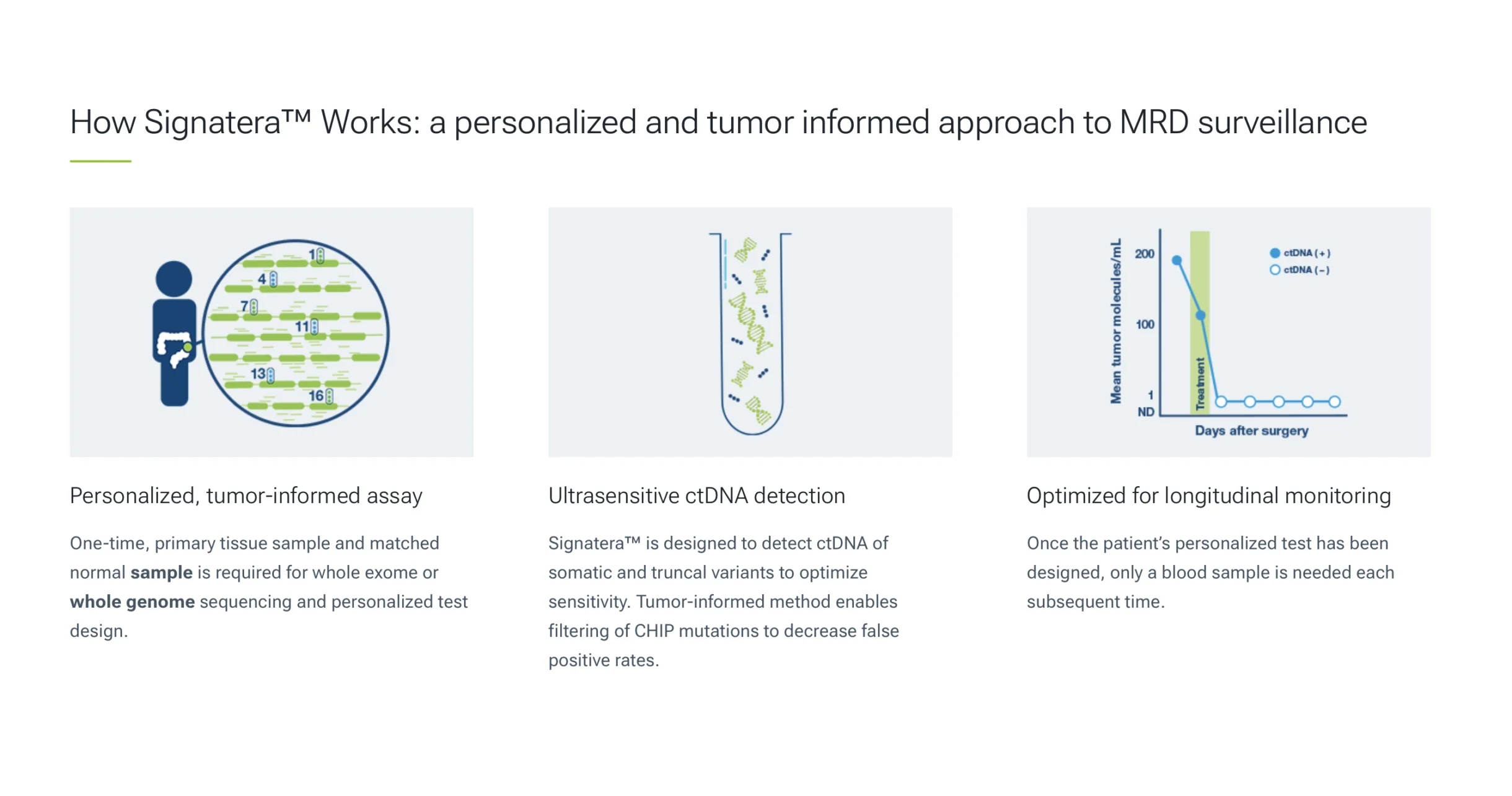
Source/natera.com
That ability to follow the signal becomes particularly relevant in the adjuvant setting, where one of the unresolved questions is how long chemotherapy needs to continue.
“It can be very challenging to decide how much chemotherapy is warranted for a given patient. It is inconclusive, in other words, that some patients may benefit from 6 months and others may be fine with 3 months. And of course, avoiding overtreatment is very important to avoid toxicities and cost.”
The updated GALAXY analysis, part of CIRCULATE-Japan, tested that idea using two ctDNA time points: one after surgery and another after approximately three months of adjuvant chemotherapy. Patients had received roughly three or six months of treatment, allowing researchers to examine whether the change in ctDNA during treatment was associated with the value of continuing chemotherapy.
“This may be quite helpful in evaluating the relative benefit of longer duration chemotherapy for a specific patient in the context of the toxicities that he or she may be experiencing at that time point.”
When ctDNA Falls, Clears or Rises: What It Means for Chemotherapy
Once the two ctDNA measurements were compared, the patients separated into four distinct patterns – and the value of extending chemotherapy looked different across them.
- ctDNA negative after surgery and still negative at three months
“Patients who were ctDNA negative at both of those time points derived no additional benefit of 6 months versus 3 months of chemotherapy.”
This was the most straightforward pattern: molecular disease remained undetectable throughout the first three months.
2. ctDNA positive after surgery, then negative at three months
“And that was the same for patients who cleared their ctDNA, meaning it went from positive to negative after 3 months.”
Like those who remained negative throughout, patients who achieved ctDNA clearance did not appear to gain additional benefit from extending chemotherapy to six months.
3. ctDNA decreasing, but still detectable
The distinction became more important when the signal was moving in the right direction but had not fully disappeared.
“Patients who had a decreasing, but still detectable, so it had not yet cleared ctDNA after 3 months, did appear to derive benefit in terms of disease-free survival from longer duration adjuvant chemotherapy.”
Dr. Lentz linked that pattern to continued treatment sensitivity.
“They had chemo-sensitive disease, but they may not have received chemotherapy for long enough to eliminate all of the residual tumor cells.”
Among the four groups, this was the clearest example of how the direction of change could matter beyond a simple positive result.
4. ctDNA rising despite chemotherapy
The final trajectory carried a very different implication.
“The fourth group that we looked at were those that actually had a rising ctDNA concentration. It was increasing after 3 months. Those patients did quite poorly. Their median disease-free survival was just about 1 or 2 months, actually regardless of whether they received 6 or 3 months.”
And for Dr. Lentz, the biology behind that pattern pointed away from simply extending the same regimen.
“They have chemo-resistant tumor, and so giving more of the same chemotherapy, for example, FOLFOX or CAPOX, may not benefit that patient.”
From there, the focus shifts from duration to strategy.
“I would strongly consider stopping the current chemotherapy, obtaining scans to make sure that patient is not progressing grossly, and if not, I would discuss with the patient options for treatment on MRD result clinical trials. These are often novel immune checkpoint inhibitors or antibody-drug conjugates, drugs where efficacy has been observed in the metastatic setting, where we believe efficacy may be even greater in a localized setting where the patient does not have refractory metastatic disease.”
“The goal is to bring the right therapy to the right patient at the right time, again, personalizing care.”
The analysis, however, was not designed to prove that changing treatment based on ctDNA improves outcomes.
“This was not a prospective interventional trial. Patients were not randomized based on ctDNA dynamic trend. This was an observational study and this was a retrospective analysis. That’s certainly an important limitation.”
Even so, they may still help frame one of the most practical decisions in the adjuvant setting: whether the potential benefit of continuing chemotherapy outweighs the toxicity a patient is already experiencing.
“I do think though that this is quite helpful information to sit down with a patient and have a shared decision-making discussion about the relative benefit of continuing longer duration chemotherapy in the context of the toxicities that that patient may be experiencing.”
What ctDNA Adds During Immunotherapy
The question of treatment duration also extends beyond the adjuvant setting. In metastatic MSI-high colorectal cancer, immunotherapy can produce durable responses, but how long treatment needs to continue for an individual patient is less clear.
“Standard of care for a metastatic MSI-high CRC patient in the first-line setting is immunotherapy, one or two drugs, and duration is typically 2 years. That’s an arbitrary duration. That’s how the trials were conducted.”
For patients responding well, two years can mean prolonged exposure to treatment, along with additional toxicity, cost and burden on the healthcare system. Natera’s ASCO analysis looked at whether molecular response could add another piece to that decision.
The analysis drew from real-world data in metastatic MSI-high colorectal cancer patients receiving first-line immunotherapy. What separated the groups most clearly was whether ctDNA eventually became undetectable.
“Patients who achieved a ctDNA negative result, so they cleared ctDNA after starting immunotherapy, had much better overall survival. They lived much longer, like four or five times longer, than patients who had persistent ctDNA positive results. Not only did they achieve better overall survival, but they also stayed on their immunotherapy longer, and they did not need to go on to second-line treatments as much, which is often chemotherapy in this setting.”
With immunotherapy, tumor shrinkage on imaging may take time, and apparent growth can sometimes represent pseudoprogression rather than true disease progression.
“Firstly, ctDNA changes probably occur more quickly than waiting to see tumor shrinkage on a CT scan. In some patients in this cohort, they actually achieved a ctDNA negative result just a few weeks after starting immunotherapy. Second, ctDNA can help address one of the conundrums that comes up, which is the concept of pseudoprogression. What can happen is after you start immunotherapy, you can actually see an increase in size of masses on a scan. You assume that may be growth of the tumor, but actually that can be an immune infiltrate, immune cells coming in to actually attack the cancer, and it just takes longer to actually see tumor shrinkage.”
Taken together, the findings raise a broader question: how do we extrapolate this to the field?
“We think that these results demonstrate that ctDNA can provide additional benefit in treatment response monitoring compared to just doing CT scans. If you see an increase on a scan in size of masses, a drop in ctDNA can provide reassurance that in fact that patient is responding, and in fact they should continue with immunotherapy.”
That becomes especially relevant when treatment has worked well enough for another decision to come into view: whether it is necessary to continue at all. Dr. Lentz describes the situation of a patient with a strong radiographic response and repeatedly negative ctDNA who asks, “Can I stop treatment and continue with monitoring?”
“I think ctDNA can provide an additional level of reassurance that overall survival is probably going to be quite high for that patient. And it provides additionally another layer of protection that ctDNA can continue in surveillance to make sure it continues to be negative if that patient decides to take a treatment holiday.”
The opposite pattern was much less reassuring.
“People who never achieved ctDNA negative status after starting immunotherapy had about four or five times worse overall survival compared to patients who achieved negativity. They also needed to go on to second-line treatment much more often.”
But here too, the evidence has an important boundary. The analysis came from real-world data rather than a prospective trial assigning treatment duration according to ctDNA results. For now, the findings add information to the conversation around response and treatment duration; they do not establish a ctDNA-based stopping rule.
After Liver Metastasis Resection: Who Needs More Chemotherapy?
At ESMO GI, the same broader question – whether ctDNA can help distinguish who benefits from more treatment – appeared in a very different setting.
The analysis focused on patients with colorectal cancer metastatic to the liver whose disease could be surgically resected. Some presented with liver metastases at diagnosis, while others developed a later recurrence after treatment for localized disease. In either case, surgery offered the possibility of curative treatment.
“Unlike a stage three colon cancer patient where adjuvant chemotherapy is recommended for everybody, there’s no level one evidence that adjuvant chemotherapy or perioperative chemotherapy for resectable liver metastatic CRC patients provides overall survival benefit.”
That uncertainty has translated into very different treatment approaches.
“Some people give chemotherapy before and or after surgery to all of these patients. Some people don’t give chemotherapy much at all because overall survival benefit has not been demonstrated.”
The GALAXY analysis separated patients according to whether they had received chemotherapy before surgery and whether ctDNA was detectable afterward.
- No neoadjuvant chemotherapy + postoperative ctDNA positive
“In patients who went straight to surgery, and meaning they did not receive neoadjuvant chemotherapy, and they were ctDNA positive after surgery, they derived overall survival benefit and disease-free survival benefit from adjuvant chemotherapy with a large effect size, approximately 70% reduction in death, compared to not receiving adjuvant chemotherapy.”
The result was especially notable because of the long-standing uncertainty around an overall survival benefit in this setting.
“First time ever that a study in this patient population, with or without ctDNA, has been able to demonstrate overall survival benefit.”
2. No neoadjuvant chemotherapy + postoperative ctDNA negative
The result moved in the opposite direction when no molecular residual disease was detected after surgery.
“Patients who went straight to surgery, who did not have a ctDNA positive result after surgery, derived no benefit of adjuvant chemotherapy.”
3. Neoadjuvant chemotherapy before surgery
“In the group that received neoadjuvant chemotherapy, then had surgery, they did not benefit from adjuvant chemotherapy regardless of the post-operative ctDNA result.”
Dr. Lentz’s explanation returns to the same biological idea that appeared in the ASCO adjuvant analysis: persistence despite treatment may say something about sensitivity to that treatment.
“Let’s say there’s a patient who gets neoadjuvant FOLFOX, then they go on to surgery, and despite those things they remain ctDNA positive. To me, that indicates that they have a chemoresistant tumor. There’s still residual disease present despite the treatments that they have received previously. And giving more FOLFOX is not going to be helpful.”
The parallel with the earlier GALAXY findings is difficult to miss. In both analyses, persistent or rising molecular disease after exposure to chemotherapy raised doubts about simply extending the same regimen.
“I think that this analysis, while still retrospective and observational, again have to consider that limitation, is practice changing because finally we have a tool that allows us to personalize the decision for adjuvant chemotherapy in CRC patients who are oligometastatic to the liver and have undergone resection.”
That qualification matters. The analysis can identify groups with very different outcomes and apparent treatment benefit, but it was not a prospective trial in which therapy was assigned according to ctDNA status.
What Comes Next for ctDNA-Guided Care
That is also where the next phase of the evidence becomes important.
Across the studies discussed at ASCO and ESMO GI, ctDNA was associated with treatment response, prognosis and differences in apparent treatment benefit. The larger question is whether acting on those signals prospectively can improve patient outcomes.
“There are many ongoing prospective interventional trials that use Signatera ctDNA as the integral biomarker, which means that it is used to make treatment decisions prospectively. These are trials that evaluate the benefit of adjuvant chemotherapy. These are trials that evaluate the benefit of serial testing with Signatera for up to 3 years in surveillance – for example, in patients who initially have a ctDNA negative result to potentially allow for systemic chemotherapy if they do turn ctDNA positive.”
That distinction between observing what ctDNA predicts and using it to determine what treatment a patient receives is likely to define how far the field can move from molecular monitoring toward truly adaptive treatment. And for Dr. Lentz, the direction is already clear.
“The takeaway from both of these conferences is that serial ctDNA testing with Signatera in CRC both in the adjuvant and metastatic space provides clinical utility.”
The ambition is not simply to detect recurrence earlier or divide patients into higher- and lower-risk groups. It is to make each result actionable in the context of the individual patient.
“Treat the right patient with the right drugs at the right time.”
Whether ctDNA-guided treatment can improve outcomes will depend on the prospective interventional studies now moving through the field. But the conversation is already shifting from whether molecular disease can be detected to what clinicians should do when its trajectory becomes visible.
Written by Eliz Baloyan, MD, Editor at OncoDaily
Interview by Sergey Badalyan, Assistant Managing Editor at OncoDaily Medical Journal