
Key takeaways
- Broad molecular testing needs to happen upfront because the result can completely change first-line treatment.
- In lung cancer, DNA and RNA testing complement each other and help avoid missing actionable alterations and fusions.
- Protecting tissue and coordinating biopsy, pathology, and NGS from the beginning can prevent testing failures later.
- ctDNA can speed up molecular profiling, especially in metastatic disease, but it should complement rather than replace tissue testing.
At the Community Oncology Global Congress (COGC 2026), organized by OncoDaily, Pranshu Bansal, Director of Thoracic Oncology at Ironwood Cancer Research Center in Phoenix, Arizona, discussed the role of actionable genomic alterations and IHC testing in metastatic lung cancer, with a focus on what testing is needed and how those results should guide initial treatment decisions in community oncology.
His talk came back repeatedly to one practical challenge:
“The important point is that all of the biomarkers should be tested upfront because they can completely change the treatment we choose.”
Actionable Genomic Alterations in Lung Cancer
“In lung cancer, we now have multiple oncogenic drivers that are considered actionable and can be treated with medications, either oral therapies or IV drugs.
These alterations account for more than 50% of non-squamous lung cancers, so we are mostly talking about adenocarcinomas. Some squamous cell cancers can also have these alterations, but they are much more common in adenocarcinoma.
If we can identify these genomic alterations upfront, we are more likely to find TKIs that provide superior progression-free survival compared with systemic chemoimmunotherapy upfront. On average, they also have much less toxicity and can preserve quality of life.
In the United States, more than 80% of lung cancers are treated in the community, so it is important that this testing reaches community practices.
In addition to actionable genomic alterations, PD-L1 testing is also important. It is an imperfect marker, but it does help guide prognosis and predict response to immunotherapy. So optimizing testing is definitely one of the bottlenecks to delivering high-quality precision oncology.
We now have several genetic markers with approved targeted therapies. EGFR is the most common, especially in patients who are non-smokers. We also have ALK, ROS1, BRAF, MET exon 14, RET, NTRK, and KRAS G12C.
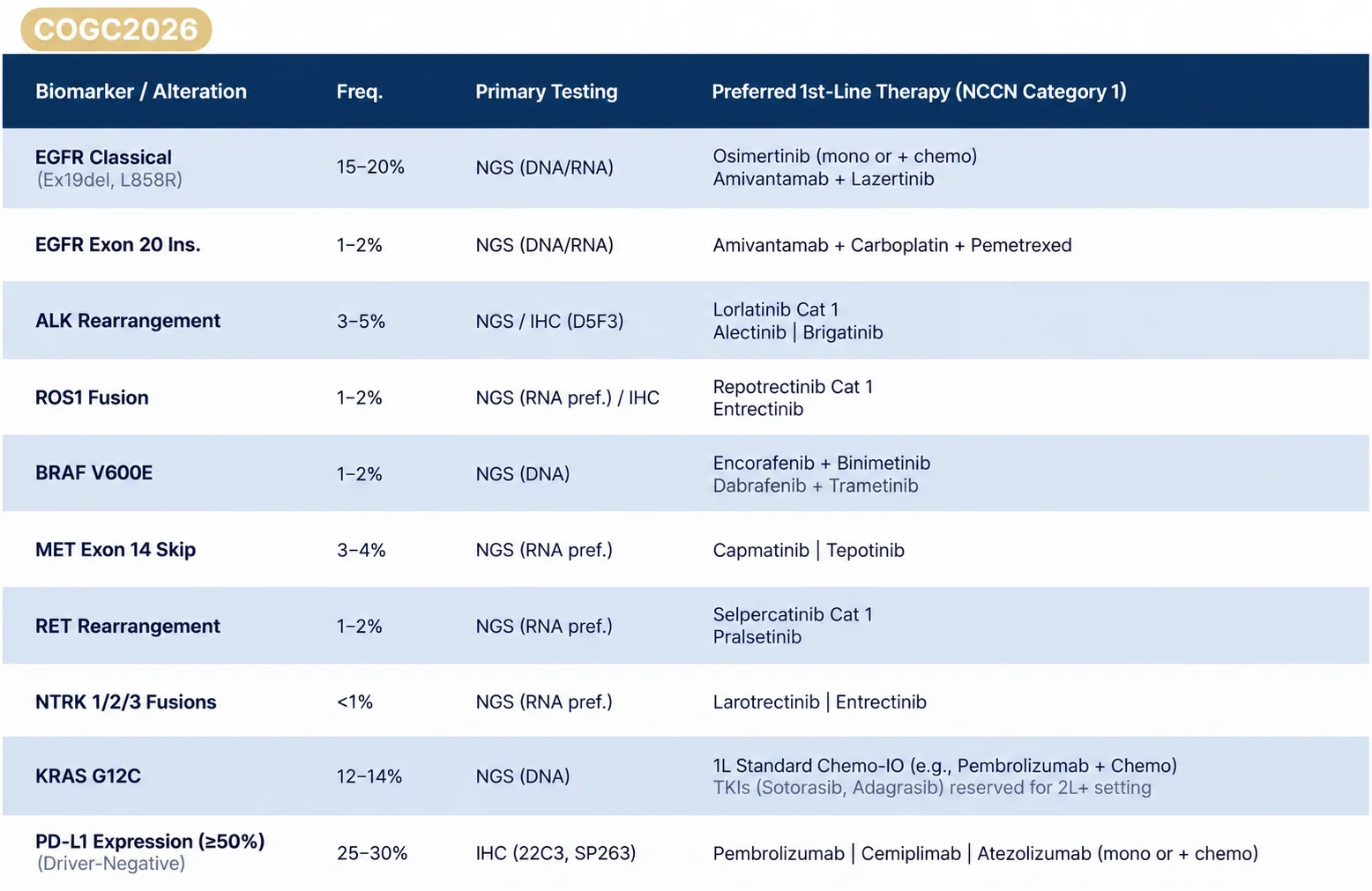
Most of these have targeted therapies available in the first-line setting, while KRAS G12C is still mainly a second-line target.
The important point is that all of these markers should be tested upfront because they can completely change the treatment we choose.”
Why Lung Cancer NGS Needs Both DNA and RNA
“When it comes to lung cancer NGS testing, DNA-based sequencing is the standard, but RNA-based sequencing is also very important because it helps identify fusions.
RNA-based testing can sometimes capture novel fusion partners involving ROS1, RET, NTRK, and ALK rearrangements.
DNA-based testing is usually better for point mutations, copy-number variants, and amplifications, and DNA is more stable.
So we try to get both DNA- and RNA-based testing done upfront so that we do not miss any of those novel alterations or fusions, so the approach now is increasingly to incorporate both tests.
We now also have IHC markers that are becoming relevant in later lines of treatment, including c-MET and HER2, and TROP2 is an emerging marker as antibody-drug conjugates continue to develop.
So beyond the frontline, as newer therapeutics come to the market, I think the role of NGS testing is going to continue expanding.”
Why Biomarker Testing Still Falls Short
“There is widespread awareness among oncologists that NGS testing needs to be ordered. Data suggest that more than 90% of community oncologists will order NGS testing, while only about 39.5% of patients actually get the full NGS profile completed.
A lot of this comes down to tissue-related issues. Some of it is also delays in getting NGS results back, and patients may start frontline therapy before those results are available.
Approximately 30% of patients start treatment without the NGS results being available at the time treatment begins. That can lead to suboptimal therapy, increased toxicity, and potentially poorer outcomes if we do not have all the information upfront.
The approach we have used in the community is really multidisciplinary.
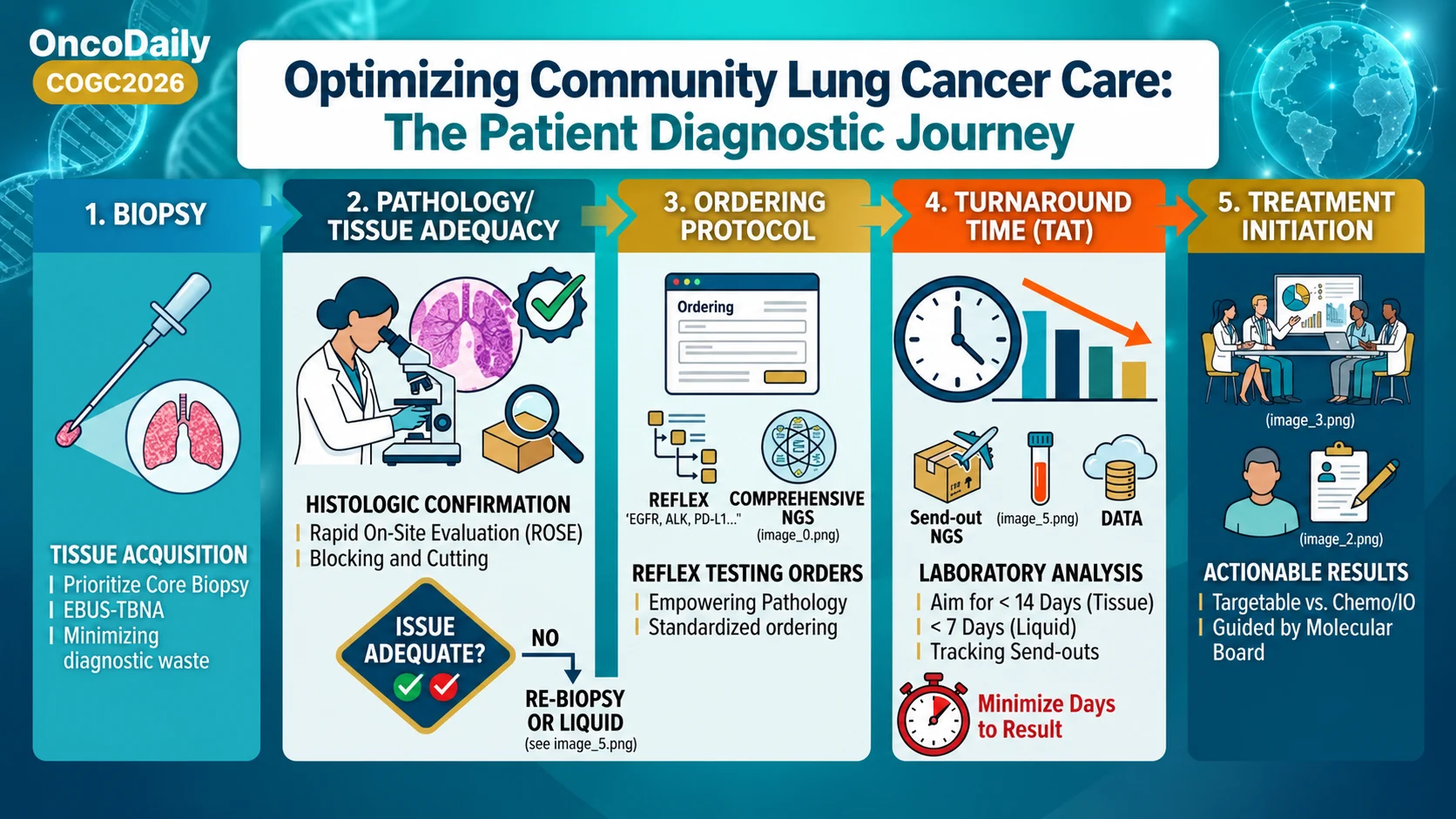
1.The first step in lung cancer is usually the biopsy. We prefer EBUS biopsies when possible because we can get multiple cores in one procedure.
If interventional radiology has to biopsy a peripheral nodule or a metastatic site, we prefer that they obtain multiple cores upfront – ideally at least three – and use larger-gauge needles when possible because those cores tend to provide better tissue. FNA samples can sometimes be more limited.
2.With on-site evaluation and awareness from pathology, the pathologist can help guide the person performing the procedure to make sure there is enough tissue not only for standard IHC testing and diagnosis, but also for NGS.
3.We also need to empower local pathologists to reflex to comprehensive NGS panels if they are available locally, or, if testing is being sent to an outside laboratory, to preserve enough cell blocks or slides for NGS.
4.Turnaround time is another important issue. That means working with the local or outside NGS laboratory and involving the pathologists who oversee the testing to see whether turnaround time can be improved, or whether we can at least get a rapid targeted panel while waiting for the expanded panel.
So really, the goal is to get the NGS lab, the local pathologist, and the person doing the biopsy all on the same page. Establishing the diagnosis and doing IHC alone are not enough. We need enough tissue for NGS.”
Using ctDNA From the Start
“In the community, we have definitely incorporated upfront circulating tumor DNA testing for metastatic patients.
The yield tends to be very high in metastatic disease. More than 80% to 90% of these patients are shedders, so ctDNA can often pick up the same biomarkers that tissue testing does, and the concordance is pretty high.
But it is still not the gold standard, especially in patients who are non-smokers.
If a liquid biopsy does not identify an actionable genomic alteration, I still make sure that I have good comprehensive tissue-based NGS.
We usually send both upfront because ctDNA can have a rapid turnaround time of around seven days, and in many stage IV patients it can identify the same actionable alteration. It is also becoming much better at identifying fusion proteins. So ctDNA can definitely be incorporated upfront as a complement to tissue-based NGS rather than simply being used later as a supplement.”
Making the Workflow Work in the Community
“Another important thing in the community is having access to virtual molecular tumor boards when possible, if time and resources allow, as it can be useful to have a panel discussion for patients with metastatic disease to make sure that none of the newer biomarkers are being missed.
EMR integration also helps. When NGS laboratories are integrated with local electronic medical records, there tends to be less fall-off in testing orders compared with paper orders, communication is faster, and the process is easier to track.
Nurse navigators can also play a larger role in the community if resources allow. They can track send-out orders, flag delayed results, and make sure that the data are available before the patient returns for follow-up.
All of these things can help bring multiple stakeholders into the process from the beginning of a lung cancer patient’s journey.
Tissue is still one of the biggest challenges, and timing is another. Sometimes patients need to start treatment before the full molecular results are back. That is where ctDNA can be especially helpful, because it can give us useful information more quickly while we are still waiting for tissue-based testing.
And then there is molecular expertise. With newer biomarkers and less common mutations, there can be uncertainty, and having access to molecular expertise – whether through tumor boards, online platforms, or other networks – can help.
In higher-resource community settings, some practices may have rapid core biopsy, in-house NGS testing, and dedicated molecular tumor boards, which makes the process much more streamlined.
In more resource-constrained settings, the approach may depend on standardized cell blocks, local IHC to confirm the diagnosis, careful optimization of the sample, and then sending it to an outside laboratory.
Digital platforms and telemedicine can help track those samples, standardize the process, and provide access to the right expertise when it is needed.”
Protect the Tissue, Get the Full Picture
“So the takeaway would be to get a broad NGS panel, PD-L1 IHC, HER2 IHC, and c-MET IHC when appropriate.
Protect the tissue. Talk to the pathologist early and make sure there is enough material not just for the first round of testing, but also for anything we may need later.
I also use ctDNA upfront and, whenever possible, I wait for the molecular results before making the full treatment decision.
If the patient is very symptomatic, chemotherapy can be started first while immunotherapy is held until the NGS results are back. That way, we avoid unnecessary toxicity and do not risk missing the chance to use a TKI upfront.
And if the patient is a non-smoker, I definitely try to make sure I have the full molecular panel before starting any kind of therapy.”
Written by Eliz Baloyan, MD, Features Writer and Editor at OncoDaily and CancerWorld