Key takeaways
- Patient navigation should begin with patient needs and barriers, not with a predefined staffing model.
- Navigation programs should use existing resources, families, survivors, and community networks where formal navigator capacity is limited.
- Success should be measured through outcomes such as time to diagnosis, treatment initiation, adherence, patient satisfaction, and trial or biomarker access.
- The navigator’s scope should be clearly defined by who is served, where navigation begins and ends, and which barriers it addresses.
- The ultimate goal of navigation is not to work around fragmentation forever, but to identify gaps and improve the system itself.
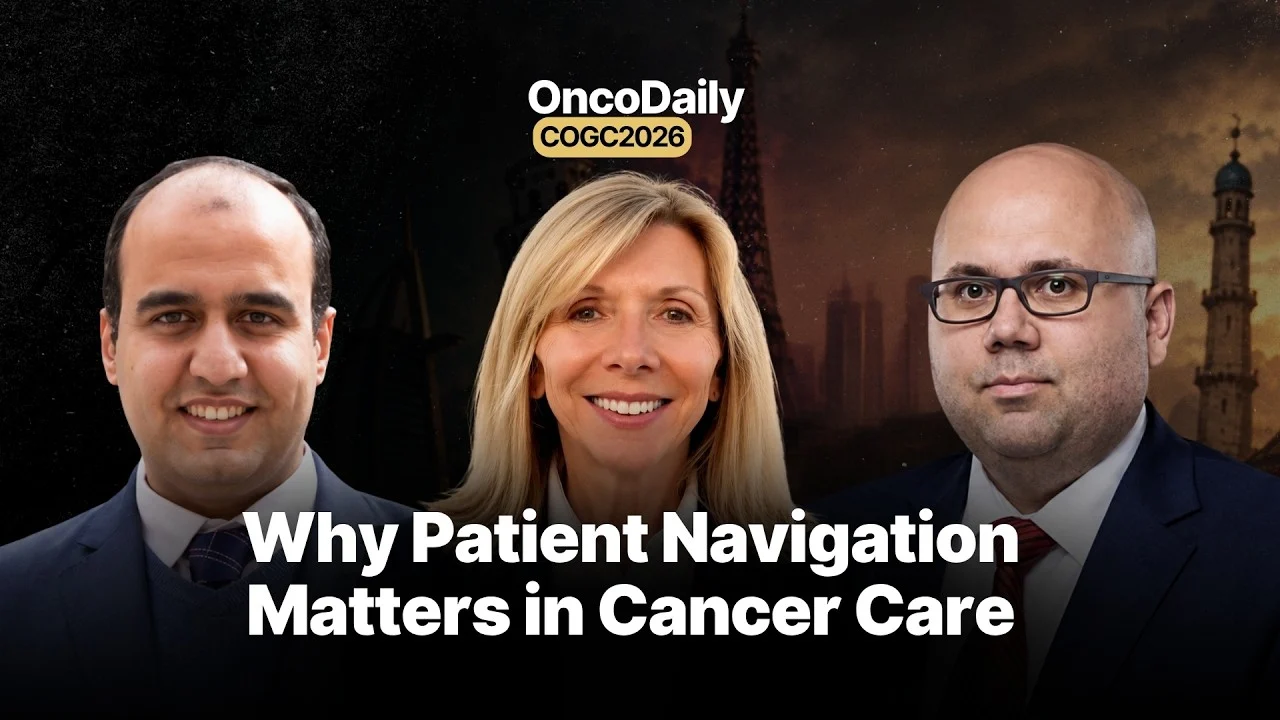
At the Community Oncology Global Congress (COGC 2026), organized by OncoDaily, Devika Das, Division Director of Hematology and Oncology at the University of Mississippi Medical Center, led an expert discussion with Hadi Mohamad Abu Rasheed, Scientific Advisor at Qatar Cancer Society; Ahmed H. Abdulaziz, Lecturer and Researcher of Mechanical Engineering at the Faculty of Engineering, Ain Shams University; and Martha Raymond, Founder and CEO of GI Cancers Alliance and The Raymond Foundation, on how patient navigation can improve access, coordination, and outcomes in community oncology.
The discussion moved quickly beyond the idea of navigation as simply hiring someone to guide patients through appointments.
The bigger challenge was understanding where patients become lost, which barriers matter most in each community, how existing resources can be used more effectively, and whether navigation is actually changing what happens to the patient.
Later in the session, Vidya Kollu, who works across different U.S. healthcare systems as a locum oncologist, added another perspective on how strongly navigation can influence the patient experience in fragmented and underserved settings.
Start With the Patient, Not the Program
Raymond described patient navigation as something that has to begin with listening.
“We literally go right to the patient.”
Her organization asks patients and communities where support is missing, what they need, and which barriers make their cancer journey harder. Those answers can differ substantially between populations, particularly in underserved and underrepresented communities.
“I don’t think it’s a one size fits all.”
That same patient-centered approach can continue into survivorship. Raymond described patients and caregivers returning after their own cancer experience and asking how they can help others, creating an opportunity to train survivors, caregivers, and community leaders as advocates and navigators themselves.
Abu Rasheed agreed that programs should resist the instinct to begin with staffing models, protocols, and budgets.
“We should always start with the patient needs.”
His questions were simple:
- Where do patients feel lost?
- Where are they confused?
- What prevents them from moving through treatment and maintaining their well-being?
Only after identifying those needs, he argued, should a health system map the resources it already has.
“Most of the time, we don’t need to have staff.”
That may mean redesigning existing roles rather than automatically creating an entirely new navigation workforce.
His experience in Qatar also challenged the assumption that a high-income country can simply solve gaps by spending more.
“You have to be efficient in what you’re using in the system.”
His preferred approach was to identify the problem, map existing resources, pilot navigation around a specific disease, service, or barrier, and then expand based on what works.
The eventual goal should be larger than helping individual patients work around a broken pathway.
Navigation should show the health system where that pathway needs to be fixed.
“The ultimate goal for navigation is to improve the system.”
Otherwise, Abu Rasheed warned, health systems risk layering navigation programs on top of the same fragmentation without addressing why patients needed help in the first place.
Use What the Community Already Has
The discussion also showed how different navigation can look depending on available resources.
Abdelaziz contrasted more established systems with lower-resource settings, where waiting to create the “perfect” navigation infrastructure may mean waiting indefinitely.
His answer was pragmatism.
In Egypt, he described using call centers to follow up with patients who miss appointments and understand why they did not return.
He also pointed to a resource that formal healthcare models may overlook: family.
“We have a big advantage here in this part of the world, which is the very tight family bonds.”
A son, daughter, spouse, or other caregiver may already be accompanying the patient throughout treatment. In settings without enough professional navigators, training and supporting those caregivers could help reduce loss to follow-up, improve appointment attendance, and support treatment adherence.
His center has also relied on junior physicians and pharmacists to coordinate between disciplines when dedicated navigation staff are unavailable.
Das saw parallels in her own work in Mississippi and previously in Alabama.
In rural communities, where patients may travel hours for care, navigation can extend beyond formally employed staff. Patients, survivors, family members, and community contacts can become trusted local points of connection.
That might mean checking on another patient, sharing a ride to an appointment, or helping a family understand how to get through the next step.
“Just kind of having those little touch points in the community for people who can reach out to our patients and their families and check in at different moments, I think is a great way to sort of grow this beyond the health system.”
How Do You Prove Navigation Works?
For health system leaders, however, believing navigation helps is rarely enough.
Das raised a practical challenge familiar to anyone trying to build a program: every new position needs a business case.
That means defining measurable outcomes.
Time to diagnosis and time to treatment are obvious starting points. But Raymond argued that navigation should also be evaluated through what happens during treatment.
- Can patients stay on therapy?
- Are adverse effects identified early enough for the clinical team to intervene before a patient becomes too unwell to continue?
- Are more patients receiving biomarker testing?
- Are eligible patients considering and entering clinical trials?
Those outcomes make navigation part of treatment quality rather than simply an administrative service.
Abdelaziz made the case that relatively modest organizational interventions can sometimes deliver meaningful improvements at a fraction of the cost of advanced technologies.
Multidisciplinary teams, clinical audit, and navigation may be far less expensive than introducing a new immunotherapy, robotic surgery program, or high-technology radiotherapy platform.
Yet they can influence whether patients reach diagnosis, begin treatment, and stay in care.
“You need to convince the payer and you have literature to support that.”
For resource-constrained systems, that distinction matters: improvements in organization can sometimes be implemented earlier than expensive therapeutic expansion.
Abu Rasheed broadened the list of potential measures further: treatment initiation, adherence, patient satisfaction, time to diagnosis, quality of life, hospital admissions, and other indicators depending on what data a system can realistically collect.
But he added one question that should sit alongside every metric:
“Who’s not sitting on the table? Who’s not in your data set? Who’s not captured?”
A navigation program may improve already-good access for patients who are easiest to reach while continuing to miss those with the greatest barriers.
For Abu Rasheed, disadvantaged and vulnerable populations therefore have to be deliberately visible in both program design and evaluation.
When Does Navigation Start – and When Does It End?
Once a navigation program exists, another set of difficult questions appear:
- What exactly is the navigator responsible for?
- Does navigation end when the patient reaches the oncology clinic?
- Does the navigator remain involved during treatment?
- What about toxicity management, survivorship, clinical trials, insurance, transportation, or psychosocial support?
Raymond argued for continuity when the patient values that relationship.
“Once a patient or a caregiver feels comfortable with an individual who’s a navigator, we feel it’s really important that as long as that patient would like to keep that relationship going, it’s really important that we are there throughout the continuum.”
But she also acknowledged that one person cannot realistically be an expert in everything.
Her programs therefore use navigators with different areas of training. Some may focus on clinical trials or precision oncology. Others may deal more with transportation, insurance, emotional support, or practical barriers.
The result is closer to team-based navigation than a single navigator expected to solve every problem.
Abu Rasheed suggested defining the scope through four practical questions:
- Who is being navigated?
- Where in the cancer pathway does navigation begin and end?
- Which barriers is the navigator responsible for addressing?
- And what are the limits of that navigator’s professional role?
“We need to understand who we are serving, which point in the cancer pathway are we going to do it… and then we understand what are the barriers that they will be responsible for.”
The navigator’s role, in his view, is fundamentally about identifying barriers, providing information, coordinating referrals, and closing gaps.
Kollu added that limited staffing makes those boundaries especially important.
In many practices, there may be no disease-specific navigator. One person may be responsible for multiple cancer populations.
In those circumstances, disease- or stage-specific prioritization may help practices use limited resources more effectively while still preserving continuity for patients who need it most.
Lay Navigators and Advocacy Groups Can Extend the Reach
Several speakers returned to the potential of survivors, caregivers, faith communities, and advocacy organizations.
Das described lay navigation as an underused resource, particularly in rural communities where churches, faith-based organizations, and other local networks already connect people who trust one another.
Raymond saw advocacy organizations as a bridge between those communities and formal health systems.
That requires training.
A survivor or caregiver may understand the patient experience intimately, but lay navigators also need to understand the boundaries of their role and know when an issue needs to return to the medical team.
“They need to know the boundaries.”
With training and ongoing education, Raymond argued, advocacy organizations can help community practices build navigation capacity even when those practices cannot independently create large programs.
Das gave a practical example from thoracic oncology.
Sometimes the need is not another medical appointment.
It is simply connecting a patient with someone who has already lived through the treatment they are about to begin.
“They just want to talk to somebody who’s been through this.”
That connection can happen virtually, making advocacy organizations particularly useful for patients who cannot easily travel to a large center.
Navigation Is About the Barrier, Not the Job Title
By the end of the discussion, the panel had described many different versions of navigation.
A nurse navigator. A trained survivor. A family caregiver. A junior physician. A pharmacist. A call center. An advocacy organization. A virtual support service.
The model may change from one health system to another because the barriers change too.
Raymond returned to the question that had guided her approach from the beginning:
“What do you need? Where are the gaps?”
Abu Rasheed made the same point from a system perspective.
Navigation should not become an exercise in inventing another title or reproducing somebody else’s program.
“It’s not about a title or a job title or a name. It’s more about identifying what are the barriers and finding a solution for it.”
Ultimately, the best navigation program would do more than help patients survive a fragmented system.
It would expose the fragmentation clearly enough that the system itself could change.
That also explains why Abdelaziz argued that navigation, advocacy, and clinical governance deserve more space alongside discussions of new drugs and technologies.
“These kinds of services, they have equal, if not more impact than novel treatments and novel therapeutic technologies.”
And even as the conversation briefly turned to artificial intelligence, Abu Rasheed kept the distinction clear.
“AI is very important. But we just need to remind ourselves always, it’s just a tool.”
Technology may help identify needs, communicate information, or extend navigation further.
But the principle remains unchanged.
Find where the patient is getting lost.
Understand why.
Use the people and resources available.
Measure whether the intervention works.
And then fix as much of the underlying system as possible so the next patient has fewer barriers to navigate at all.
Written by Eliz Baloyan, MD, Features Writer and Editor at OncoDaily and CancerWorld
Watch the full video on YouTube.