Key takeaways
- Quality in high-volume cancer care has to be built into the system, not depend on how much individual clinicians can carry.
- Standardization, workforce design, and quality tracking can help protect care in resource-constrained settings.
- Closing the infrastructure, workforce, and visibility gaps will be essential for strengthening community oncology across the Asia-Pacific region.
- Hub-and-spoke networks, remote contouring, and simple registries can help extend care beyond major centers.
At the Community Oncology Global Congress, (COGC 2026), organized by OncoDaily, Mohana Murali Kolluri, consultant radiation oncologist at Trinity Hospitals, focused on a challenge familiar to many oncology centers working with limited resources: how to maintain quality while caring for a high volume of patients.
Drawing from his experience in a smaller radiation oncology setting, he explored the pressures created by limited infrastructure, workforce shortages, long travel distances, and gaps in follow-up, while outlining practical ways to protect the quality of care through standardization, workforce design, and low-cost quality tracking.
At the center of his presentation was a clear message:
“Quality has to be engineered into the system, not left to the endurance of individual clinicians.”
What High-Volume Cancer Care Looks Like in India
The pressure becomes clear when looking at the scale of cancer care in India.
India recorded approximately 1.41 million new cancer cases in 2022, with many patients presenting with locally advanced disease. Radiotherapy capacity remains limited, with around 0.5 LINACs per million people nationally and access concentrated in only a fraction of the country’s districts.
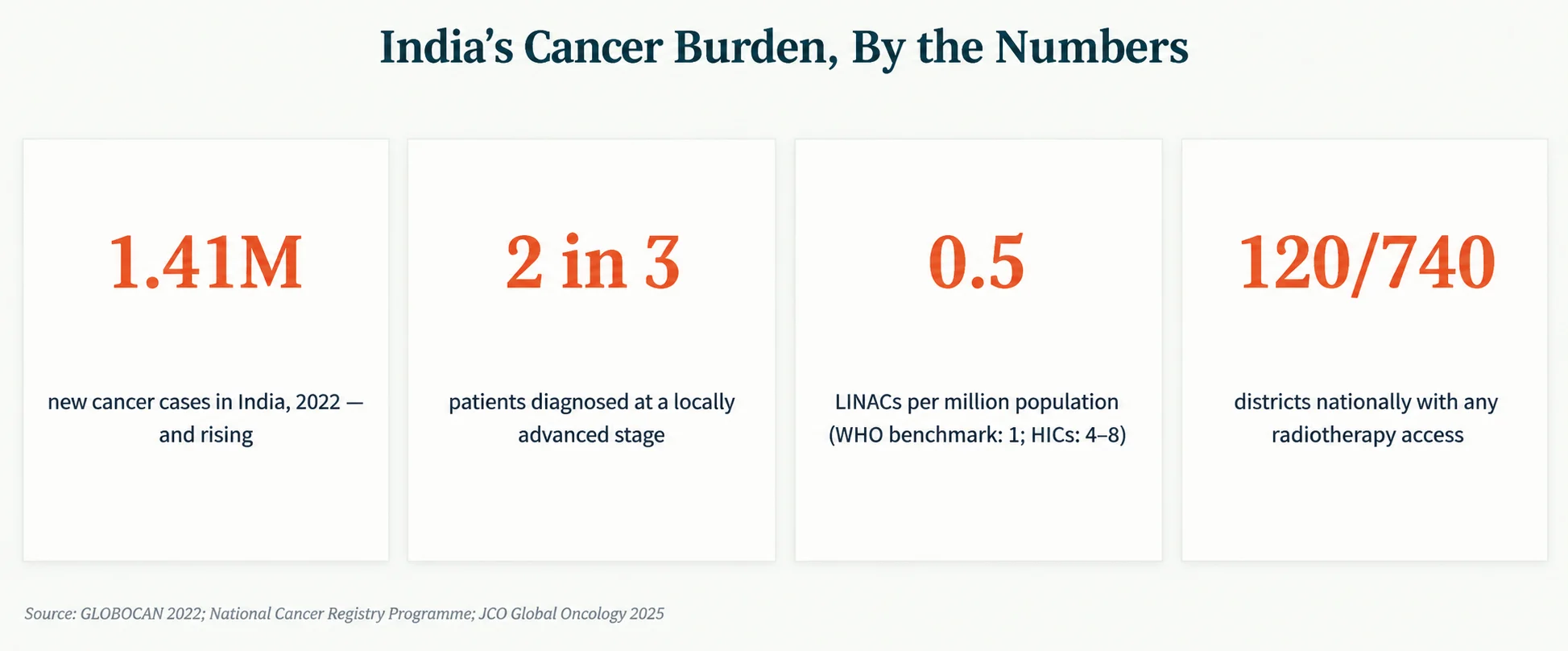
The workforce faces similar pressure. India has approximately 5,000 practicing radiation oncologists serving a very large annual case volume, while radiation physicists, therapists, nurses, and other members of the oncology team are often required to take on several roles at once.
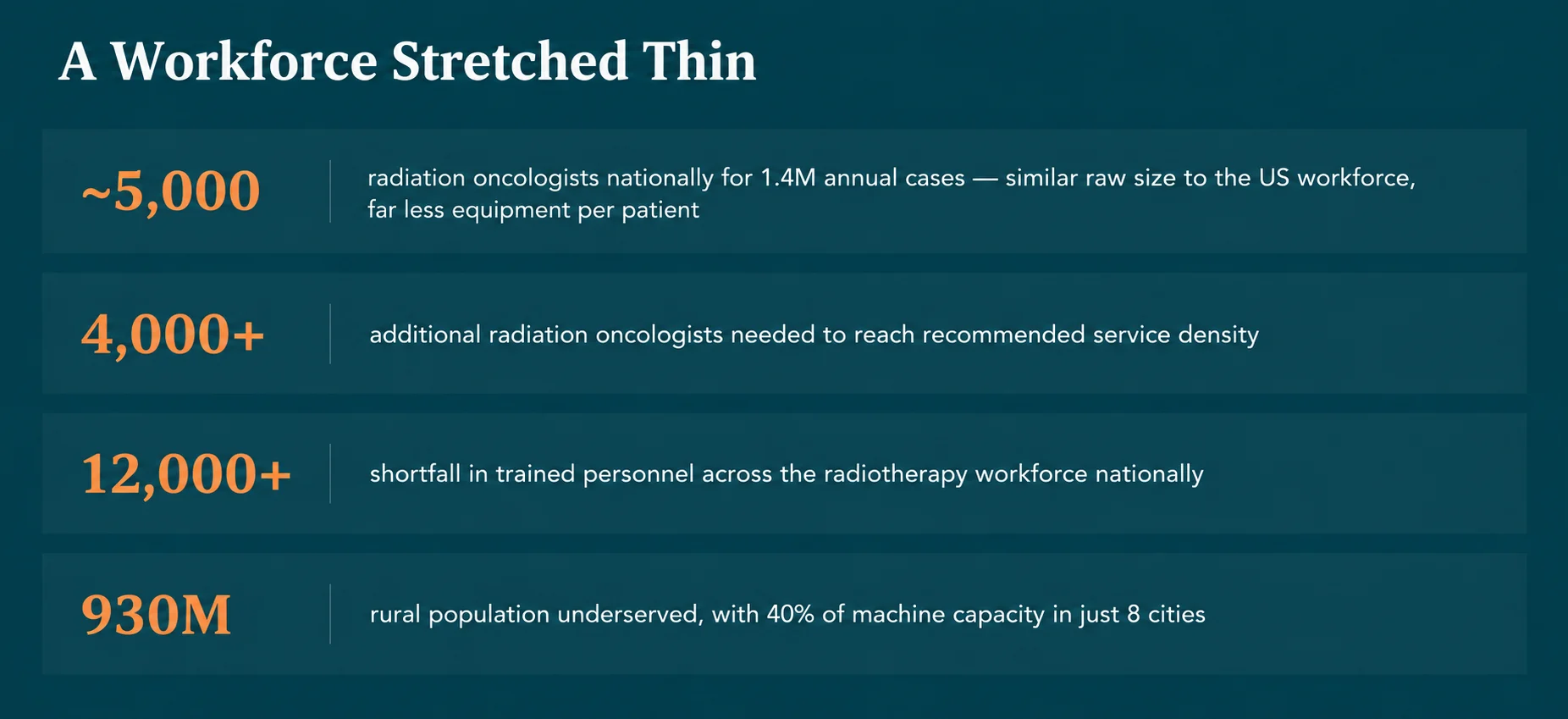
In some settings, patients may travel three, four, or even five hours for a single consultation.
The danger in such a system is not necessarily a sudden collapse in care. It is the gradual erosion of quality as clinicians and teams work under continuous pressure.
The same challenge extends beyond India. Across the Asia-Pacific region, increasing cancer incidence and unequal distribution of radiotherapy infrastructure mean that national averages can hide major differences in access. India’s average machine density, for example, does not show how unevenly that capacity is distributed across the country.
The problem, therefore, is not only how much infrastructure exists, but where it exists and who can reach it.
Three Ways to Protect Quality
In a high-volume setting, protecting quality depends on having a structure that helps the team work consistently even when time, staff, and resources are limited.
“We have designed three pillars that protect quality: standardization, workforce design, and quality tracking.”
1. Standardization as a Substitute for Bandwidth
In a high-volume clinic, it is not possible to give every case unlimited physician time.
Standardized, evidence-based clinical pathways can help reduce unnecessary variation in staging, treatment sequencing, and follow-up scheduling. They create a more consistent pathway for common presentations while preserving clinicians’ time for cases that genuinely require individual judgment. And standardization helps compensate for limited clinical bandwidth by creating clear, evidence-based pathways for common high-volume cases.
So the goal is to make care more consistent, even when teams are working under heavy time pressure.
2. Designing the Workforce Around Reality
The second pillar is making better use of the workforce that already exists.
Nurses, therapists, technicians, and other team members can be trained to take greater responsibility for areas such as patient triage, education, and follow-up coordination.
This is not about lowering standards. It is about making better use of the people already on the team. When nurses, therapists, technicians, and other staff can confidently take on the parts of care they are trained for, specialists have more room to focus on the complex decisions that need their attention.
3. Quality Tracking Does Not Have to Be Expensive
Quality monitoring is sometimes treated as something available only to large, well-funded cancer centers, but the approach is much simpler.
From the time a patient enters the outpatient department until treatment is completed, the team records key dates across the care pathway: presentation, immobilization, treatment planning, treatment completion, and scheduled follow-up. If a patient misses part of the pathway, the team can identify the gap early and respond.
These registries also allow the center to track treatment interruptions, toxicities, follow-up adherence, and adverse outcomes.
In this setting, innovation often has less to do with introducing expensive technology and more to do with improving the way the system functions. Better triage, smoother handoffs between diagnosis and treatment, communication in regional languages, and systematic follow-up can all reduce the chances of patients being lost during care.
Where the System Still Falls Short
Good organization can improve care, but it cannot eliminate every limitation.
There is still an infrastructure ceiling. No amount of workflow improvement can replace a linear accelerator that does not exist.
Follow-up is another major challenge. Patients who have already traveled several hours for treatment may be reluctant or unable to make the same journey again one, two, or three months later.
For some, treatment itself feels urgent, while follow-up feels optional.
That can have serious consequences. Some patients return to local or traditional practitioners rather than to the oncology center, meaning that recurrence may only be identified at a later stage.
Retention creates another difficulty.
Centers may spend years training staff only to lose them to larger institutions, overseas opportunities, or other jobs. At the same time, data generated in smaller and remote centers may remain disconnected from national cancer registries, leaving a major part of the real-world picture underrepresented.
Radiotherapy infrastructure adds another layer to these challenges. Even when a center has the workforce and clinical systems in place, expanding capacity can still be slowed by high equipment costs, import duties, and approval and installation processes that may take a year or more.
Extending Care Beyond the Main Center
One way to reduce the burden on both patients and specialists is to bring more of the care pathway closer to where patients live.
A hub-and-spoke model can connect smaller local units with the main oncology center, allowing patients to be monitored closer to home while complaints, adverse events, and other concerns are communicated back to the treating team.
The same idea applies within the workforce itself. Rather than concentrating every responsibility with the physician, other members of the team can be trained to take on more of the day-to-day work.
“At my center we are trying to educate the nurses, the therapists, and even the technicians by giving them small pieces of information. It doesn’t take much time. It’s hardly a three- to five-minute session every single day about one important point, educating the team. I feel that helps a lot.”
The aim is to make better use of the people already there, so that care does not depend on one clinician carrying every part of the process.
Digital support can extend that reach further.
“What we are working on is digital planning. Sometimes, if I go for a camp or into extreme rural settings, it becomes a challenge to contour the cases. So we take remote contouring support, and this helps us to complete the work in time.”
Registries are another part of that system. Treatment interruptions, missed appointments, and follow-up losses are tracked so patients can be contacted early, while monthly reviews give the team a clearer picture of who completed treatment, who did not return, and where gaps are appearing.
None of these approaches requires a highly sophisticated setup. Their value comes from helping a small team stay connected to patients, share responsibility, and catch problems before they become bigger ones.
Building Quality That Can Last
Regional collaboration can strengthen what individual centers are already trying to do. Platforms that allow oncology professionals to exchange ideas, discuss difficult cases, and learn from other health systems can help smaller centers work with greater support rather than in isolation.
“These are many things we are planning to do. Some of them are being done, some we are thinking to do, and it’s not completely solved. It’s underway across the whole region, I feel, but the direction is coherent.”
The direction is clear: close the infrastructure gap through investment and decentralization, strengthen the workforce through formal task-shifting and retention, and improve visibility through better shared data.
For community oncology centers across the Asia-Pacific region, the question is not whether high patient volumes will continue. They will. The real test is whether quality can be protected as those numbers grow.
And that will depend on the systems being built now – how teams are organized, how patients are followed, how resources are shared, and how much support reaches centers working far from major academic institutions.
For many patients, those community centers are not the edge of cancer care. They are the place where cancer care actually happens.
Written by Eliz Baloyan, MD, Features Writer and Editor at OncoDaily and CancerWorld
Watch the full video on YouTube.