
Key takeaways
- Immunotherapy-based combinations have improved survival in metastatic RCC, but many patients eventually require second-line treatment.
- CONTACT-03 and TiNivo-2 demonstrated no benefit from routine immune checkpoint inhibitor rechallenge after prior immunotherapy.
- Cabozantinib remains an established second-line option, supported by evidence from CaboPoint and BREAKPOINT.
- LenCabo and LITESPARK-011 demonstrated improved progression-free survival with lenvatinib plus everolimus and belzutifan plus lenvatinib, respectively, compared with cabozantinib.
- Treatment selection should balance efficacy, toxicity, prior therapies, patient characteristics, and access to treatment and supportive care.
Maria Bourlon, Medical Oncologist and Head of the Urologic Oncology Clinic at Instituto Nacional de Ciencias Médicas y Nutrición Salvador Zubirán in Mexico City, examined the evolving evidence for second-line treatment in metastatic renal cell carcinoma (RCC) during her presentation at VIRO 2026 – Global Voices in Renal Oncology by OncoDaily.
Immunotherapy-based combinations have substantially improved survival in advanced RCC, with several frontline regimens demonstrating durable responses and long-term clinical benefit. However, many patients eventually experience disease progression and require additional treatment.
The question of what comes after first-line therapy has become increasingly important as newer combinations enter clinical practice. Cabozantinib remains an established option, while emerging evidence from LenCabo and LITESPARK-011 is introducing additional strategies involving mTOR and HIF-2α inhibition.
For Bourlon, selecting the next treatment involves more than comparing efficacy results. Previous therapies, disease progression, patient fitness, toxicity, and access to medication all influence what can realistically be achieved in subsequent lines.
The Changing Treatment Landscape in Metastatic RCC
The management of metastatic RCC has undergone several major transitions, from cytokine-based treatments to targeted therapies and, more recently, immunotherapy-containing combinations.
Four regimens have played a particularly important role in establishing contemporary first-line treatment standards for advanced clear cell RCC:
- Nivolumab plus ipilimumab
- Pembrolizumab plus axitinib
- Nivolumab plus cabozantinib
- Pembrolizumab plus lenvatinib
Each demonstrated an overall survival benefit compared with sunitinib in its respective pivotal phase III trial.
Long-term follow-up has reinforced the durability of these benefits. CheckMate 214 has provided approximately nine years of follow-up for nivolumab plus ipilimumab, while the major IO-TKI trials have also reported increasingly mature survival outcomes.
Across these studies, median overall survival has extended well beyond what was historically achievable with earlier systemic therapies, although outcomes vary by IMDC risk group, treatment regimen, and patient characteristics.
In some favorable-risk populations, survival estimates have extended beyond five years.
Nevertheless, improved overall survival does not mean that patients remain on their original treatment indefinitely.
Disease progression, treatment-related toxicity, and the need to discontinue individual components of a regimen continue to create demand for effective second-line and later-line therapies.
Bourlon also emphasized the geographical differences in kidney cancer presentation. Patients in low- and middle-income countries may be more likely to present with advanced disease, reflecting differences in diagnostic access and healthcare infrastructure.
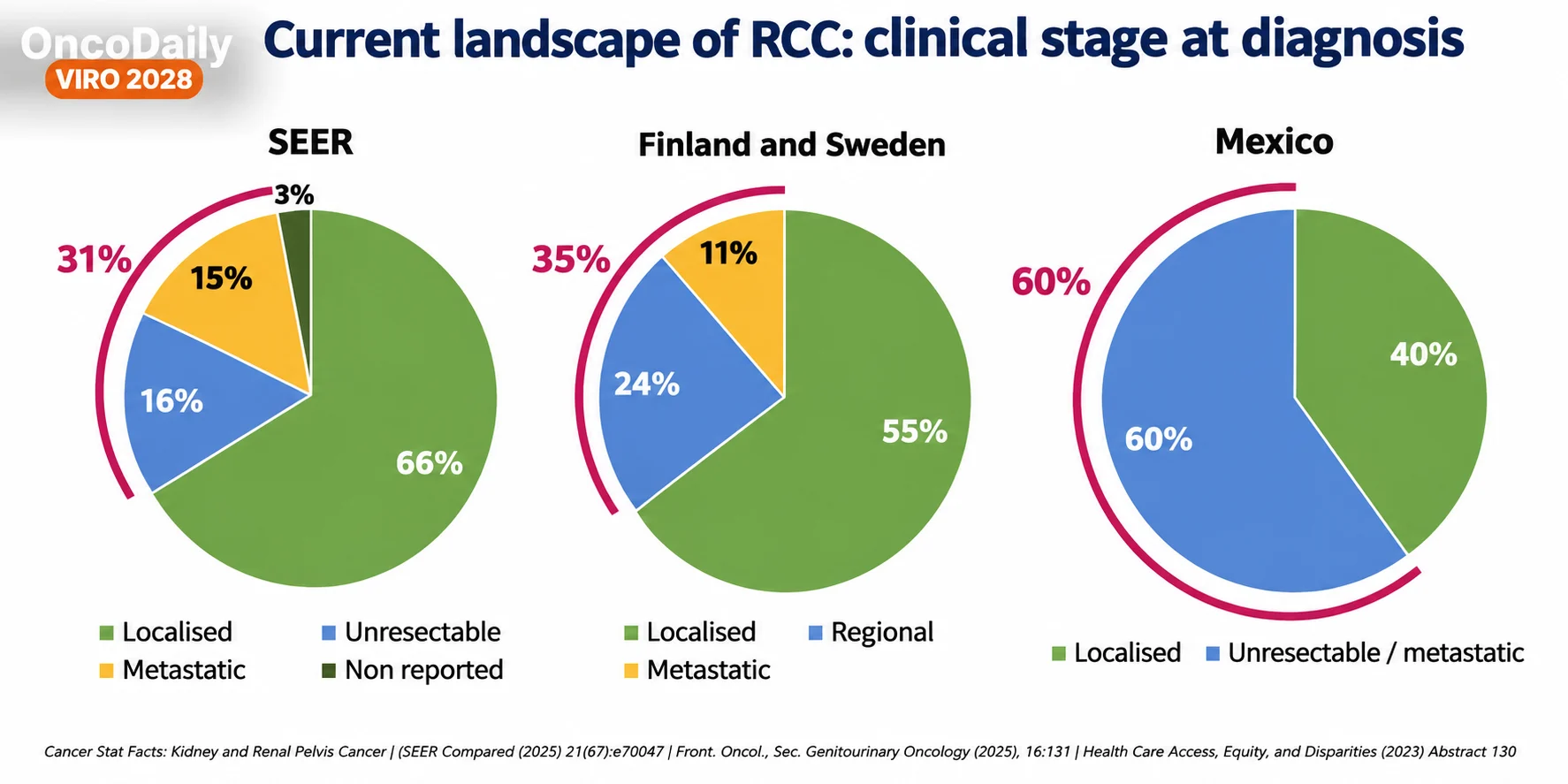 These disparities become particularly consequential when patients require multiple successive lines of systemic treatment.
Why Second-Line Treatment Requires a Different Approach
Despite an expanding number of available treatments, not every patient with metastatic RCC receives subsequent systemic therapy.
Bourlon discussed multinational real-world evidence from the United States, Mexico, and the United Kingdom indicating that fewer than half of patients in some cohorts received second-line treatment, with an even smaller proportion progressing to third-line therapy.
The availability of several effective regimens therefore does not necessarily translate into access to multiple treatment opportunities for every patient.
This makes treatment sequencing important from the beginning of metastatic disease management.
The choice of second-line therapy depends substantially on the initial regimen.
For patients previously treated with nivolumab plus ipilimumab, VEGF-targeted therapy may represent the next therapeutic approach, as these patients have generally not received a TKI during frontline treatment.
The situation is different for patients progressing after an IO-TKI combination, particularly when the first-line regimen already included cabozantinib.
Other available strategies include lenvatinib plus everolimus, HIF-2α-directed treatment, and clinical trial enrollment.
However, the selection of treatment must also account for the pattern of disease progression and the patient’s ability to tolerate further therapy.
“Not every patient is the same and not every situation will lead to the same treatment decision.”
Bourlon emphasized the importance of assessing disease burden, metastatic sites, progression rate, performance status, nutritional condition, comorbidities, concurrent medications, previous toxicity, and individual treatment priorities.
The objective is not simply to achieve tumor shrinkage, but to maintain disease control, prolong survival, manage symptoms, and preserve quality of life.
Why Immunotherapy Rechallenge Has Not Improved Outcomes
One of the most important questions following progression on frontline immunotherapy is whether introducing another immune checkpoint inhibitor can provide additional clinical benefit.
Two randomized phase III trials have directly investigated this approach.
TiNivo-2 evaluated tivozanib plus nivolumab compared with tivozanib monotherapy in patients with advanced RCC previously treated with an immune checkpoint inhibitor.
The addition of nivolumab did not improve progression-free survival. Median progression-free survival was 5.7 months with the combination compared with 7.4 months with tivozanib alone.
Similarly, CONTACT-03 compared atezolizumab plus cabozantinib against cabozantinib monotherapy in patients who had experienced progression following previous checkpoint inhibitor treatment.
Median progression-free survival was 10.6 months with atezolizumab plus cabozantinib and 10.8 months with cabozantinib alone. The addition of atezolizumab did not improve overall survival and was associated with greater treatment-related toxicity.
These findings have important implications for treatment sequencing.
Although immunotherapy remains central to first-line RCC management, routine checkpoint inhibitor rechallenge after progression on an immunotherapy-containing regimen has not demonstrated additional clinical benefit in these studies.
Consequently, second-line treatment strategies increasingly focus on VEGF-targeted therapy and combinations involving different mechanisms of action.
Cabozantinib Remains an Important Second-Line Treatment
Among the available TKIs, cabozantinib has accumulated substantial evidence supporting its activity following progression on immunotherapy-based combinations.
Bourlon discussed several prospective studies, including BREAKPOINT, CaboPoint, and CANTATA, which have helped characterize its role in previously treated RCC.
The multicenter phase II BREAKPOINT trial evaluated cabozantinib in patients with metastatic RCC progressing after prior anti-PD-1 or anti-PD-L1 treatment.
In the prospective cohort of 30 patients, median progression-free survival reached 8.3 months, demonstrating clinically meaningful activity in this population.
Additional evidence came from CaboPoint, a multicenter phase II study specifically investigating cabozantinib as second-line therapy following frontline checkpoint inhibitor combinations.
Patients were divided into two cohorts according to their previous treatment:
Cohort A: Previous nivolumab plus ipilimumab.
Cohort B: Previous checkpoint inhibitor plus VEGF-targeted therapy.
The independently assessed objective response rates were 40.5% in cohort A and 27.5% in cohort B.
Median overall survival was 24.3 months and 24.1 months, respectively.
These findings demonstrate the activity of cabozantinib after different immunotherapy-containing regimens, although the nonrandomized cohort design does not establish comparative efficacy between treatment sequences.
Bourlon also reviewed CANTATA, which investigated the addition of the glutaminase inhibitor telaglenastat to cabozantinib.
Although telaglenastat failed to improve outcomes compared with cabozantinib alone, the study contributed further evidence regarding the activity of cabozantinib in previously treated patients.
Cabozantinib also has evidence of activity across different metastatic sites, including intracranial disease, an important consideration for patients with complex patterns of progression.
Its established efficacy, clinical experience, and familiar toxicity profile continue to make it a relevant treatment option after first-line immunotherapy.
LenCabo: Can Lenvatinib Plus Everolimus Improve Second-Line Outcomes?
The randomized phase II LenCabo trial introduced important comparative evidence for patients with metastatic clear cell RCC progressing after previous PD-1 inhibitor therapy.
The investigator-initiated multicenter study compared lenvatinib plus everolimus with cabozantinib, two regimens commonly considered in the post-immunotherapy setting.
A total of 90 patients were randomized, of whom 86 received their assigned treatment.
At a median follow-up of approximately 20 months, lenvatinib plus everolimus demonstrated superior progression-free survival:
Median progression-free survival: 15.7 months with lenvatinib plus everolimus versus 10.2 months with cabozantinib.
Hazard ratio: 0.51 (95% CI, 0.29–0.89; P = 0.02).
Objective response rate: 52.6% versus 38.6%.
The results support the potential advantage of combining VEGF-targeted therapy with mTOR inhibition after prior checkpoint inhibitor exposure.
However, this improvement was accompanied by greater toxicity.
Treatment discontinuation due to adverse events occurred in 20% of patients receiving lenvatinib plus everolimus, compared with 10.9% receiving cabozantinib.
Overall survival data remained immature and inconclusive.
For Bourlon, these findings reinforce the importance of patient selection. A combination that produces greater tumor shrinkage or longer disease control may be particularly relevant for patients with symptomatic disease or an urgent need for response.
At the same time, its potential benefits must be weighed against treatment tolerability, existing comorbidities, and the patient’s priorities.
LenCabo provides valuable randomized evidence, but its relatively small sample size and phase II design should be considered when interpreting the results.
LITESPARK-011: HIF-2α Inhibition Enters the Post-Immunotherapy Setting
Another major development in subsequent-line RCC treatment is the introduction of HIF-2α inhibition.
The phase III LITESPARK-011 trial evaluated belzutifan plus lenvatinib against cabozantinib in patients with advanced clear cell RCC previously treated with anti-PD-1 or anti-PD-L1 therapy.
Belzutifan inhibits HIF-2α, a transcription factor involved in tumor growth, metabolism, and angiogenesis in clear cell RCC. Lenvatinib targets multiple receptor tyrosine kinases, including those involved in VEGF signaling.
Combining these agents offers a treatment strategy that targets complementary biological pathways without relying on renewed checkpoint inhibition.
The randomized trial enrolled 747 patients.
At the second interim analysis, the combination demonstrated improved progression-free survival and objective response rates compared with cabozantinib.
The subsequent prespecified final analysis confirmed a statistically significant progression-free survival benefit:
Median progression-free survival: 14.6 months with belzutifan plus lenvatinib versus 10.6 months with cabozantinib.
Hazard ratio: 0.74 (95% CI, 0.61–0.89).
Objective response rate: 53% versus 40%.
On September 24, 2026, the US Food and Drug Administration approved belzutifan in combination with lenvatinib for adults with advanced RCC containing a clear cell component following prior PD-1 or PD-L1 inhibitor treatment.
However, the final overall survival analysis did not demonstrate a statistically significant difference.
Median overall survival was 33.7 months with belzutifan plus lenvatinib and 28.6 months with cabozantinib, with a hazard ratio of 0.85.
The results establish progression-free survival and response advantages for the combination but do not demonstrate an overall survival benefit.
For patients progressing after frontline immunotherapy, LITESPARK-011 introduces another evidence-supported therapeutic strategy based on a different mechanism of action.
However, the efficacy findings must be interpreted alongside treatment-related toxicity and the practical requirements of administering the combination.
Toxicity and Access Can Determine Which Treatment Is Feasible
Bourlon devoted particular attention to the safety considerations associated with later-line systemic treatment.
TKIs have well-established adverse-event profiles, including hypertension, diarrhea, fatigue, hand-foot syndrome, liver enzyme abnormalities, and proteinuria.
The frequency and severity of these toxicities vary between agents, making previous treatment experience an important consideration.
The introduction of belzutifan adds a different set of concerns.
Anemia and hypoxia are important adverse effects of HIF-2α inhibition, and some patients may require treatment interruptions, dose modifications, transfusions, or supplemental oxygen when clinically indicated.
These considerations become especially relevant in healthcare systems where supportive care resources are limited.
Bourlon questioned whether a treatment can be considered acceptably tolerable without accounting for the resources patients need to manage its adverse effects.
A patient who lives far from a specialized center, has limited access to blood transfusions, or has significant preexisting cardiopulmonary disease may face different challenges from those encountered in clinical trials.
The safety of treatment must therefore be evaluated within the patient’s clinical and healthcare context.
Similarly, the greater response rates associated with combination therapy must be balanced against toxicity, financial burden, and the likelihood of treatment interruption.
Improved efficacy does not automatically make a regimen the most appropriate choice for every patient.
Individualizing Treatment After First-Line Failure
The emergence of comparative data from LenCabo and LITESPARK-011 has expanded the evidence available for subsequent-line metastatic RCC treatment.
However, these studies evaluated different populations and treatment strategies, and their results should not be compared directly to establish which combination is superior.
Cabozantinib remains an established option supported by prospective studies and substantial clinical experience.
Lenvatinib plus everolimus offers an alternative with randomized phase II evidence demonstrating improved progression-free survival compared with cabozantinib, although greater toxicity must be considered.
Belzutifan plus lenvatinib has demonstrated a progression-free survival benefit in a larger phase III trial and introduces HIF-2α inhibition into the post-checkpoint inhibitor setting.
For Bourlon, the choice among these approaches ultimately depends on the individual patient’s situation.
A patient with rapidly progressive, symptomatic disease may require a regimen capable of achieving substantial tumor reduction. Another patient with more indolent progression, significant comorbidities, or limited supportive care access may benefit from a different therapeutic approach.
Previous treatments also matter. The options available after nivolumab plus ipilimumab may differ from those following an IO-TKI combination, particularly if the patient has already received cabozantinib.
The decision should incorporate treatment history, progression characteristics, clinical fitness, toxicity, patient priorities, and access to subsequent therapies.
As more combinations become available, the central challenge in metastatic RCC is increasingly determining which treatment offers the most appropriate balance of efficacy, safety, and feasibility after first-line failure.
The expanding evidence base provides clinicians with more options, but the optimal treatment sequence remains individualized, particularly when access to later lines of therapy cannot be guaranteed.
Written by Eliz Baloyan, MD, Features Writer and Editor at OncoDaily and CancerWorld