
Key takeaways
- Pluvicto has moved into the frontline setting for metastatic hormone-sensitive prostate cancer, but the overall survival data are still maturing.
- Choosing between Pluvicto and triplet therapy should be individualized using disease burden, PSMA status, chemotherapy fitness, comorbidities, renal function, baseline blood counts, toxicity, and patient preference.
- PSMA imaging is becoming a key decision point because it determines whether Pluvicto is an option and helps shape the treatment pathway. Pasted text
- High-volume, chemotherapy-fit patients may be better suited to triplet therapy, while low-volume disease can bring radiation-based strategies into the discussion.
At the Community Oncology Global Congress (COGC 2026), organized by OncoDaily, José W. Avitia, Medical Oncologist at New Mexico Cancer Center, focused on a question that has become increasingly relevant in metastatic hormone-sensitive prostate cancer: as more effective frontline options become available, how should clinicians decide which treatment is right for an individual patient?
With Pluvicto moving earlier in the treatment pathway, the choice is no longer simply about whether a therapy is available. Disease burden, PSMA status, chemotherapy fitness, comorbidities, toxicity, patient preference, and even local infrastructure can all influence the decision.
A New Frontline Role for Pluvicto
“Pluvicto was first approved in 2022 in the metastatic castration-resistant setting after chemotherapy. At that point, this was a tool we reached for when we had exhausted other options.
In 2024, we received approval to use it before chemotherapy, which was quite exciting. And now, in July 2026, based on the PSMAddition data, we can treat patients with metastatic hormone-sensitive disease in the frontline setting using Pluvicto together with an ARPI and ADT.
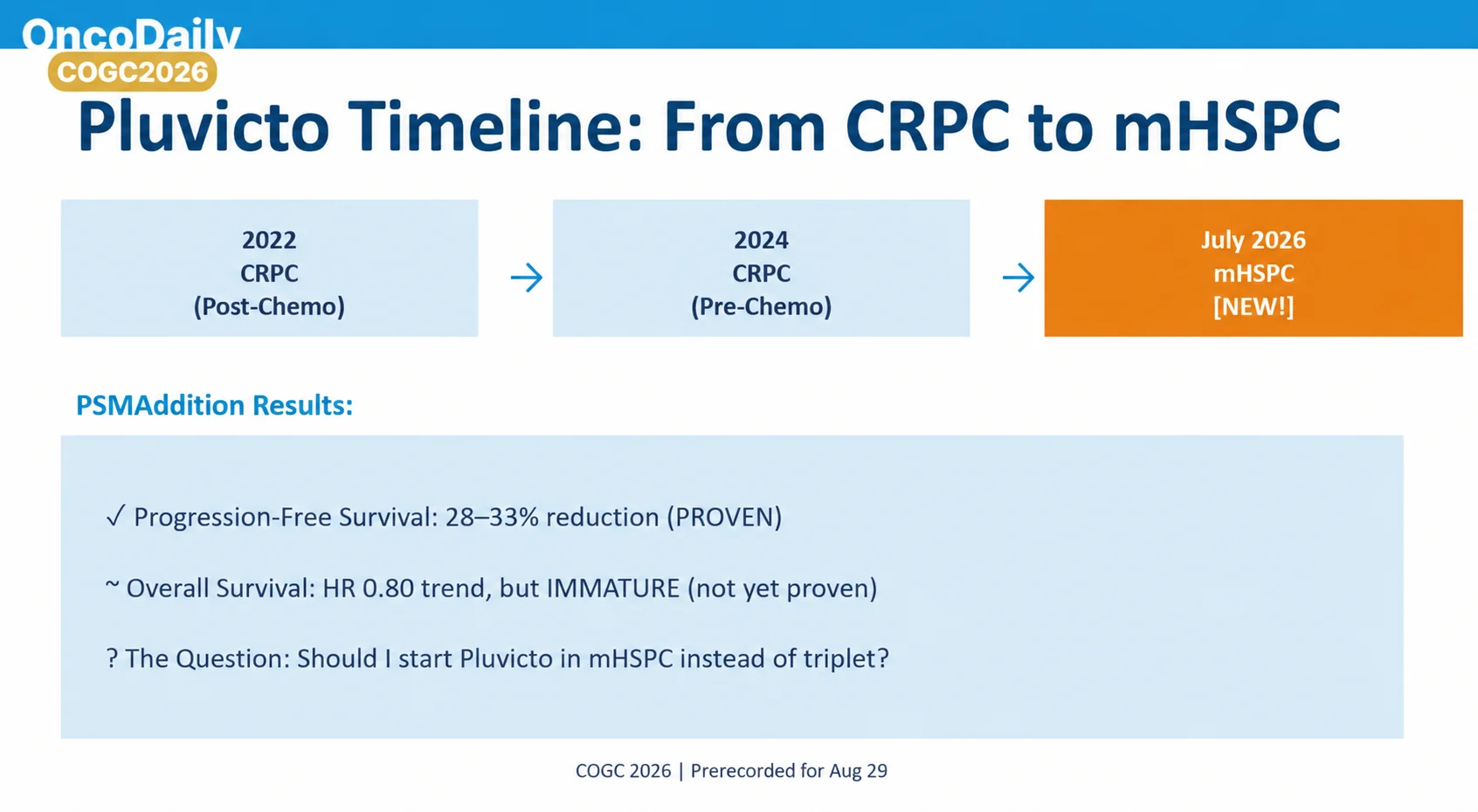
The results are encouraging. There was improvement in progression-free survival, with a reduction in progression of approximately 20% to 33%. Overall survival is also trending in an encouraging direction, with a hazard ratio of approximately 0.8, but the data are still premature. Median follow-up was only about 23 months, so we need more time for those results to mature.”
Pluvicto or Triplet Therapy?
“The question now is: who should receive Pluvicto frontline, and who should receive triplet therapy frontline?
Triplet therapy consists of an ARPI, docetaxel, and ADT, based on the ARASENS trial. Those data are mature. We know there is an overall survival benefit, with a hazard ratio of 0.68, and progression-free survival was also an important secondary endpoint.
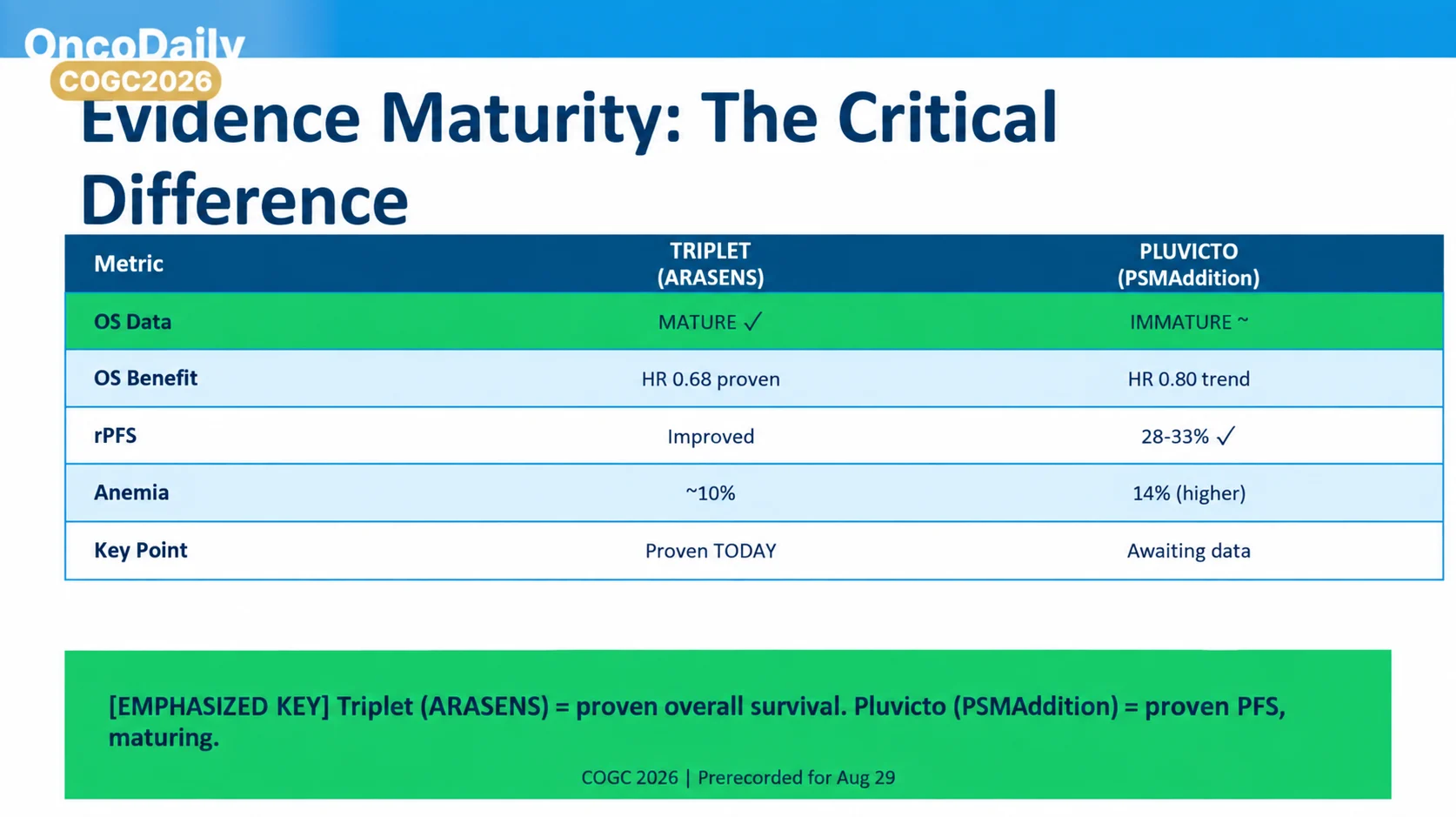
We also understand the toxicity better. Grade 3 anemia occurred in about 10% of patients in the triplet group. This is a proven approach and has become one of the standards for treating these patients.
With PSMAddition, some of the evidence is still maturing. There is an encouraging overall survival trend with a hazard ratio of 0.8, and we have seen progression-free survival benefit, but we do not yet have enough follow-up. Grade 3 anemia was somewhat higher, at about 14%.
So now we have to ask how we make that decision for the individual patient.
We start with the baseline CBC. Does the patient already have a suppressed hemoglobin? Knowing that Pluvicto may be somewhat harder on the bone marrow, that becomes part of the decision.
Renal function matters as well. We have to be cautious about adding toxicity, particularly in patients with significant renal dysfunction.
Age is important. Can this patient tolerate chemotherapy? What comorbidities do they have? Do they have congestive heart failure? Are they on dialysis?
Prior toxicities also matter. Does the patient already have neuropathy? That could influence whether we want to use docetaxel.
And then there is patient preference. Some patients do not want to lose their hair. Others may have concerns about the isolation requirements around Pluvicto.
- Do they have a caretaker?
- What is their ECOG performance status?
- Are they fit enough for chemotherapy?
These are all determinants that help us choose the appropriate treatment for an individual patient. The toxicity profiles are different: anemia was about 10% with triplet therapy and 14% with Pluvicto, while neutropenia was fairly similar. Triplet therapy can cause neuropathy and hair loss, which we do not typically see with Pluvicto. With either approach, we also have to be especially cautious in patients with a GFR below 30.”
PSMA Status Is the Gateway
“The important thing I have to stress is that PSMA status is the gateway for everything.
I encourage clinicians, when PSMA imaging is available, to obtain it early because it allows us to understand what options the patient has now and what options may be available later.
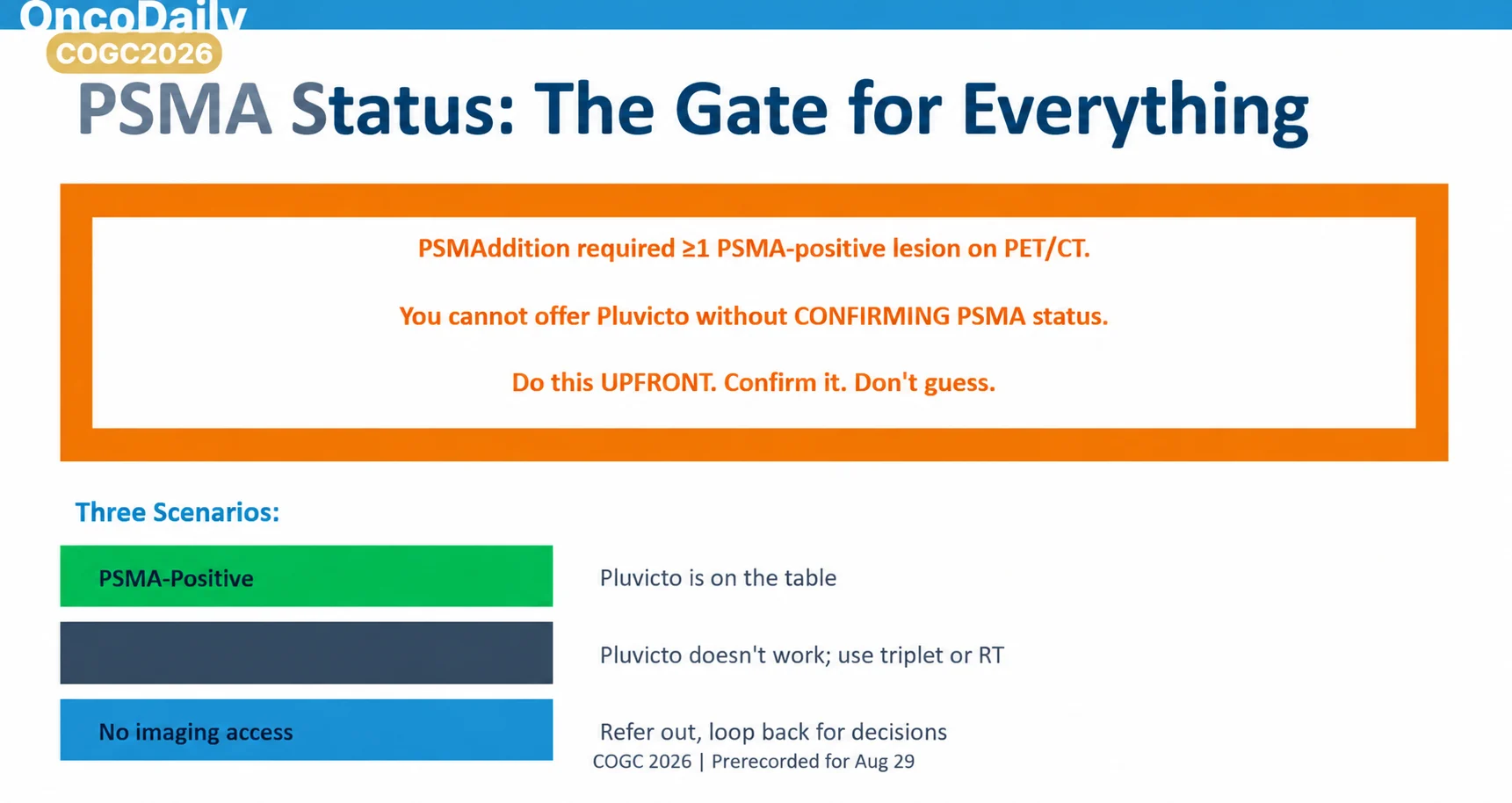
If the patient is PSMA-positive, then Pluvicto becomes an option. If the patient is PSMA-negative, then we are looking at triplets, doublets, and radiation.
And if you do not have access to PSMA imaging or Pluvicto at your site, then it is time to establish referral loops. Make sure you have relationships with colleagues who do have those resources, because that opens additional options for your patients.”
Disease Burden Helps Define the Path
“When a patient with newly metastatic hormone-sensitive disease comes in, I first look at the disease burden.
- Are they high-volume?
- Do they have four or more bone metastases?
- Do they have visceral disease?
- Are they fit for chemotherapy?
If the patient has high-volume disease and is fit for chemotherapy, then triplet therapy based on ARASENS may be the appropriate choice.
If they are not fit for chemotherapy, then I look at whether they are PSMA-positive. If they are, Pluvicto becomes an option. If Pluvicto is not appropriate or available, then we can consider doublet therapy.
For a patient with low-volume disease, with four or fewer metastases and no visceral disease, another question becomes whether radiation therapy is accessible. If it is, radiation together with an ARPI and ADT can be considered based on the STAMPEDE data, which demonstrated an overall survival benefit in this setting.
If radiation therapy is not accessible, Pluvicto may be another consideration in a PSMA-positive patient, and doublet therapy remains an option as well.”
Modern Care With Limited Resources
“I work in Albuquerque, where we have the full infrastructure. We have PSMA imaging, Pluvicto, triplet therapy, and radiation oncology.
But in our reservation clinic, we do not have PSMA imaging. Patients have to be referred to the city or to a satellite clinic approximately 180 miles away. They also have to travel for Pluvicto. We do have access to triplet therapy and radiotherapy.
That distinction is important because in both locations, we want to provide modern medical care. Nothing should be second class.
We also have to understand the global reality of where we practice. In the United States and Europe, some centers may have access to multiple ARPIs, PSMA imaging, Pluvicto, chemotherapy, and radiation. But even within the United States, access can vary because of insurance coverage.
In other parts of the world, clinicians may have access to only one ARPI, or perhaps only ADT and chemotherapy. You may not have the full arsenal.
But we can still provide modern medicine in the community setting without having every treatment available.”
Three Patients, Three Different Decisions
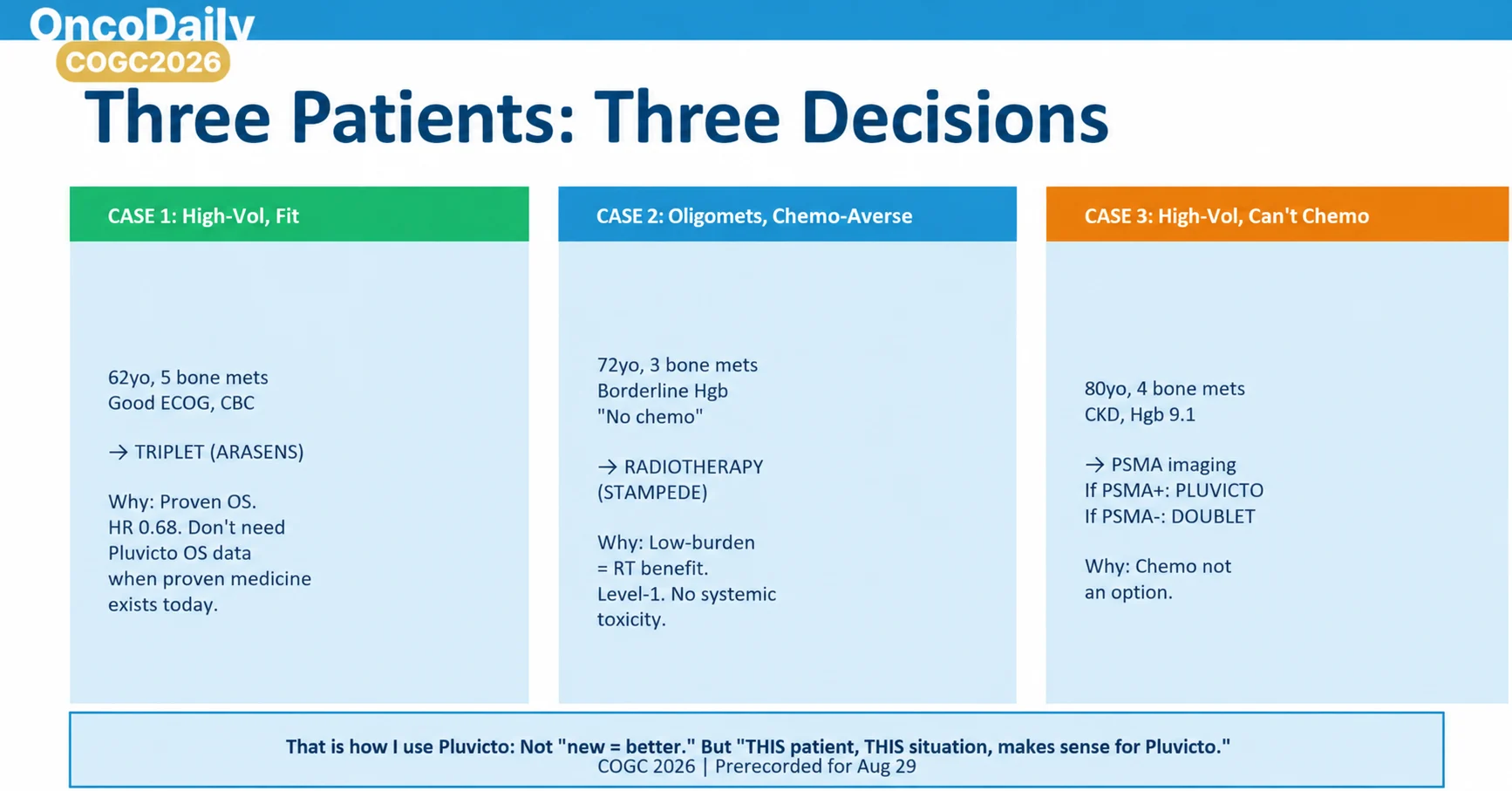
“Consider a 62-year-old patient:
- with five bone metastases,
- good performance status,
- normal CBC.
In this patient, I would choose triplet therapy based on ARASENS because we have mature evidence demonstrating an overall survival benefit. We know the Pluvicto overall survival data are still premature.
For a second patient, imagine a 72-year-old man:
- with three bone metastases
- borderline hemoglobin
- does not want chemotherapy.
Because he has low-volume disease, radiation-based treatment together with systemic therapy can be considered based on the STAMPEDE evidence. That gives him an evidence-based option while avoiding chemotherapy toxicity.
Then consider an 80-year-old patient
- with four bone metastases
- high-volume disease
- hemoglobin of nine
- chronic kidney disease
- cannot receive chemotherapy.
If his PSMA imaging is positive, Pluvicto may be an option. If he is PSMA-negative or Pluvicto is unavailable, we can use a doublet. Chemotherapy may not be possible for that patient, but that does not mean we have no effective treatment to offer.”
Knowing Which Tool to Reach For
“Providing modern treatment for patients with metastatic hormone-sensitive disease is not about having every drug at your disposal. It is about knowing which tool to reach for.
We need evidence to support our thinking. Sometimes we are limited by the drugs we have access to, but we also have our clinical judgment to determine which regimen is best for which patient and under what circumstances.
It is also about developing partnerships with clinicians who have resources that we may not have locally.
We have the evidence from ARASENS. We have the PSMAddition data. We have the STAMPEDE data. At this point, we have the capability to provide modern medicine in the community setting.
All of us have the ability to provide first-rate care, wherever we practice.”
Written by Eliz Baloyan, MD, Features Writer and Editor at OncoDaily and CancerWorld