Key takeaways
- Patient-owned health records can bring fragmented oncology data from multiple centers into one place.
- AI matching can narrow hundreds of open studies down to the trials a patient may actually be eligible for.
- HealthTree’s model has supported large-scale recruitment, including more than 600 tissue samples for one myeloma study.
- The central goal is to make trial participation less dependent on geography.
At the Community Oncology Global Congress (COGC 2026), organized by OncoDaily, Jenny Ahlstrom, Founder and CEO of the HealthTree Foundation, discussed how patient-owned health data and digital infrastructure could support more distributed clinical trials, particularly for patients who cannot easily travel to major academic centers.
Her presentation centered on making clinical trials easier to find, join, and stay on through patient-owned data and distributed research, with one message standing out:
“It shouldn’t matter where you live to participate in a clinical trial.”
The Challenges Behind Distributed Clinical Trials
“There are many challenges with running distributed clinical trials in the community.
Those include:
- Identifying eligible patients who fit trial criteria
- Making community physicians aware of available trials
- Educating patients and obtaining consent
- Overcoming geographic and travel barriers
- Managing the burden of trial data collection
- Keeping patients engaged and retained on study
- Training sites and maintaining quality control
- Giving sponsors visibility into trial progress
- Maintaining patient engagement after the trial ends
The way we are working to support distributed clinical trials in the community really rests on a patient-owned personal health record.
In the United States, that model is supported by the 21st Century Cures Act, which allows patients to share their own health data with other applications.
We have FHIR integrations – FHIR is the data-transfer standard in the United States – and we have connected to more than 7,900 hospitals through integrations with electronic health record vendors.
This allows us to pull data directly, on behalf of the patient, into a personal health record. That record can also incorporate information that may sit outside the traditional electronic health record, including PDF documents such as genetic testing, NGS, or FISH results.
We are integrating wearables into the platform. We can survey patients for patient-reported outcome data using validated instruments, ask social determinants of health questions, and include genetic and lifestyle data.
So this becomes a single source of truth for the patient.”
One Record Across Multiple Cancer Centers
“For oncology patients, fragmented data can become a major obstacle.
Most oncology patients are going to an average of three different centers. An academic center may not have all of their data. Their community center may not have all of their data.
Pulling that information together is what enables things like clinical trial matching.
Once the information enters the platform, it is cleaned and standardized so it can be used for clinical trial matching, treatment matching, patient-facing services, and AI-enabled analytics. That process also requires common data standards.
The most common standard being used in the U.S. is called OMOP. But that standard also has to be extended because it does not really have enough buckets to fit all the different types of data that are coming in now.
Using this infrastructure, HealthTree has completed more than 250 surveys and studies, partnered with more than 150 research investigators, and involved more than 124,000 study participants in multiple myeloma.
This is a platform that can enable greater clinical trial participation from patients in a distributed way.”
What Distributed Research Can Look Like
“One example was the NUTRIVENTION-2 study, led by Urvi Shah at Memorial Sloan Kettering Cancer Center, which evaluated the impact of a plant-based diet on the microbiome and progression of smoldering myeloma.
HealthTree helped by sending kits out across the United States, so patients did not have to travel to participate in the study. They were able to use the kit and send the data back, while HealthTree acted as a facilitator for patient recruitment and patient-facing support.
Another project involved a predictive-risk study led by Ola Landgren and Benjamin Diamond at the University of Miami.
The researchers needed hundreds of additional tissue samples from original bone marrow biopsies.
We identified patients who were willing to participate in the study, did the outreach to invite them, and then called the facilities to have five unstained slides from the original bone marrow biopsy sent to the University of Miami. The University then performed the genetic testing, and that was matched with the EHR data aggregated by HealthTree to identify outcomes based on the therapies received.
The goal was to build a computational model capable of predicting which newly diagnosed patients would or would not respond to particular myeloma therapies.
In the model, each column represented a different patient, showing the pattern and number of mutations identified for that individual. Along the bottom, the different myeloma therapies they had received were mapped against their outcomes.
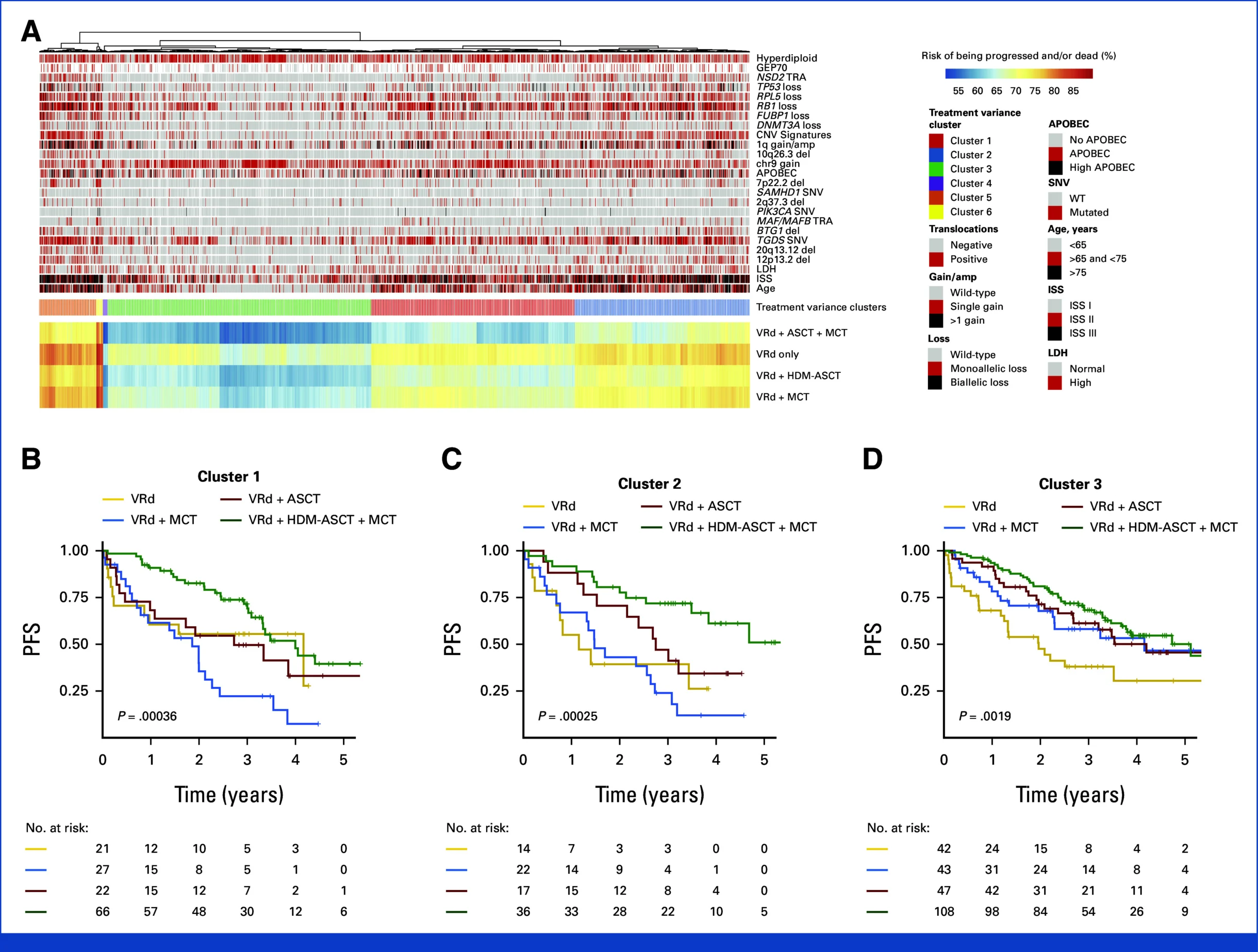
Source: Maura F, et al. J Clin Oncol. 2024;42:1229–1240. CC BY 4.0.
By bringing together genetic information, treatment history, and clinical outcomes, the researchers could begin identifying patterns that might predict response to specific therapies.
This is a perfect use of both technology and a distributed clinical trial model because we were able to get them more than 600 samples.
They had noted that it would have taken them more than 10 years to accrue that many samples if they had done it themselves.”
Using AI to Find the Right Trial
“The next step is using the same patient-owned data to make clinical trial matching easier.
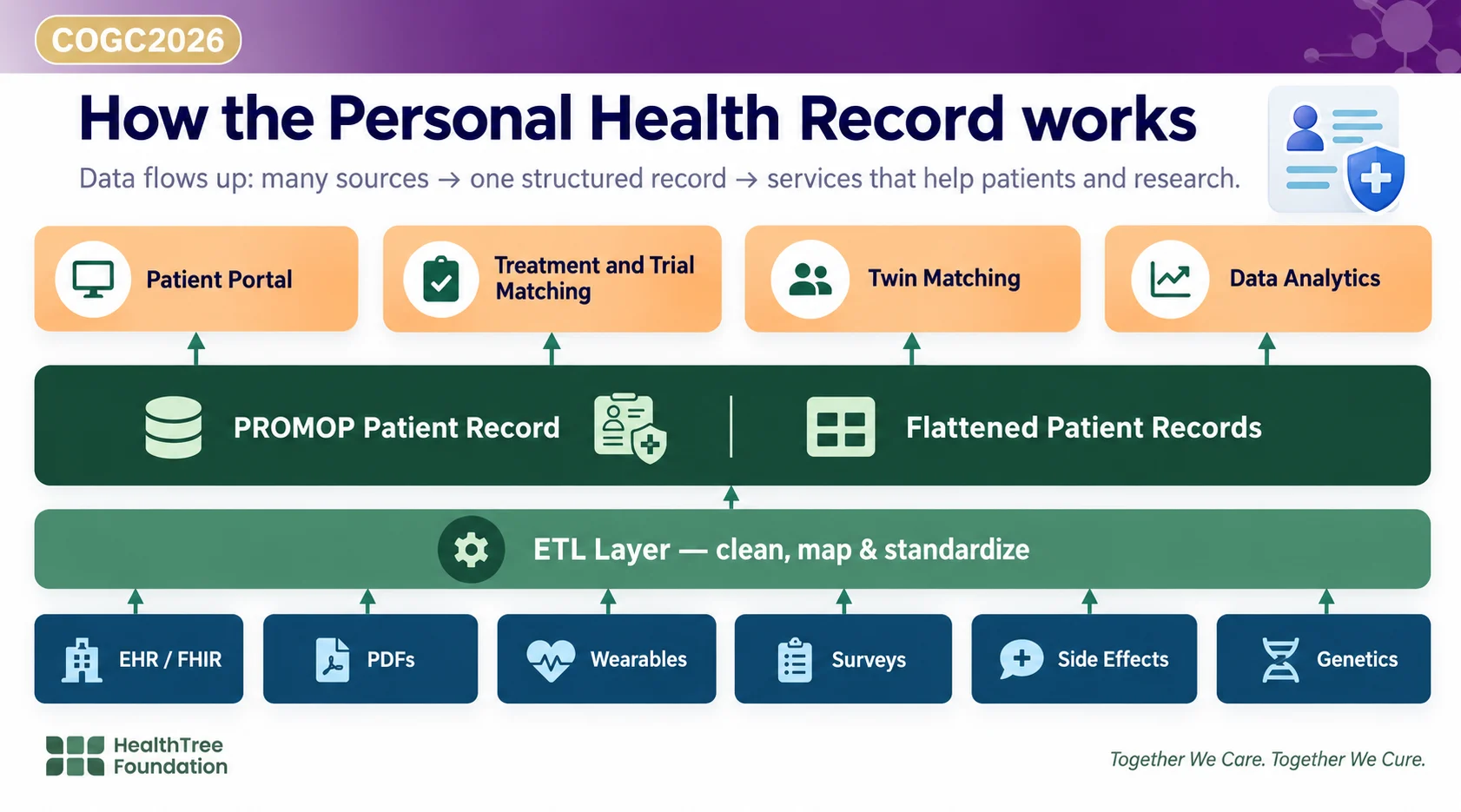
A patient with this personal health record can go in and match themselves to clinical trials.
As a myeloma patient, I have gone on ClinicalTrials.gov before. There are more than 500 open myeloma trials, and finding a trial that I actually match to is an impossible feat.
HealthTree uses AI to extract information from ClinicalTrials.gov and place it into a standardized format that can then be compared with the patient’s own health data.
It shows patients only the trials that they are eligible to join, whether that is in the newly diagnosed setting, remission, or relapsed/refractory disease. Patients can identify trials themselves, but tools are also being developed on the clinician side so physicians can match patients to clinical trials.
The system is designed to show all potentially relevant trials rather than limiting results according to geography. It shouldn’t matter where you live to participate in a clinical trial.
For patients who cannot manage repeated travel, distributed models may allow at least some aspects of research participation to move closer to home.”
Clinical Trials at Every Stage of Care
“I have personally participated in many clinical trials, including receiving CAR T-cell therapy through one, so I understand both the burden on patients and the importance of research participation.
This is how we get to cures.
Patients should be considering clinical trials at every single stage, whether they are newly diagnosed or relapsed cancer patients. Making that possible requires more than identifying a trial.
The same platform can support consent, connect data from multiple centers, collect patient-reported outcomes at defined time points, and keep participants engaged through text or email notifications.
We can build a page that becomes the consent form and takes the patient into the EHR data-connection piece. The patient can connect all of their centers so that you have a complete picture of the patient.
That FHIR data collection goes into a single database.
We can use our online survey platform for patient-reported outcome collection at certain time points, keep patients engaged through notifications by text or email, and give sponsors access to clinical trial data.
HealthTree is also working toward FDA 21 CFR Part 11 compliance, which would allow the model to support this type of research on a larger scale.
The broader idea is to make the patient’s own health record part of the research infrastructure – connecting fragmented data, identifying eligible trials, reducing unnecessary travel, supporting participation throughout the study, and keeping patients engaged after enrollment.”
Written by Eliz Baloyan, MD, Features Writer and Editor at OncoDaily and CancerWorld