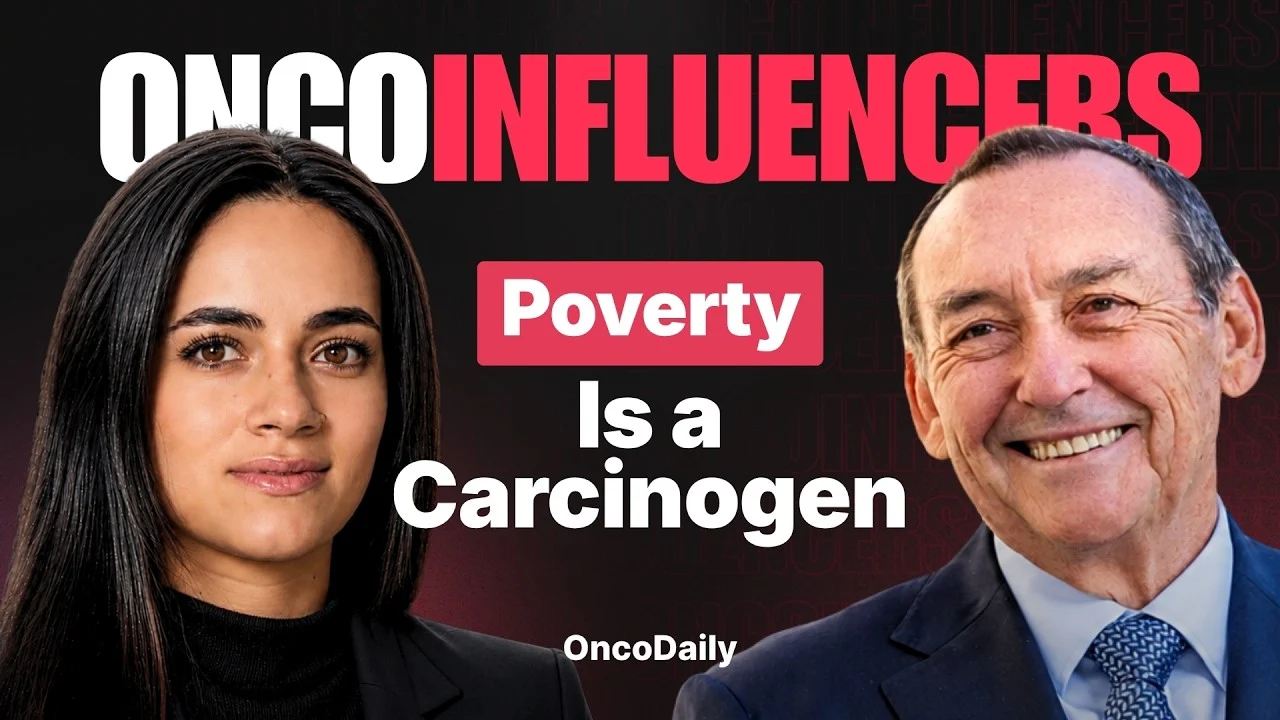
Some careers are built around a subject. Others eventually ask you to live inside it.
For decades, Jeff Dunn had worked on cancer from the angles that medicine can sometimes overlook: behavior, quality of life, survivorship, public health, access. Then, a month before he was due to take up the presidency of the Union for International Cancer Control, he was diagnosed with cancer himself.
The diagnosis did not send his career in a new direction. If anything, it made the questions he had already spent years working on feel more immediate.
Today, he is Professor of Social and Behavioural Science and Chair of Cancer Survivorship at the University of Southern Queensland, a former President of the Union for International Cancer Control (UICC), and a longtime figure in prostate cancer research and advocacy. His work has taken him from national guideline development in Australia to international cancer policy, while keeping quality of life and the experience of living with cancer firmly within the conversation.
Looking back, the path makes sense. At the beginning, however, none of it was planned.
A Career That Began Somewhere Else
Oncology was not part of Dunn’s childhood plan. He arrived at university interested in biological science and, at one point, imagined something closer to marine biology. Psychology and sociology eventually pulled him in another direction, leading to a career in the behavioral sciences and, over time, their application to cancer control.
His work came to span public health, psychosocial oncology, interventions and quality of life. One of the strongest influences on that path was psychiatrist Jimmie Holland, widely regarded as a founder of modern psycho-oncology.
“She was a great inspiration to me. She worked at Memorial Sloan Kettering as a psychiatrist deep into her 80s, and I found that inspirational and motivating. I credit Jimmie particularly in this second half of my career with the direction that I took.”
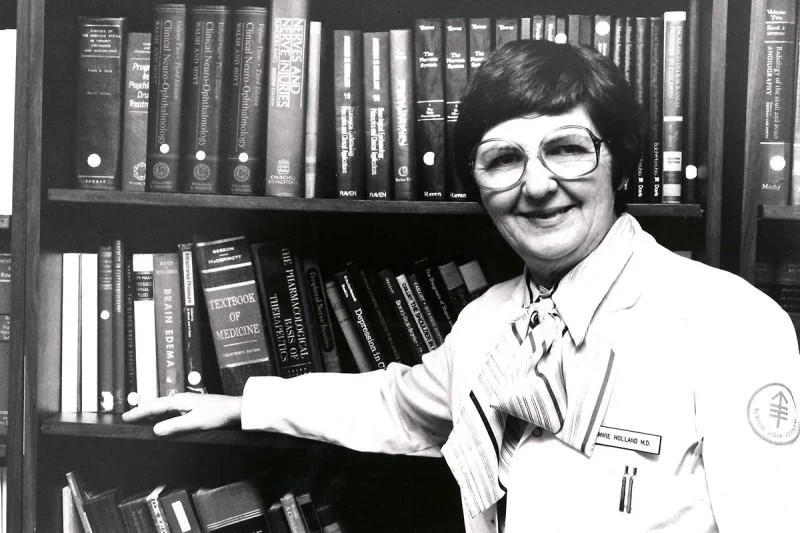
Jimmie C. Holland, MD, founder of psycho-oncology, pictured in her office in the early 1990s. Photo: Memorial Sloan Kettering Cancer Center.
That direction is still visible in his work at the University of Southern Queensland, where he is Professor of Social and Behavioural Science and Chair of Cancer Survivorship. His research ranges from supportive care and quality of life to public health and early detection.
One current trial is examining a nurse-led intervention for men receiving androgen deprivation therapy for prostate cancer. At the same time, Dunn recently chaired the development group behind Australia’s updated national guidelines for the early detection of prostate cancer.
The combination matters because it places two very different moments of the cancer experience in the same frame: finding disease earlier, and helping people live better after diagnosis and treatment.
“The university role allows me a breadth of scope to look at a whole range of things. So it’s not all about quality of life and supportive care.”
That breadth would later become important on a much larger stage.
Leading UICC While Becoming a Patient Himself
There was an almost uncomfortable irony to the timing.
For decades, cancer had been Dunn’s field of work – something he studied, advocated around and tried to improve at the level of systems and populations. Then, just one month before he was due to take up the presidency of the Union for International Cancer Control, the distance between professional expertise and personal experience collapsed.
“As I was about to take up the presidency of the UICC four years ago, I myself was diagnosed with cancer.”
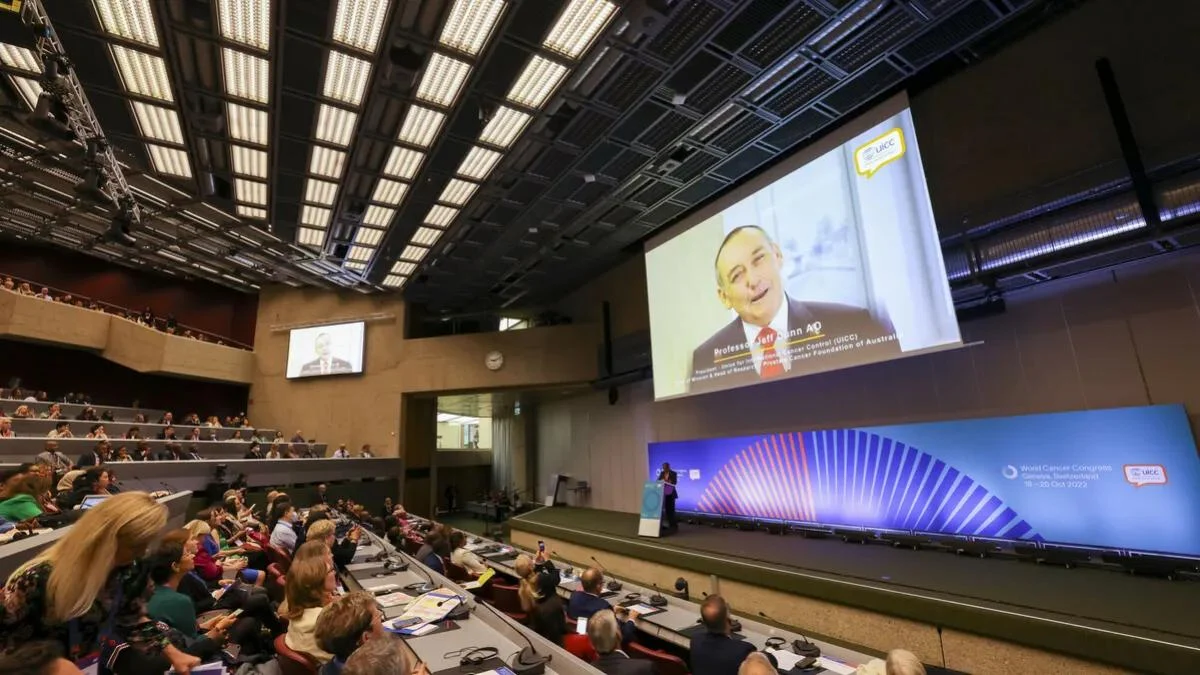
Prof. Jeff Dunn addresses the 2022 World Cancer Congress remotely from Australia. Weeks earlier, he had been diagnosed with mantle cell lymphoma, preventing him from travelling to Geneva as he began his term as UICC President. Photo: Union for International Cancer Control (UICC), World Cancer Congress 2022. UICC
He was preparing to lead the global peak body for cancer control organizations while beginning to navigate cancer from the other side.
“It seemed to me and to many of my friends and colleagues around the world a great irony that literally a month before I was taking up the presidency of the global peak body for cancer control organizations, I myself was diagnosed.”
The news travelled quickly through the international community he was about to lead. Messages came from friends and colleagues around the world – some serious, some humorous enough that he chose not to repeat them publicly – but the response itself stayed with him.
“The outpouring of support messages… and the outpouring of support from all around the world was really quite moving and motivating. Anyway, and as you can see, I’m in remission. It’s not over yet, but I’m in remission and doing well.”
He stepped into the presidency carrying that diagnosis with him. And the organization he was taking over was itself emerging from a bruising period.
COVID-19 had stripped away many of the things that normally held an international network together. Conferences had been cancelled. Travel had stopped. Scholarships and training opportunities had been interrupted. Community cancer organizations that depended on philanthropy and fundraising had seen those lifelines shrink. Even the World Cancer Congress and World Cancer Leaders Summit – two of UICC’s major convening moments – had been lost to the pandemic.
After years of cancelled meetings and interrupted travel, UICC’s members needed opportunities to meet again, exchange experience and rebuild the relationships that had been difficult to sustain through the pandemic.
“Our focus coming out of COVID was very much about consolidation, getting back to our membership, reconnecting, looking for ways that we could support members, rebuild, reconnect, pursue their mission, perhaps in different ways.”
For an organization with more than a thousand members across the world, those opportunities to gather carried real weight. They were where cancer organizations compared experience, learned from one another and rebuilt the relationships that made collaboration possible.
“Our real priorities were to reconnect, to rebuild, to re-energize and to support our membership.”
The World Cancer Congress returned. Member organizations began meeting again. Training, capacity building and international collaboration resumed. And even while UICC was rebuilding those connections, the work that could not wait continued – including efforts to improve access to cancer medicines through the Access to Oncology Medicines Coalition (ATOM).
“We were also very much involved in ATOM, our Access to Oncology Medicines Coalition, making sure that we got medicines, affordable medicines, to all countries around the world, not just those that could afford it.”
Those years placed Dunn in an unusual position. He was leading an organization devoted to reducing the global burden of cancer while still living with the consequences of his own diagnosis. At the same time, UICC was trying to restore the relationships and programs that had been fractured by the pandemic.
Neither story had a clean ending. Dunn remained in treatment. The effects of COVID did not disappear overnight. But by the end of his presidency, he felt the organization had regained something more important than a schedule of meetings.
“Today, we’re stronger, more connected and more effective than we ever were.”
Leadership Is a Platform, Not a Prize
When Dunn was asked about being named among the Stanford-associated top 2% of scientists worldwide, he initially answered with humor.
“Isn’t it nice to know that after all these years, there’s got to be at least someone out there that reads what you write?”
But he quickly moved away from the recognition itself. Whether the platform came from academic visibility, the UICC presidency or another leadership role, he saw professional recognition primarily as leverage.
“If you get these opportunities or you get any professional recognition, it’s a platform to actually bring about positive change. It’s a platform to communicate to others, to raise issues, to perhaps try and influence policy or programs or priorities or strategies in ways that you’re going to deliver better outcomes for people.”
His definition of leadership follows the same logic. It begins with creating enough room for talented people to do their work well, but it also requires actively helping the next person move forward.
“For most people’s careers, there’s been somebody who’s opened a door, provided an opportunity, offered an invitation to take up a challenge or to do something exciting, or to take a chance on a promotion or responsibility. I think when we get the chance in our careers, we need to look for opportunities to open doors for others.”
That emphasis on bringing people forward is not separate from cancer control. Dunn connects it directly to retaining talent and building the collective capacity needed to deal with a problem no single profession can solve.
The same collective view becomes much sharper when the conversation turns from leadership to inequality.
“Poverty Is a Carcinogen”
Asked what he would change about cancer care worldwide, the answer moved quickly past treatments and technologies to something far more basic: whether people have the means to reach and benefit from care in the first place.
“Cancer care doesn’t happen in a vacuum. And certainly, I’m on record for saying we talk about carcinogens and those types of things, or modifiable risk factors. Well, in cancer control, if you look at what’s happening globally, probably one of the biggest modifiable risk factors is poverty.”
Then he put it more starkly.
“Poverty is a carcinogen. Inequity as a carcinogen is the way I think about that.”
The phrase is deliberately provocative, but the reality behind it is familiar across cancer care. Where someone lives, what they can afford, whether they can reach a specialist, whether diagnosis comes early enough, whether treatment is available at all – these conditions can shape what happens long before a new therapy ever enters the picture.
That is why the next part of his answer turns to the barriers surrounding cancer progress.
“We’ve got to make sure we share that as evenly as we can so that each and every one of us benefits from this. So that it’s not concentrated or it’s not behind walls, whether they be geographic walls or financial walls or cultural walls, and that it’s available to each and every one of us around the world, no matter where we are.”
Those walls can look very different. Sometimes they are the distance between a patient and a cancer center. Sometimes they are cost. Sometimes they are the absence of early detection, specialist care or a health system able to translate evidence into everyday practice.
That concern with what happens between evidence and access is also visible in his work in prostate cancer. In Australia, Dunn helped lead the development of updated national guidelines for early detection, but approval of a guideline was only one part of the job. The next step was getting that evidence into primary care, where decisions about testing and referral actually begin.
“Primary care is critical for prostate cancer – making sure that the messages are out there, making sure that general practitioners and those in primary care understand what the evidence says, what the evidence tells us to do in terms of actions clinically, and then how we comply with those to ensure the best possible outcome.”
Scale that problem beyond one disease or one country, and the question becomes much harder. Cancer science can advance rapidly while access to its benefits remains profoundly uneven.
His answer ends where it began: with the people who are still on the wrong side of those walls.
“We just need to mobilize and marshal to make sure we do the very best we can in relation to ensuring that each and every one of us, no matter where we are or who we are, what we believe, how much money we have, gets access to cancer control.”
When Work-Life Balance Stops Being Theoretical
For much of the interview, Dunn speaks in the language of systems, organizations and populations. The conversation about work-life balance brings the scale abruptly back down.
Asked how he manages it, he answers with characteristic dryness.
“If you ask my wife, she’ll say not very well at all. I’ve got to say to you, or my children, they don’t say I do a good job of that either.”
The humor does not last long before the reason becomes clear.
“I’ve had to make a little more time lately because I still have some latent side effects and I’m still in treatment. So occasionally, I’m forced into work-life balance, if you know what I mean.”
Cancer had also forced some adjustments to the life he enjoyed outside work.
“I certainly like the outdoors. We do a lot of outdoor activity, a lot of hiking. Again, I haven’t been able to do so much lately, and I’ve had to adjust to that, of course.”
There are quieter pursuits too – and one alternative career that still makes him laugh.
“I keep a few cattle. I pretend to be a farmer. I mean, if I had to choose another life, I’d be a farmer. But I think that ship has sailed, as they say.”
But when he talks about balance, he does not offer a formula.
“For me, it really is a matter of making sure you enjoy your life. I’ve got a very close and supportive and loving family and network of friends. I’ve got wonderful work opportunities. I really enjoy the people I work with at the UICC, Prostate Cancer Foundation of Australia, at the University of Southern Queensland. I mean, I’m blessed in that regard.”
There is something fitting in hearing a cancer survivorship researcher describe survivorship without turning it into a slogan. Treatment is still ongoing. Some activities have changed. Work remains important. So do family, friendship, movement, humor and the parts of life that exist beyond a professional title.
“I do the best I can with balance, but I’m probably not the right person to ask. Again, if you talk to my wife and family.”
“No Matter Who You Are, We Need You”
By the final question, the conversation had moved through research, survivorship, global leadership, inequality and Dunn’s own experience of cancer.
Asked what he would say to young oncologists hoping to contribute to global cancer control, he widened the invitation beyond oncologists altogether.
“To young professionals in cancer control out there, no matter who you are, we need you. There is something that you can do to help, something meaningful. We need you. Stay the course.”
The rest of his answer is almost a catalogue of how many different kinds of work cancer control requires. Basic science, prevention, early detection, clinical trials, drug discovery, advocacy, communication, medicine, psychology and social work all appear in the same list.
No single discipline owns the problem.
“For us to make meaningful gains in cancer control globally, there’s a role for everyone. Cancer control globally is not a job for one person or one group of professionals. It’s a job we all have a role in.”
His advice is therefore less about choosing the right title than about finding where you can contribute, building the skills to do it well and learning from people who will help you grow.
“If you’re interested in it, I implore you, develop the interest. Find people that will support you in that. Find people that you’d like to learn from. Mix with those people and make a contribution.”
For someone whose career has moved from behavioral science to survivorship, research, advocacy and global cancer leadership – and who has now experienced cancer from the patient side as well – the ending is strikingly simple.
“No matter who you are, we need you. There is something that you can do to help. Something meaningful. We need you. Stay the course.”
Written by Eliz Baloyan, MD, Features Writer and Editor at OncoDaily and CancerWorld
Interview by Shushan Hovsepyan, MD, SVP of OncoDaily