
Key takeaways
- Biomarker testing is most useful when it happens early enough to shape the treatment plan.
- In colorectal cancer, MSI/MMR, RAS, BRAF, and other actionable alterations can directly change therapy choices.
- Upper GI cancers often require a broader biomarker panel because of their molecular heterogeneity.
- Liquid biopsy can help when tissue is insufficient, but negative results may still need tissue confirmation.
- Testing can prevent ineffective treatment and spare patients unnecessary toxicity.
At the Community Oncology Global Congress (COGC 2026), organized by OncoDaily, Jeanine Frances Ewing, Board-Certified Oncology Pharmacist and Oncology Pharmacy and Clinical Practice Specialist, discussed the essential role of biomarker testing in colorectal and upper gastrointestinal cancers, and how increasingly precise molecular information is changing treatment decisions.
Her central message was straightforward: precision oncology only works when the right biomarker information is available early enough to guide care.
From One-Size-Fits-All to Precision Oncology
“Our therapeutic landscape has really evolved from a one-size-fits-all approach, where we used to use cytotoxic chemotherapy for everybody, into a highly developed, precise, biomarker-driven pathway.
This has given us insight into each patient’s specific cancer and its genetic makeup to help us make treatment decisions.
Biomarkers are proteins or DNA found in the blood or tissue, and they help us look at the processes of that specific cancer, analyze its makeup, and guide our treatment decisions.
There are various types of biomarkers we can look at. Diagnostic biomarkers detect the presence of disease and help us initially diagnose the cancer. In colon cancer, for example, we look at a patient’s CEA levels.
Prognostic biomarkers provide insight into how aggressively the disease behaves regardless of treatment, while predictive biomarkers can give us insight into the potential response to specific therapies.
Again, in colon cancer, we look at KRAS or NRAS status prior to using cetuximab. So different treatments have specific biomarkers.
Colorectal and upper GI cancers remain leading causes of cancer-related death globally. Guidelines recommend testing first and testing early.
Sometimes, despite our standard guidelines, significant gaps remain, and many eligible patients might miss out on targeted therapies. By shifting our pathways toward automated reflex testing at the time of the initial biopsy, some of these logistical bottlenecks may be bypassed, so that we can have all the information available at the initial consultation.
Through this precision medicine-based approach, we can tailor treatment to each patient. This can potentially avoid overtreatment, reduce toxicities, and decrease the overall cost of care. And through the use of targeted therapies, we can improve efficacy and survival.”
Essential Biomarker Testing in Colorectal Cancer
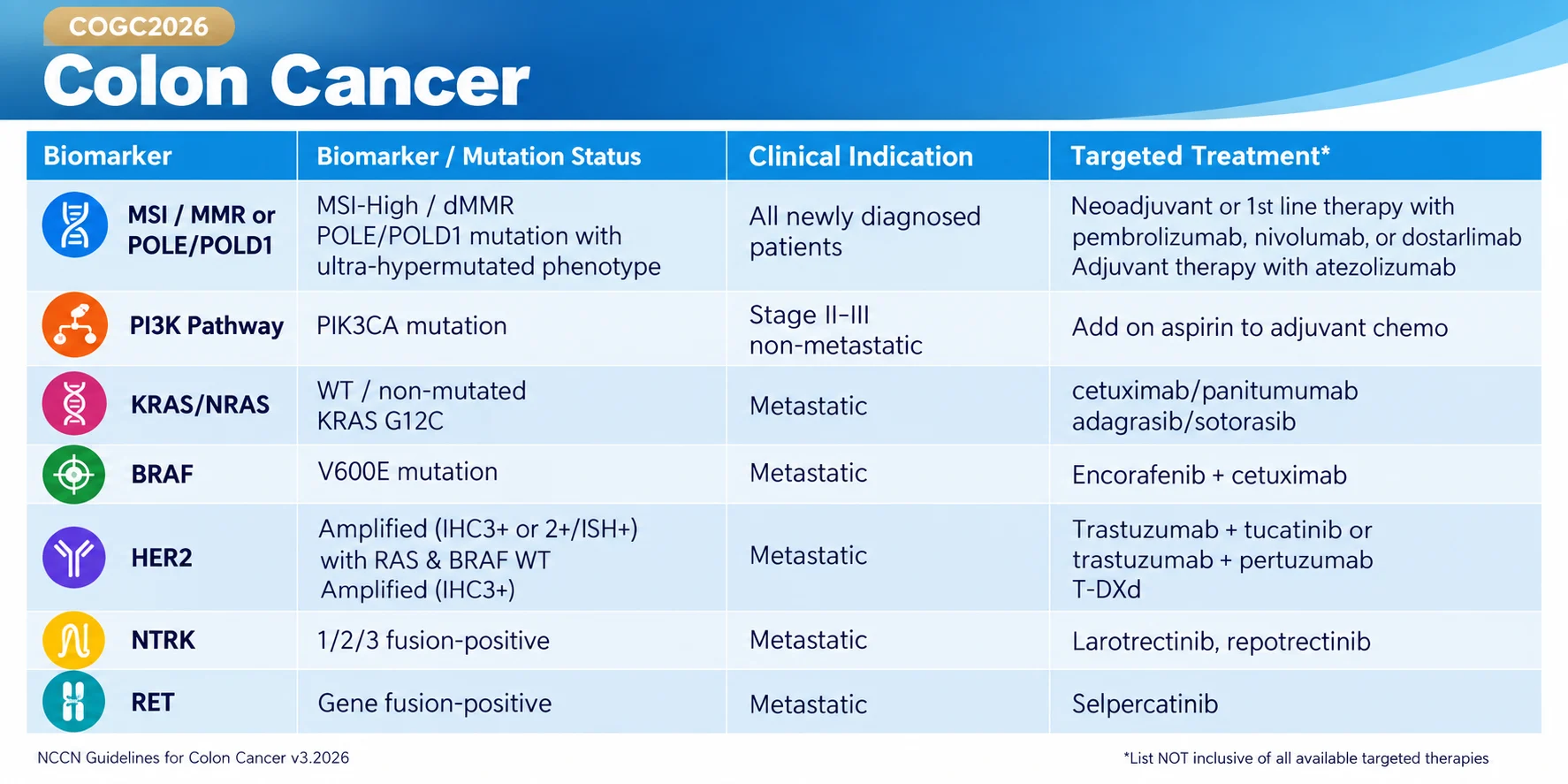
“Starting first with colon cancer, guidelines dictate that every newly diagnosed colorectal cancer patient should be tested for MSI or MMR status.
This acts as a screen for hereditary Lynch syndrome, but it also helps us determine the role of immunotherapy.
Additionally, testing for PI3K pathway alterations can help determine whether adding aspirin to adjuvant therapy could provide benefit for patients with a PIK3CA mutation.
For metastatic disease, broad genomic profiling is recommended, and this must include the RAS pathway.
For instance, if we have a patient with mutated KRAS or NRAS genes, anti-EGFR therapies such as cetuximab or panitumumab have been shown to be ineffective. So giving those therapies would subject the patient to unnecessary toxicity without any clinical benefit.
If we identify a BRAF V600E mutation, which is found in approximately 8% to 10% of metastatic cases, this signifies a highly aggressive disease. Adding targeted therapies such as encorafenib plus an anti-EGFR therapy has improved outcomes.
So identifying these mutations allows us to directly target therapy and improve outcomes for patients.
If MSI or MMR status is found to be high or deficient, or if the patient has a POLE or POLD1 mutation, this can also guide treatment decisions with immunotherapy in different settings.
And as I mentioned, for patients with a PIK3CA mutation, adding aspirin to adjuvant therapy has been shown to provide a survival benefit.
Then, in subsequent lines of metastatic disease, after initial therapy, we have other targets such as HER2, NTRK, and RET.”
A Broader Panel for Upper GI Cancers
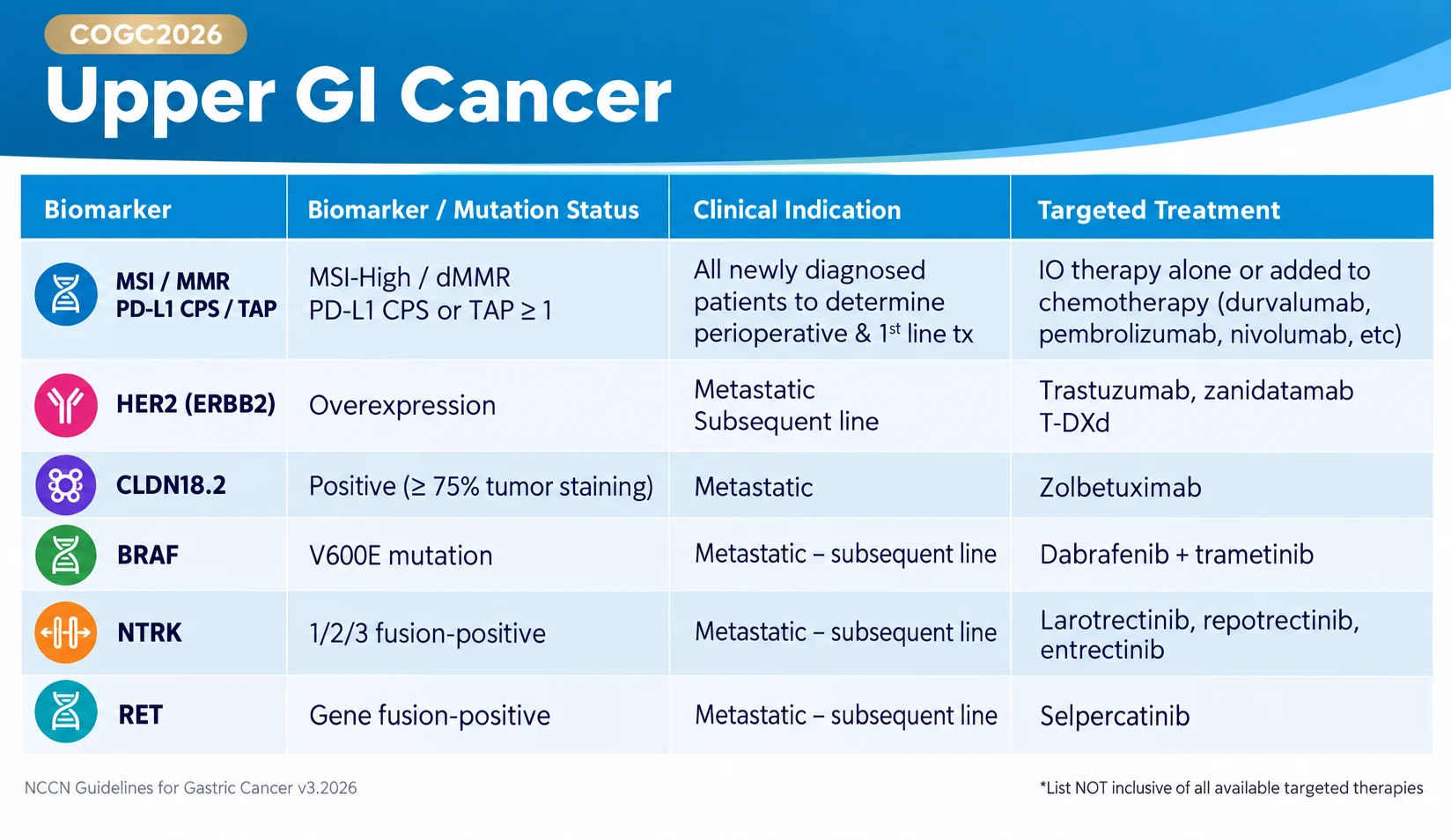
“Shifting to upper GI cancers – including esophageal, gastric, and gastroesophageal junction cancers – the heterogeneity is incredibly high, so this requires a slightly broader panel.
Testing for HER2 and PD-L1 remains standard of care for treatment decisions, including perioperative and first-line therapy.
For immunotherapy selection, a high CPS score indicates a stronger benefit from checkpoint inhibitors upfront.
More recently, a new biomarker, Claudin 18.2, has really transformed clinical practice. It is present in about 20% to 40% of upper GI adenocarcinomas and can be targeted using zolbetuximab in HER2-negative patients.
For upper GI cancers, it is especially important to have this information available before treatment selection.
For example, in patients who are MMR-proficient or have a PD-L1 CPS score of less than one, using immunotherapy may increase the risk of toxicity without providing meaningful clinical benefit.
And then we have Claudin 18.2. Of note, it requires a high level of tumor staining, with 75% of tumor cells staining considered positive, to identify patients who may benefit from frontline therapy with zolbetuximab.
We also know that several biomarkers may coexist. So we have several potential combination therapies, and we are continuing to learn more in this landscape as ongoing clinical trials continue.
Again, identifying these biomarkers allows us to directly target therapy and improve outcomes for our patients.”
Testing Has to Happen in Time
“Unfortunately, we may encounter technical challenges and limitations with biomarker testing for some patients.
Some procedures may not produce enough tumor tissue to run all the necessary testing. Therefore, we also have liquid biopsy through circulating tumor DNA as a valuable tool.
A negative liquid biopsy should then be verified by tissue testing, but it can provide real-time information and identify resistance mutations without having to perform repeated invasive procedures.
If results are delayed, treatment can also be delayed, allowing the disease to progress. So timely testing and having those results available is truly imperative.
By ensuring that workflows are in place for pathology ordering, using liquid biopsy to supplement insufficient tissue samples, and cultivating a collaborative network, we can deliver tailored and effective care for all of our patients, and ultimately, reduce toxicities and improve outcomes.”
Written by Eliz Baloyan, MD, Features Writer and Editor at OncoDaily and CancerWorld
Watch the full video on YouTube.