The first Community Oncology Global Congress (COGC 2026), organized by OncoDaily, brought together oncology professionals from around the world to discuss the challenges and opportunities shaping cancer care in community settings.
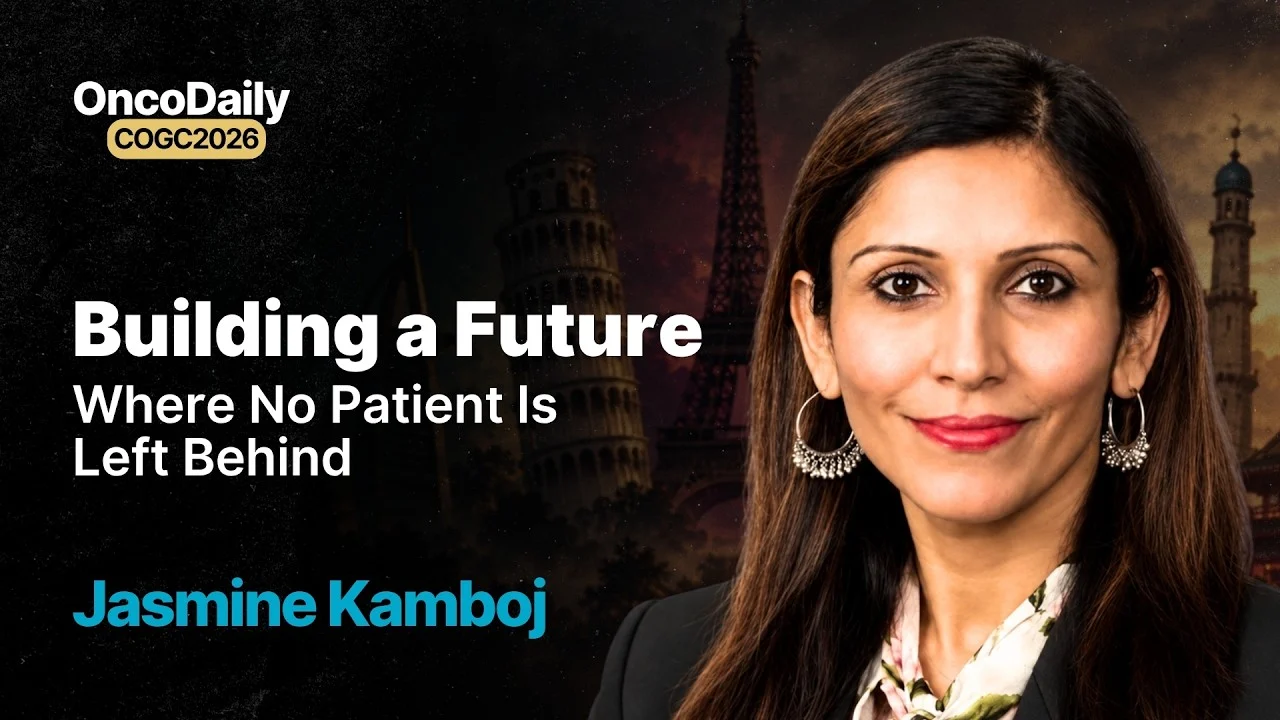
Opening the Congress, Jasmine Kamboj, Congress President and Medical Director of the Cancer Care and Infusion Center at Northfield Hospital + Clinics, focused on why community oncology must have a central place in the future of cancer care.
She set the tone for the Congress with a powerful message:
“Welcome to the first Community Oncology Global Congress by OncoDaily. And now, let us build that future together.”
Community Oncology at the Front Line
“Community oncology is not the periphery of cancer care; it is the front line.
It is where a patient first hears the words, ‘You have cancer,’ and where their family asks, ‘What do we do now?’ That is precisely why it deserves a central stage.
The geography of cancer care is changing. For years, oncology innovation has been closely associated with major academic medical centers – and rightly so. These institutions are essential to discovery, the development of new therapies, transformative research, and training the next generation.
But discovery is only the beginning. A therapy does not change a patient’s life simply because it exists, and a biomarker does not help simply because a lab can identify it.
A breakthrough is only a breakthrough when it reaches the patient. That journey from discovery to delivery is where community oncology is indispensable.
The future of oncology will be defined not only by what we discover, but by how broadly, how quickly, and how equitably we can deliver it.
Innovation must be deliverable. We are living through a remarkable period of therapeutic progress, but that raises another question: can we actually deliver it? Do practices have the pharmacy infrastructure, nursing expertise, emergency protocols, and monitoring capacity to administer these treatments safely? Can health systems support them, can patients afford them, and can treatment begin on time?
Because in oncology, time matters. Cancer care is a race against time – from an abnormal screening result to diagnosis, staging, pathology and biomarker testing, and finally to treatment.
Community oncology is uniquely positioned to address these delays because these practices understand the barriers within their own communities – which referrals take days, which take weeks, and the realities behind the statistics.”
Access, Research, and Precision Oncology
“Access is one of the most important conversations we will have at this Congress. Access to diagnosis, specialists, pathology and molecular testing, clinical trials, radiology and surgery, radiation oncology, supportive care, and the infrastructure that makes all of it possible. A patient’s zip code should not become a biomarker of survival.
Next is research. For too long, there has been an artificial separation between research and community patients. But the patients treated in community practices are the same patients we need represented in the evidence that guides cancer care: older adults, people in rural and underserved communities, those with multiple medical comorbidities, patients who cannot travel hundreds of miles, who speak different languages, or who face financial toxicity. Community oncology can bring clinical trials closer to these patients, generate real-world evidence, and create partnerships that allow smaller practices to contribute meaningfully to discovery.
And with precision oncology, we also have to talk about precision of access. Is precision oncology truly for all? If advanced molecular testing is available only to patients who can reach larger academic centers, it risks becoming another source of inequity. Perhaps the goal should not simply be precision medicine, but precision medicine with access and timely delivery.”
AI, Infrastructure, and the Needs of an Aging Population
“Artificial intelligence is an opportunity, not a replacement.
It has enormous potential and may help us identify patterns in data, improve documentation, support clinical decision-making, identify the patients who may benefit from interventions, improve workflows, reduce administrative burdens, and potentially expand the capabilities of smaller oncology practices. AI should augment the oncologist, not replace the relationship between the oncologist and the patient. Because cancer care is not simply information delivery. It is a human problem.
The future of oncology should be technology-enabled but human-centered.
Infrastructure is not separate from cancer care. An infusion chair is infrastructure. A trained oncology nurse and a reliable pharmacy are infrastructure. Increasingly, data and artificial intelligence are infrastructure too. If we want community oncology to deliver sophisticated, high-quality care, we have to invest in the systems that make that care possible.
At the same time, oncology has to adapt to an aging population. Older adults make up a growing proportion of patients with cancer and face distinct challenges involving function, cognition, nutrition, polypharmacy, frailty, caregiver support, transportation, social isolation, and financial vulnerability.”
The future of oncology must be not only disease-centered, but person-centered.”
Financial Toxicity, Leadership, and Global Collaboration
“Financial toxicity is another form of cancer care-related toxicity. A cancer diagnosis can threaten not only a patient’s health, but also their employment, housing, education, savings, family stability, and future. A therapy may be clinically appropriate and still be financially devastating.
Financial navigation must become part of comprehensive cancer care.
Leadership, meanwhile, is about building strong communities and connecting patients, systems, research, and policy. It is not about having the largest institution or the biggest research budget. It is about asking what we can build together that none of us can build alone.
A community oncologist in Kenya may face different challenges from one in Canada, just as a physician in India may face different infrastructure barriers from a physician in the United States. But the common threads remain: access, timely diagnosis, safe treatment, evidence-based practice, and care for our patients.
The future of oncology cannot be built in isolation.”
Questions That Demand Solutions
“This Congress is not simply about identifying problems. It is about asking: what is the solution, and how do we build it?
- Can we create global partnerships for biomarker testing?
- Can we develop stronger models for community-based clinical research?
- Can we build practical frameworks for AI adoption?
- Can we learn from countries that have addressed access differently?
- Can we improve models for financial navigation?
- Can we create training opportunities for community oncologists, young physicians, and trainees across borders?
- Can we build a global community oncology research network?
I believe the answer is yes – but only if we work together.
Cancer does not recognize borders, and sometimes the most powerful innovation is not a new drug. It is a new partnership.”
Why Does Community Oncology Need The Central Stage?
“Because the future of oncology depends on our ability to translate extraordinary science into quality clinical practice.
As we begin this Congress, I would challenge each of us to think beyond our own institution and our own country, and ask three questions:
- What is one barrier to cancer care that I can help remove?
- What is one solution from my community that I can share with the world?
- What is one idea I can take home from this Congress and turn into action?
If each of us can do that, this meeting becomes more than a Congress. It becomes a movement – one that works toward a future where a patient’s location does not determine the quality of cancer care they receive.
Let us give community oncology the stage it deserves. Let us make access an innovation, research more inclusive, and leadership more collaborative. And let us build a future in which no patient is left behind simply because they live outside the traditional centers of cancer care.
Welcome to the first Community Oncology Global Congress by OncoDaily.
And now, let us build that future together.”
Written by Eliz Baloyan, MD, Features Writer and Editor at OncoDaily and CancerWorld