Key takeaways
- In Malawi, cancer drug access improved gradually through advocacy, procurement reform, dedicated budgeting, stronger pharmacy involvement, and inclusion of cancer medicines in the national essential medicines list.
- Even when a medicine is considered essential, special procurement procedures can still create long delays and make treatment unpredictable.
- Financial toxicity affects both public and private care, especially for newer cancer therapies that are expensive, poorly covered, or procured one patient at a time.
- Expanding access must address quality as well as quantity; more medicines do not improve care if the products are substandard or the system cannot deliver them safely and consistently.
At the Community Oncology Global Congress (COGC 2026), organized by OncoDaily, Irene Chidothe-Chisale, Chief Clinical Oncologist at Malawi National Cancer Centre, explored what access to essential cancer medicines actually requires in lower-resource settings, using Malawi as a practical example of how cancer drug access has evolved over time.
Her presentation moved beyond the question of whether medicines appear on a national list and looked instead at the wider system that determines whether those treatments are available in sufficient quantities, affordable, of reliable quality, and ultimately able to reach patients when they are needed.
Essential Medicines Depend on More Than a List
The World Health Organization defines essential medicines as treatments that address the priority healthcare needs of a population. That means there first has to be a demonstrable public health need, but the medicines themselves must also be effective, safe, and cost-effective.
In cancer care, meeting that definition is only the beginning. A functioning health system is needed around those medicines, with adequate quantities, appropriate formulations, affordable pricing, reliable supply, and systems that can control costs without compromising the quality of care. The ultimate purpose is not simply to purchase more drugs, but to improve cancer treatment outcomes.
This goal also sits within Sustainable Development Goal 3, particularly target 3.8, which calls for access to safe, effective, quality, and affordable essential medicines and vaccines for all by 2030.
Yet cancer makes that goal increasingly difficult to achieve. The burden is rising, treatment costs are increasing, and inequalities in access remain deeply established. In low- and lower-middle-income countries, cancer spending must often compete with many other health priorities, including communicable diseases, making sustainable approaches to cancer treatment access increasingly urgent.
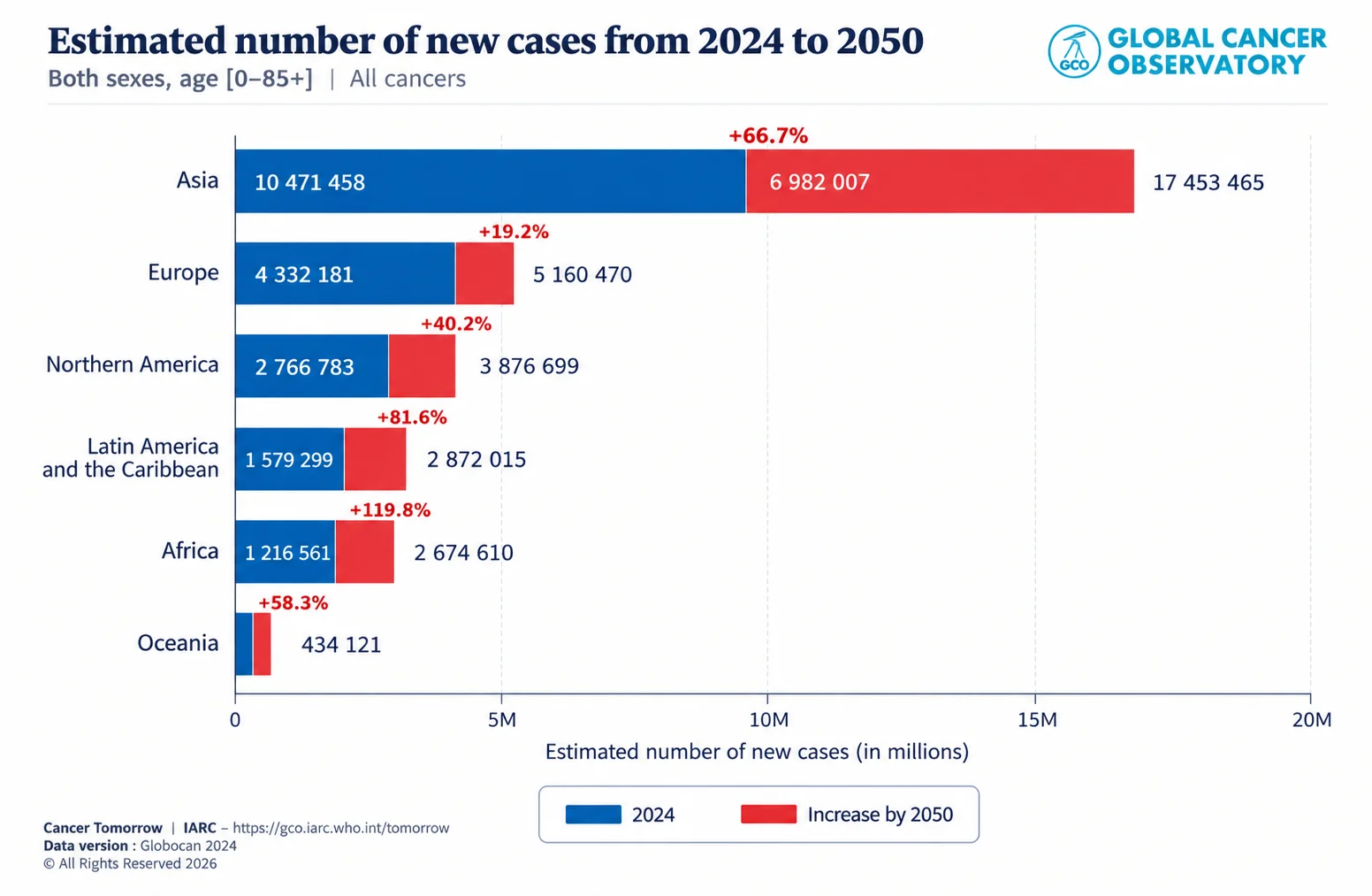
Africa may still account for fewer cancer cases than some other regions in absolute numbers, but the projected percentage increase is substantial. That growth means health systems already struggling with limited oncology capacity will be expected to manage considerably more disease in the coming years. Simply expanding drug budgets without strengthening the surrounding infrastructure is unlikely to be enough.
Why Patients Still Face Delays
Delivering systemic cancer therapy requires infrastructure that remains limited in many settings. There may be only a small number of treatment centers, inadequate facilities, and restricted laboratory and diagnostic capacity. Workforce shortages extend from specialists to supportive-care professionals, while patients may have to travel long distances and find accommodation simply to receive treatment. These barriers contribute to treatment abandonment and can make even a theoretically available medicine practically inaccessible.
The consequences become especially clear when a patient travels a considerable distance only to arrive at a facility and learn that the required medicine is unavailable. That may mean remaining away from home for longer than planned or making the entire journey again later, neither of which is simple for patients already dealing with the financial and logistical burden of cancer care. Medicine availability therefore has to be understood as part of a much larger health-system problem.
There is also another dimension that can be overlooked when access is discussed only in terms of supply: quality. Increasing the number of medicines available does not solve the problem if some of those products are substandard. In lower-resource settings, access therefore has to address both the quantity of treatment available and confidence in the quality of what patients are receiving.
Malawi’s Progress on Cancer Drug Access
Malawi illustrates how this access landscape can gradually change. Cancer care is currently concentrated at tertiary hospitals within a health system that is predominantly public. Although services are generally provided without direct charges, there is no mandatory national health insurance, and the essential health package historically placed greater emphasis on communicable diseases.
When the country’s first Malawian oncologist arrived in 2010, there was no dedicated oncology drug budget. Cyclophosphamide was occasionally available, but use was limited enough that medicines could expire, while some supply was also being used for Kaposi sarcoma treatment.
The initial response was therefore extremely practical: begin with the medicines needed for the cancers actually being seen and gradually build a more organized system around them. Doxorubicin and methotrexate were added, pharmacists became involved, and the process of defining the country’s oncology medication needs started to take shape.
That work then moved beyond the hospital. Media engagement helped draw national attention to the condition of cancer services and the gaps in medicine availability. Political advocacy was followed by engagement with the central procurement system, eventually leading to the creation of an essential cancer medicines list and a formal quantification process. Over time, this evolved into an independent national cancer-center drug budget, with additional funding also being considered within central hospital budgets specifically for oncology medicines.
As more oncologists entered the system, their participation in hospital drug and therapeutics committees also increased, helping oncology become more visible within procurement and budgeting decisions. At the same time, charitable partnerships became another source of access. Organizations such as the Max Access Foundation initially supported targeted therapies and later expanded access to CDK4/6 inhibitors for breast cancer.
Government-to-government agreements have occasionally brought large consignments of medicines as well. These can provide important short-term relief, but they are difficult to predict and therefore cannot serve as the foundation of a sustainable supply system. The longer-term progress has been the incorporation of cancer medicines into the Malawi Essential Medicines List, which is adapted from the WHO Model List of Essential Medicines and revised every two years.
When Essential Does Not Mean Accessible
Even after cancer drugs are included on a national essential medicines list, the procurement category assigned to them can make an enormous difference. Medicines are classified according to the level at which they are used and whether they are considered vital or essential. They are also categorized according to how they are procured. Some are frequently stocked, while others require special procurement procedures.
Rituximab and trastuzumab are examples of medicines that fall into the special-procurement category in Malawi. That classification itself creates another potential delay, because the drugs are not necessarily sitting on a shelf waiting for a patient. Access therefore depends not only on whether a medicine has been recognized as essential, but also on whether procurement processes allow it to reach facilities predictably and on time.
Overall, Malawi’s essential medicines list has a reported compatibility rate of around 77% with the WHO Essential Medicines List.
However, limitations are not confined to the public sector. Private care is largely insurance-based, but coverage remains poor for many newer and more expensive treatments. Nivolumab, for example, may require at least 30 days to obtain and is procured individually for each patient rather than routinely stocked.
Patients can consequently face substantial out-of-pocket shortfalls. In some cases, that financial toxicity becomes severe enough that a patient begins treatment privately but later transfers to the public sector before completing therapy. The distinction between public and private access is therefore not as simple as one system having drugs and the other not having them. Both can contain different forms of delay, affordability problems, and interruptions in continuity of care.
Financing and Procurement Need Different Solutions
One approach Malawi has introduced is optional paying services within public institutions.
This creates a middle ground where some treatments can be offered at a subsidized cost while also increasing the purchasing power of the institution. Discussions around national health insurance continue, but in the meantime, alternative financing models may provide at least some additional flexibility.
Procurement is another area where structural changes could make a difference.
The current reliance on intermediaries can increase costs and may also make quality assurance more difficult. Greater direct engagement with manufacturers could potentially reduce both problems. Regional or pooled procurement could also increase purchasing power by allowing countries or institutions to negotiate as part of a larger market rather than buying small quantities independently.
In the longer term, local production may provide another way of strengthening supply chains. Producing medicines closer to where they are used could improve availability, reduce some dependence on international supply routes, and potentially make quality easier to regulate. For countries repeatedly facing shortages or long procurement delays, that kind of structural investment may become increasingly important.
Biosimilars also have an obvious role, particularly for biological treatments whose originator products remain expensive.
As more biosimilars become available, they could help bring some therapies within reach of health systems that would otherwise struggle to finance them. The value of biosimilars, however, still depends on the same broader questions of procurement, quality assurance, supply, and appropriate clinical use.
When Partnerships Fill the Gaps
No single mechanism is likely to solve the access problem, particularly when national oncology budgets remain limited and are competing with many other health priorities. Partnerships therefore become an important part of the strategy, whether they are public-private collaborations within a country or broader regional and global initiatives.
One example is the ATOM Coalition, which focuses on strengthening capacity in lower-resource countries and improving access to cancer medicines, including immunotherapies. Its broader goal is to reduce cancer-related suffering and deaths in LMICs by improving both access to and appropriate use of essential cancer treatments. Initiatives like this can complement national systems, particularly where individual countries do not have enough purchasing power or technical capacity to solve every access problem independently.
Partnerships, however, work best when they strengthen a system rather than create isolated streams of donated medicines. Predictable procurement, trained staff, diagnostic capacity, treatment infrastructure, and monitoring still have to exist if the medicines are going to produce meaningful and sustainable improvements in cancer outcomes.
What Real Access Requires
Expanding cancer medicine access ultimately begins with evidence.
Health systems need data that demonstrate the burden of disease and justify why a particular treatment should be prioritized. There also needs to be evidence that the medicine provides a meaningful clinical benefit and that its use is aligned with treatment guidelines adapted appropriately to the local setting.
The same process has to continue after a medicine has been introduced. Monitoring and evaluation systems are needed to assess whether practice remains evidence-based, whether medicines are reaching the patients who need them, and whether the investment is actually improving outcomes. At the same time, countries need to continue strengthening the broader cancer infrastructure, from prevention and diagnosis through treatment and supportive care.
The central message is therefore that essential cancer medicine access cannot be reduced to the number of drugs sitting in a pharmacy. Supply matters, affordability matters, and expanding the list of available therapies matters, but none of those is sufficient if quality cannot be guaranteed or if the health system cannot reliably deliver treatment to the patient.
In settings already at risk of receiving substandard medicines, that distinction becomes especially important. Access has to mean both enough medicine and medicine of the right quality.
Written by Eliz Baloyan, MD, Features Writer and Editor at OncoDaily and CancerWorld