Key takeaways
- The right study has to be both scientifically meaningful and realistic for the clinic to execute without protocol deviations.
- Trial matching should be proactive, with patients identified before they urgently need another treatment option.
- Electronic medical records and AI can help identify candidates earlier, but they support rather than replace physician and coordinator review.
- A strong trial portfolio means little if patients never enroll; real access depends on the right trial, patient, timing, and workflow coming together.
- The broader goal is to reduce travel and operational burden so patients can access innovation while staying within their community. Pasted text
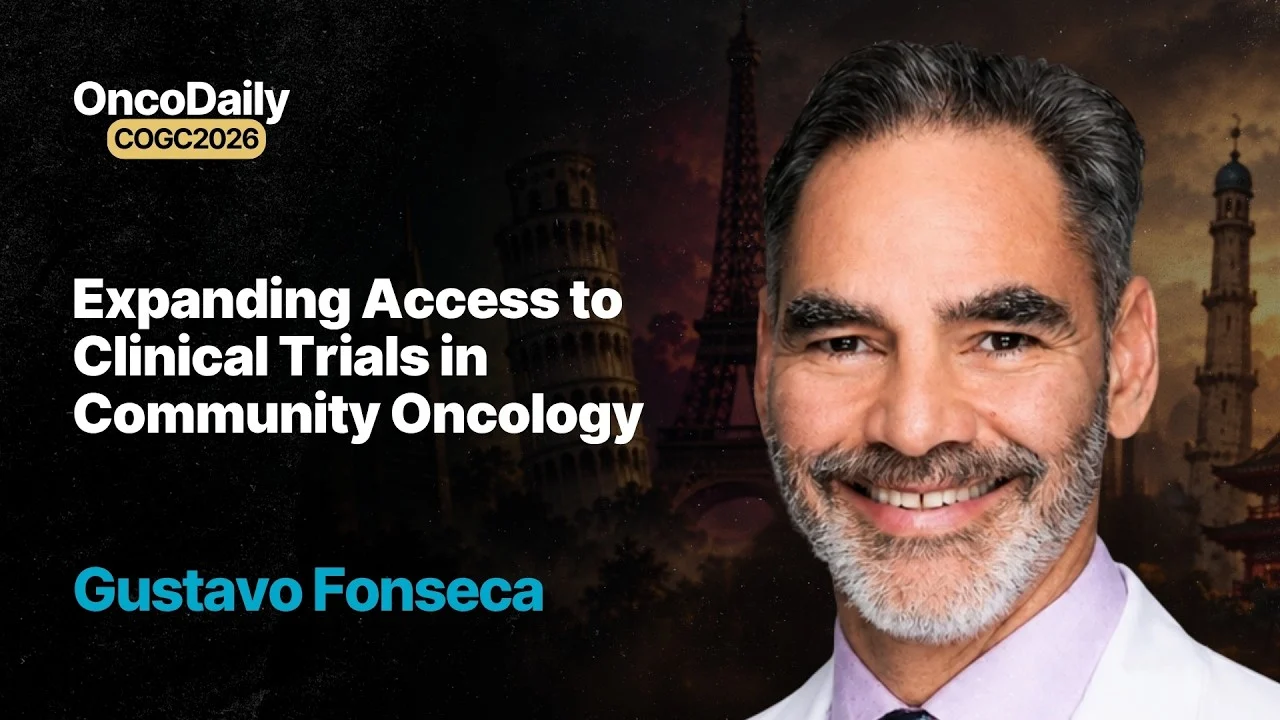
At the Community Oncology Global Congress (COGC 2026), organized by OncoDaily, Gustavo Fonseca, Director of research and clinical trials at Florida Cancer Specialists and Research Institute, discussed how clinical trials can become part of everyday community oncology, allowing patients to access innovative therapies without leaving the places where they already receive their care.
“In the community, research has to be part of the clinical care.”
Drawing on decades of experience conducting research across a large community oncology network in Florida, Fonseca explained what has to happen behind the scenes to make that possible – from choosing the right studies and identifying patients early to building the workflows, staffing, and regulatory systems that allow research to fit into routine care.
The Goal: Keep Innovation Close to Home
“We are trying to continue delivering top-of-the-class care to our patients while they are closer to home, while they are in their community, while they are with their family, and not necessarily identifying only the patients who can get on an airplane and travel four hours to be part of a clinical trial.
We want to make sure that the day-to-day community patients who come to see their nearby hematologist or oncologist are still receiving the best care by having access to a clinical trial portfolio that is top-of-the-line, globally acceptable, and National Cancer Institute-vetted.
We are a group of more than 200 physicians and advanced practice providers delivering day-to-day hematology and oncology care throughout the state of Florida, and we have been doing research in the community for decades.
Today, we have more than 180 clinical trials open at any given time, and we enroll more than 800 patients each year. We participate in global clinical trials as well as studies brought to us by sponsors, while the patient continues to receive care closer to home.
The idea is that while patients are being taken care of on a daily basis, they can still participate in innovative clinical trials.
Even though this is the experience of one state in the United States, we believe that many of these principles can be applied to other parts of the country and other parts of the world.”
Research Has to Fit Into Routine Care
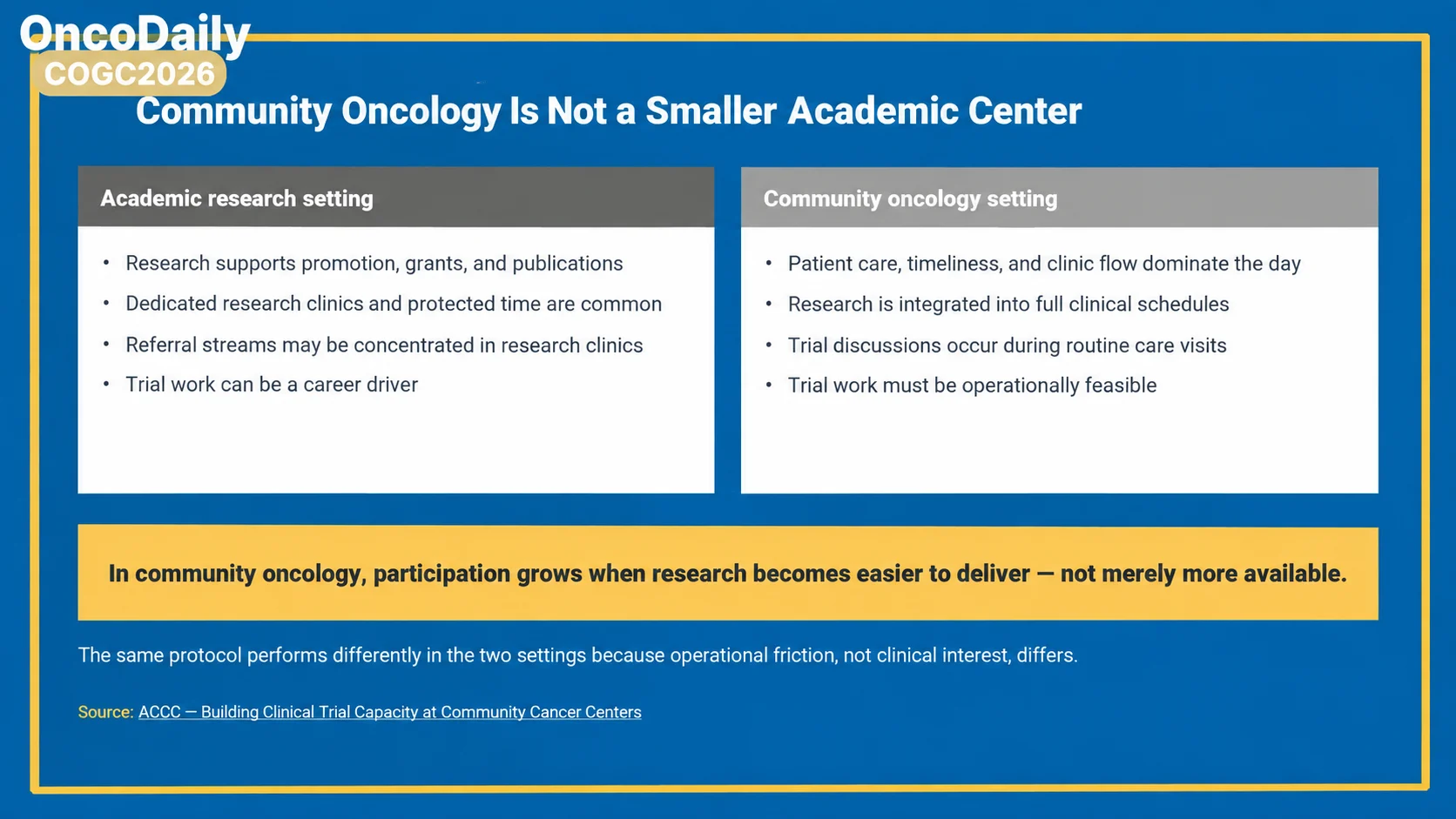
“There is a difference between the academic research setting and the community oncology setting.
In the academic setting, research may be supported by grants and publications, and you may have a dedicated research clinic, laboratory, and staff.
In the community, we are seeing a multitude of patients – hematologic malignancies, breast cancer, colon cancer, unusual sarcomas, and many other diseases – and we have a much narrower time opportunity.
In the academic setting, there are referral streams, with physicians identifying patients and sending them to a particular researcher or professor.
In the community, the research has to be part of the clinical care. The clinical trial has to accommodate the patient’s routine care visits.
For us, this is passion-driven work. We are trying to make sure that research becomes part of their care and that our patients can receive the best treatment while remaining close to home.”
Finding the Trial Before the Patient Needs It
“We know that the National Cancer Institute, the NCCN Guidelines, and other groups that have evaluated the importance of conducting clinical trials in the community recognize that this is vital for patients.
Many times, a clinical trial may be one of the best opportunities for a patient. The progress of oncology has been such that, in many circumstances, the standard-of-care treatment is one of the arms, while the patient may also have the opportunity to receive a newer therapy.
We can simply look at the history of oncology over the last 20 years to understand how much progress has come through clinical research. So we want to deliver that opportunity in the community as well.
But we do not want to work in a reactive model.
Twenty or twenty-five years ago, that may have been the way oncology worked. A patient might go through three or four standard chemotherapies, and then suddenly we would say, ‘We do not have anything else. Let us find a phase I study.’
The disease progresses, and only then are the options sought.
We want to move toward a proactive model.
Patients should be followed before they become eligible for a particular study. Maybe they have a targetable molecular finding. Maybe they are following a particular sequence of therapies. Maybe they have lung cancer, have received immunotherapy, and we already know that a particular next-line agent or trial may become relevant.
In the reactive model, the physician is urgently looking for an option.
In the proactive model, we want those opportunities to be prepared in advance.
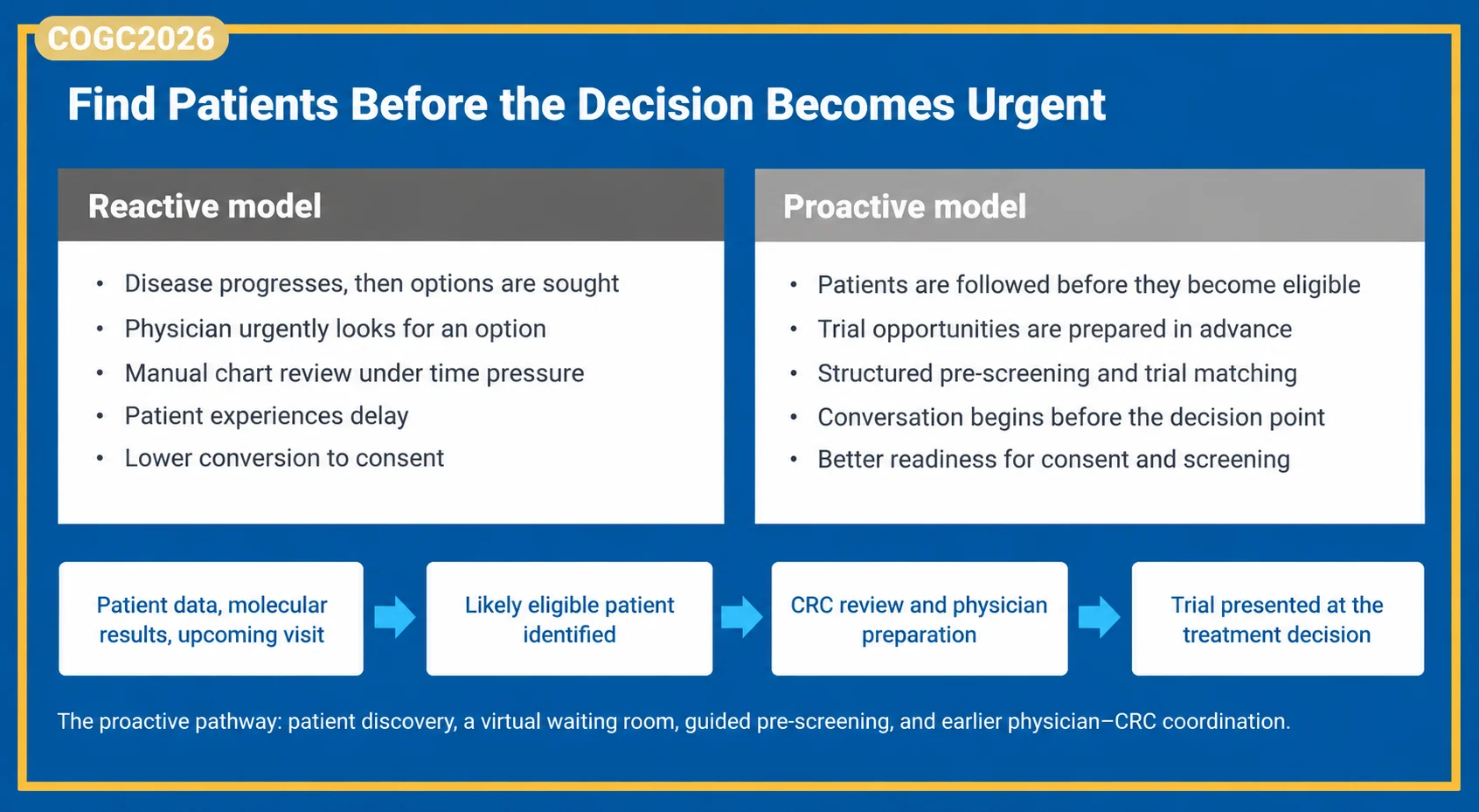
This is where electronic medical records and artificial intelligence can help us.
We are trying to match patients and studies more effectively so that we can communicate those opportunities to the clinical team.
It is important to have the patient’s data, molecular results, treatment history, and other clinical information available so that the patient can be identified.
Then the chart can be reviewed in detail, the inclusion and exclusion criteria can be assessed, and the study can be presented to the patient.
Technology can help us identify the opportunity earlier.”
Before the Trial Begins: The Right Study, The Right System
“We start by choosing the right studies.
They need to have scientific value, but they also need to fit our patient population and fit operationally within the clinic. For example, if a study requires a pharmacokinetic blood sample eight or twelve hours after treatment, or after a six-hour infusion, that may not work in a community clinic that is no longer open at that time.
If the protocol requires it, we cannot simply decide not to do it. That would be a protocol deviation. If the sponsor thought that procedure was important enough to include in the protocol, then by accepting that study we are making a commitment to perform it correctly.
So if we know we cannot do that, we should not choose that study.
The goal is to create a high-value trial menu for our patients – something scientifically attractive, but also something that can realistically be executed in the community with a reasonable commitment from both patients and physicians.
But choosing the right studies is only the beginning. Those studies also need to be supported by the right clinical team.
You need a physician, an advanced practice provider, and a clinical research coordinator who is dedicated to making sure that the protocol is followed to the letter. We do not want to give a very experimental, very novel, and potentially dangerous therapy without monitoring the patient appropriately. The protocol has to be followed very carefully, and that requires a real partnership between the physician and the clinical research coordinator.
Behind that clinical team, you also need a reliable operational process. Staff have to make sure that all training has been completed, financial disclosures are in place, and the investigational product is handled correctly from the moment it is shipped until the moment it is administered to the patient. Temperature requirements, drug accountability, and the entire chain of delivery all have to be maintained.
The same applies to quality assurance and regulatory support. If there is an audit by the sponsor or by the FDA, all of these processes need to be properly established so that there is no disruption to patient care.
Then, when the patient comes for a routine visit, the staff should already be identifying whether that patient may be a clinical trial candidate. That information needs to be visible so that the physician and the patient can discuss the trial as one of the treatment options.
If the physician, the patient, and the family think that it may be appropriate, then the patient can meet with the clinical research coordinator, review the consent form, learn more about the study, and understand whether there will be extra imaging, laboratory tests, or other requirements.
The truth is that science is complicated, so clinical research does require extra time. But compared with the patient who has to travel three, four, or five hours by car, or get on an airplane to reach an academic center, here we are trying to bring all of this to the patient.
We want to identify eligibility clearly, enroll the patient when appropriate, and keep the travel burden to a minimum. At every step, however, there can be a delay, and there can be a point where somebody at the site or in the clinic needs to recognize how we avoid losing that patient.
We do not want unnecessary friction to reach the point where the patient says, ‘Just give me the pill my doctor already mentioned,’ instead of continuing with the clinical trial.
At the end of the day, all of this is centered on patient access to innovation. You need good studies, good clinical staff, reliable operations, and a process that is smooth enough for the patient to actually reach the trial while still keeping everything in their best interest.”
It Takes Two to Make the Trial Work
“There is a dance to this process.
The physician needs the coordinator – it takes two to tango.
The physician understands the patient, the family, the overall situation, and the willingness to participate in a clinical trial and do the extra work that comes with it.
The clinical research coordinator understands the protocol, knows how to follow it, and makes sure that we avoid exclusions or deviations that could put the patient or the family at unnecessary risk.
All of this is about reaching a timely, informed, patient-centered decision.
We want the patient to enroll when it is appropriate, but we also want to make sure that he or she is being served in the best possible way.”
The Measure of Success Is Patient Access
“Access, speed, quality, and the overall experience are all vital if a clinical trial program in the community is going to be successful.
And accrual is ultimately one of the outcomes that we need to measure. If we activate a study, we need to look at how long it takes to enroll patients and identify what can be improved in the system.
Because just having a good portfolio does not mean that we are actually delivering the care. At the end of the day, it is the patient who is enrolled in the clinical trial who actually benefits.
There may be a lot of staff working behind the curtain to make that happen, but if the patient does not get accrued, the system has not helped them.
For research to truly translate into access, several things have to come together:
- The right trial – one that is scientifically strong and relevant to the patient population.
- The right patient – identified early enough to consider participation.
- The right time – before the opportunity is lost through progression or treatment changes.
- The right workflow – one that reduces unnecessary friction for patients, physicians, and staff.
In the community, this can be done, and it can be very beneficial to both patients and research progress. But we also have to remove the barriers that make participation harder than it needs to be.
If the process becomes too burdensome, staff become disillusioned, physicians feel that research is too difficult to integrate into routine care, and patients may decide not to participate.
Smart improvements in workflow can make a significant difference, and this is another area where technology, including AI, can help.”
Written by Eliz Baloyan, MD, Features Writer and Editor at OncoDaily and CancerWorld