Key takeaways
- AI is most useful when it is built into the clinical workflow, not added as another separate tool.
- The biggest opportunity is to move care from reactive to proactive, using AI to prioritize risk, triage symptoms, and trigger follow-up.
- Safe use of AI requires human oversight, clear accountability, privacy, equity, and explainability.
- Agentic AI may be especially useful in community oncology because it can connect tasks such as triage, documentation, and scheduling within one workflow.
- AI should be judged by whether it improves workflows and patient outcomes, not only by model accuracy.
At the Community Oncology Global Congress (COGC 2026), organized by OncoDaily, Fred Ashbury, Co-founder and Chief Scientific Officer at VieCure, focused on a question that is becoming more important as artificial intelligence enters routine oncology practice: is the real value of AI in the model itself, or in the workflow built around it?
For community oncology, adding another platform, login, alert, or dashboard can easily increase complexity rather than reduce it. The presentation shifted the focus away from choosing the “best” AI tool and toward redesigning how information moves, who acts on it, and how quickly that action reaches the patient.
AI Needs More Than a Good Model
“The real question for me is no longer which decision-support tool we should use. It is which workflow that decision-support tool will be built into.
In many practices today, AI is still a bolt-on. People are using different user IDs and passwords, alerts are piling up, and clinicians have to leave their existing electronic medical record or other platforms to access decision-support applications.
For AI to succeed in community oncology, particularly where multiple technology ecosystems are already operating, it has to become fully integrated. Roles and handoffs need to be redesigned around what we are trying to accomplish, and somebody needs to be clearly accountable for acting on specific alerts. Otherwise, we simply create more alert fatigue.
We have also heard for decades that technology is going to save clinicians time. But if these tools are not integrated into the workflow, those time savings do not materialize.
And patients need to remain part of that system. They should not simply be on the receiving end.”
Four Ways AI Is Entering Oncology
“We have moved through several generations of artificial intelligence. We began with rules-based expert systems, then machine learning, followed more recently by generative AI and now agentic AI, where multiple steps can be carried out by semi-autonomous agents.
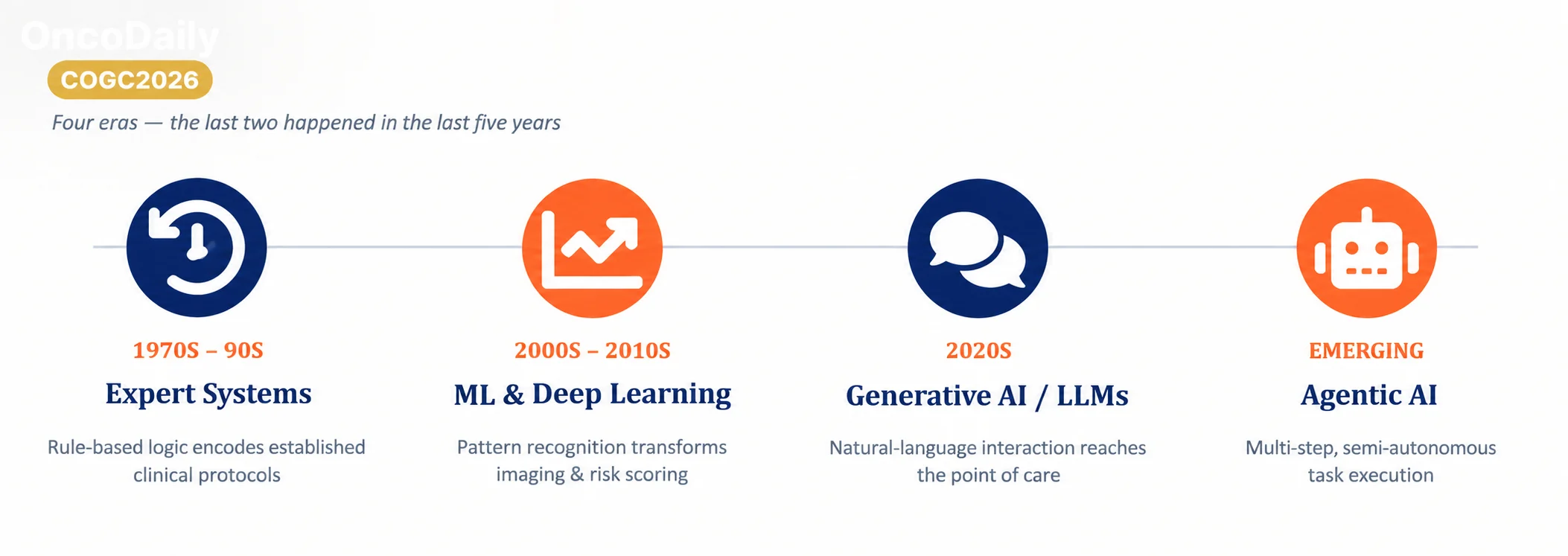
In community oncology, these approaches are not necessarily replacing one another. We are increasingly using elements of all of them.
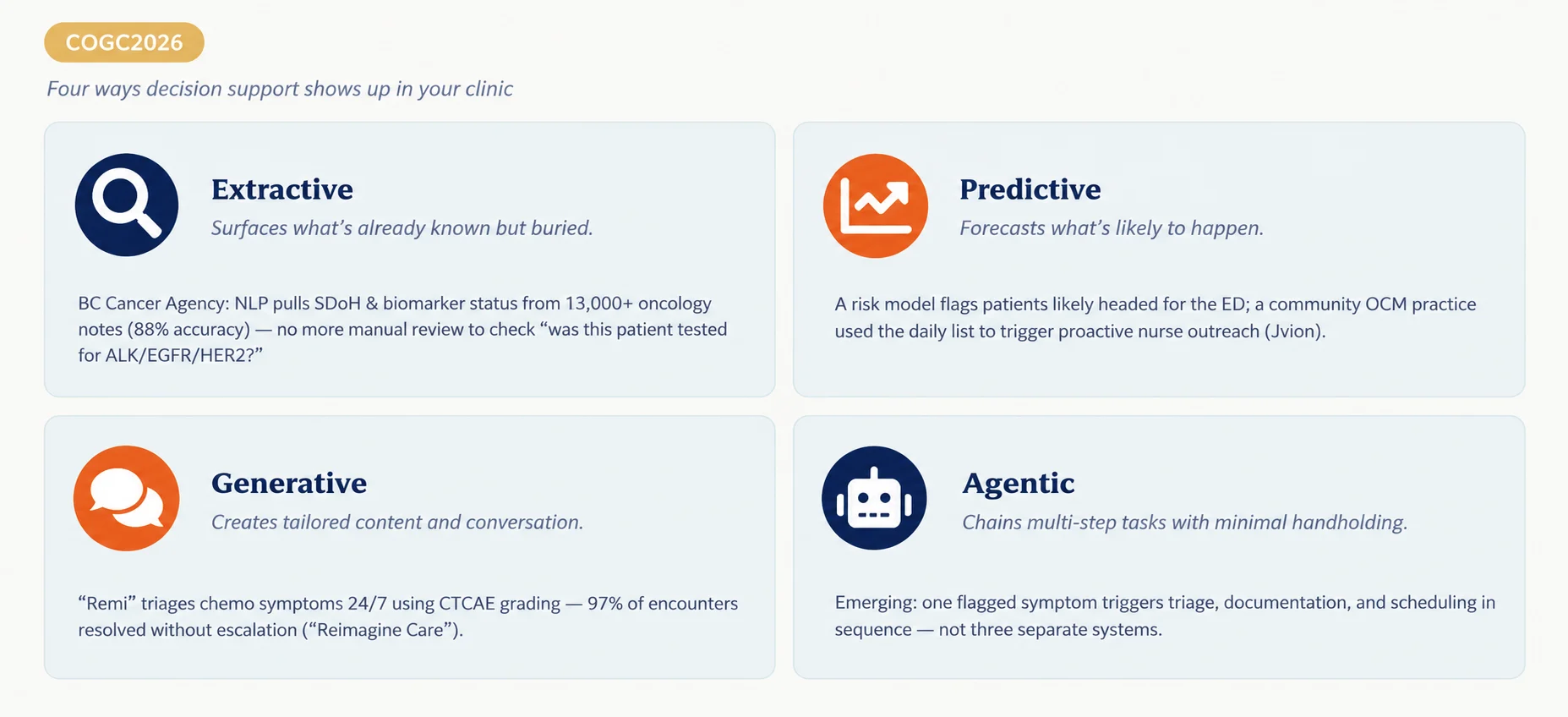
One form is extractive AI. It identifies information that already exists but is buried inside the record. For example, natural language processing can pull social determinants of health or biomarker status directly from oncology notes, reducing the need for manual chart review.
Then there is predictive AI, which can forecast what is likely to happen – for example, identifying patients at increased risk of an emergency department visit or hospital admission.
Generative AI can support symptom management. Patient-reported chemotherapy symptoms can be graded using CTCAE-based systems, helping determine which encounters require escalation and which can be managed without additional intervention.
And then there is agentic AI, where a symptom trigger might initiate triage, documentation, and follow-up scheduling in sequence rather than requiring three separate systems.
The important point is not simply that these technologies exist. It is how they change the work that happens around them.”
From Reactive Care to Risk-Triggered Care
“Across the cancer journey, AI can help change the way work is prioritized.
In diagnostic workup, patients are often organized according to when a scan was performed rather than according to clinical risk. AI can help identify which patients need attention most urgently.
In treatment planning, imaging, clinical, and molecular data can be combined to estimate recurrence risk. Instead of presenting tumor board cases simply in the order they were submitted, cases can be risk-stratified so that the most urgent or clinically significant cases rise to the top.
Supportive care is another important area. Generative systems can grade chemotherapy-related symptoms in real time. If nursing teams are responsible for toxicity follow-up, the workflow can change from calling every patient to managing the exceptions – the patients who actually need additional clinical attention.
In survivorship and rehabilitation, EHR data can be combined with patient-reported outcomes so that the clinic moves from fixed check-ins to risk-triggered outreach.
That is the transition I am interested in: from reactive care to proactive care.
The algorithm itself is not what changes the outcome. The redesigned workflow is what changes the outcome.”
Who Benefits From AI?
“We also have to ask whose workflow we are transforming and who can actually use these systems.
If we build digital care only for people who speak English well, have stable housing, reliable connectivity, and feel comfortable asking questions, then inequity is already built into the model.
AI can potentially help expand virtual access, particularly for rural communities where distance makes traditional care more difficult.
Language access is another important area. This is not simply about translation. It is also about cultural adaptation of language, so that communication actually works for the people receiving it.
And we need to recognize that we are not going to staff our way out of the workforce problem.
Oncology is already dealing with burnout, and across many disciplines people are retiring faster than they are being replaced. The solution cannot simply be to hire more people.
We need a layered model of care, and digital tools will have to become part of that model.”
Scaling AI Safely Requires More Than Accuracy
“If we are going to scale AI in oncology, we need to make it safe.
First, there should always be a human in the loop. Even a model performing at 88% accuracy is still missing 12%. That may be better than some manual processes, but it does not eliminate the need for human accountability.
We also need equity accounting to make sure that tools are working across different populations.
Privacy and governance are critical. Patients should understand what information is being collected, why it is being collected, who can see it, and how it is helping them.
Today, I do not think that understanding is always there. Patients and even clinical staff may upload complete medical records into general AI tools and query them for possible solutions without fully understanding the privacy implications.
Explainability matters as well. Oncology already looks like a black box to many people outside the specialty. AI can become another black box unless we can make clear what data it is using and which references support its recommendations.
A recommendation should not simply appear. We need to be able to ask: what evidence produced this answer, and is it actually the right evidence?
Finally, we need regulatory clarity. Evolving standards should not indefinitely delay useful tools, but deployment still requires appropriate oversight.”
Why Agentic AI May Fit Community Oncology
“Agentic AI may be particularly relevant for community oncology because it allows a workflow to be divided into smaller, dedicated functions.
A patient-reported symptom, for example, could trigger one agent responsible for triage, another for documentation, and another for scheduling follow-up.
Instead of asking one general-purpose large language model to do everything, we can use dedicated solutions for specific tasks.
That also makes problems easier to identify. If there is an error in triage, we can examine the triage model. When everything is embedded in one enormous model, finding where the problem occurred becomes much more difficult.
These smaller models may also be more realistic for community oncology budgets. They are more focused, less expensive to run, and potentially easier for an academic or community IT team to manage.
You can still have one connected system, but underneath it are individual agents performing specific jobs.”
Measure the Workflow, Not Just the Model
“For clinicians, the question should be straightforward: is this technology actually working inside your workflow?
Does it help you make the right decision at the right time for the right patient? Or does it require additional logins, additional platforms, and additional coordination with colleagues before anything happens?
There also needs to be a clear plan for who acts on the output. Role designation is essential.
For researchers, I would like us to move beyond reporting only model accuracy. Accuracy is important, but I also want to know what happened to the workflow.
Did staffing change? Were people added, reduced, or repurposed? How long did it take to reach the intervention? Did clinical outcomes improve?
For policymakers, AI-enabled proactive care may help stretch already constrained healthcare budgets by reducing unnecessary emergency visits and hospital admissions. But regulation should address the workflow and accountability chain, not just the model.
And for patients and advocates, transparency is essential. Who was represented in the training data? Who was excluded? What is automated, and what is reviewed by a human?
The bottom line is that AI’s promise in community oncology is not only decision support. It is workflow transformation that reaches all the way to the patient, while keeping the patient in the loop rather than simply at the endpoint.
The challenge is to take one workflow and redesign it from end to end – and then measure the human outcome, not simply the performance of the model.”
Written by Eliz Baloyan, MD, Features Writer and Editor at OncoDaily and CancerWorld