
Key takeaways
- Kidney cancer incidence and mortality are increasing in parts of Latin America, with delayed diagnosis and healthcare infrastructure limitations contributing to poorer outcomes.
- Public–private healthcare disparities in Brazil are associated with substantial differences in diagnosis, treatment access, and survival among patients with RCC.
- The LACOG 1120 Registry revealed major survival disparities, with approximately 80% five-year overall survival in the private system versus 42% in the public system, according to the figures presented.
- Access to second-line and subsequent therapies remains limited in Brazil's public healthcare system, restricting treatment opportunities for patients with metastatic RCC.
- Expanding clinical research, strengthening public hospital infrastructure, and developing locally relevant oncology guidelines could improve access to effective treatments and reduce inequalities in kidney cancer care.
Fernando Maluf, Associate Medical Director of the Oncology Center at BP – A Beneficência Portuguesa de São Paulo, member of the Management Committee of the Oncology Center at Hospital Israelita Albert Einstein, and cofounder of Instituto Vencer o Câncer, examined the disparities in renal cell carcinoma (RCC) diagnosis, treatment, and survival across Latin America during his presentation at VIRO 2026 – Global Voices in Renal Oncology by OncoDaily.
While advances in immunotherapy and targeted treatment have significantly improved outcomes in metastatic RCC, access to these therapies remains deeply unequal.
Brazil offers a particularly revealing example. The country has a large public healthcare system serving approximately three-quarters of its population alongside a private sector with substantially greater access to modern oncology treatments.
For patients with kidney cancer, the differences extend beyond drug availability. They include the stage at diagnosis, waiting times for surgery and radiotherapy, opportunities to receive subsequent treatment, and ultimately, survival.
Drawing on epidemiological data, Brazilian RCC registries, international studies, and his work in expanding clinical research, Maluf examined how these disparities influence patient outcomes and what could be done to address them.
Kidney Cancer Incidence and Mortality in Latin America
The burden of kidney cancer has been increasing across parts of Latin America, with concerning trends reported in Brazil and several neighboring countries.
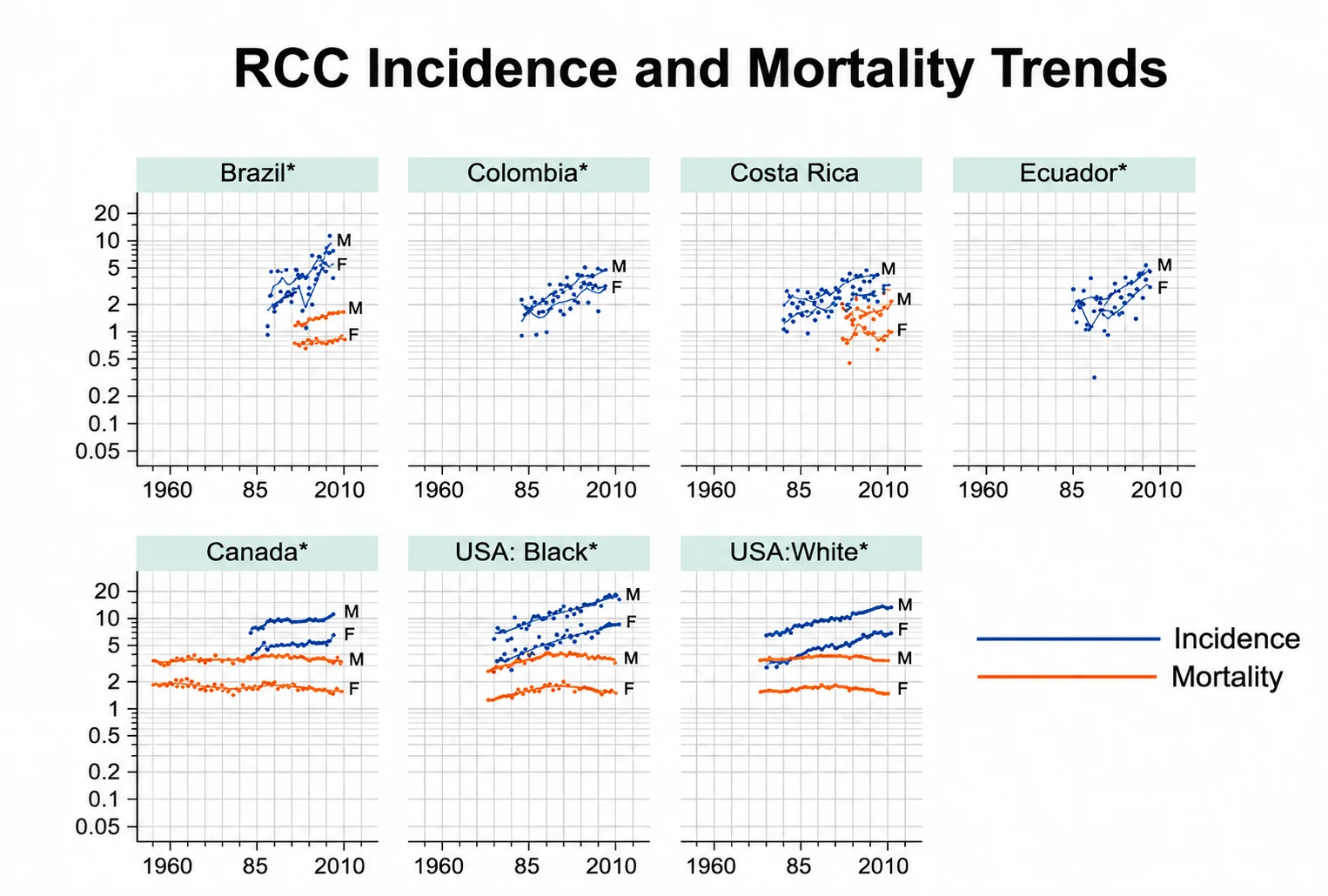
Maluf cited epidemiological estimates indicating more than 11,000 new kidney cancer diagnoses and approximately 4,460 deaths annually in Brazil, consistent with figures reported for 2022.
Unlike some high-income countries, where kidney cancer mortality has stabilized or declined, Brazil has experienced increasing mortality alongside rising incidence, according to the trends discussed in his presentation.
Similar concerns have been reported in Costa Rica, Colombia, and Ecuador.
These developments reflect a complex interaction of demographic changes, lifestyle-related risk factors, diagnostic practices, and healthcare access.
Maluf identified obesity as one of the factors potentially contributing to the increasing burden of RCC in the region, while also emphasizing the consequences of delayed diagnosis.
Patients in underserved areas may have fewer opportunities for incidental tumor detection through imaging performed for unrelated medical conditions. As a result, renal tumors may remain undiagnosed until symptoms develop or disease has reached a more advanced stage.
The problem is compounded by regional differences in healthcare infrastructure. Access to specialized hospitals, diagnostic imaging, surgical services, and oncology treatment is generally more concentrated in Brazil’s major cities and southern regions than in parts of the north, northeast, and smaller municipalities.
These geographical inequalities influence not only when kidney cancer is diagnosed but also which treatments patients can subsequently receive.
Two Healthcare Systems, Different Treatment Opportunities
Brazil’s public healthcare system, the Sistema Único de Saúde (SUS), serves the majority of the population, while approximately one-quarter have supplementary private health insurance.
Although both systems provide cancer care, access to newer technologies and systemic therapies differs substantially.
Patients receiving treatment through private insurance generally have greater access to immunotherapy combinations, targeted agents, and specialized oncology services.
For patients relying on public healthcare, the available options have historically been more restricted.
Maluf explained that reimbursement mechanisms contribute to this disparity. Public oncology services operate within defined funding arrangements, and the amounts allocated for treatment may be insufficient to cover newer, high-cost medications.
He cited metastatic RCC as an example, describing monthly reimbursement of less than $700 in the setting discussed, substantially below the cost of an immunotherapy regimen such as nivolumab plus ipilimumab.
This financial gap can prevent treatments supported by international clinical evidence from being routinely available to patients in the public system.
Historically, sunitinib and pazopanib have been among the principal systemic options available for metastatic RCC through public healthcare, while many newer immunotherapy-based combinations have remained difficult to access.
Brazil has recently taken steps to expand public-sector medication provision, including an October 2026 initiative involving sunitinib and pazopanib. Nevertheless, the wider availability of modern immune checkpoint inhibitor combinations remains an important unresolved issue.
Infrastructure introduces additional challenges.
Long waiting times for diagnostic investigations, surgery, and radiotherapy can delay treatment initiation. Maluf also referred to historical Brazilian estimates indicating that tens of thousands of cancer patients annually were unable to receive indicated radiotherapy because of insufficient treatment capacity.
Although this estimate concerns cancer care broadly rather than RCC specifically, it illustrates the structural limitations affecting oncology services.
For kidney cancer patients, delayed diagnosis combined with restricted treatment access can have consequences throughout the disease course.
LACOG 1120: The Survival Gap Between Public and Private Care
One of the most important datasets presented by Maluf came from the LACOG 1120 Registry, an observational study conducted through the Latin American Cooperative Oncology Group.
The analysis included 230 patients with renal cell carcinoma treated in Brazil’s public and private healthcare systems between September 2022 and November 2023.
The registry examined patient characteristics, stage at diagnosis, treatment patterns, and clinical outcomes.
Its findings demonstrated substantial differences between the two healthcare settings.
Patients treated in the public system were more likely to present with advanced disease, while early-stage diagnoses were more frequent among privately insured patients.
According to the published analysis, stage IV disease was present at diagnosis in 25.5% of public-sector patients compared with 17.9% of private-sector patients. Conversely, stage I disease accounted for 20.6% and 33.3% of diagnoses, respectively.
These differences suggest that opportunities for earlier diagnosis are not distributed equally.
The survival findings were particularly concerning.
The figures presented by Maluf indicated a five-year overall survival rate of approximately 80% in the private system compared with 42% in the public system, an absolute difference of nearly 38 percentage points.
The disparity was also evident among patients with stage IV disease.
At two years, overall survival was:
- 60.0% among patients treated in the private system
- 23.8% among patients treated in the public system
These observations reflect outcomes in an observational cohort rather than a randomized comparison. Differences in stage distribution, baseline characteristics, healthcare access, and other factors may all contribute to the survival gap.
Nevertheless, the magnitude of the difference raises important questions about how access to diagnosis and treatment influences outcomes in Brazilian RCC care.
Access to Second-Line Treatment Remains Particularly Limited
The LACOG 1120 Registry also identified substantial differences in the use of systemic therapy.
First-line treatment for metastatic RCC was recorded in 53.6% of patients in the private-system cohort compared with 34% in the public-system cohort.
Among those receiving systemic treatment, public-sector patients were predominantly treated with sunitinib or pazopanib, while patients in the private system had greater access to immune checkpoint inhibitors and IO-TKI combinations.
Differences became even more pronounced in subsequent lines.
Maluf reported second-line treatment use of approximately 27% in the private system compared with only 5% in the public system in the registry data he presented.
Third- and fourth-line therapies were rarely used among public-sector patients.
These findings are consistent with an earlier Brazilian treatment-pattern study led by Paulo G. Bergerot, which examined 3,990 patients with metastatic RCC.
In that historical cohort, 79% received first-line systemic therapy, but only 20% received second-line and 5% received third-line treatment.
The study demonstrated substantial attrition between successive lines of therapy compared with international reference populations.
Although these data predate many contemporary immunotherapy combinations, they illustrate a persistent challenge: the availability of an effective treatment does not guarantee that patients will receive it.
For patients with metastatic RCC, access to subsequent therapy becomes increasingly important as disease progresses after initial treatment.
However, Maluf’s presentation showed that this opportunity can depend heavily on healthcare coverage and the treatment resources available locally.
What International Studies Reveal About Regional Differences
Maluf also reviewed international research examining whether outcomes in metastatic RCC differ across geographical regions.
A pooled analysis led by André P. Fay, published in Journal of Global Oncology in 2018, evaluated 4,736 patients with metastatic RCC enrolled in phase II and III trials of targeted therapies.
The study included patients from North America, Latin America, Europe, Asia, Oceania, and Africa.
Investigators identified differences in baseline patient characteristics, treatment history, and healthcare-related factors.
For example, only approximately 50% of patients enrolled from Latin America had undergone nephrectomy before trial participation, compared with considerably higher proportions in North America.
This observation may reflect differences in disease presentation, surgical eligibility, referral patterns, and access to care, although the study could not establish a single explanation.
Importantly, despite these baseline differences, the analysis found broadly similar adjusted overall survival outcomes across geographical regions among patients enrolled in clinical trials.
This finding offers a different perspective from the survival disparities observed in Brazilian routine care.
It suggests that when patients across regions enter structured clinical studies and receive protocol-defined treatment, some differences in outcomes may become less pronounced.
However, clinical trial participants represent a selected population and do not necessarily reflect the broader patient population in each country.
The results should therefore not be interpreted as evidence that geographical disparities in cancer care have disappeared.
Rather, they reinforce the potential importance of improving access to clinical trials, standardized treatment, and specialized cancer services.
Maluf also discussed research from the Latin American Renal Cancer Group examining prognostic factors in patients with de novo metastatic RCC.
That analysis identified disease burden and metastatic distribution as important predictors of survival, including differences according to the number of metastatic lesions and the number of organs involved.
Such regionally generated evidence can help clinicians better understand the characteristics of the patients they treat and identify questions that may be insufficiently addressed by studies conducted predominantly in high-income countries.
Expanding Clinical Research Through Instituto Vencer o Câncer
For Maluf, one of the most practical ways to address treatment disparities is to strengthen clinical research within underserved healthcare systems.
Latin America has historically been underrepresented in international oncology trials, limiting both access to investigational therapies and the generation of evidence reflecting local populations.
Through Instituto Vencer o Câncer, an organization he co-founded with Dr. Antonio Buzaid and Dr. Drauzio Varella, Maluf has been involved in developing a network of clinical research centers across Brazil.
The initiative focuses particularly on public hospitals and institutions serving large patient populations in regions with limited access to oncology research.
Rather than relying exclusively on established academic research centers, the program identifies hospitals with the clinical capacity to participate in trials but without the necessary research infrastructure.
These institutions receive support through a structured development process involving professional training, research capacity building, and preparation for participation in clinical studies.
Once qualified, centers can be connected with trial sponsors and evaluated for appropriate research protocols.
Maluf reported that the initiative had developed 24 research units across Brazil.
An institutional report published in May 2026 had documented 20 participating centers, 344 studies, and 313 recruited patients, demonstrating the network’s expansion.
The program is intended to create opportunities for patients who might otherwise have limited access to newer systemic treatments.
Clinical trials can provide eligible patients with access to protocol-defined care and investigational therapies while also strengthening local research capabilities and increasing the geographical diversity of trial participation.
However, trial enrollment does not guarantee access to a superior treatment, and research participation cannot replace the need for sustainable improvements in routine healthcare provision.
Connecting Patients With Available Clinical Trials
Beyond developing research infrastructure, Instituto Vencer o Câncer has introduced a patient-matching and referral platform designed to connect patients with potentially relevant clinical studies.
The system considers factors such as diagnosis, disease stage, and available research protocols to facilitate identification of suitable trial opportunities.
This approach attempts to address another important barrier: patients and referring physicians may be unaware of available clinical studies, particularly when research centers are located outside their immediate healthcare network.
By improving communication between hospitals, researchers, and patients, the initiative aims to make clinical trial access less dependent on geographical location or institutional connections.
Maluf also emphasized the broader value of developing research capabilities in public hospitals.
Clinical research can contribute to professional training, improve familiarity with emerging therapeutic approaches, and support the collection of data from populations that have traditionally been underrepresented in cancer studies.
Why Latin America Needs Locally Relevant Oncology Guidelines
International guidelines provide an essential foundation for evidence-based RCC treatment, but their implementation is often difficult in healthcare systems where the recommended therapies are not routinely available.
Maluf argued that regional consensus recommendations can help clinicians make appropriate treatment decisions while accounting for local limitations.
For example, treatment pathways developed for settings with access to multiple immunotherapy combinations may not be directly applicable to a public hospital where sunitinib or pazopanib represents the principal available systemic option.
Similarly, recommendations concerning treatment sequencing must account for whether patients can realistically access second-line and subsequent therapies.
Locally adapted guidelines can help address these differences by considering drug availability, reimbursement policies, diagnostic capacity, infrastructure, and the practical circumstances of patients.
However, regional adaptation should remain grounded in clinical evidence and patient safety rather than simply accepting restricted access as inevitable.
Maluf also emphasized the need for better epidemiological data, more comprehensive cancer registries, and stronger research collaborations across Latin America.
Underreporting, fragmented data collection, and differences in healthcare systems make it difficult to fully understand the regional burden of RCC and evaluate the effectiveness of interventions.
Improved data collection could help identify underserved populations, guide resource allocation, and support policies aimed at reducing inequalities in cancer outcomes.
Toward More Equitable Kidney Cancer Care in Latin America
The experience of Brazil illustrates how the benefits of therapeutic innovation can vary dramatically within the same country.
Modern immunotherapy and targeted therapies have improved the treatment of metastatic RCC, but patients may face different opportunities for diagnosis, surgery, systemic treatment, and clinical trial participation depending on where and how they receive care.
The LACOG registry findings demonstrate that these inequalities are associated with substantial differences in survival, although further research is necessary to determine the relative contribution of each factor.
Maluf’s proposed strategies focus on strengthening clinical research, increasing access to effective medications, improving referral pathways, and developing regional treatment recommendations that reflect local healthcare realities.
The expansion of research networks into public hospitals offers one approach to improving access while generating more representative clinical evidence.
Yet reducing disparities in RCC outcomes will also require broader improvements in diagnostic services, healthcare financing, treatment infrastructure, and the availability of established therapies.
For Latin America, the challenge is ensuring that advances demonstrated in international clinical trials can be translated into meaningful improvements for patients across both public and private healthcare systems.
Written by Eliz Baloyan, MD, Features Writer and Editor at OncoDaily and CancerWorld