Key takeaways
- Precision oncology can still provide useful prognostic information even when a matched therapy is inaccessible, but access pathways such as compassionate use and patient-assistance programs remain essential.
- Genetic counseling should begin before testing, not only after results return, because family history, expectations, affordability, and other clinical details can change how results are interpreted.
- Local genomic datasets are needed because current classifications and evidence are still heavily based on Western populations and may not fully reflect regional variation.
- Molecular tumor boards need to move beyond major centers, with virtual and shared models helping smaller community practices access specialist interpretation.
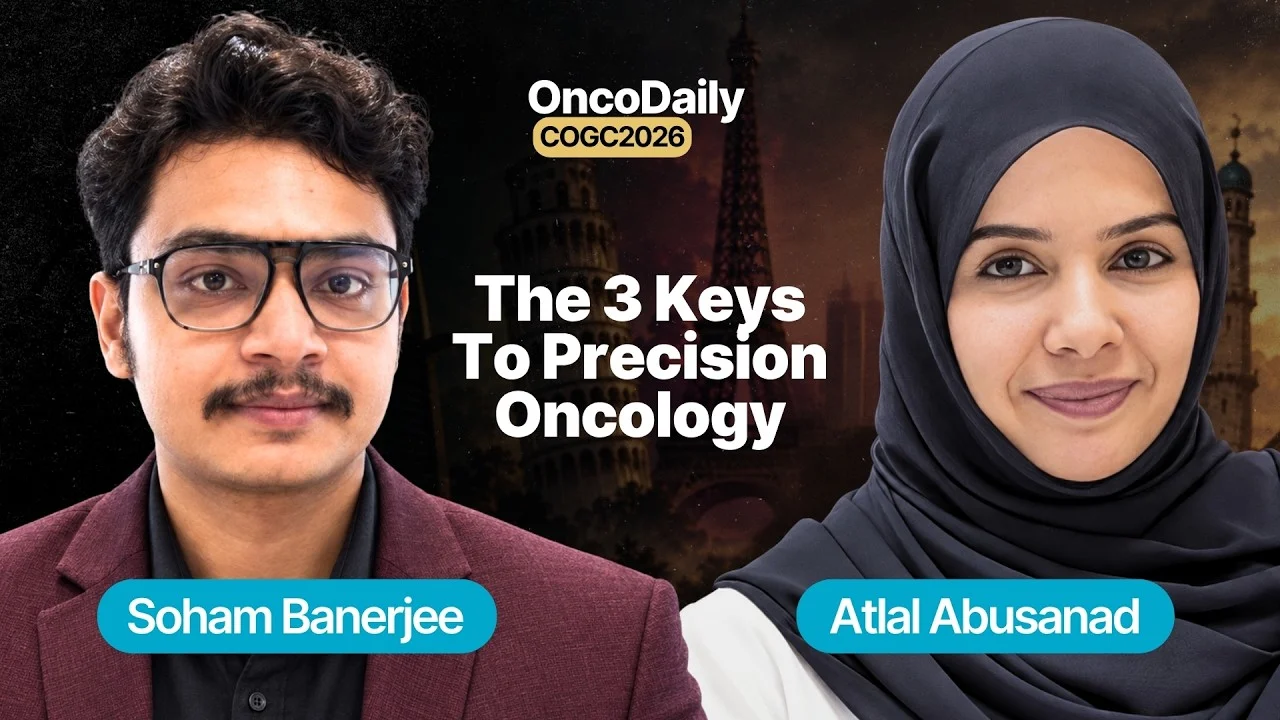
At the Community Oncology Global Congress (COGC 2026), organized by OncoDaily, Suman S. Karanth, Additional Director of Medical Oncology at Fortis Memorial Research Institute in Gurugram, moderated an expert discussion with Soham Banerjee, Senior Consultant Genetic Counselor and Medical Geneticist at Sharanya Super Speciality Hospital, and Atlal Abusanad, Professor of Medicine and Medical Oncology at King Abdulaziz University in Jeddah, on how precision oncology can become sustainable outside major academic centers.
The panel moved beyond the question of whether genomic testing should be available in community practice. The harder questions were what happens when a target is found but the drug cannot be accessed, who helps patients understand complex results, how smaller centers can use molecular tumor boards, and whether countries can rely indefinitely on genomic data generated largely in Western populations.
Again and again, the discussion returned to the same conclusion: precision oncology does not become sustainable simply because the test exists. The system around the test matters just as much.
When the Target Is There but the Drug Is Not
Karanth opened with one of the most difficult situations in precision oncology: a molecular report identifies an actionable alteration, but the corresponding therapy is unavailable, unapproved, or unaffordable.
That can leave patients asking a reasonable question: if treatment access is unlikely, was testing worthwhile in the first place?
Abusanad argued that testing can still provide value beyond matching a patient to a drug.
“Why do I get tested if I cannot access the treatment?
It is not only to predict the treatment, but also to understand the disease – how it is going to behave with other regular or conventional treatments.”
At the same time, she emphasized that healthcare systems cannot treat access as an afterthought. Pharmaceutical companies, compassionate-use programs, charities, and patient-access organizations all have a role when a potentially useful therapy lies beyond a patient’s reach.
Her own experience showed how uneven those pathways remain.
“It doesn’t matter if you’re working in a high-resource setting or a resource-limited setting. You will still face the accessibility issue.”
Genetic Counseling Should Come Before the Test
For Banerjee, one of the most important workflow changes is bringing genetic counseling in earlier.
Early in his career, he often saw patients only after testing had already been completed, when they needed help interpreting the report.
Over time, that approach changed.
“We have understood the patients should have counseling before opting for the test.
When you are counseling a patient and their family, very minute details come up.”
He described a patient with breast cancer whose broader medical history emerged during counseling and had implications for how her treatment was being understood.
The larger point was that genomic testing does not happen in isolation from the rest of a patient’s life, treatment, expectations, and family history.
Counselors also become important when expectations do not match reality.
“When expectations and affordability don’t match, a question arises.
When expectations and affordability match but the results are not matching, again a question arises.
These gaps are where counselors can play a role.”
But access to that support is limited. Banerjee estimated that India would require far more genetic counselors than are currently available, making collaboration essential rather than optional.
Karanth summarized that role simply:
“Genetic counselors quietly become the patient advocates.”
Precision Oncology Needs Local Data
The conversation then moved to another problem: the genomic evidence used to classify variants and guide treatment does not represent every population equally.
Banerjee pointed to variants of uncertain significance as one example.
“We don’t have across-the-globe data.
We don’t have our own country data.
We all are different.”
The concern is not that existing international guidelines are unusable. Abusanad argued that they remain clinically relevant and should continue to guide practice until stronger local datasets are available.
But the frequency and distribution of molecular alterations – and potentially pharmacogenomic differences – may vary between populations.
“Until we have our validated local data, we’re going to use what has already been generated by Western societies because it is still relevant to our practice.
But we definitely need to work on building our local data.”
Her proposal was collaborative rather than institution-specific: national task forces involving clinicians, geneticists, oncologists, administrators, and people capable of translating genomic knowledge into public understanding.
Banerjee pushed that idea even further toward the community level.
“We need task forces at a very lower level – the cities, the villages, the states.
Then we can have a proper ladder of communication and a proper ladder of our datasets.”
Education, he added, cannot remain confined to hospitals. Schools, colleges, teachers, psychologists, and local community leaders can all help make concepts such as cancer prevention and genomics more understandable outside specialist clinics.
Molecular Tumor Boards Have to Leave the Major Centers
Molecular tumor boards are one way to help clinicians interpret increasingly complicated genomic results.
But the panel acknowledged an obvious limitation: the specialists needed for those discussions are often concentrated in large metropolitan or academic centers.
Banerjee described the current gap directly.
“The molecular tumor board concept is only restricted to the higher specialty or super-specialty hospitals.
We are not yet there in the community setup.”
For Abusanad, virtual participation is one practical way to expand access.
“Having them as virtual tumor boards will make it easier for many of us to join.
It will enable other healthcare workers and other team members to attend even if they are not on the same premises or are living in different cities.”
She also suggested integrating molecular expertise into disease-specific tumor boards, allowing genomic interpretation to sit alongside input from medical oncology, radiation oncology, pathology, radiology, and other specialties.
Karanth highlighted the difficulty of applying that model in smaller community settings, where one oncologist may treat many different cancers rather than focusing exclusively on breast, GI, GU, or another disease site.
That, she acknowledged, remains one of the practical limits of precision oncology outside large centers.
Start With People, Collaboration and Education
Karanth ended by asking both panelists a deliberately practical question: if they had limited resources to build a precision oncology program in a community center, what would they fund first?
Banerjee’s answer did not begin with sequencing equipment.
“The first three things I would like to invest in are, first, a good resource person who can guide us.
Second is good collaborations for the diagnostic and molecular testing.
And third, educate the patients and educate the surrounding doctors.”
What would he avoid at the beginning?
“Buying expensive machinery and starting our own lab.
We can easily collaborate with the labs who are already performing.”
Karanth reduced his answer to three words:
“People, collaboration and education.”
Abusanad added another essential investment: making sure genomic information is integrated into the electronic health record.
“You know the test has been done, but you have to go search for it.
Documentation is very essential, specifically if the patient is seen by doctors at different time points.”
The panel’s closing message was therefore less about building a sophisticated molecular laboratory and more about building a reliable system around precision care.
Trained people. Accessible counseling. Strong diagnostic partnerships. Molecular tumor boards. Local datasets. Better documentation. Clear workflows.
And, perhaps most importantly, collaboration.
For community centers with limited resources, the first investment in precision oncology may not be the most expensive technology.
It may be making sure the right people and connections are already in place before the first genomic report arrives.
Written by Eliz Baloyan, MD, Features Writer and Editor at OncoDaily and CancerWorld