
Key takeaways
- Chronological age alone is not enough to predict how an older patient will tolerate cancer treatment.
- G8 or VES-13 screening can help identify which patients aged 65 and older need a full geriatric assessment.
- A comprehensive geriatric assessment looks beyond ECOG to function, cognition, comorbidities, nutrition, social support, medications, and frailty.
- CARG, CRASH, and CARG-BC can help estimate chemotherapy toxicity risk and support more informed treatment decisions.
- The goal is to use the assessment to adjust treatment, add support early, and avoid both overtreatment and undertreatment.
At the Community Oncology Global Congress (COGC 2026), organized by OncoDaily, Esther G. Chong, Medical Oncologist and Assistant Professor at OHSU Knight Cancer Institute, focused on a question that becomes increasingly important as the cancer population ages: how much does chronological age actually tell us about a patient’s ability to tolerate treatment?
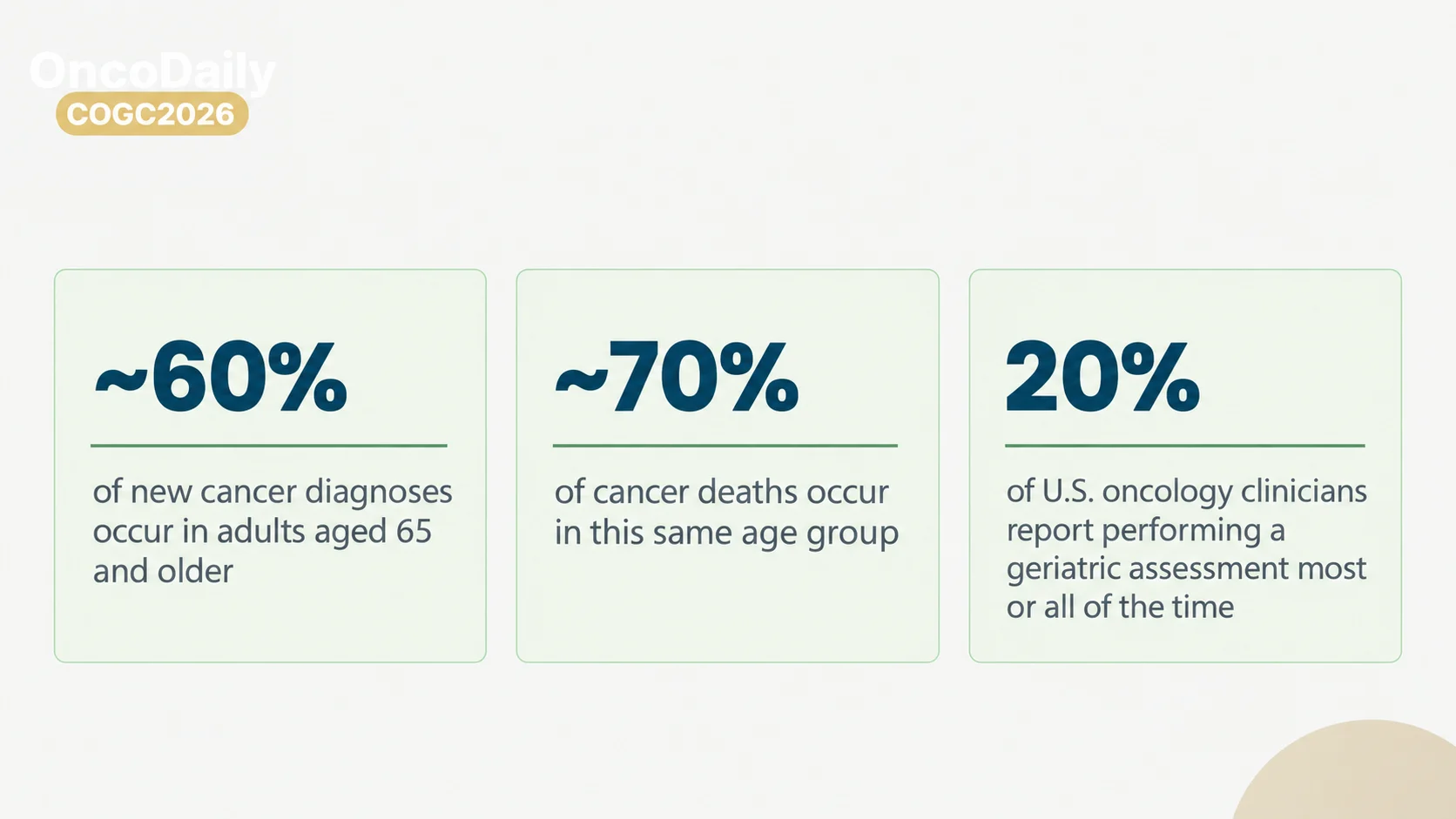
About 60% of new cancer diagnoses occur in adults aged 65 and older, and approximately 70% of cancer deaths occur in the same age group. Yet only around 20% of U.S. oncology clinicians report performing a geriatric assessment most or all of the time.
The issue discussed is that chronological age tells clinicians very little about how an individual patient will tolerate systemic therapy. Two patients can be the same age – and even carry the same ECOG performance status – while having completely different levels of vulnerability.
Two Patients, Same Age, Very Different Risk
The problem was illustrated with two hypothetical patients, both aged 78.
Patient 1: More robust
- Independent in activities of daily living
- No significant unmanaged comorbidities
- No major cognitive or mood concerns
- Strong social support network
- Well nourished
- No significant polypharmacy concerns
- Could be classified as ECOG 0-1
Approach: This patient may be able to tolerate systemic therapy relatively well, but age alone should still not determine the treatment decision.
Patient 2: More vulnerable
- Needs help with instrumental activities such as finances, medications, or transportation
- Multiple uncontrolled comorbidities
- Mild cognitive impairment that may only be apparent to close family members
- Lives alone with limited caregiver support
- Takes five or more medications daily
- Could also be classified as ECOG 0-1
Approach: This patient requires a closer assessment of function, cognition, comorbidities, social support, medication burden, and other vulnerabilities before treatment is selected.
The contrast highlights an important limitation of traditional performance measures. On paper, both patients may appear similar. Their biological ability to tolerate therapy may be very different.
ECOG Performance Status and Karnofsky Performance Status remain widely used because they are familiar, quick, and easy to calculate. But they were validated largely in younger populations and do not reliably capture many of the vulnerabilities that become increasingly relevant in older adults.
Performance Status as a Biomarker
“I would argue to say that performance status should be like a biomarker. It is both predictive and prognostic.”
This matters both in daily practice and when clinical trial evidence is applied to older patients.
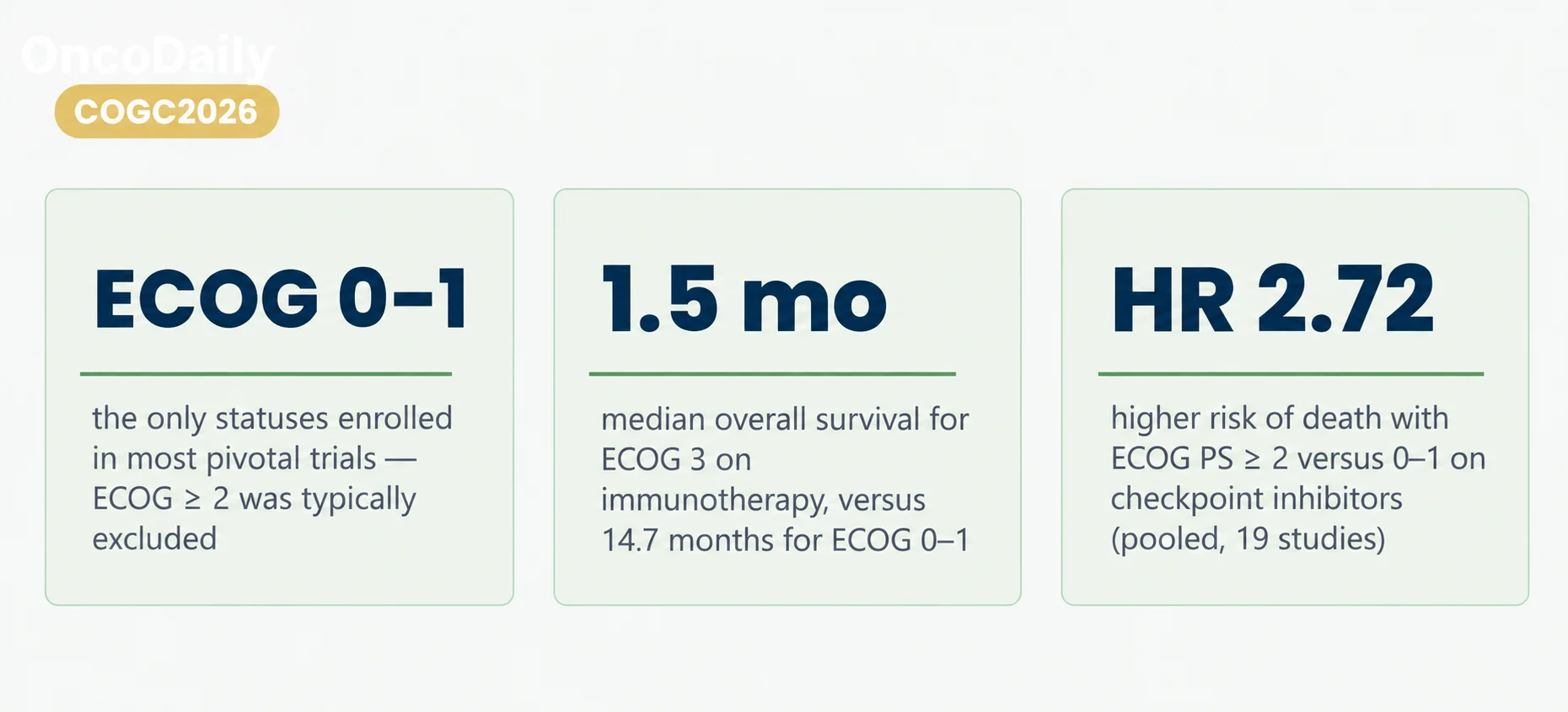
Many pivotal oncology trials primarily enroll patients with an ECOG performance status of 0 or 1, while an ECOG of 2 or higher may exclude a patient from participation. Yet poorer performance status is associated with a greater likelihood of dose reductions, treatment interruptions, and other modifications that can affect outcomes.
Data from immunotherapy studies have also shown differences in progression-free survival, overall survival, and mortality risk among patients with poorer performance status.
The goal of refining performance assessment is therefore not simply to identify patients who should receive less treatment. It is to avoid both overtreatment and undertreatment.
A fit older adult should not be denied effective therapy simply because of age. At the same time, an apparently well patient may have vulnerabilities that place them at substantially greater risk once treatment begins.
Screen First, Then Assess
A comprehensive geriatric assessment can help uncover those differences.
The NCCN Older Adult Oncology Guidelines framework described in the presentation follows a stepwise approach. Patients aged 65 and older can first undergo a short screening test. Those who screen positive can then proceed to a fuller comprehensive geriatric assessment.
Two brief tools highlighted were the G8 and VES-13.
The G8 contains eight items and is designed to be completed in approximately five minutes or less. It assesses factors including:
- Appetite
- Weight loss
- Mobility
- Neuropsychological concerns
- Comorbidities
The tool is highly sensitive for detecting vulnerability and also provides independent prognostic information for one-year survival.
The Vulnerable Elders Survey-13 (VES-13) contains 13 items and is also designed as a brief screening tool. It considers:
- Age
- Activity
- Independence
- Self-rated health
- Difficulty with physical tasks
- Need for assistance with daily activities
A positive G8 or VES-13 is not the final assessment. It identifies the patients who may benefit from a deeper evaluation.
The comprehensive geriatric assessment then looks more closely at functional status, comorbidities, cognition, nutrition, psychological state, social support, polypharmacy, and overall activity or frailty. These areas can uncover vulnerabilities that may not be obvious during a routine oncology visit but can become highly relevant once systemic treatment begins.
Predicting Chemotherapy Toxicity
Another difficult question in geriatric oncology is whether an older patient can tolerate chemotherapy – particularly when the proposed regimen is aggressive.
There is no way to predict an individual patient’s future with certainty, but validated toxicity calculators can help make that discussion more objective.
CARG toxicity score
The Cancer and Aging Research Group (CARG) toxicity score estimates the likelihood of grade 3 or higher chemotherapy toxicity in adults aged 65 and older.
Rather than relying only on age or ECOG status, it incorporates factors that help stratify patients according to their risk of severe treatment-related toxicity.
CRASH score
The Chemotherapy Risk Assessment Scale for High-Age Patients (CRASH) similarly estimates the risk of serious chemotherapy toxicity in older adults.
It can provide another way to quantify risk before treatment begins and support a more individualized discussion about the potential benefits and harms of chemotherapy.
CARG-BC
The CARG-BC tool further refines toxicity prediction for older patients with early breast cancer who are being considered for adjuvant chemotherapy.
These tools do not replace clinical judgment. They give clinicians and patients more information with which to make that judgment.
Instead of describing treatment simply as “too aggressive” or “probably tolerable,” the conversation can focus on a more concrete question: what is this patient’s estimated risk, what is contributing to that risk, and what can be done to reduce it?
Assessment Should Change What Happens Next
The value of a geriatric assessment lies in what happens after the vulnerabilities are identified.
Randomized trials have shown that geriatric assessment-directed interventions can reduce treatment-related toxicity and premature treatment discontinuation while helping preserve quality of life and independence.
The assessment can also identify which professionals should become involved before treatment starts.
A functional limitation may prompt rehabilitation support. Nutritional concerns may require dietetic input. Cognitive impairment may affect how treatment instructions are communicated or how medications are managed. Polypharmacy may require medication review. Limited social support may signal the need for navigation, caregiver planning, or additional community services.
Geriatric oncology therefore becomes inherently multidisciplinary.
The purpose is not simply to generate another score for the medical record. It is to identify vulnerabilities early enough to intervene.
Screen, Assess, Act
Dr. Chong reduced the approach to three practical steps that can be brought back to clinic.
1. Screen
Patients aged 65 and older should undergo a brief geriatric screening using a tool such as the G8 or VES-13.
2. Assess
If screening identifies vulnerability, proceed to a comprehensive assessment of:
- Function
- Cognition
- Nutrition
- Mood
- Social support
- Comorbidities
- Medications
- Frailty
3. Act
When chemotherapy is being considered, add tools such as CARG or CRASH to help estimate toxicity risk, guide dose and supportive-care decisions, and set realistic treatment goals with the patient.
The central message is simple: chronological age is not enough to determine treatment fitness.
Two patients of the same age can have completely different levels of resilience and vulnerability. A comprehensive geriatric approach makes those differences visible – allowing treatment to be tailored not only to the cancer, but to the older adult who will actually receive it.
Written by Eliz Baloyan, MD, Features Writer and Editor at OncoDaily and CancerWorld
Watch the full video on YouTube.