Key takeaways
- Digital oncology is most useful when it improves information flow and connects patient-reported symptoms to timely clinical action.
- A functioning regional MDT needs more than videoconferencing; it requires complete diagnostic information, structured communication, and clear responsibility for each patient.
- Technology cannot compensate for missing pathology, radiology, research staff, pharmacy support, or other infrastructure needed to act on clinical decisions.
- Strong networks need a funded coordinator, clear local accountability, protected time, and equity measured as an outcome rather than assumed.
At the Community Oncology Global Congress (COGC 2026), organized by OncoDaily, Debanjan Kundu, Clinical and Radiation Oncologist at Chittaranjan National Cancer Institute, examined what digital innovation can realistically do for multidisciplinary cancer care – and where technology alone falls short.
His presentation focused less on platforms and more on the systems around them:
- how information reaches clinicians,
- how expertise can be distributed across regional networks,
- who remains responsible for the patient,
- whether expanding digital access reduces disparities.
“The strongest evidence in digital oncology isn’t about technology.”
Where Cancer Care Loses Information
One of the strongest examples presented came from symptom monitoring. In a randomized trial of more than 700 patients receiving outpatient chemotherapy, patients reported symptoms weekly and nurses were alerted when symptoms became severe or worsened. Patients experienced less deterioration in quality of life, fewer emergency admissions, and remained on chemotherapy longer. Longer-term follow-up also showed a survival benefit.
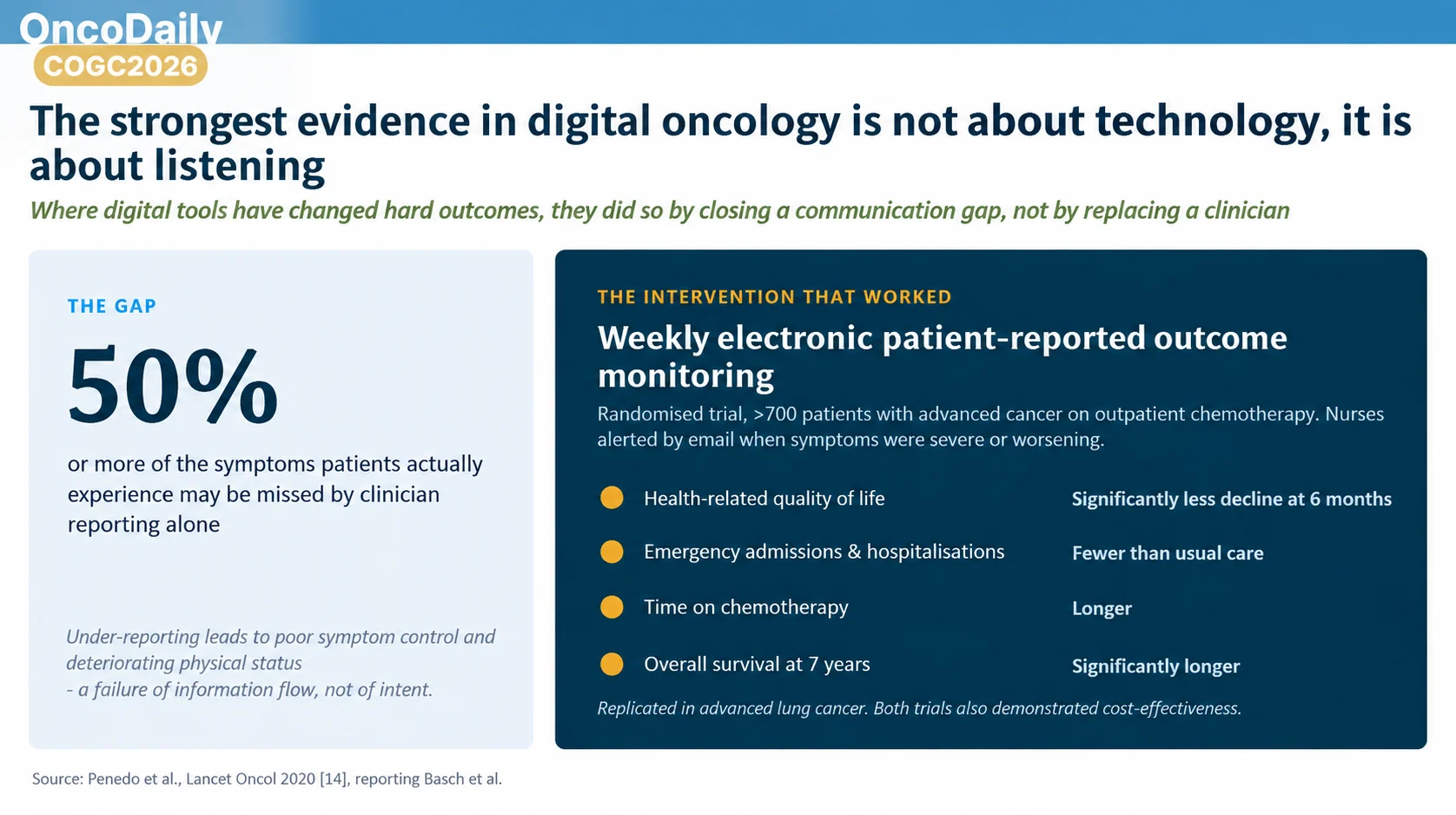
The intervention itself was relatively simple: symptoms were collected systematically and connected to clinical action.
That becomes particularly important when oncology expertise is geographically concentrated. There’s a mismatch between where many patients live and where specialist cancer services are located, and examples from the United States and India to illustrate how rural populations may have limited direct access to oncologists and specialized cancer facilities
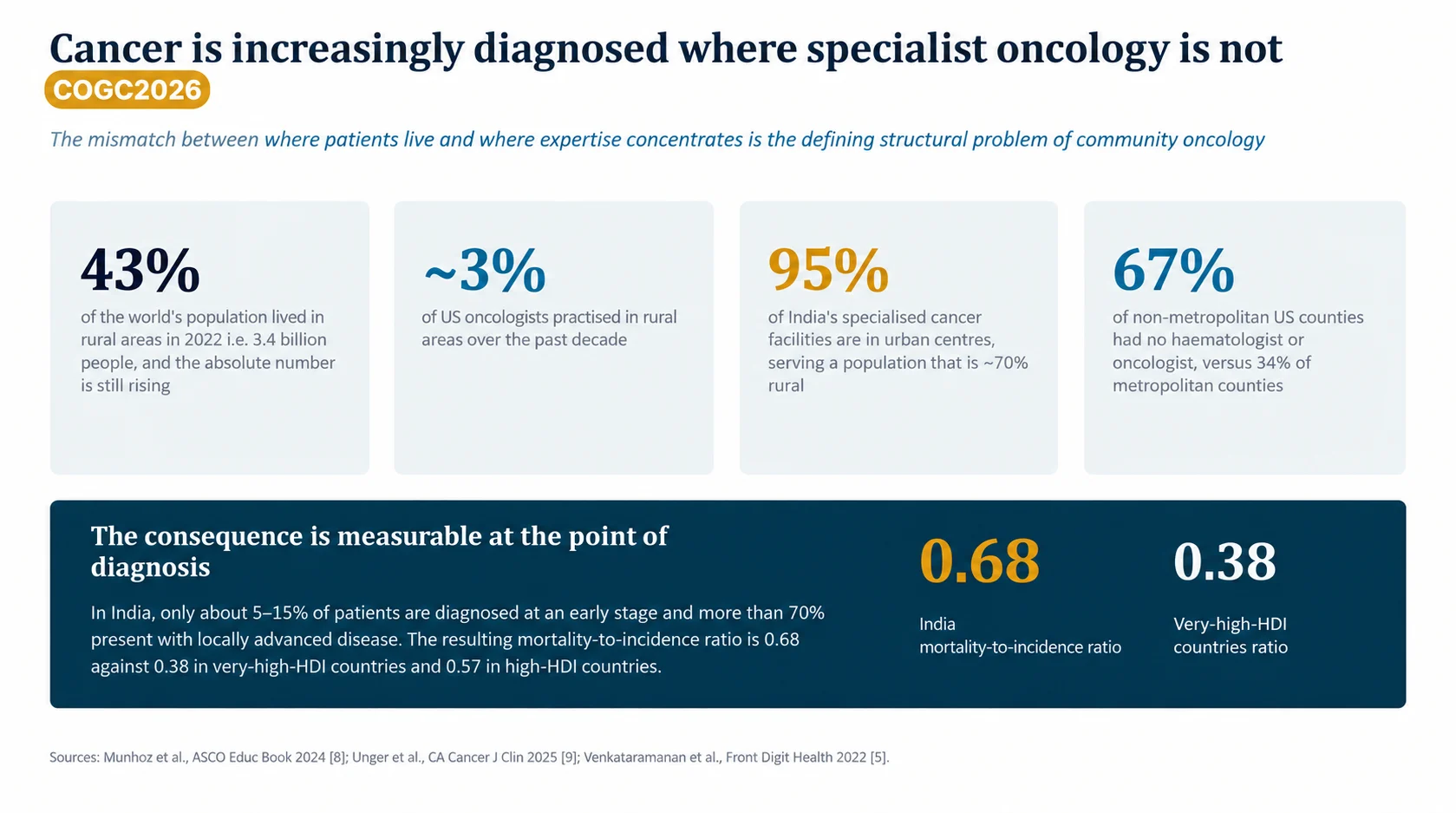
But geography is only part of the problem.
Modern cancer care has become increasingly multidisciplinary, involving imaging, pathology, surgery, systemic therapy, radiation, supportive care, and follow-up. Every additional interaction creates another point where information can be delayed or lost.
“Fragmentation isn’t a gap between hospitals. It’s a gap at every handover.”
Presentation, imaging, pathology, decision-making, treatment, and follow-up can each become a failure point, resulting in delayed planning, duplicated investigations, or incomplete follow-up.
A Tumor Board Is Not the Same as an MDT
There’s an important distinction between a tumor board and a functioning multidisciplinary team.
A tumor board is primarily consultative: a case is presented, discussed at one point in time, and the treating physician ultimately carries the decision forward.
A multidisciplinary team is a structure that can remain involved throughout the patient’s pathway, reach consensus collectively, and – importantly for regional oncology – operate across different locations.
That distinction matters in settings where a complete team does not exist within a single hospital.
Data from pediatric solid tumor units across Southeast Asian low- and middle-income countries illustrate the problem. Among 46 identified units, specialist availability could be assessed in 37. Pediatric oncologists and surgeons were widely available, but pediatric-trained radiologists were available in about 54%, pathologists in 41%, radiation oncologists in 30%, and nuclear medicine physicians in 14%. Only four of the 46 units had pediatric-trained expertise across all six key subspecialties.
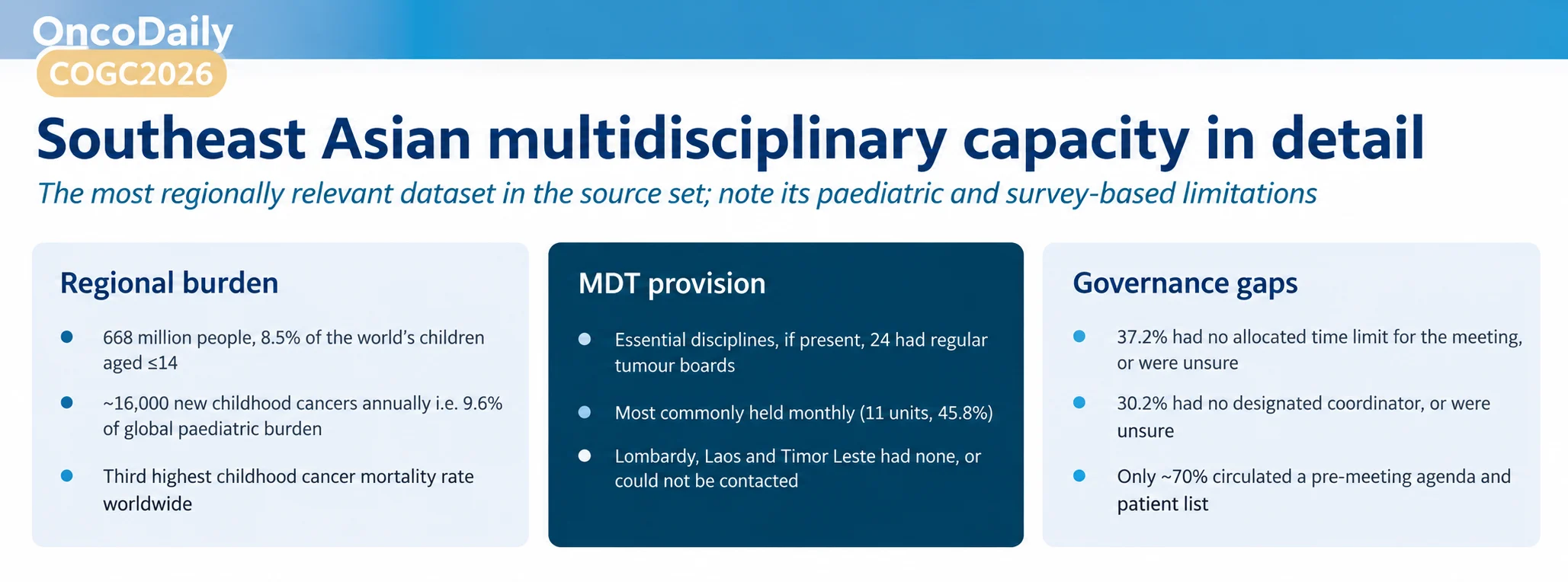
The availability of surgeons, radiologists, and pathologists was also significantly associated with whether a multidisciplinary tumor board existed at all.
The implication is that counting oncologists alone can miss the true workforce constraint. A multidisciplinary network may fail because pathology, radiology, or another essential specialty is missing.
Building the Right Kind of Network
Not every digital oncology network is designed to solve the same problem.
A review of 50 studies identified six forms of videoconference-supported collaboration in oncology. Two are particularly relevant for regional care: MDT-Equal, in which comparable multidisciplinary teams review difficult cases together, and MDTM-Collaborate, in which teams with complementary specialists combine to form a complete multidisciplinary meeting.
The difference is practical. If two complete teams want another perspective on a complex case, an MDT-Equal model may provide that additional review. But if a community center lacks a radiation oncologist or specialist pathologist, a second opinion does not solve the underlying problem. The center needs access to a composite team that supplies the expertise it does not have locally.
A regional oncology network should ultimately perform four functions: support case decisions, provide a route for rapid escalation when a patient deteriorates between visits, maintain longitudinal coordination close to home, and create a learning system through audit.
Many programs build only the first.
The division of responsibility between hub-and-spoke is therefore critical. The hub should manage complexity and return a clearly documented plan with a named local clinician, while the spoke retains responsibility for implementation and ongoing care.
Otherwise, tele-oncology risks becoming a referral mechanism that simply transfers patients toward large centers rather than strengthening local capability.
The Data Must Arrive Before the Meeting
Digital connectivity cannot compensate for missing clinical information.
The pre-meeting case packet was described as a clinical safety intervention. Across network studies, obtaining complete information before multidisciplinary discussion repeatedly emerged as a major difficulty, while insufficient preparation of radiology and pathology was also identified as an important barrier.
A remote meeting may connect specialists hundreds of kilometers apart, but the discussion is still compromised if the imaging cannot be reviewed, the pathology is unavailable, or essential clinical information has not reached the team.
A case without the necessary data should therefore be deferred rather than pushed toward a premature recommendation.
That principle shifts the focus of digital transformation. The meaningful question is not whether a hospital has installed videoconferencing or another digital platform, but which clinical bottleneck that technology has actually removed.
The strength of evidence varies considerably across different digital oncology models.
Remote symptom monitoring linked directly to clinical action has randomized evidence behind it. The evidence for videoconference-based collaboration is less robust: the review he cited included 50 studies, but relatively few were prospective or randomized. Evidence for hub-and-spoke coordination is more limited still, and evidence that digital health itself reduces rural treatment disparities remains insufficient.
That does not mean regional digital networks are ineffective. It means feasibility and improved access should not automatically be interpreted as proof of improved survival or reduced inequality.
Some implementation examples have nevertheless demonstrated clear operational gains. Telecolposcopy in rural Arkansas connected a specialist hub with four spoke sites and delivered care to patients across much of the state, while other regional models have reduced travel, supported remote radiotherapy review, supervised chemotherapy delivery in smaller communities, and expanded access to clinical trials.
These examples show that digital models can solve specific access problems. The harder task is demonstrating which models translate those improvements into better and more equitable cancer outcomes.
What Failure Teaches About Digital Oncology
Some of the strongest lessons came from programs where the technology itself worked but the care pathway still broke down.
A program in Kerala screened nearly 2,500 people at spoke sites. Of 299 positive cases, 145 were referred for diagnostic services, yet only 46 completed the workup.
A clinical trial example from New Mexico showed a similar gap. An Albuquerque center enrolled approximately 20 to 30 patients each month, while Gallup, about 140 miles away and staffed by the same physicians, enrolled none. The difference was not physician expertise or videoconferencing, but the absence of research staff, pharmacy services, and other support infrastructure needed to make trial participation possible.
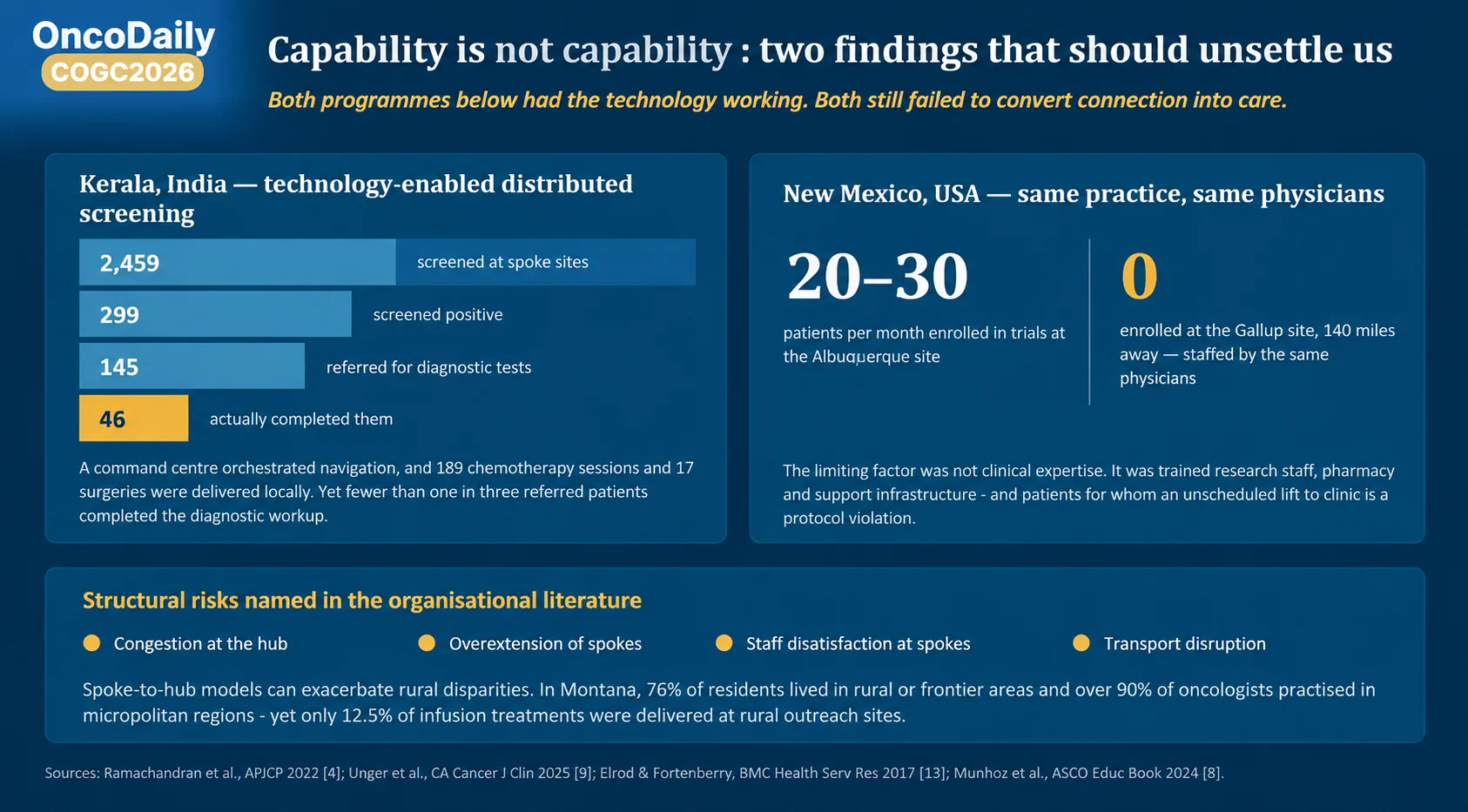
These examples expose a broader limitation: access to expertise cannot substitute for the infrastructure needed to act on that expertise.
Digital inequity can also exist at several levels – among patients who differ in connectivity, language, cost, and digital literacy; among providers who take on additional workload; and within the technology itself, including AI systems developed using populations that may not represent the patients in whom they are eventually deployed.
A network designed to reach underserved patients can therefore widen disparities if it primarily reaches those who were already better connected.
Build the Network Before Adding AI
Several conditions emerged as essential for building a regional oncology network that can function reliably over time.
It needs a named and funded coordinator responsible for assembling cases, obtaining missing information, circulating meeting lists, and documenting decisions. Diagnostic inputs – particularly radiology and pathology – need to be strengthened before money is spent primarily on connectivity. Responsibility at the spoke must be explicit, clinicians need protected time rather than relying on goodwill, and training should include support staff as well as physicians.
Most importantly, equity has to be measured rather than assumed.
A practical implementation pathway can begin with a small number of high-burden cancers, clearly defined referral triggers, a funded coordinator, and a minimum data set required for every case. Regular regional MDT meetings can then be introduced with standardized documentation and a named local clinician responsible for follow-up. Nurses and navigators can be added next, alongside escalation pathways and, where feasible, selected treatments delivered closer to home.
Only after that foundation is functioning does AI enter the pathway.
For now, AI is best positioned as a tool to reduce cognitive and administrative workload with human sign-off, rather than replace multidisciplinary treatment decisions. Detection applications are advancing more rapidly, while prognosis and treatment selection remain less mature.
The larger message is that a community hospital does not need every specialist physically present in the same building.
It needs the complete expertise to exist somewhere across the network – and a system capable of reliably bringing that expertise, the necessary data, and clinical responsibility together around the patient.
“The future of community oncology is not digital for its own sake. It is connecting the right expertise, data and decisions to the right patient close to home – and proving that we did.”
Written by Eliz Baloyan, MD, Features Writer and Editor at OncoDaily and CancerWorld