Key takeaways
- Biomarker testing needs to start at diagnosis so results can guide the first treatment decision.
- When specialists work across separate practices, direct communication can be more practical than relying on a single tumor board.
- Pathology is a key part of the multidisciplinary team because tissue adequacy and reflex testing can determine whether treatment starts on time.
- Community oncology can act as the hub that keeps sequencing, communication, and continuity together.
At the Community Oncology Global Congress (COGC 2026), organized by OncoDaily, Darshil Shah, Medical Oncologist and Director of GI Oncology at Ironwood Cancer Research Center in Phoenix, Arizona, focused on a challenge that is especially familiar in community practice: how to deliver truly multidisciplinary GI cancer care when the specialists, testing, and treatment decisions are spread across different teams and institutions.
In that setting, the question is not whether multidisciplinary care matters, but how to make it work when the usual structure of a single tumor board simply does not exist.
Biomarker Testing Is a Workflow Problem
“Before we get to the multidisciplinary framework, there is a problem we are all aware of: biomarker testing. And it is measurable.
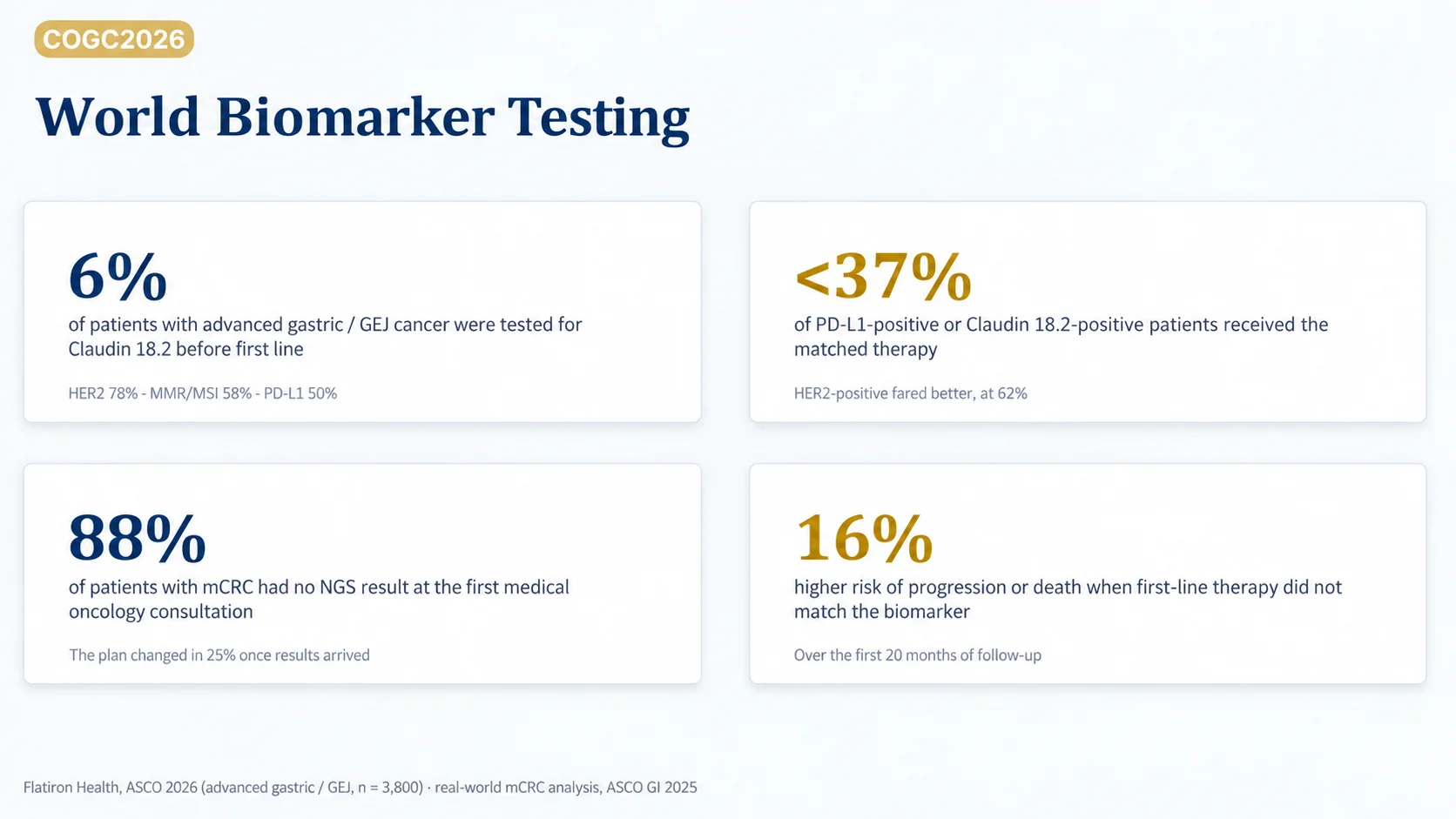
In advanced gastric and gastroesophageal junction cancer, an analysis presented at ASCO this year found that Claudin 18.2 was tested in only 6% of patients, PD-L1 in about half, and MMR in 58%.
Fewer than 37% of PD-L1-positive or Claudin-positive patients received matched therapy, and when first-line therapy did not match the biomarker, there was a 16% higher risk of progression or death over 20 months.
In colorectal cancer, a real-world analysis found that next-generation sequencing results were not available at the initial oncology consultation in 88% of patients. And when those results did arrive, the treatment plan changed in about a quarter of them.
None of that is really a knowledge gap. Every oncologist in this session knows what to order. The problem is much more about workflow – making sure biomarker testing starts at diagnosis and that the results are available in time to guide the first treatment decision.
In colorectal cancer, RAS status, BRAF V600E status, MSI/MMR, HER2, and a broad panel that captures rare fusions are important. MSI-high disease can lead to checkpoint inhibition. RAS- and BRAF-wild-type left-sided disease can guide the use of anti-EGFR therapy with chemotherapy. BRAF V600E can direct us toward a targeted combination, and rare fusions can lead to their matched inhibitors.
In upper GI malignancies, PD-L1, HER2, MMR, and Claudin 18.2 are increasingly important to know. HER2, Claudin 18.2, and PD-L1 together help determine the first-line regimen.
On both sides, a biomarker-driven clinical trial is also a legitimate first-line answer. If the panel is not back before you write the first order, the decision has been made for you.
Pathology is the first multidisciplinary team partner. For us, several pathology groups have to function as one. You need enough tissue for the full panel, and when tissue is insufficient, you can reflex to circulating tumor DNA or send both at the same time. Automatic ordering at diagnosis and reflex testing are key to getting timely biomarker results. And it is very important that the results are communicated rapidly and in a standardized way to the treating oncologist. That last point can really help close the 88% gap we just saw.”
Making Multidisciplinary Care Work
“Ironwood is a large community oncology practice. We have 50 medical oncologists who subspecialize, and 18 of them are GI medical oncologists, all caring for one shared patient population.
Our surgeons, pathologists, and radiologists sit outside the practice entirely, and we work with several independent groups. That means a single standing tumor board is not really available to us, and no one meeting can bring everyone together.
In that setting, the medical oncologist becomes the one constant. We hold the sequencing decisions, the communication, and the continuity, so everything that follows has to be built around that reality rather than pretending it away.
What has worked for us is communication.
Just pick up the phone and call the surgeon. Discuss the case when you see the patient.
We have created a secure messaging platform that connects these independent groups so we can share confidential patient information securely. We also use shared image review so radiology images can be reviewed together rather than in isolation.
And we are increasingly using our electronic medical record to prompt biomarker review and remind providers to continuously check biomarker status.”
Two Cases for Early Multidisciplinary Care
“Let me present a case of metastatic colon cancer.
This was a 62-year-old patient with a left-sided sigmoid primary and synchronous bilobar liver metastases. NGS was performed at diagnosis, and the patient was considered borderline resectable with a nearly obstructing primary.
In this case, it is increasingly important that we involve the colorectal surgeon and hepatobiliary surgeon within a week of diagnosis to create a truly multidisciplinary plan. It matters whether conversion to resection is our intent, because that can drive the frontline regimen.
We also need to know whether we should cap oxaliplatin exposure at around four months to reduce liver injury, and we need to know how to manage the primary tumor – whether with an endoscopic stent or a diverting stoma.
All of those decisions need to be made right at diagnosis with involvement of the multidisciplinary team.
The second case was a 58-year-old patient with gastric adenocarcinoma, HER2 IHC 3+, PD-L1 CPS 2, and microsatellite-stable disease.
The patient had limited metastatic disease with bulky adenopathy, but no visceral or peritoneal spread. Staging laparoscopy showed no peritoneal deposits, cytology was negative, and the patient was experiencing progressive weight loss.
The patient was considered unresectable at that point, but potentially resectable with a deep and durable response. So it was extremely important to get surgical involvement before cycle one to assess the peritoneum. It also helped us choose a HER2-directed regimen with the goal of achieving a deep and durable response and potentially creating an opportunity for resection after several cycles.
And it was important to get a nutritionist and other supportive services involved right at diagnosis to preserve the patient’s performance status and nutritional status if the time came for surgical resection.”
Keeping Innovation and Care Local
“This is the era of biomarker-driven treatments, so we also make sure that every patient is screened for frontline clinical trials.
We partner internally as well as with academic centers to match patients with studies quickly. At Ironwood, our network is spread throughout the Phoenix area, so whenever possible, we try to keep care local and give patients access to clinical trials without requiring them to travel long distances.
So these are some of the take-home messages.
Community oncology is the hub of GI cancer care.
Relationships and reflex processes – not meetings – are what really drive outcomes.
And we are excited about liquid biopsies and AI-assisted workflows, which will continue to improve efficiency.”
Written by Eliz Baloyan, MD, Features Writer and Editor at OncoDaily and CancerWorld