Key takeaways
- Community oncology in Africa is not primarily a treatment site; it is where interpretation, permission, financing, navigation, follow-up, and palliation often happen before and after formal cancer care.
- Task shifting only works when it is designed, certified, and funded; otherwise, it simply transfers costs and responsibility onto unpaid workers and families.
- Prevention is the most scalable form of community oncology, including HPV and hepatitis B vaccination, HPV self-collection, tobacco and alcohol control, and Helicobacter pylori treatment.
- A functional cancer system needs a clear division of roles between community and specialist care, connected by referral pathways, registries, and payment mechanisms.
At the Community Oncology Global Congress (COGC 2026), organized by OncoDaily, Clement Adebamowo, Director of the Division of Cancer Epidemiology at the University of Maryland School of Medicine, challenged the assumption that community oncology looks the same in every setting.
In the United States, the term often describes cancer care delivered outside academic centers. Across much of Africa, that definition breaks down. Specialist workforces and radiotherapy infrastructure are concentrated, definitive treatment often cannot be decentralized, and many of the decisions determining whether a patient ever reaches cancer care are made long before a diagnosis.
The presentation focused on a more practical question: which parts of cancer care can be delivered in the community, and which still need to remain centralized?
What Community Oncology Means in Africa
“In the United States, community oncology means a site of care where roughly four out of five American cancer patients are treated in practices defined chiefly by not being academic centers.
It is a useful idea, but it does not survive its journey to Africa.
There is no dispersed oncology workforce. Only 28 of 54 African countries have external beam radiotherapy, and only 21 have brachytherapy. No African country has radiotherapy capacity that matches its demand.
So in Africa, community oncology cannot simply mean a place where cancer is treated. It is where cancer is decided long before it is ever diagnosed. It is where a lump noticed by a patient is interpreted, where permission to seek care is granted or withheld, where money for care is raised – or not raised – and where many patients ultimately live and die.”
Community here is therefore not a site. It is a set of functions: interpretation, permission, financing, and follow-up. No single clinic performs all of those functions, and no cancer center can absorb them.”
Family, Faith, Tradition, and Access to Care
“We often speak about ‘the community’ as if it is singular, warm, and consensual. In reality, it is none of those things.
An African patient may sit at the intersection of several communities: her family, her congregation, traditional authorities, her savings collective, and the different people through whom she first encounters healthcare. None of these groups speaks for all the others.
The more useful question is not who counts as the community, but which decisions can be made locally and which need to stay centralized.
Permission may sit with kinship. Turnout may sit with the congregation. Entry may sit with traditional leaders. Payment may sit with savings collectives or unions. First contact with healthcare may sit with a healer, a prayer house, or a patent medicine vendor.
These are not simply obstacles outside the healthcare system. In many places, they are part of the healthcare system itself. And the community is not always neutral toward a cancer diagnosis. Sometimes it becomes a barrier.
In our qualitative work on cervical cancer prevention in Nigeria, for example, the requirement for a husband’s permission emerged as an important barrier even to uptake of free cervical cancer screening.
So when we say that we should defer to the community, we have to be precise about what we mean. Communities are shaped not only by geography, but by history, power, and exploitation.”
When Community-Based Care Becomes Cost Shifting
“Community care is also often imagined as a cheaper form of healthcare.
Task shifting can absolutely be part of the solution, but only when the task is shifted in a designed, certified, and paid-for way.
When task shifting simply means asking an unpaid worker to absorb a function that the health system has not funded, that is not innovation. It is abandonment.
Across Africa, the term community health worker can still refer to an unpaid woman carrying responsibilities that the public health system itself has not financed. Cancer financing often reflects the same reality: instead of following a single formal model, the cost of care may be shared across extended families, hometown unions, community savings groups, and, increasingly, remittances from the diaspora.
So when we say cancer care in Africa is paid for out of pocket, we need to ask: whose pocket?
Often it is not only the patient’s. It is the pocket of her immediate family, extended family, village, and wider community – and that pocket may be emptied by cancer care.
The test for any proposed community-based intervention should therefore be very simple:
- Does it come with a defined workforce?
- Are those workers certified?
- And is there a budget line?
If not, it is not a sustainable solution. It is a transfer of costs.”
Complex Cancer Care Is Possible – But It Has a Price
“We should also be clear that complex cancer care is feasible in Africa, and it is already being delivered.
Butaro District Hospital in rural Burera, Rwanda, provides multimodal cancer care, including cervical cancer treatment, with outcomes that can approach those seen in higher-income settings. We have other examples at Kenyatta and Moi, a myeloma program in Western Kenya, newer pathology capacity in Malawi, telepathology, and remote radiotherapy planning.
These examples show that sophisticated cancer care can be delivered successfully, but they also expose the scale of the financial commitment required. The real question is not only whether the technology or expertise exists, but whether health systems and patients can afford to sustain it. Every such program ultimately depends on a financing model capable of supporting the care it promises to deliver.
And even when the clinical program exists, that does not automatically protect patients from catastrophic expenditure, treatment abandonment, or impoverishment.
So the existence of advanced cancer services does not by itself solve the financing problem.”
What Belongs in the Community?
About one-third of new cancers in Africa are attributable to modifiable causes. Among women, the proportion is approximately 38%, with infections alone accounting for around 30% of female cancers.
This is where community-level action can make a direct difference:
- HPV vaccination to prevent HPV-related cancers
- Hepatitis B vaccination to reduce the risk of liver cancer
- HPV self-collection to expand access to cervical cancer screening
- Tobacco taxation to reduce tobacco use
- Alcohol regulation to lower alcohol-related cancer risk
- Helicobacter pylori treatment to reduce the risk of gastric cancer
Many of these interventions can be delivered close to where people live. None requires an oncologist, a cancer center, or a linear accelerator.
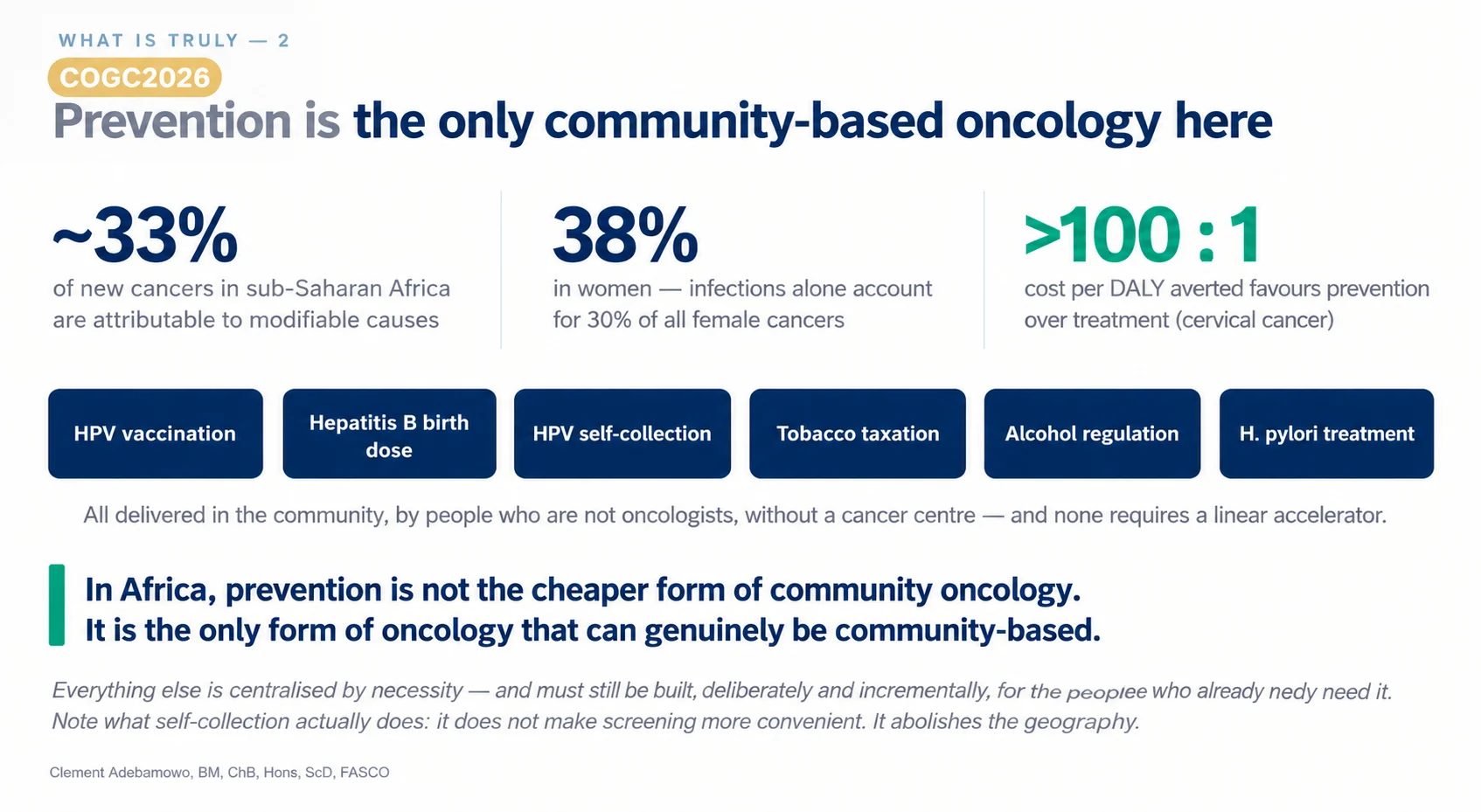
For cervical cancer, for example, the cost per disability-adjusted life-year averted strongly favors prevention over treatment. In sub-Saharan Africa, preventive oncology should therefore not be viewed simply as a cheaper version of community oncology. It is the part of oncology that can genuinely be community-based at scale.
Diagnosis and definitive treatment are different. They often need to remain centralized, where the necessary workforce, expertise, and equipment already exist.
This leads to a broader way of thinking about community oncology. It is not primarily about moving cancer care from one physical place to another. It is about deciding where each function belongs.
Interpretation, permission, prevention, navigation, financing, follow-up, and palliation can sit within the community. Diagnosis and definitive treatment should remain where the required expertise and infrastructure are available.
What connects the two is just as important: a referral spine, a cancer registry, and a payment mechanism.
When those functions are distributed well, they begin to form a cancer control system. When they are not, prevention risks remaining trapped inside tertiary centers while highly specialized treatment is expected to operate in settings that cannot realistically support it.”
The Lessons Run in Both Directions
“There is also a final lesson here, and it runs in both directions.
Task shifting, lay navigation, self-collection, single-visit algorithms, community financing, and community-based palliative care are not simply African improvisations around scarcity.
Increasingly, these are the same operating models that high-income countries, including American community oncology, are trying to adopt.
The lesson from Africa is therefore not simply how to deliver cancer care with fewer resources.
It is how to understand which functions truly belong close to patients, which require centralized expertise, and how to build a system that connects the two.”
Written by Eliz Baloyan, MD, Features Writer and Editor at OncoDaily and CancerWorld