Key takeaways
- Community oncology is where most cancer care happens, making it a critical setting for identifying real-world problems and research priorities.
- Major gaps across the Americas include late diagnosis, unequal access to technologies and treatments, workforce shortages, fragmented care, and limited clinical trial access.
- Pragmatic clinical trials can help answer region-specific questions by using simple designs, broad eligibility, few endpoints, low infrastructure, and minimal extra procedures.
- Independent research is essential because many important community-level questions are not addressed by industry-sponsored trials.
At the Community Oncology Global Congress (COGC 2026), organized by OncoDaily, Carlos Barrios, medical oncologist in Porto Alegre, Brazil, and Chair of the Latin American Cooperative Oncology Group (LACOG), focused on how community oncology across the Americas can become a stronger source of both cancer care and clinical research.
Community oncology is where many of the realities of cancer care become most visible – late diagnosis, unequal access, workforce shortages, fragmented systems, and unanswered treatment questions.
The presentation focused on how those everyday challenges can become the starting point for pragmatic clinical trials: simpler, more feasible studies designed around the settings where patients actually receive care and the questions that matter most in daily practice.
Where Evidence Meets the Patient
“Why is community oncology important? Because that is where practice is happening. That is where oncology is actually reaching patients, and that is where everything becomes real.
Diagnosis, treatment, toxicity management, survival, palliation – and that is also where we build trust and hope with our patients.
A strong community oncology system should therefore represent the place where the evidence actually meets the patient.
When we look at estimates of where cancer patients are currently being cared for, the numbers are very telling. Even though the confidence around some of these data is not as high as we would like, estimates consistently suggest that approximately 80% to 90% of patients are being managed in community settings.
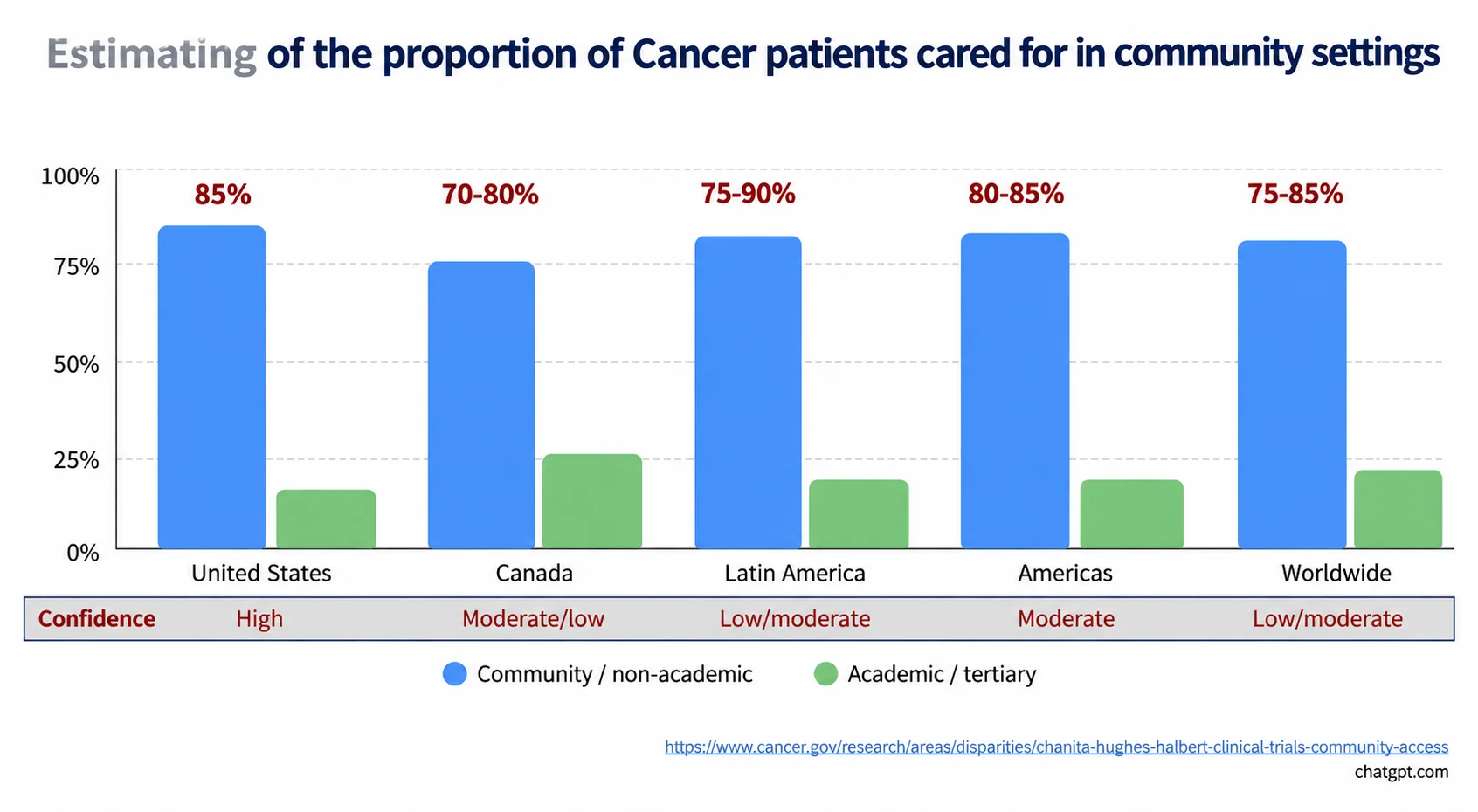
So if this is where most patients are receiving care, this is also where many of the most relevant questions about cancer care are becoming visible.”
The Gaps Across the Americas
“We also have to recognize that there are significant gaps, and each one deserves detailed analysis.
The Americas are extremely heterogeneous. The socioeconomic and healthcare environment in North America is very different from what we see in Central America, the Caribbean, and South America. But despite those differences, there are recurring gaps that we can recognize across the region.
One is late diagnosis, which has a major impact on outcomes and needs to be addressed.
Access is another major issue. Access to biomarkers, radiation therapy, surgery, new technologies, and many cancer medicines remains very different across the continent.
Workforce is another important challenge, including shortages of nurses and other healthcare professionals.
Fragmentation of healthcare systems is also extremely important. Patients often need significant navigation support simply to move through diagnosis, treatment, follow-up, and survivorship.
And clinical trial access remains particularly unequal. Most trials are concentrated in the United States and Canada, while relatively few are available across Central America, the Caribbean, and South America.”
Research Must Start Where Patients Are Treated
“If we think about the pillars needed to strengthen community oncology, we can talk about access, quality, workforce, and generation of data. But I want to concentrate particularly on research.
Trials that arise from the reality where patients are actually being cared for are extremely important.
The problems identified in community oncology – and the potential solutions to those problems – should also be able to generate research questions from within the community setting itself.
We already have tools that can help us do this:
- Tele-tumor boards,
- artificial intelligence,
- internet-based communication,
- teleconferencing,
- broader molecular access are increasingly available.
But one area that deserves particular attention is what we call pragmatic clinical trials.
Independent research is challenging in both developed and developing countries because most clinical trials today are sponsored by pharmaceutical companies. Those studies understandably address questions that align with drug development and commercial priorities.
There is nothing inherently wrong with that. But it means that many regional problems and important patient-outcome questions remain unexplored.
So the question becomes: how can we develop strategies that stimulate more independent research in Latin America?”
What Makes a Pragmatic Clinical Trial?
“Pragmatic trials should have the potential to change practice across different healthcare settings and different geographies.
Something that works in community oncology in the United States should ideally also generate useful knowledge for Canada, Brazil, Argentina, Peru, Ecuador, and other countries.
To make that possible, these trials need to be designed differently.
- They should require low levels of infrastructure.
- They should be low-cost, affordable, and feasible from a practical point of view.
- They should address simple questions with broad clinical impact, use only a few meaningful endpoints, and have straightforward inclusion criteria.
The population should be closer to the real world and more generalizable, rather than the highly selected and idealized populations that we sometimes see in conventional clinical trials.
Data collection should also remain simple. Case report forms may only need to be one, two, or three pages. There should be very few additional procedures beyond standard care.
Extensive translational research, additional specimen collection, and complicated trial-related procedures should generally not be what defines this type of study.
And importantly, pragmatic trials should incorporate artificial intelligence and digital tools where they can simplify procedures and help follow patients throughout the trial journey.”
Equity Can Begin With Research in the Community
“Enhancing equity and diversity in clinical research remains a major priority, and there is no better place to begin than community oncology.
Pragmatic clinical trials should arise from the experiences that individual community oncologists encounter in their daily work.
These physicians see the barriers directly. They know where patients are being diagnosed late, where access is failing, where treatment pathways become fragmented, and which clinically important questions remain unanswered.
Those experiences should not remain isolated observations. They can become research questions, and those questions can be developed into practical studies that reflect the populations we actually treat.
If we want clinical research to become more representative, community oncology cannot remain simply a site where trials designed elsewhere are opened. It should also become a place where the questions themselves are generated.”
Community Oncology Is Not the Periphery
“Community oncology should not be seen as the periphery of cancer care, because it is not.
It is the platform where we can deliver equity, where we should deliver quality, where we can bring innovation, and where trust becomes part of the entire process.
Across the Americas, our task is not only to discover the best cancer treatments.
It is also in community settings that we are exposed to the realities of cancer care – realities that can generate new ideas and ultimately be translated into pragmatic research designs.
If community oncology is where most patients are being treated, then it should also be one of the places where the next important questions in cancer care begin.”
Written by Eliz Baloyan, MD, Features Writer and Editor at OncoDaily and CancerWorld
Watch the full video on YouTube.