Key takeaways
- Bispecific therapy is more accessible than CAR T-cell therapy in some settings, but it still requires a strong safety infrastructure.
- CRS and ICANS must be recognized quickly, and staff beyond the oncology team should know how to respond.
- Start with a small number of patients so the team can build experience before scaling the program.
- The EMR should flag patients receiving bispecific therapy so emergency and urgent care teams know when to contact oncology.
- Community delivery is feasible when the program is planned in advance rather than improvised around the first toxicity.
At the Community Oncology Global Congress (COGC 2026), organized by OncoDaily, Astha Thakkar, hematologist-oncologist at WakeMed, focused on what it actually takes to bring bispecific antibody therapy into community practice.
Unlike CAR T-cell therapy, bispecific T-cell engaging antibodies are available off the shelf and do not require apheresis or individualized cellular manufacturing. That can lower some of the barriers to T-cell directed immunotherapy – but it does not make these treatments simple.
The real test comes before the first dose is ever given: is the community practice prepared to recognize toxicity quickly, manage it safely, and know exactly who takes over when something goes wrong?
Safety Starts Before the First Dose
“Bispecific therapies target a specific antigen on the cancer cell – for example, BCMA in multiple myeloma or CD20 in lymphoma – and CD3 on the T cell, bringing them into close proximity and facilitating an antitumor immune response.
Unlike CAR T-cell therapy, which requires referral to a specialized center, apheresis, and reengineering of the patient’s T cells, bispecific therapy is off the shelf.
That reduces some of the barriers to T-cell mediated immunotherapy and can make it an option for patients who may not be able to get to CAR T-cell therapy immediately or may not be considered appropriate candidates.
But these therapies still carry the risk of cytokine release syndrome, or CRS, and immune effector cell-associated neurotoxicity syndrome, or ICANS.
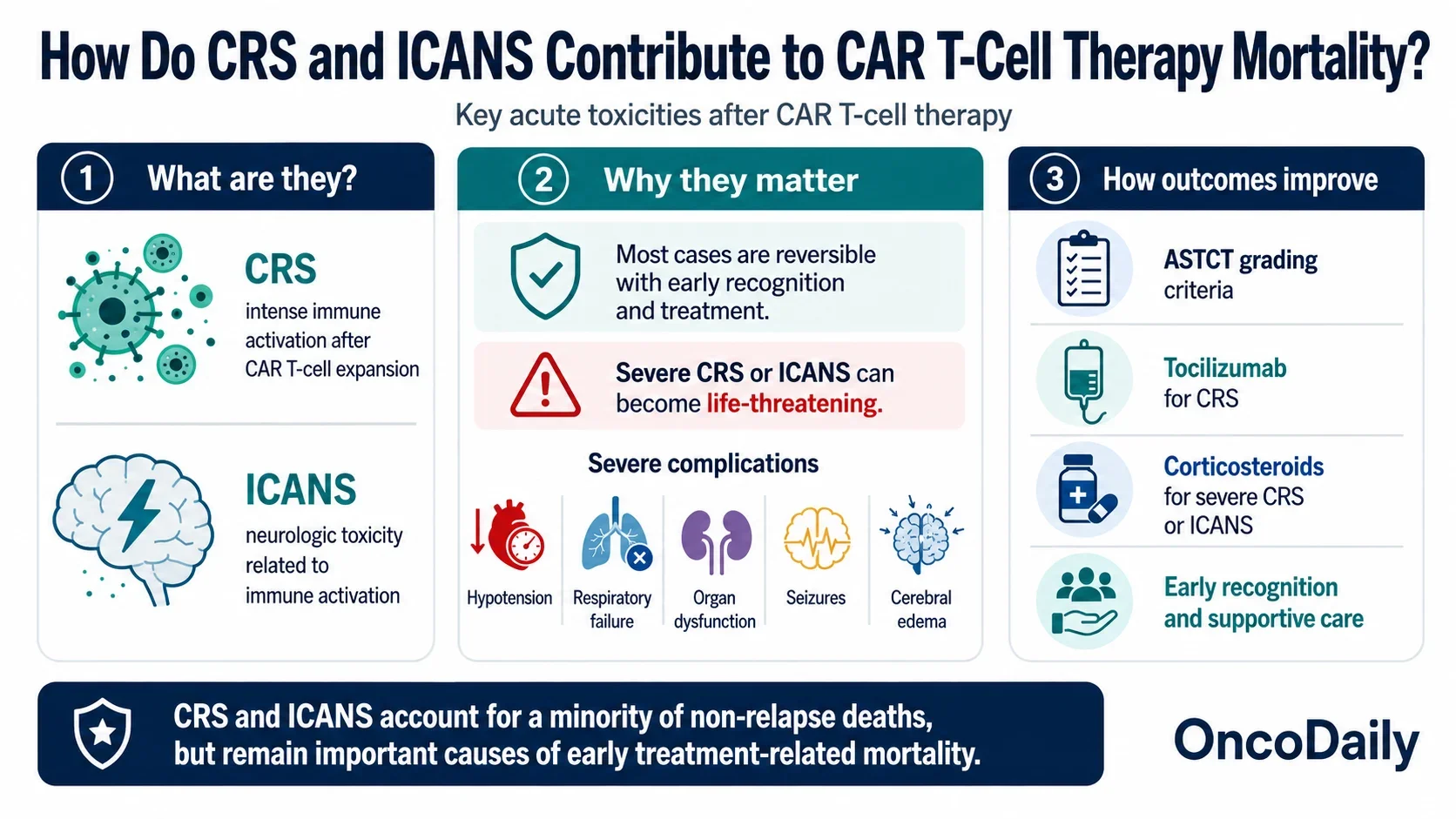
Both require prompt recognition and management, because they can become serious very quickly.
So before initiating these therapies in the community, the infrastructure has to be in place.
When we were building our bispecific program, there were several things we knew we needed from the beginning:
- Oncology expertise, including a physician familiar with the therapy
- Pharmacy support
- Oncology-trained nurses
- Access to a hospital and ICU
- Emergency medications, particularly tocilizumab, immediately available
- Close collaboration with hospitalists and critical care teams
- Careful patient selection and education
- Adequate caregiver support, especially during step-up dosing
- Written procedures for CRS and ICANS management
You want to work through those details before the first patient is admitted.
Even something as specific as the dexamethasone dose may vary depending on the agent and the clinical situation. Those are not decisions you want the team trying to make for the first time in the middle of an acute toxicity.
The protocol needs to exist before the problem does.”
CRS and ICANS: Recognition Before Reaction
“One of the first barriers we encountered was simply familiarity.
People working in the same cancer center can come from very different levels of training and exposure. When you introduce a new therapy, the first step is getting everybody onto the same page.
Manufacturer resources can be helpful here. Medical science liaisons can connect the practice with nurse educators and other resources, and we have been able to use that support to arrange education for our nursing teams relatively quickly.
But the education cannot stop with oncology.
Many non-oncology physicians and advanced practice providers may have limited experience recognizing CRS or ICANS, so we also need to educate the people who may actually see the patient when something goes wrong.
At WakeMed, we approached this as a team. An MD and PharmD worked together to explain the therapies, the possible adverse effects, CRS grading, ICANS grading, and the ICE assessment that may be needed when a patient presents with neurologic symptoms.
And then there is a very practical question that comes up all the time:
Who do you call?
That sounds simple, but it has to be answered before the program starts.
There should be clearly defined coverage for nights, weekends, and holidays. Patients and caregivers should have a direct number they can call after hours.
Instead of sending somebody through a general answering service, for example, they may be able to contact an oncology unit where an oncology-trained charge nurse can answer questions, recognize a potential emergency, and alert the appropriate physician or APP.
Those small operational details can make an enormous difference when a patient develops a fever or neurologic change outside normal clinic hours.”
Start Small, Scale Safely
“When you implement the program, start small.
Plan for perhaps one to five patients before trying to roll it out at scale.
That gives the physicians, nurses, pharmacists, and the rest of the team a chance to build confidence and learn from each patient before the volume increases.
You also need to understand the administrative process. That may include institutional pharmacy and therapeutics approval, formulary addition, and any applicable REMS requirements for the therapy and prescribing site.
Regulatory requirements are changing, so the program has to stay current.
The FDA has removed REMS requirements for certain CAR T-cell products, but several hematologic bispecific antibodies still have REMS programs related to CRS and neurologic toxicity.
The electronic medical record can also become an important safety tool.
Patients may receive wallet cards identifying the therapy they are receiving, but I also want a flag in the EMR.
If that patient arrives in the emergency department or urgent care, the clinician should immediately see that this person is receiving a bispecific therapy and that oncology needs to be contacted.
That can make it much easier for frontline emergency physicians to triage the patient appropriately.”
The Program Does Not End After Step-Up Dosing
“Once patients move beyond the initial treatment phase, they still need frequent reassessment.
That may mean two or three appointments a week or follow-up after each step-up dose so that we have opportunities to identify adverse effects, monitor cytopenias, and catch infections early.
For patients who live farther away, we can use telehealth or nurse telephone check-ins several times a week during those first few weeks.
That gives us another chance to recognize delayed CRS, neurologic changes, or other complications early enough to intervene.
Pharmacists are also extremely valuable here. Clinical pharmacist practitioners can help manage antimicrobial prophylaxis, steroid dosing, and steroid tapers.
And one practical strategy I particularly like is having an emergency dexamethasone dose available at home.
Patients can be educated that if they develop fever or confusion, they may be instructed to take the emergency dose – but they still need to come to the emergency department for full evaluation.
The medication at home is not a substitute for evaluation. It is part of a larger safety plan.
That really captures what makes community delivery possible.
Bispecific therapy may be off the shelf, but the program around it cannot be improvised.
Start small. Educate everyone who may encounter the patient. Define who gets called. Build the emergency pathway. Use the EMR. Follow patients closely.
If those pieces are in place before the first patient is treated, then therapies that once seemed limited to highly specialized centers can become much more feasible to deliver safely in the community.”
Written by Eliz Baloyan, MD, Features Writer and Editor at OncoDaily and CancerWorld
Watch the full video on YouTube.