Key takeaways
- Cancer care improves when referral pathways are connected, not fragmented.
- OncoKids shows how digital tools can link rural facilities with specialist pediatric oncology care.
- Strong multidisciplinary teams depend on communication across institutions and levels of care.
- Virtual communities such as Africa Cancer ECHO can extend learning, coordination, and specialist support beyond individual hospitals.
At the Community Oncology Global Congress (COGC 2026), organized by OncoDaily, Abena Yeboah Aduse-Poku, Clinical and Radiation Oncologist from Kumasi, Ghana, focused on a challenge that extends far beyond the availability of cancer specialists: how to make limited expertise work as a coordinated system.
In Ghana, where cancer care is concentrated in a small number of centers and patients may travel hundreds of kilometers to reach treatment, multidisciplinary teams can help connect specialists, reduce delays, and make better use of the resources already available. The question is not whether every facility can have every specialist, but whether the right expertise can be connected around each patient.
Coordination When Specialists Are Few
Ghana sees approximately 27,000 new cancer cases each year in a population of about 33 million, yet there are only around 30 oncologists nationwide and three comprehensive cancer centers, largely concentrated in the south.
For patients living in northern Ghana, accessing specialized cancer care may require traveling more than 300 kilometers.
Those distances make fragmented care particularly difficult. A cancer patient may move from primary care to medical oncology, surgery, radiation oncology, pharmacy, social work, psychiatry, nursing, and other specialties. Without coordination, the responsibility for connecting those services can easily fall on the patient.
Multidisciplinary care offers a way to bring those different parts of the system together.
Evidence presented during the talk showed that, in lung cancer, patients managed through multidisciplinary teams had a lower risk of death, reached treatment faster, and were more likely to receive guideline-concordant care.
But in lower-resource settings, the value of MDTs goes beyond clinical decision-making. They can also reduce the burden on patients to find specialists themselves, limit unnecessary duplication of tests and imaging, and extend specialist expertise into rural or lower-resource facilities through referral networks and virtual tumor boards.
Four Building Blocks of an Effective MDT
A multidisciplinary team does not become effective simply because several specialists are involved.
The first requirement is role clarity. When professionals from multiple disciplines come together, responsibilities need to be clearly defined so that there are neither unnecessary overlaps or gaps in care. Each part of the process should have someone who is responsible, accountable, consulted, or informed.
The second is communication.
MDT discussions cannot be treated as optional work added to an already busy schedule. Time for communication needs to be protected, whether meetings happen weekly, every two weeks, monthly, in person, or virtually.
The third is connected technology. Digital tools can make it possible for specialists in different locations to communicate, review patients, and coordinate decisions without needing to be physically present in the same institution.
And finally, there has to be accountability. Teams need to periodically review what happened to the patients they discussed and whether recommendations actually translated into care.
Without that follow-up, an MDT risks becoming a meeting rather than a functioning care pathway.
Expanding Local Oncology Capacity
One example comes from work supported by City Cancer Challenge, which helped strengthen multidisciplinary cancer care in Kumasi across several parts of the system rather than focusing on a single intervention.
The work included expanding pathology access, developing the cancer workforce across multiple disciplines, strengthening communication with primary care providers and other members of the cancer-care team, and improving referral pathways.
That wider approach matters because an MDT cannot function well if the surrounding system remains disconnected.
The goal was not only to improve what happened during multidisciplinary meetings, but also to strengthen the diagnostics, workforce, communication, and referral processes that determine whether patients ever reach those meetings in the first place.
As one of the mentors involved in the work described it, the value of the initiative was that it improved cancer care “across the entire spectrum” rather than through a single-focus intervention.
OncoKids: Improving Pediatric Cancer Referrals
One of the most practical results of that work was the development of the Kumasi OncoKids app, designed as a mobile referral pathway connecting peripheral facilities, specialists, and the Komfo Anokye Teaching Hospital.
The system allows a referring facility to enter patient information and communicate with specialists, including in settings where internet connectivity may be unreliable. The specialist can then review the referral, confirm the case, and direct the patient into an appropriate pathway.
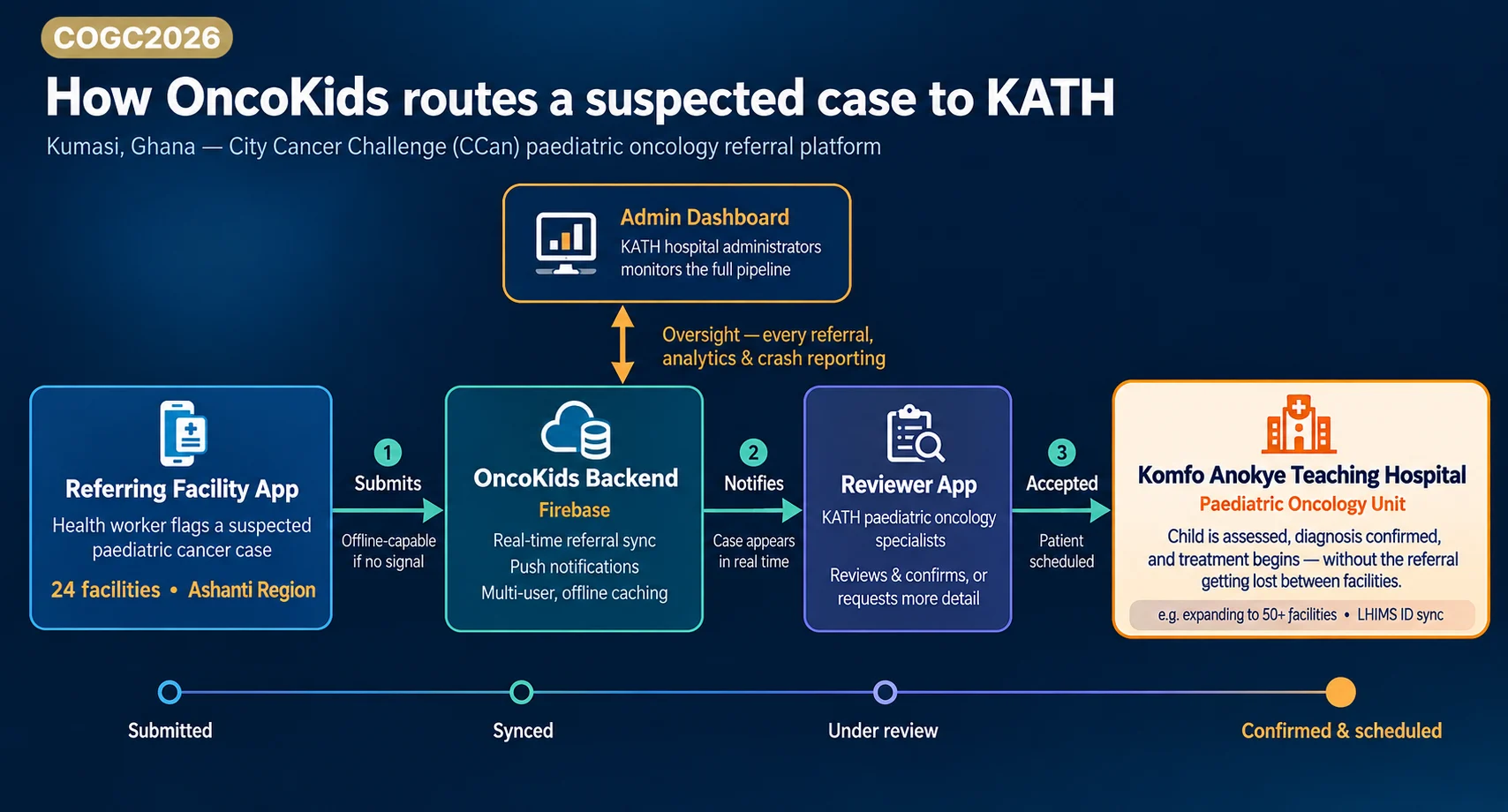
This addresses a common problem in fragmented systems: patients who are referred from rural or peripheral facilities but become lost somewhere between the first suspicion of cancer and arrival at the specialist center.
By making that referral visible and trackable, the system can help identify patients who might otherwise disappear in transit.
In that sense, the technology is not the intervention by itself. Its value comes from connecting the people already responsible for the patient and giving the referral pathway a structure that can be followed.
Virtual Tumor Boards as a Bridge to Expertise
Multidisciplinary care also does not have to remain within one hospital or even one country.
The African ECHO Project provides one example, bringing together more than 200 participants from 14 countries in monthly virtual tumor board meetings lasting about 90 minutes.
These meetings allow clinicians to discuss difficult cases, but their impact can extend further. They can create professional networks, support research collaboration, and connect clinicians who may otherwise have limited access to subspecialty expertise. That model offers a practical way for institutions with fewer specialists to participate in a larger community of expertise without waiting until every workforce gap has been filled.
International partnerships can strengthen that further. Partner institutions can open places in their tumor boards to colleagues from lower-resource settings, offer mentorship, share protocols and training materials, and create opportunities for clinicians to learn from one another.
Importantly, those exchanges do not have to move in only one direction. Approaches adapted for lower-resource environments can also provide useful lessons for other health systems.
Build MDTs Before the Resource Gaps Are Closed
External support can help establish multidisciplinary programs, but sustainability depends on local ownership.
The City Cancer Challenge experience was designed around that principle: outside support can strengthen the system, but the teams, referral pathways, and professional relationships need to remain functional after a grant or individual project ends.
That is particularly important in lower- and middle-income countries, where shortages in workforce, infrastructure, diagnostics, and treatment are unlikely to disappear quickly.
Waiting for every gap to be solved before developing coordinated care would mean waiting indefinitely.
The central message was therefore not that multidisciplinary teams require a fully resourced system. It was almost the opposite:
“We build multidisciplinary teams while the resource gaps are still open, and not after they are filled.”
In settings where specialists are few and distances are long, coordination itself becomes a way of stretching expertise further – connecting patients to the right people, reducing unnecessary delays, strengthening referral pathways, and making limited resources work as one system rather than as isolated parts.
Written by Eliz Baloyan, MD, Features Writer and Editor at OncoDaily and CancerWorld